
How to Effectively Address a Statement of Inquiry
- Slides: 13
How to Effectively Address a Statement of Inquiry (SOI)
Table of Contents Understanding the Statement of Inquiry Considering Big Questions Considering Articles Making Connections into Paragraphs Practice
Understanding the Statement of Inquiry (SOI) Reparations by national governments for the acts of past generations are just and necessary unless they unfairly infringe upon the rights or financial freedom of the nation’s current citizens.
Questions and Connections to Consider in Relation to the SOI What is the SOI saying? What can I agree or disagree with? What terms do I need to have a clear understanding of? Are any terms vague or unclear? Can/should they be addressed in my response? Do I agree/disagree? How can I effectively respond in 45 minutes in class?
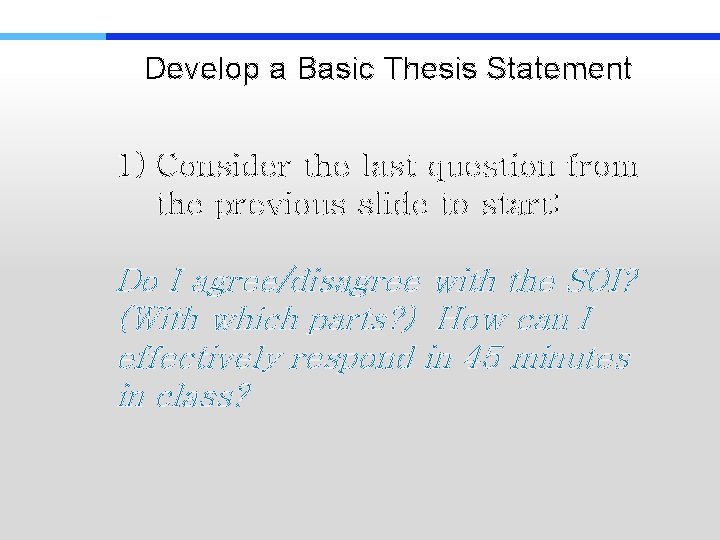
Develop a Basic Thesis Statement 1) Consider the last question from the previous slide to start: Do I agree/disagree with the SOI? (With which parts? ) How can I effectively respond in 45 minutes in class?
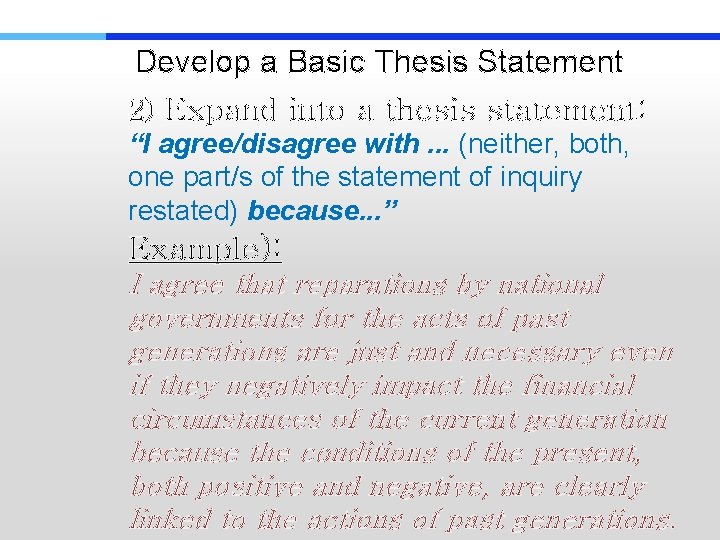
Develop a Basic Thesis Statement 2) Expand into a thesis statement: “I agree/disagree with. . . (neither, both, one part/s of the statement of inquiry restated) because. . . ” Example): I agree that reparations by national governments for the acts of past generations are just and necessary even if they negatively impact the financial circumstances of the current generation because the conditions of the present, both positive and negative, are clearly linked to the actions of past generations.
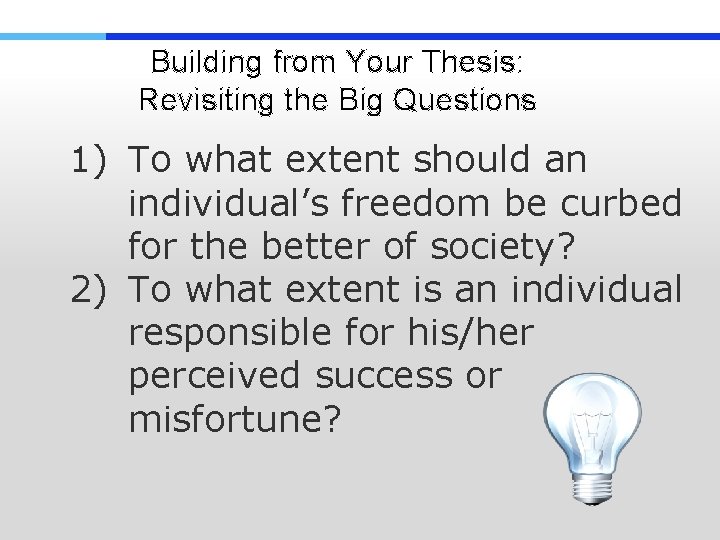
Building from Your Thesis: Revisiting the Big Questions 1) To what extent should an individual’s freedom be curbed for the better of society? 2) To what extent is an individual responsible for his/her perceived success or misfortune?
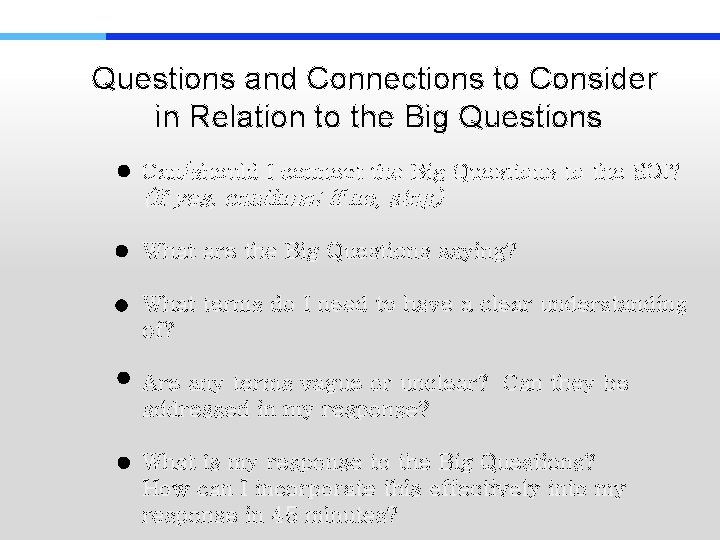
Questions and Connections to Consider in Relation to the Big Questions Can/should I connect the Big Questions to the SOI? (If yes, continue; if no, stop) What are the Big Questions saying? What terms do I need to have a clear understanding of? Are any terms vague or unclear? Can they be addressed in my response? What is my response to the Big Questions? How can I incorporate this effectively into my response in 45 minutes?
Gathering Evidence from Sources Articles read and discussed in class: “The Economics of Reparations” “How Asians View Each Other” “Japan, WWII, and the Case for Reparations in the United States”
Questions and Connections to Consider in Relation to Sources What were the articles about? What key points or examples are potentially relevant to the SOI? How reliable are the sources? Are any authors experts on the topic? Do the articles provide the same perspective? Are there any foundational disagreements that could be explored in my own writing? Which sections/quotes can I use to support my own opinion or to establish an alternative position to challenge?
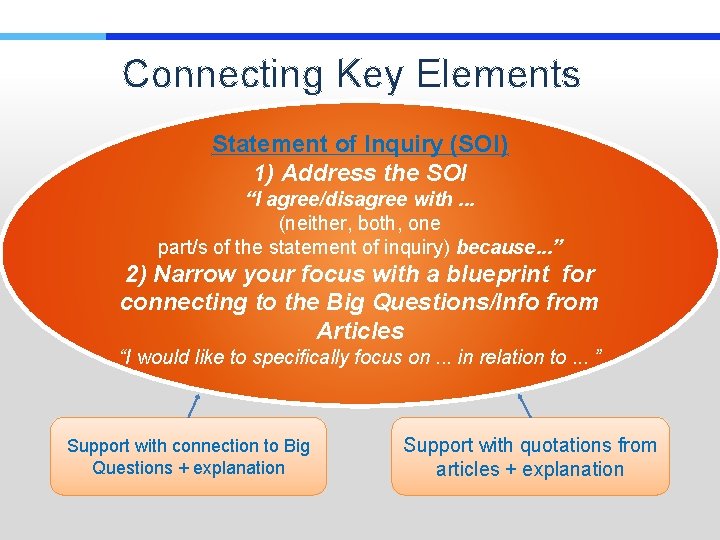
Connecting Key Elements Statement of Inquiry (SOI) 1) Address the SOI “I agree/disagree with. . . (neither, both, one part/s of the statement of inquiry) because. . . ” 2) Narrow your focus with a blueprint for connecting to the Big Questions/Info from Articles “I would like to specifically focus on. . . in relation to. . . ” Support with connection to Big Questions + explanation Support with quotations from articles + explanation
Connections into Paragraphs See sample handout
Practice After developing a basic thesis, practice writing support paragraphs using the approach in the practice sheet found on the blog