
How to Eat an Elephant Problem solving skills
How to Eat an Elephant? Problem solving skills Sharon Gurr Counsellor / Trainer
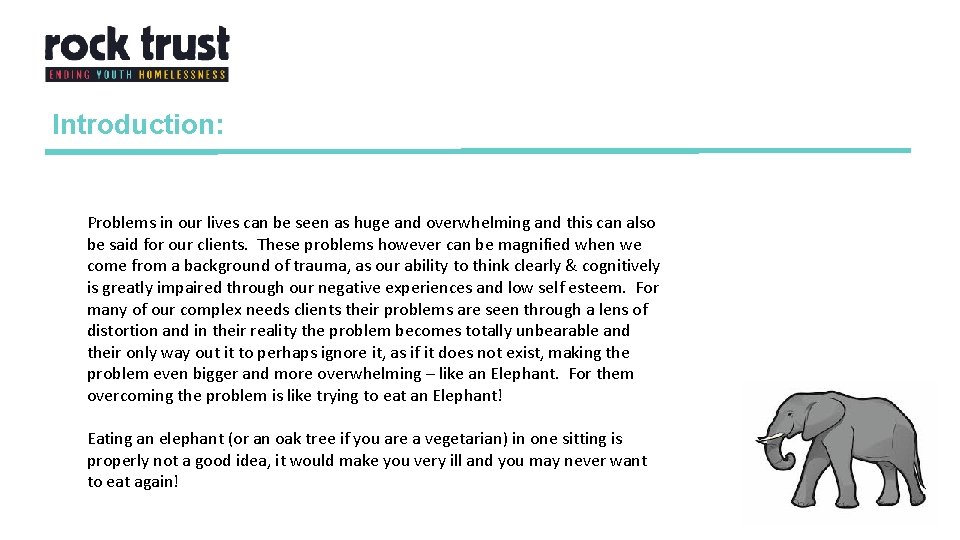
Introduction: Problems in our lives can be seen as huge and overwhelming and this can also be said for our clients. These problems however can be magnified when we come from a background of trauma, as our ability to think clearly & cognitively is greatly impaired through our negative experiences and low self esteem. For many of our complex needs clients their problems are seen through a lens of distortion and in their reality the problem becomes totally unbearable and their only way out it to perhaps ignore it, as if it does not exist, making the problem even bigger and more overwhelming – like an Elephant. For them overcoming the problem is like trying to eat an Elephant! Eating an elephant (or an oak tree if you are a vegetarian) in one sitting is properly not a good idea, it would make you very ill and you may never want to eat again!

Step 1: Break into Chunks • Eating an elephant in one go will make you ill and may even put you off wanting to face it ever again, problems are the same • Breaking it (problem) into smaller manageable pieces will make it seem a lot more easier and less daunting • You may want to start by writing down what the problem is then think of all the elements that make up the bigger picture Can you think of a problem in your life right now that you could try to break down into chunks?

Step 2: Brainstorm Allow your mind to run free – get creative & get writing! • Brainstorm ideas of how to best solve this piece of the problem, don’t be afraid to ask for help • No idea is too small, big, crazy or silly – ideas are just that … ideas! • Don’t rush, spend time and think it through – like climbing stairs, take it one step at a time

Step 3: Make a Plan • Choose a brainstorm idea, pick one to work on first – better to start with the easy ones, that way you will achieve it easier, making you feel good and motivated to take on the next piece • Write down step by step how you are going to do it, as small as you need them to be • Now write down things that could get in the way – barriers to preventing you fulfilling your plan, come up with a mini plan in overcoming these barriers – so you are not taken by surprise!

Step 4: Check & Action ASK YOURSELF: • Is it realistic ? • Are you aiming at just one thing? • Is it Slow? • Is it easy? • Are you prepared for the barriers? If you can answer yes to them all… Then go for it!
Step 4: Review If you are worried that your plan may not work out, well the best way to test it is to put it into action • How did that go, was it easy? • Did you learn anything new, about the situation or about yourself? • What would you do differently or do again? • What did you like or not like?

Conclusion: When something goes wrong, it is too easy to feel disheartened and give up but what we can do is to remind ourselves why we started this in the first place, we may have to even write this down to remind ourselves, we could even write ourselves a letter from the new you. If things are still going wrong, its not the end of the world, perhaps look at working on a different chunk of the elephant, and we may need to seek additional support through counselling or other services. While there are problems that we may not have control over like, illness or old age there are some we can fix by breaking it into bite size chunks and making a plan. We may also need to ask for help for the bigger pieces but what we need to remember is that for most problems the key is to break them down into small enough steps you can manage now – How do you eat an elephant – one bite at a time!

Contact Us Admin@rocktrust. org 0131 557 4059 www. rocktrust. org Registered charity no. SC 018708
- Slides: 9