
HOW TO DRAW CLIMATE GRAPHS MARIA SANZ How
- Slides: 5
HOW TO DRAW CLIMATE GRAPHS MARIA SANZ
How to draw a climate graph By the end of today’s lesson you will: • know how to draw a climate graph. • be able to read a climate table and graph.
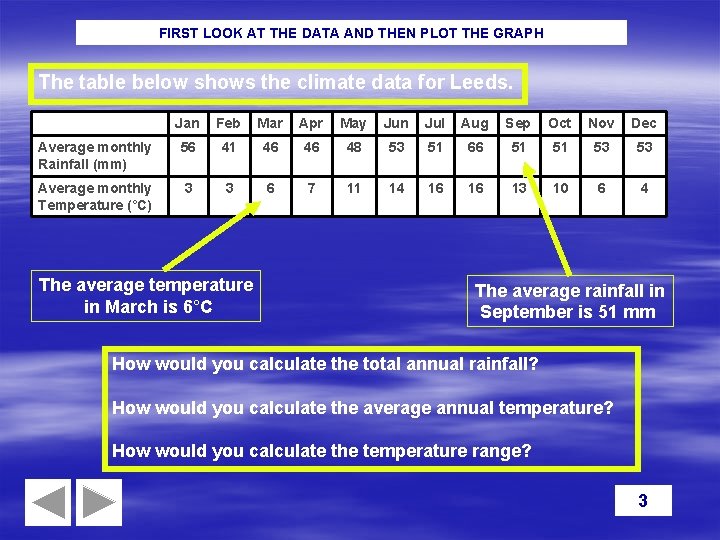
FIRST LOOK AT THE DATA AND THEN PLOT THE GRAPH The table below shows the climate data for Leeds. Jan Feb Mar Apr May Jun Jul Aug Sep Oct Nov Dec Average monthly Rainfall (mm) 56 41 46 46 48 53 51 66 51 51 53 53 Average monthly Temperature (°C) 3 3 6 7 11 14 16 16 13 10 6 4 The average temperature in March is 6°C The average rainfall in September is 51 mm How would you calculate the total annual rainfall? How would you calculate the average annual temperature? How would you calculate the temperature range? 3
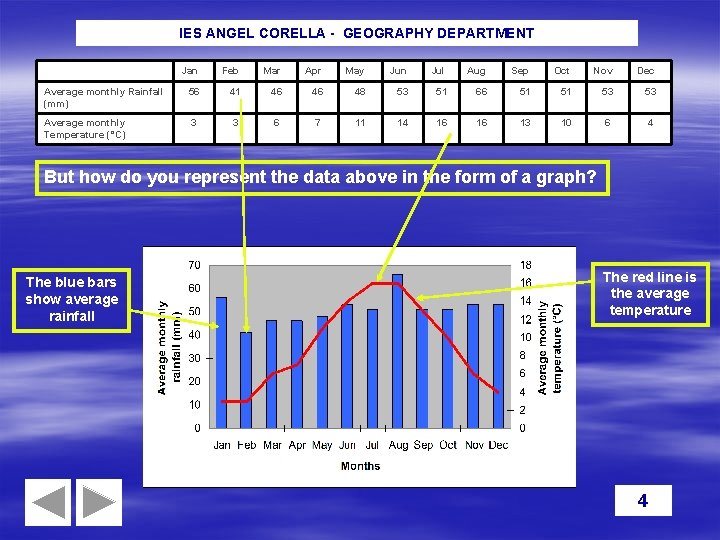
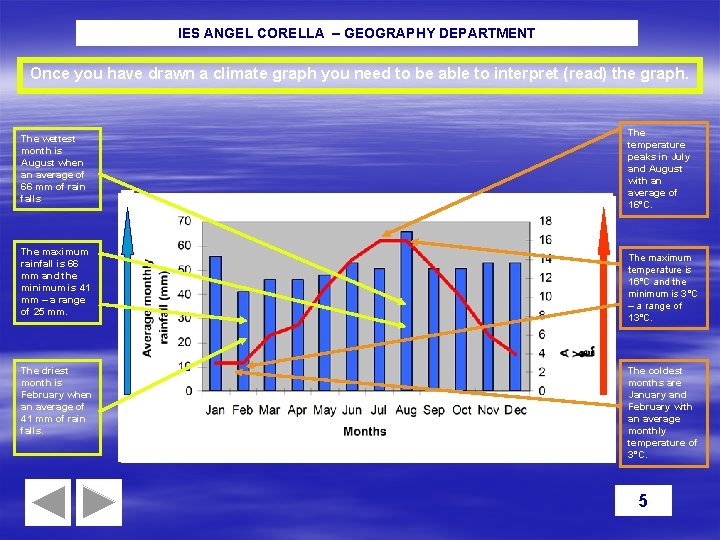
IES ANGEL CORELLA - GEOGRAPHY DEPARTMENT Jan Feb Mar Apr May Jun Jul Aug Sep Oct Nov Dec Average monthly Rainfall (mm) 56 41 46 46 48 53 51 66 51 51 53 53 Average monthly Temperature (°C) 3 3 6 7 11 14 16 16 13 10 6 4 But how do you represent the data above in the form of a graph? The blue bars show average rainfall The red line is the average temperature 4
IES ANGEL CORELLA – GEOGRAPHY DEPARTMENT Once you have drawn a climate graph you need to be able to interpret (read) the graph. The wettest month is August when an average of 66 mm of rain falls The maximum rainfall is 66 mm and the minimum is 41 mm – a range of 25 mm. The driest month is February when an average of 41 mm of rain falls. The temperature peaks in July and August with an average of 16°C. The maximum temperature is 16°C and the minimum is 3°C – a range of 13°C. The coldest months are January and February with an average monthly temperature of 3°C. 5