
How to Do Moore with Less Moores Law
- Slides: 16
How to Do Moore with Less! Moore’s Law & What We Do When We Get There: Squeezing Moore Out of the Electromagnetic Spectrum Prepared Remarks of John Muleta Chief, Wireless Telecommunications Bureau Federal Communications Commission In collaboration with Dr. Thomas Stanley Chief Engineer, Wireless Telecommunications Bureau Federal Communications Commission Wireless Telecommunications Symposium Cal Poly Pomona May 14, 2004 1
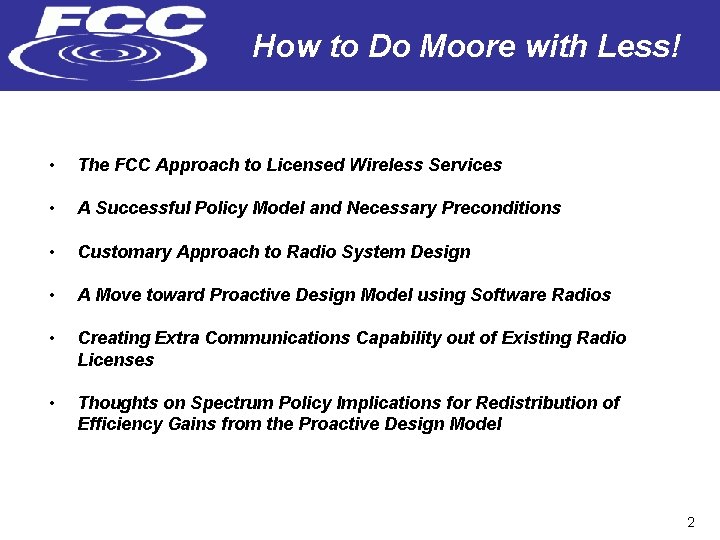
How to Do Moore with Less! • The FCC Approach to Licensed Wireless Services • A Successful Policy Model and Necessary Preconditions • Customary Approach to Radio System Design • A Move toward Proactive Design Model using Software Radios • Creating Extra Communications Capability out of Existing Radio Licenses • Thoughts on Spectrum Policy Implications for Redistribution of Efficiency Gains from the Proactive Design Model 2
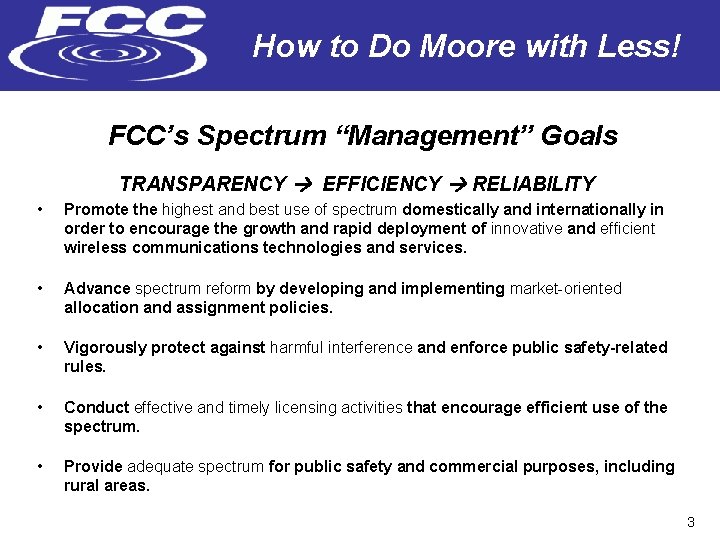
How to Do Moore with Less! FCC’s Spectrum “Management” Goals TRANSPARENCY EFFICIENCY RELIABILITY • Promote the highest and best use of spectrum domestically and internationally in order to encourage the growth and rapid deployment of innovative and efficient wireless communications technologies and services. • Advance spectrum reform by developing and implementing market-oriented allocation and assignment policies. • Vigorously protect against harmful interference and enforce public safety-related rules. • Conduct effective and timely licensing activities that encourage efficient use of the spectrum. • Provide adequate spectrum for public safety and commercial purposes, including rural areas. 3
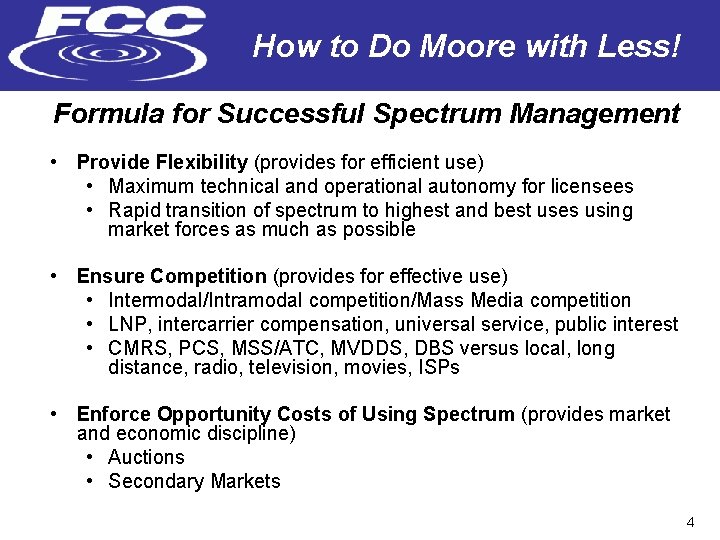
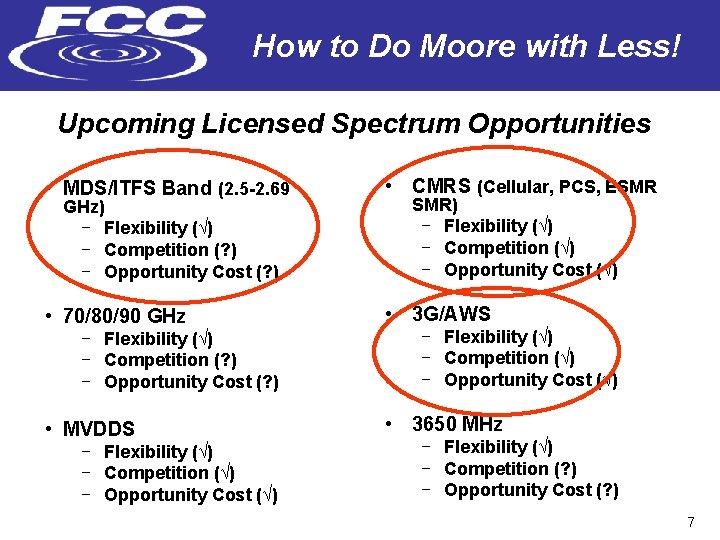
How to Do Moore with Less! Formula for Successful Spectrum Management • Provide Flexibility (provides for efficient use) • Maximum technical and operational autonomy for licensees • Rapid transition of spectrum to highest and best uses using market forces as much as possible • Ensure Competition (provides for effective use) • Intermodal/Intramodal competition/Mass Media competition • LNP, intercarrier compensation, universal service, public interest • CMRS, PCS, MSS/ATC, MVDDS, DBS versus local, long distance, radio, television, movies, ISPs • Enforce Opportunity Costs of Using Spectrum (provides market and economic discipline) • Auctions • Secondary Markets 4
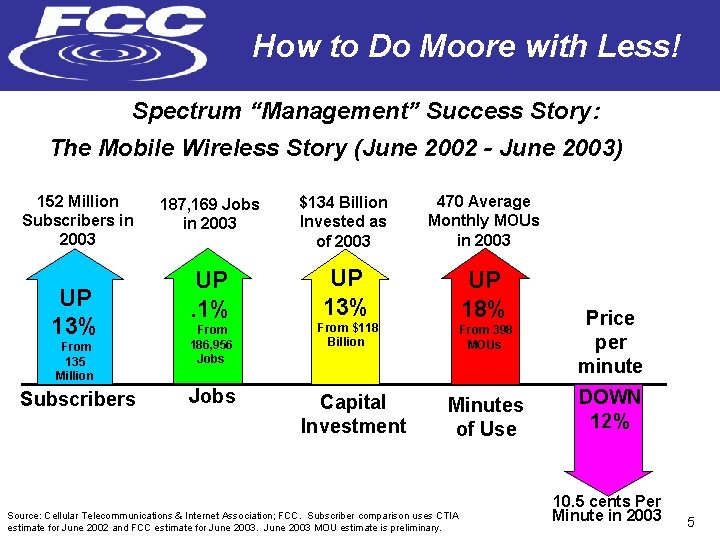
How to Do Moore with Less! Spectrum “Management” Success Story: The Mobile Wireless Story (June 2002 - June 2003) 152 Million Subscribers in 2003 UP 13% From 135 Million Subscribers 187, 169 Jobs in 2003 $134 Billion Invested as of 2003 470 Average Monthly MOUs in 2003 UP. 1% UP 13% UP 18% From 186, 956 Jobs From $118 Billion Capital Investment From 398 MOUs Minutes of Use Source: Cellular Telecommunications & Internet Association; FCC. Subscriber comparison uses CTIA estimate for June 2002 and FCC estimate for June 2003 MOU estimate is preliminary. Price per minute DOWN 12% 10. 5 cents Per Minute in 2003 5
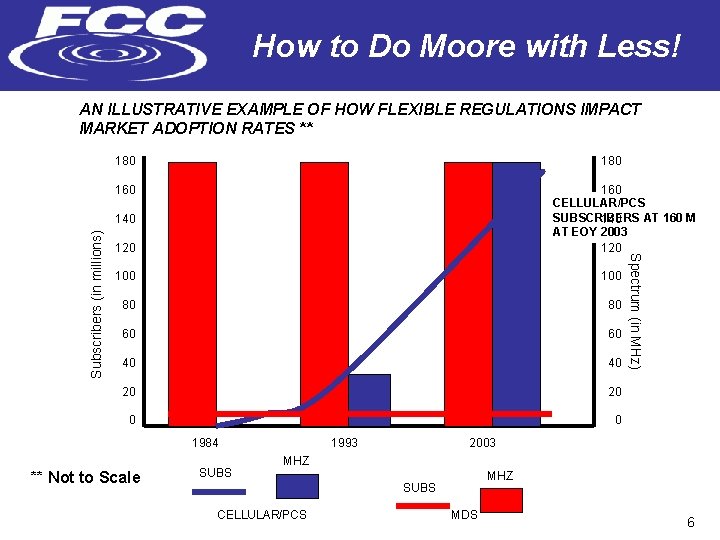
How to Do Moore with Less! AN ILLUSTRATIVE EXAMPLE OF HOW FLEXIBLE REGULATIONS IMPACT MARKET ADOPTION RATES ** 180 160 Subscribers (in millions) 140 120 100 80 80 60 60 40 40 20 20 0 0 1984 ** Not to Scale SUBS 1993 Spectrum (in MHz) 160 CELLULAR/PCS SUBSCRIBERS AT 160 M 140 AT EOY 2003 120 2003 MHZ SUBS CELLULAR/PCS MDS 6
How to Do Moore with Less! Upcoming Licensed Spectrum Opportunities • MDS/ITFS Band (2. 5 -2. 69 • CMRS (Cellular, PCS, ESMR • 70/80/90 GHz • 3 G/AWS GHz) - Flexibility (√) - Competition (? ) - Opportunity Cost (? ) • MVDDS - Flexibility (√) - Competition (√) - Opportunity Cost (√) SMR) - Flexibility (√) - Competition (√) - Opportunity Cost (√) • 3650 MHz - Flexibility (√) - Competition (? ) - Opportunity Cost (? ) 7
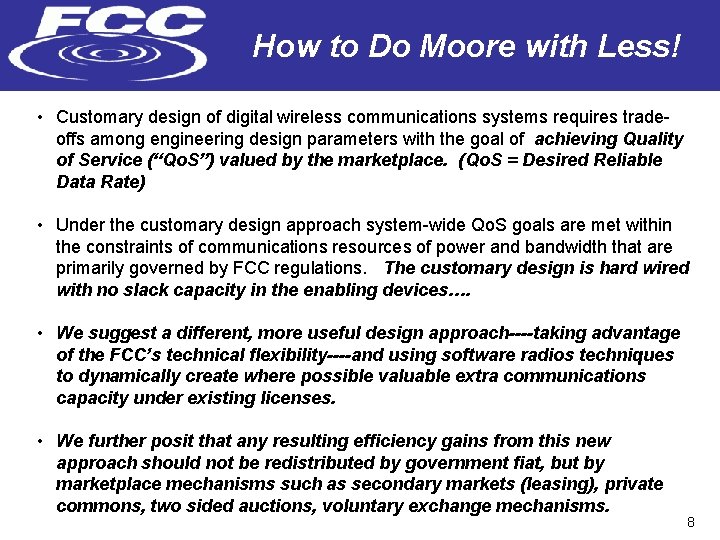
How to Do Moore with Less! • Customary design of digital wireless communications systems requires tradeoffs among engineering design parameters with the goal of achieving Quality of Service (“Qo. S”) valued by the marketplace. (Qo. S = Desired Reliable Data Rate) • Under the customary design approach system-wide Qo. S goals are met within the constraints of communications resources of power and bandwidth that are primarily governed by FCC regulations. The customary design is hard wired with no slack capacity in the enabling devices…. • We suggest a different, more useful design approach----taking advantage of the FCC’s technical flexibility----and using software radios techniques to dynamically create where possible valuable extra communications capacity under existing licenses. • We further posit that any resulting efficiency gains from this new approach should not be redistributed by government fiat, but by marketplace mechanisms such as secondary markets (leasing), private commons, two sided auctions, voluntary exchange mechanisms. 8
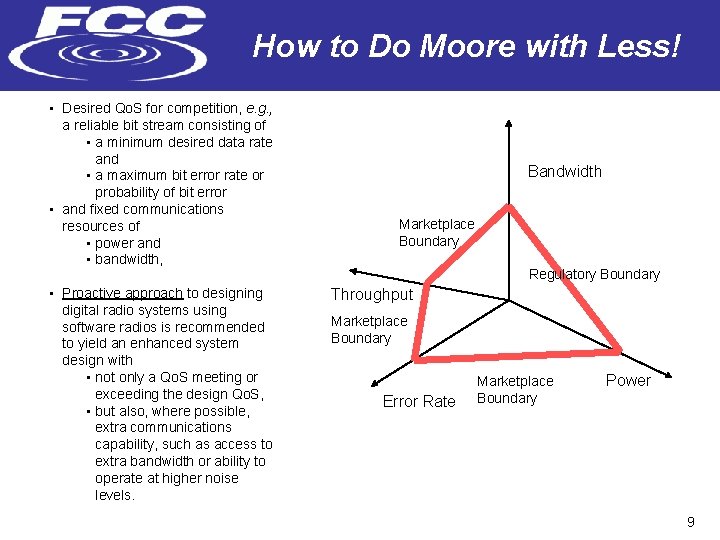
How to Do Moore with Less! • Desired Qo. S for competition, e. g. , a reliable bit stream consisting of • a minimum desired data rate and • a maximum bit error rate or probability of bit error • and fixed communications resources of • power and • bandwidth, • Proactive approach to designing digital radio systems using software radios is recommended to yield an enhanced system design with • not only a Qo. S meeting or exceeding the design Qo. S, • but also, where possible, extra communications capability, such as access to extra bandwidth or ability to operate at higher noise levels. Bandwidth Marketplace Boundary Regulatory Boundary Throughput Marketplace Boundary Error Rate Marketplace Boundary Power 9
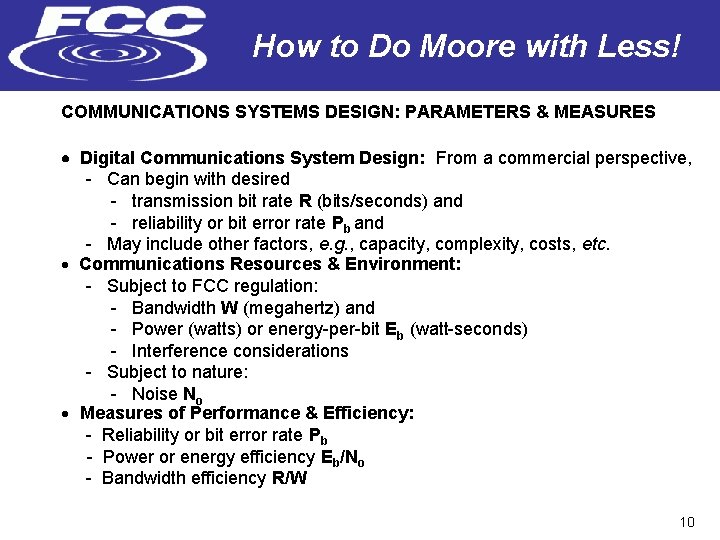
How to Do Moore with Less! COMMUNICATIONS SYSTEMS DESIGN: PARAMETERS & MEASURES Digital Communications System Design: From a commercial perspective, - Can begin with desired - transmission bit rate R (bits/seconds) and - reliability or bit error rate Pb and - May include other factors, e. g. , capacity, complexity, costs, etc. Communications Resources & Environment: - Subject to FCC regulation: - Bandwidth W (megahertz) and - Power (watts) or energy-per-bit Eb (watt-seconds) - Interference considerations - Subject to nature: - Noise No Measures of Performance & Efficiency: - Reliability or bit error rate Pb - Power or energy efficiency Eb/No - Bandwidth efficiency R/W 10
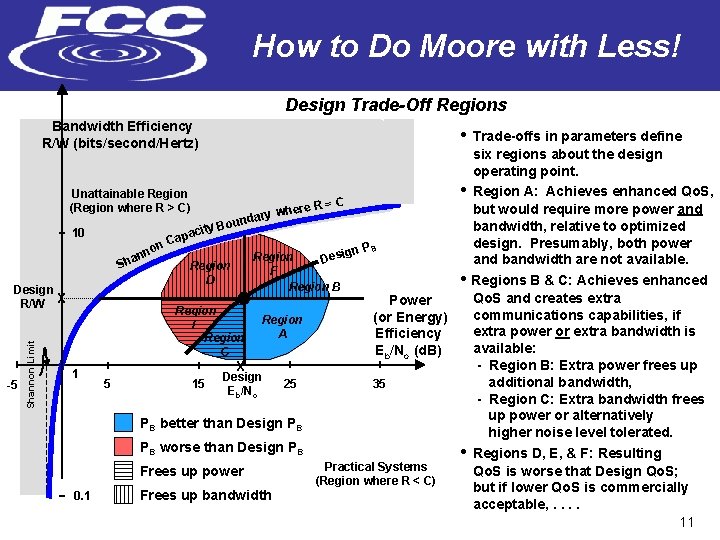
How to Do Moore with Less! Design Trade-Off Regions Bandwidth Efficiency R/W (bits/second/Hertz) • Trade-offs in parameters define Shannon Limit six regions about the design operating point. • Region A: Achieves enhanced Qo. S, Unattainable Region C = R e (Region where R > C) but would require more power and her ary w d n u bandwidth, relative to optimized y Bo 10 acit p a design. Presumably, both power n. C n PB no g i s n Region a De and bandwidth are not available. Sh Region F D • Regions B & C: Achieves enhanced Region B Design Qo. S and creates extra Power R/W X Region communications capabilities, if (or Energy) Region E extra power or extra bandwidth is A Efficiency Region available: Eb/No (d. B) C - Region B: Extra power frees up X 1 Design additional bandwidth, 15 25 35 5 -5 Eb/No - Region C: Extra bandwidth frees up power or alternatively PB better than Design PB higher noise level tolerated. PB worse than Design PB • Regions D, E, & F: Resulting Practical Systems Qo. S is worse that Design Qo. S; Frees up power (Region where R < C) but if lower Qo. S is commercially Frees up bandwidth 0. 1 acceptable, . . 11
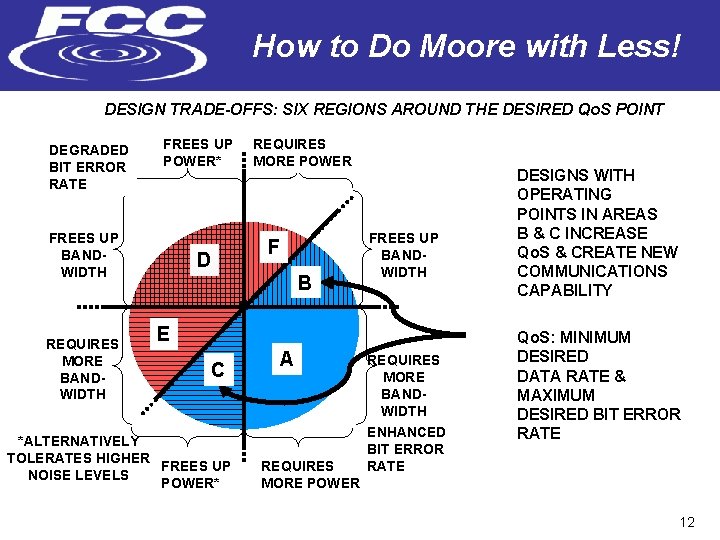
How to Do Moore with Less! DESIGN TRADE-OFFS: SIX REGIONS AROUND THE DESIRED Qo. S POINT DEGRADED BIT ERROR RATE FREES UP POWER* FREES UP BANDWIDTH REQUIRES MORE BANDWIDTH D REQUIRES MORE POWER F B FREES UP BANDWIDTH E C *ALTERNATIVELY TOLERATES HIGHER FREES UP NOISE LEVELS POWER* A REQUIRES MORE POWER REQUIRES MORE BANDWIDTH ENHANCED BIT ERROR RATE DESIGNS WITH OPERATING POINTS IN AREAS B & C INCREASE Qo. S & CREATE NEW COMMUNICATIONS CAPABILITY Qo. S: MINIMUM DESIRED DATA RATE & MAXIMUM DESIRED BIT ERROR RATE 12
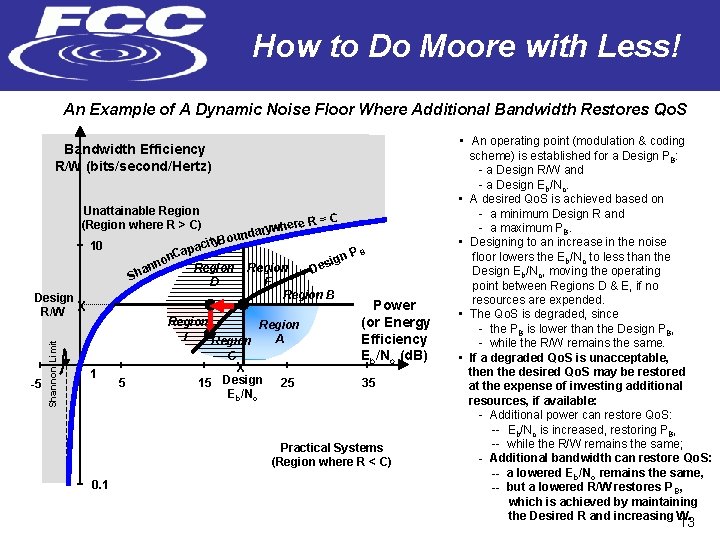
How to Do Moore with Less! An Example of A Dynamic Noise Floor Where Additional Bandwidth Restores Qo. S • An operating point (modulation & coding Bandwidth Efficiency R/W (bits/second/Hertz) Unattainable Region (Region where R > C) Design R/W X Shannon Limit re R = C ywhe ndar y. Bou acit p a PB n. C ign no s e n Region D a Sh F D Region B 10 -5 • Region E A Region C 1 X 5 15 Design Eb/No 25 Power (or Energy Efficiency Eb/No (d. B) 35 Practical Systems (Region where R < C) 0. 1 • • • scheme) is established for a Design PB: - a Design R/W and - a Design Eb/No. A desired Qo. S is achieved based on - a minimum Design R and - a maximum PB. Designing to an increase in the noise floor lowers the Eb/No to less than the Design Eb/No, moving the operating point between Regions D & E, if no resources are expended. The Qo. S is degraded, since - the P B is lower than the Design PB, - while the R/W remains the same. If a degraded Qo. S is unacceptable, then the desired Qo. S may be restored at the expense of investing additional resources, if available: - Additional power can restore Qo. S: -- Eb/No is increased, restoring PB, -- while the R/W remains the same; - Additional bandwidth can restore Qo. S: -- a lowered Eb/No remains the same, -- but a lowered R/W restores P B, which is achieved by maintaining the Desired R and increasing W. 13
How to Do Moore with Less! The Engineering Implications of the New Design Model Proactive Design Model (Invest for Competitive Qo. S & Increased Communications Capability): Maximizing/minimizing trade-offs are made among the usual parameters, but the objective changes: licensees now can do tradeoffs to achieve both desired Qo. S, while increasing spectrum capacity, where possible. Current industrial thinking assumes that noise floor and other aspects of radio environment is static; we suggest that it can be managed by design In the new software radio world, the communications system designer should design a radio assuming: Maybe a more dynamic (or variable) noise and interference environment. Modulation and coding decisions are made within the fundamental limitations of information theory as described above… 14
How to Do Moore with Less! FCC Flexibility Regime and The Implications of the New Design Model Our Proactive Design Model is defined as the development of Wireless Digital Communications Systems using software radios dynamically responding to the environment; its objective is to promote efficiency in Spectrum Utilization, while enabling licensees to offer competitive service in the marketplace (No longer a Hobbesian Choice). This design approach will create more access to spectrum capacity and more intense use of spectrum where the Increased Spectrum Capability can be utilized for improving the existing service or developing new services. The FCC’s flexible spectrum technology policies already encourage licensees to invest in expanded software radio designs to meet both a desired Qo. S and while achieving an increase in communications capacity, where possible. Enable customary tradeoffs under constraints, but assumes dynamic radio (i. e. , interference boundaries, noise floor, etc. ) environment. 15
How to Do Moore with Less! So What More Can Be Done on Spectrum Policy towards this Model? To the extent possible, policy should rely on market forces to determine what is the best use of the extra communications capability developed by licensees. In the new world of dynamically managed radio environment, redistributing excess spectrum capability by fiat could be a disincentive to licensees to invest in more efficient use of spectrum. We posit that any resulting efficiency gains from the new Design Model should be, in the first instance, redistributed using marketplace mechanisms Market oriented policy mechanisms being implemented or being considered for rewarding licensees for increasing their investment in spectrum utilization are: Secondary markets (Leasing), Enabling private commons, Developing two-sided auctions Enabling transferable voucher mechanisms for voluntary exchanges (spectrum) 16