
How to do Extensive Reading Dr Rob Waring
How to do Extensive Reading Dr. Rob Waring Notre Dame Seishin University Okayama E-Future Day, Seoul, June 9, 2017
Why don’t people do ER? • • Don’t know what it is No space in the curriculum No one to ask how to do it Don’t know what materials are available Don’t know how to assess the reading Don’t know how to choose materials correctly No money / resources
What is Extensive Reading? Fast, fluent reading of story books with high levels of comprehension Focus on comprehension and enjoyment, not language learning Aim is to deepen already met language through massive exposure Typically this is done with ‘graded readers’ or ‘leveled readers’ Extensive reading (ER) and Intensive reading (IR) are two sides of the same coin. Intensive Reading builds language, Extensive Reading practices it. IR and ER work TOGETHER, they are NOT opposites
The aims of extensive reading To recycle important and useful words and grammar time and time again to aid acquisition To consolidate and strengthen partly known language To provide massive fluent reading practice To build reading speed To build depth of knowledge To be enjoyable – so they read more
Summary of Extensive Reading Massive language exposure at the student's level of understanding Excellent chances for the development of fluent eye movements (fluent reading) because the text is easy leading to faster reading Excellent chances to learn the patterns in the language because the student is reading a lot High probability the student is interested in what is read and that she will become a more confident reader
When reading extensively, students should READ It is CRUCIAL that learners read at the RIGHT level Read something quickly and Enjoyably with Adequate comprehension so they Don’t need a dictionary If they need a dictionary, it’s too hard and they will read slowly, get tired and stop Their aim is fluency and speed, not learning new language Typically students read at home or out of class- it doesn’t take much class time for HUGE benefits We add the reading to our existing program, we don’t replace it.
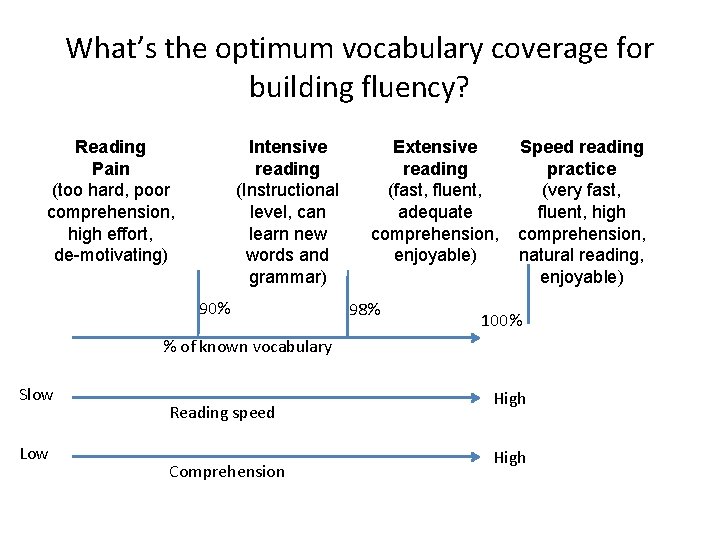
What’s the optimum vocabulary coverage for building fluency? Reading Pain (too hard, poor comprehension, high effort, de-motivating) Intensive reading (Instructional level, can learn new words and grammar) 90% Extensive reading (fast, fluent, adequate comprehension, enjoyable) 98% Speed reading practice (very fast, fluent, high comprehension, natural reading, enjoyable) 100% % of known vocabulary Slow Low Reading speed Comprehension High
Understanding your program How much time does your curriculum allow? How flexible is it? How much time for homework? Make a new ER course? Add to an existing one? Do your have suitable materials? Budget? (one off or recurring? ) Staff? How will you manage the materials? Library? Class bags? What borrowing systems do you need? How will the reading be assessed? Graded or not? Formal or informal assessment?
When do they read? Class Reading They read a book together as a class, a few pages each class Independent reading A silent reading time in class – say 10 -15 minutes per week They take a book home and read it for next week Remember - if they need a dictionary, it will slow them down.
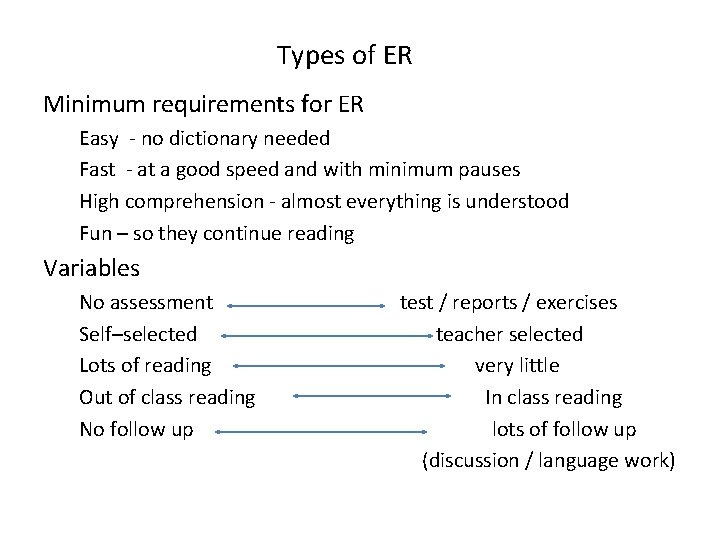
Types of ER Minimum requirements for ER Easy - no dictionary needed Fast - at a good speed and with minimum pauses High comprehension - almost everything is understood Fun – so they continue reading Variables No assessment Self–selected Lots of reading Out of class reading No follow up test / reports / exercises teacher selected very little In class reading lots of follow up (discussion / language work)
Things to recommend Start small – ? ? your own class and then expand later So slowly at first – new things take time Look for potential problems when expanding and think what you can do about them. Get ideas Experiment with different styles of ER to see what suits the school and their learners Set aims for the students, the program and yourselves Be aware that things don’t always go well – they need your support
To do list for starting an ER program 1. 2. 3. 4. 5. 6. 7. Find out about Extensive Reading Make a plan Get funding Get everyone involved Build a library Build a book recording system Make decisions about which books, which students, how much reading, how to assess etc. 8. Introduce the program 9. Evaluate it
Planning a program I It needs to: • be an integral part of the school’s curriculum • raise the learners’ reading ability and general English levels • have facilitating effects on their writing skills, spelling, grammar and speaking • motivate the learners to read, and learn from their reading • have goals that set out how much reading should be done and by when • have a reading library from which learners can select their own texts
Planning a program II It needs to: • have systems in place for cataloging, labeling, checking out, recording and returning the reading materials • have a variety of materials to read, not only graded readers and other simplified materials • show teachers, parents and the administration that you take ER seriously • have targets of both learner and program attainment that clearly show the success of the program • be bigger and more resilient than one teacher and have sufficient support so that it will continue indefinitely
Planning a program III “Think big, act small” (Hill, 1997) The program should have vision It should have the will to survive potential threats to its existence: increases in lost or mislaid materials, insufficient resources to maintain a library, teaching and financial resources being moved to other projects, a general lessening in enthusiasm after the highs of the ‘big start’
Planning a program IV Therefore, the program should – be well planned – should have built-in flexibility – be adaptable for future changes. – find ways that the program will fit within the school’s curriculum The key to a successful reading program is balance The next step is to ensure that everyone is involved
Getting support Get support from all ‘players’ school administration office staff other teachers ? ? parents students Be careful it doesn’t become ‘Suzuki-sensei’s thing’ or it will: not seen as being serious die when you leave become an object to be cut
Getting resources - money There’s always money somewhere: your school districts, city, prefecture corporate sponsors generous parents free sample materials from publishers Students buy one book each and donate them to the school hold events at school festivals - sponsored reading marathons - make cakes to sell etc.
Getting resources - materials 4000 Graded readers available in Korea Kids materials to native level Thousands more native materials Lots of online materials now (we’ll look later)
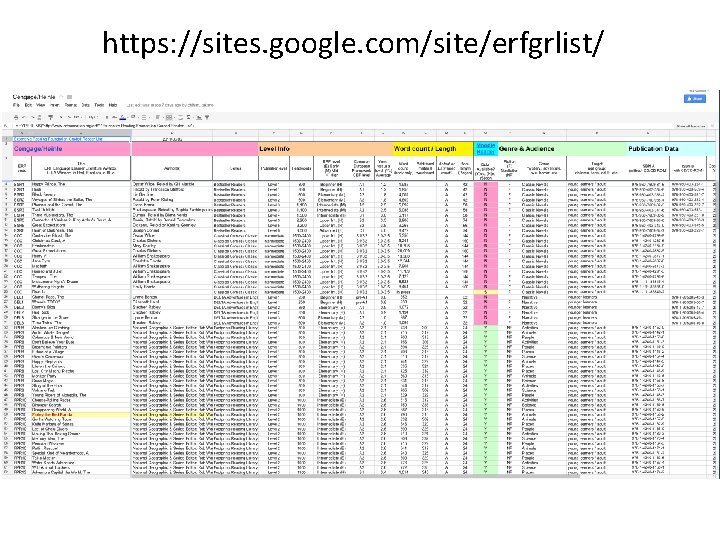
https: //sites. google. com/site/erfgrlist/
Build the library - location In the school library - best as they have borrowing systems in place now - some libraries will be happy, others not A special ‘reading room’ An area in a classroom An area in the teachers room Mobile systems – book bags or book carts Share a library with other schools – rotate libraries every semester
Getting resources - BYO If no money at all – build your own library 1. Students find something they want to read from a magazine, newspaper, website, recipe, song etc. 2. They read it with a dictionary and write definitions on the paper 3. They bring it to class and explain to others – then give to partner 4. Their partner reads it and adds any definitions they don’t know 5. They bring another one next week 6. Soon you have hundreds of student selected student graded materials
How many books do I need? At least one book per student so they can swap. If you have 30 books for 30 students you then have 30 books to share. They only cost say 450 -700 yen each. And you can use them next year. Go for variety. Aim for 2 -3 readers per student.
How much reading should they do? About a book a week or more. Beginners - A book at week at their ability level They can meet unknown words easily, so they don’t need to read much. Intermediates - A book at week at their ability level They don’t meet unknown words all the time, but their books are thicker, so they are reading more. Advanced – 2 books at week at their ability level They rarely meet unknown words, so they have to read more to meet language they don’t know.
Be careful about using Native-level (L 1) materials to build fluency Native books, magazines etc. are too hard to read fluently for MOST Japanese learners Children’s books for natives are full of difficult words, phrases and concepts Native children already know 5000 words and almost all the grammar BEFORE they start to read Japanese children know almost no English words and no grammar before they start English. Native texts usually are NOT suitable. Don’t confuse the final target (to read native texts) with the starting point and the way to get there.
Build the library – Management Book management systems should be simple and transparent Make a grading scheme so that materials can be graded by difficulty (and age appropriacy) Use a 6 to 8 level scheme (colours) going from the easiest materials to the more difficult. Each book can then be numbered and coded by its level and book number (e. g. G 4070 G = Green level, 4 = biographies, and 070 is the book number). There is probably no need to put them in author or book number order. Organize the book borrowing record system.
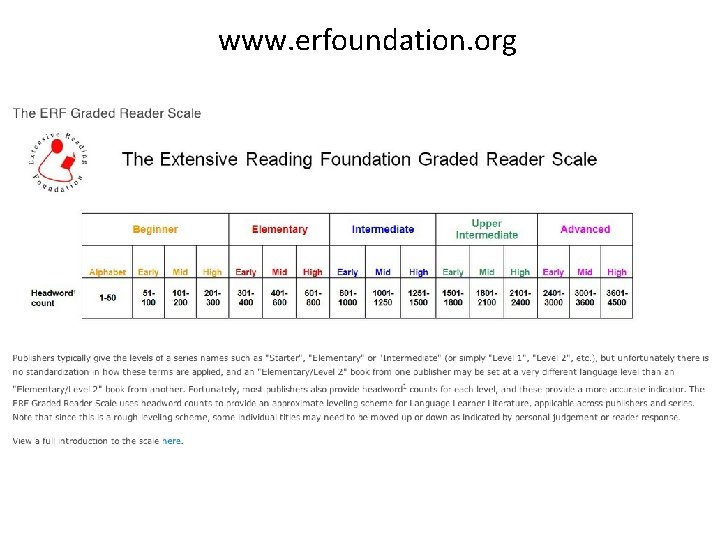
www. erfoundation. org
How do I introduce this to my students? FIRST WEEK 1. Get them to look at some books (preferably a VERY one easy for them) – something achievable. It is vital that the first book is a good experience. It should be easy, enjoyable, with very few unknown words per page. 2. If they like the book, ask them to read it for 10 minutes. (silent reading) 3. If they like it, tell them to take it home and bring it back later (say after one week). If they don’t tell them to change it for a different one.
How do I introduce this to my students? NEXT WEEK 6. The next week ask them to talk about their books, what they liked and didn’t. They return the books. 7. Point out the difference between ER (fluency, fun) and IR (learn new things), explain why ER is essential 8. Get them to choose another book (easier if the last one was difficult). 9. Do this again every week.
How does the student know her 'level’? The student looks at books at different difficulty levels. She finds one that she feels comfortable with (good reading speed, few unknown words, enjoyable, easy etc. ). She then reads it. Stop if it is too difficult / boring and find an easier book.
How can I assess the reading? Two kinds Assess their comprehension Assess they actually read it Assessing Comprehension If they can READ a book, there’s no need to test them on the details Sometimes we have to trust the students Students shouldn’t believe everything they do should be tested
How can I assess the reading? II Assessing they read something – per book Did you enjoy the ending? What kind of story is it? Students write a short report on each book read. Assessing they read something – per semester Completion of ER page goals e. g. xxx pages or books per semester / course. Assessed by adequate completion of reports / summaries. Active participation in In-class discussion of ER texts. Self-assessment (if it is not for their grades!!)
www. mreader. org 2500 crowd-sourced quizzes for published graded readers Free Adaptive test – changes for each users Basic Learner Management System
Assessing your ER program Did you achieve your goals? Through the semester write down some questions you want answering Do some action research
Why do ER programs fail? If it’s optional: students will opt out the message is ‘do the reading if you have time, it’s not as important as other things’ It says the administrators don’t see it as valuable it becomes a target to be cut out completely ER should be REQUIRED. Requiring ER means: the teachers value this reading, so we want you to do it. it’s part of the full course work – and you’ll be graded on it. the students see it as ‘natural’ and ‘normal’ not an ‘option’
Why do ER programs fail II? Curriculum changes Change to ‘test’ / speaking / CLT …. . focus ER enthusiast leaves the school Inappropriate materials Reading is too difficult / boring Age inappropriate Books don’t get replaced when lost Starting badly Too fast, Too high, Too much to read too soon Students don’t understand why they need ER
Dealing with teacher / school objections “The books are too easy and childish. They are not learning anything. ” -> easy is good - so they can build reading speed. Choose books are at the student’s fluent reading level -> Native materials are too hard, demotivating, inappropriate -> ‘intermediate’ learners can’t read intermediate graded readers “I’m not teaching so they aren’t learning” -> our job is not to ‘teach’ but to help people learn, build independence, reading speed, fluency etc. “I don’t know how to do it, or where to get information” -> I’ll help
Dealing with teacher / school objections II “Nice idea but I have no time in my course” -> If you don’t have graded reading where will your students get the massive exposure they need? -> How else will they get the ‘sense of language’ they need? “We don’t have the money for this” -> Ask your schools to reallocate funds so this reading is done; ask for donations; get some free samples etc. “We have to go through our set curriculum” -> Speak with your course designers to build in graded reading. Re-allocate resources and re-set class hours “We have to prepare the students for tests” -> Research shows students perform better on tests if they have a general sense of language, not a deconstructed ‘bitty’ one.
Promoting / adopting ER Work within the system – don’t expect miracles Understand where teachers / institutions are coming from – find out their aims What is at stake for them / what would prevent them from adopting ER? Solve those problems first. If they misunderstand the meaning of ER, then re-brand it - use the term ‘graded reading’
Promoting / adopting ER II Show some GR catalogues Set personal targets for – Your own school – Mentoring other institutions – Giving your own presentations / workshops – Finding information that may unblock roads for others – Conduct your own research
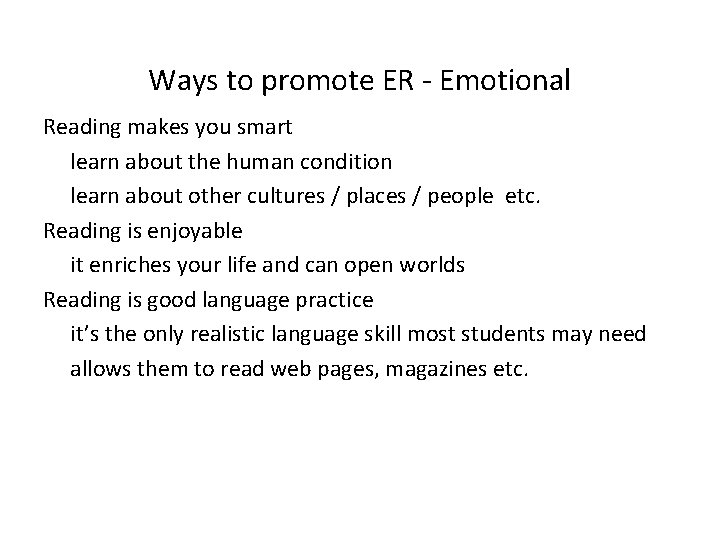
Ways to promote ER - Emotional Reading makes you smart learn about the human condition learn about other cultures / places / people etc. Reading is enjoyable it enriches your life and can open worlds Reading is good language practice it’s the only realistic language skill most students may need allows them to read web pages, magazines etc.
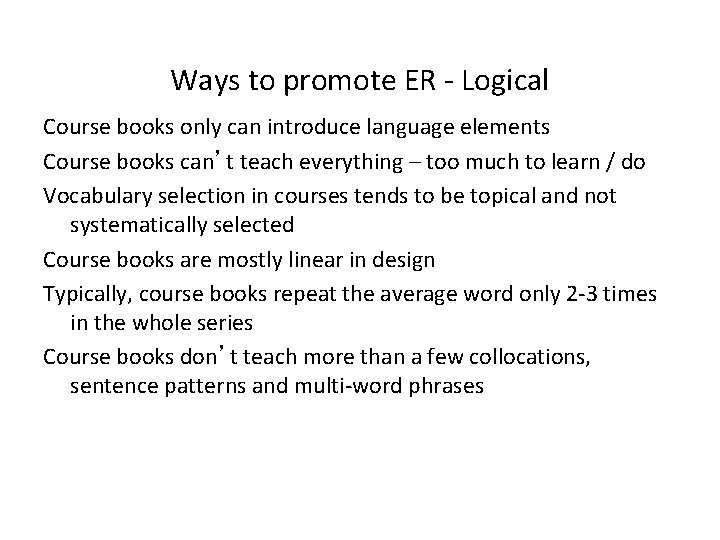
Ways to promote ER - Logical Course books only can introduce language elements Course books can’t teach everything – too much to learn / do Vocabulary selection in courses tends to be topical and not systematically selected Course books are mostly linear in design Typically, course books repeat the average word only 2 -3 times in the whole series Course books don’t teach more than a few collocations, sentence patterns and multi-word phrases
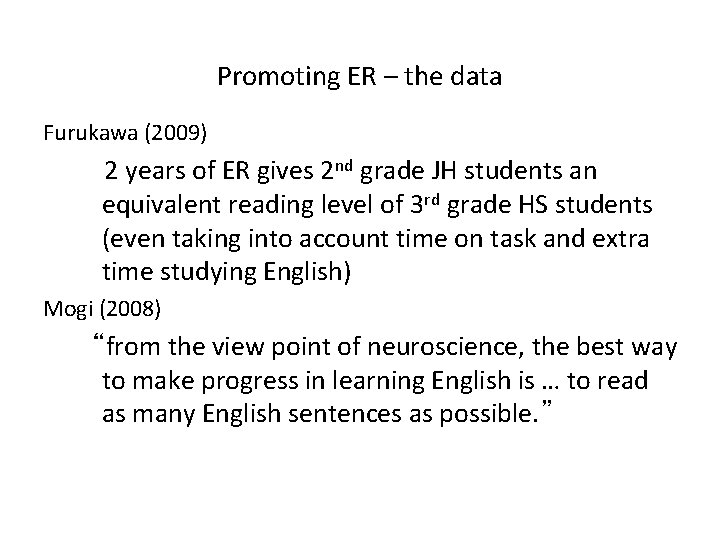
Promoting ER – the data Furukawa (2009) 2 years of ER gives 2 nd grade JH students an equivalent reading level of 3 rd grade HS students (even taking into account time on task and extra time studying English) Mogi (2008) “from the view point of neuroscience, the best way to make progress in learning English is … to read as many English sentences as possible. ”
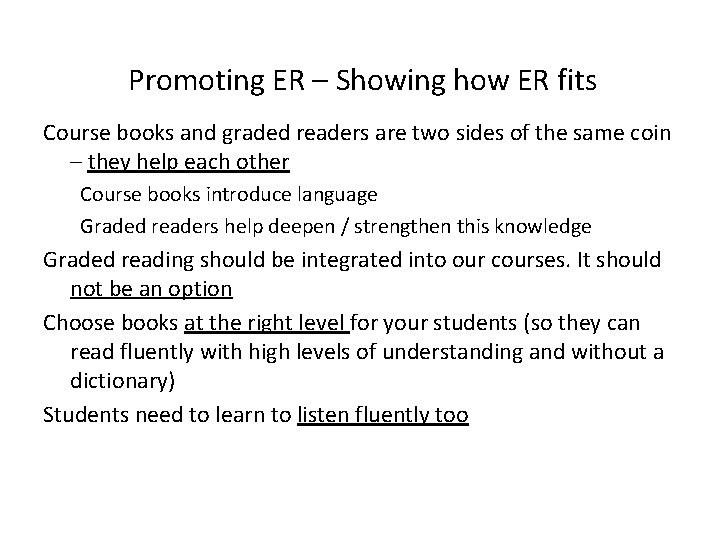
Promoting ER – Showing how ER fits Course books and graded readers are two sides of the same coin – they help each other Course books introduce language Graded readers help deepen / strengthen this knowledge Graded reading should be integrated into our courses. It should not be an option Choose books at the right level for your students (so they can read fluently with high levels of understanding and without a dictionary) Students need to learn to listen fluently too
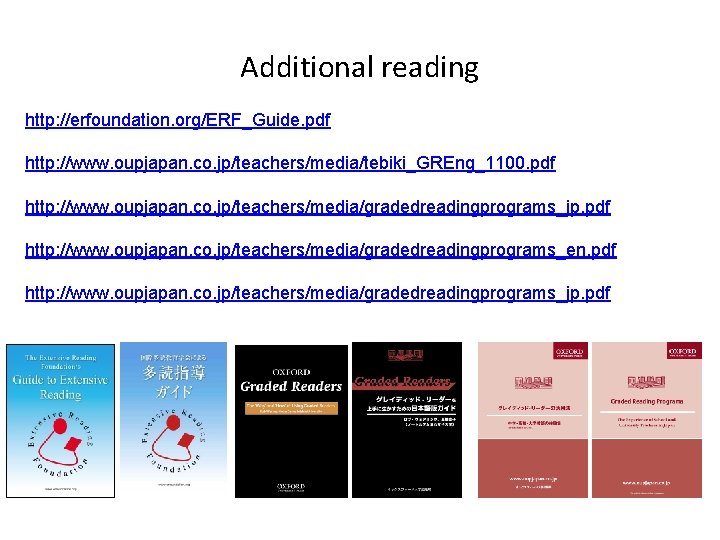
Additional reading http: //erfoundation. org/ERF_Guide. pdf http: //www. oupjapan. co. jp/teachers/media/tebiki_GREng_1100. pdf http: //www. oupjapan. co. jp/teachers/media/gradedreadingprograms_jp. pdf http: //www. oupjapan. co. jp/teachers/media/gradedreadingprograms_en. pdf http: //www. oupjapan. co. jp/teachers/media/gradedreadingprograms_jp. pdf
Today’s presentation is available online along with other presentations. Feel free to use and abuse as you wish. waring. rob@gmail. com www. robwaring. org/presentations Thank you for your time
- Slides: 46