
How To Do a Lab Report Format and
How To Do a Lab Report
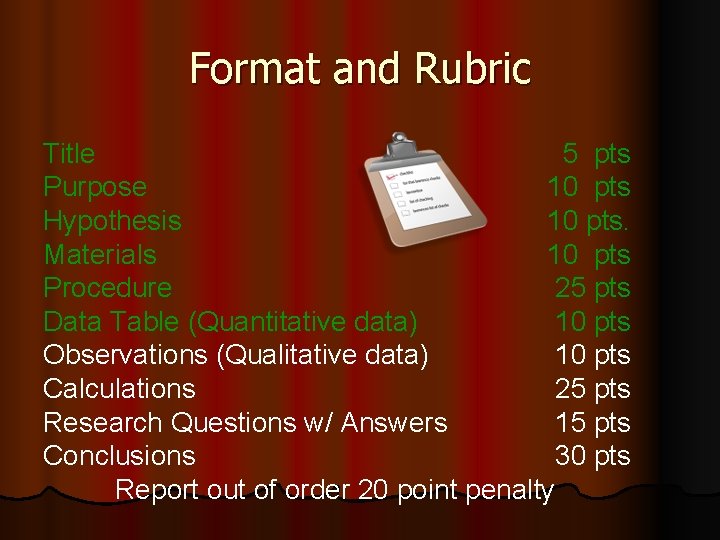
Format and Rubric Title 5 pts Purpose 10 pts Hypothesis 10 pts. Materials 10 pts Procedure 25 pts Data Table (Quantitative data) 10 pts Observations (Qualitative data) 10 pts Calculations 25 pts Research Questions w/ Answers 15 pts Conclusions 30 pts Report out of order 20 point penalty
Start Out Like This Title: l Purpose : To…(What are you trying to learn? ) l Hypothesis: If, then, because… l Materials : l Procedure : RECIPE!!! l l Step by step sequence- If this procedure is duplicated by a “rookie researcher” will they get the same or very similar results?
Data Table (s): (Quantitative data) Graphs are names “y vs. x” (dependent vs. independent variable) Observations (s): (Qualitative data) Calculation(s): Research Questions w/ Answers: Conclusions:
Conclusion l 3 to five paragraphs long… l Rubric for grading…
What makes a good conclusion… l Restate your purpose and why it was accomplished or not (are there any improvement to the technique/procedure that would have help you accomplish your purpose better, faster) l Restate your hypothesis and support/refute your hypothesis as correct or incorrect based on the data/evidence l Summarize what you did in the lab
l Summarize your findings (analyze the data, trends) WHAT DOES THE DATA MEAN? l Overall scientific principle demonstrated (Why did we do this lab? What were we trying to learn? along with contributing scientist who has done work in that field (research) l Real world application to which this study applies or possible NEW application
I. Title l. Title: Properties of Solids
Purpose To find the density of various materials. To use the property of density to solve a mystery l Purpose:
Materials: l l l l l Graph paper Ruler Balance CPO displacement tank Disposable cup 250 m. L beaker Graduated cylinder Six small identical items Approx. 100 pennies
Procedure Part 1: Part 1 1. Each lab station has a set of six objects. 2. Find the mass and volume of one object. 3. Add the second object and find their combined mass and volume.
Procedure Part 1 4. Then find the and combined mass and volume of three, four, and five objects. 5. Record your data in Table 1. 6. Although your items may look identical, their may be small differences.
Procedure Part 1 7. DO NOT OBTAIN YOUR DATA BY MULTIPLYING THE MASS AND VOLUME OF THE FIRST OBJECT BY THE NUMBER OF OBJECTS YOU HAVE.
Procedure Part 1 8. Plot your data on graph paper. 9. Label the x-axis “volume”. 10. Label the y-axis “mass”. Be sure to use the entire space on your graph paper for making your graph.
Procedure Part 2 1. Each lab group has been given a stack of approximately 100 pennies. l 2. Sort them in two stacks: l A. pre-1982 l B. post-1982 l
Procedure Part 2 3. Use the displacement tank to find the volume of the pre-1982 pennies. l 4. Use the displacement tank to find the volume of the post-1982 pennies. l 5. Record your results in Table 3. l
Procedure Part 2 6. Calculate the density of each penny. l 7. Record your results in the third row of the table. l
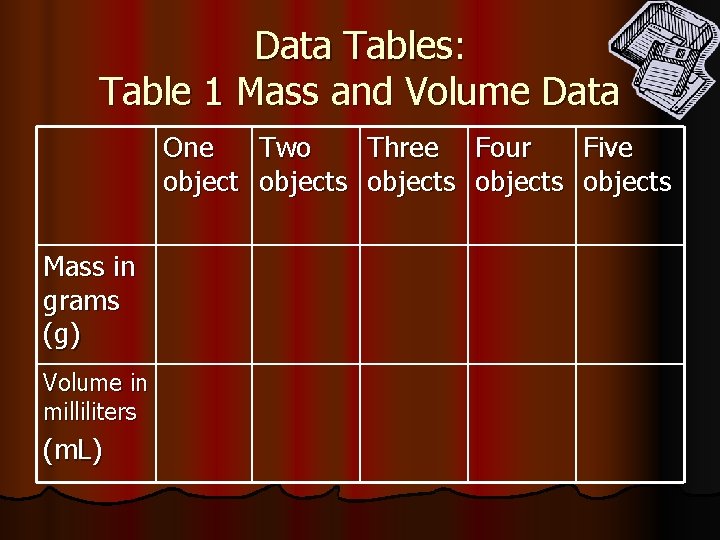
Data Tables: Table 1 Mass and Volume Data One Two Three Four Five objects objects Mass in grams (g) Volume in milliliters (m. L)
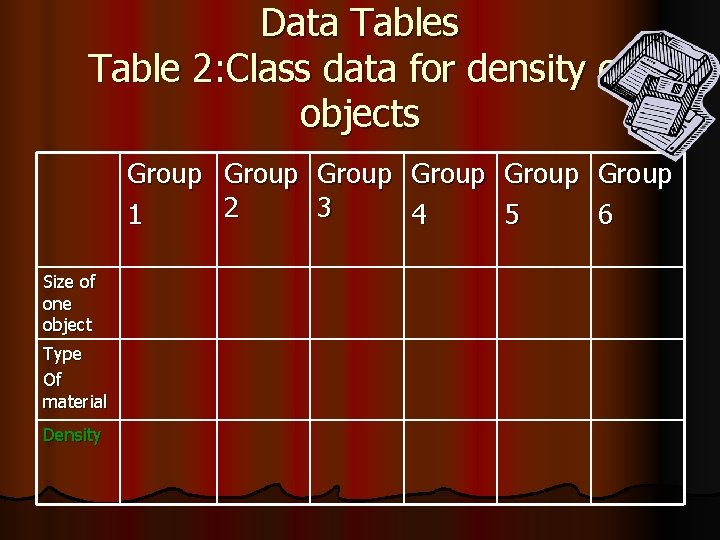
Data Tables Table 2: Class data for density of objects Group 2 3 1 4 Size of one object Type Of material Density Group 5 Group 6
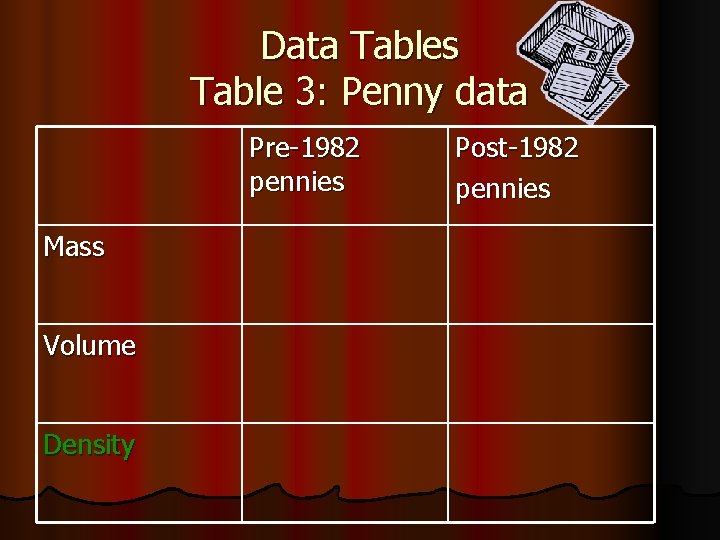
Data Tables Table 3: Penny data Pre-1982 pennies Mass Volume Density Post-1982 pennies
Observations: l. What I see, smell, feel, hear, and/or taste… during the experiment
Calculations l What math did you do in order to fill out the data table?
Research Questions l 1. Is there any pattern to the data points on your graph? For example, the points might form a smooth curve, a straight line, a random scattering, or a cluster in a certain region. If you detect a pattern, describe it.
Research Questions l 2. Take your ruler and move it along the points of the graph in order to find the line on the paper that is as close as possible to all the dots. This line is called the “line of best fit”. Draw the line.
Research Questions 3. Now draw the line. Choose any two points on the line. These will be represented as (X 1, Y 1) and (X 2, Y 2). Use the formula (Y 2 -Y 1)/ (X 2 -X 1) to calculate the slope of the line. l The slope tells you how many g/m. L there are in the material you have tested. l
Research Questions l 4. Compare your results to the result obtained by other groups. Are your slopes (results) similar or different? l 5. The relationship between a substance’s mass and volume is called it’s density. What is the density of the material you tested?
Research Questions l 6. Your graph contains data for five objects. Now, predict the mass of six objects. l 7. Use the balance to check your prediction. How does your prediction compare with the actual mass obtained with the balance?
Research Questions l 8. Use the mass you found in Step 3. Find the number on the y-axis of your graph. Now, find the point on the line that crosses that y-value. What is the x-value of that point? l 9. What does the x-value predict about the volume of the six objects?
Research Questions l 10. Now, find the volume of the six objects experimentally. l 11. How does the x-value from the graph compare with the volume you obtained experimentally?
Research Questions l 12. Does density depend on the size of the material? Give evidence to support your answer. l 13. Does density depend on the type of material? Give evidence to support your answer.
Research Questions l 14. Using what you have observed in this lab, do you suppose that density depends on the shape of the material? Why or why not? l 15. Are pre-1982 and post-1982 pennies made from the same material? Give evidence to support your answer.
Research Questions l 16. Did the bill to change the composition of the penny pass or fail?
Conclusions Pre-1982 and post 1982 pennies are made from ----- material. I know this because…. . Remember, the conclusion MUST address the purpose!
Format and Rubric Title 5 pts Purpose 10 pts Hypothesis 10 pts. Materials 10 pts Procedure 25 pts Data Table (Quantitative data) 10 pts Observations (Qualitative data) 10 pts Calculations 25 pts Research Questions w/ Answers 15 pts Conclusions 30 pts Report out of order 20 point penalty
What makes a good conclusion… l Restate your purpose and why it was accomplished or not (are there any improvement to the technique/procedure that would have help you accomplish your purpose better, faster) l Restate your hypothesis and support/refute your hypothesis as correct or incorrect based on the data/evidence l Summarize what you did in the lab
l Summarize your findings (analyze the data, trends) WHAT DOES THE DATA MEAN? l Overall scientific principle demonstrated (Why did we do this lab? What were we trying to learn? along with contributing scientist who has done work in that field (research) l Real world application to which this study applies or possible NEW application
- Slides: 36