
How to do a book review Writing a

How to do a book review
Writing a book review is a difficult task: it requires us to describe an object that is invisible, to recreate it for someone who has never seen it.
DS 1 11 th March Eve Kofosky Sedgwick, ‘Queer and now’ in Tendencies (Durham: Duke University Press, 1993), pp. 1 – 19. Denis Provencher, ‘Gay Paris: Language, Sexuality, and Space in the French Capital’ in Queer French (London: Ashgate, 2007) pp. 155 – 185. James Agar, ‘Queer in France: AIDS disidentification in France’, in Queer in Europe Contemporary Case Studies (Farnham: Ashgate, 2011), pp. 57 – 70. David M. Halperin, ‘The queer politics of Michel Foucault’ in Saint Foucault: Towards a gay hagiography (New York: Oxford University Press, 1995), pp. 69 – 85. OR an article or book chapter of your choosing about queer theory in a French context. Please speak with Dr Joanne Brueton, the course convenor, about your choice of text by mid February so that it can be validated.
The book review should have four key elements: 1. Introduction 2. Summary of the article / chapter 3. Analysis and evaluation of the book (your goal here is not simply to provide a summary of the chapter, but an argumentative and critical engagement with its principal ideas. For this, you may need to do additional reading from the course material to understand the references and thesis statements of the authors. This should be the longest part of your review) 4. Conclusion
1. Reviewers are responsible for selecting the important elements of a book and explaining their importance 2. Try reducing chapters to a sentence. Then take that reduced statement and decide how to expand it. 3. Reviewers can plot the curve in part by making extracts. Isolate passages that you might want to quote because they illustrate the best and worst characteristics of the book. Compile an anthology, a mini-book. Then reread the quotations. Why did they attract you? What do they illustrate? Which can you use to start the review or to end it? Which will you use to illuminate what points? 4. What does the book claim to do? What do we find? Were we disappointed? 5. A review has three main parts: a description of the book, an evaluation, and a defense of the evaluation.
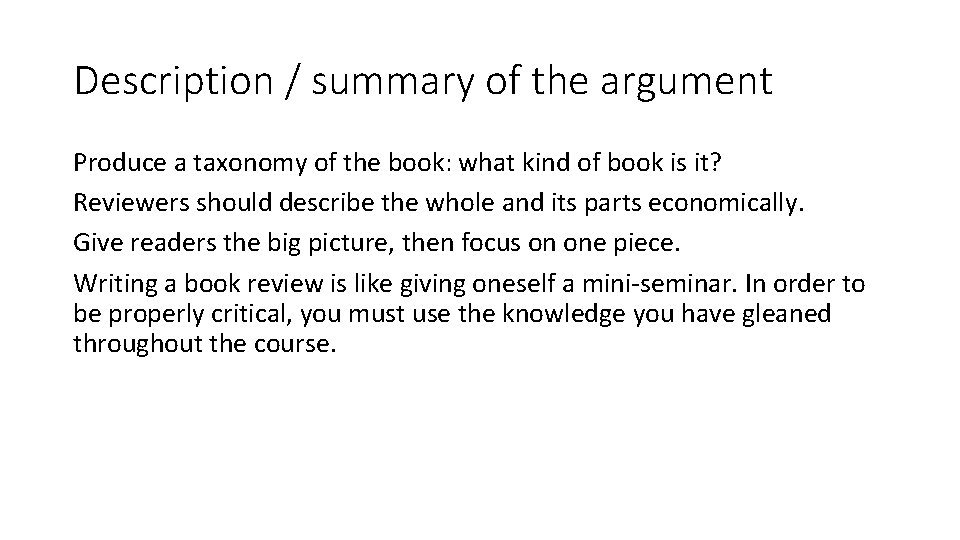
Description / summary of the argument Produce a taxonomy of the book: what kind of book is it? Reviewers should describe the whole and its parts economically. Give readers the big picture, then focus on one piece. Writing a book review is like giving oneself a mini-seminar. In order to be properly critical, you must use the knowledge you have gleaned throughout the course.
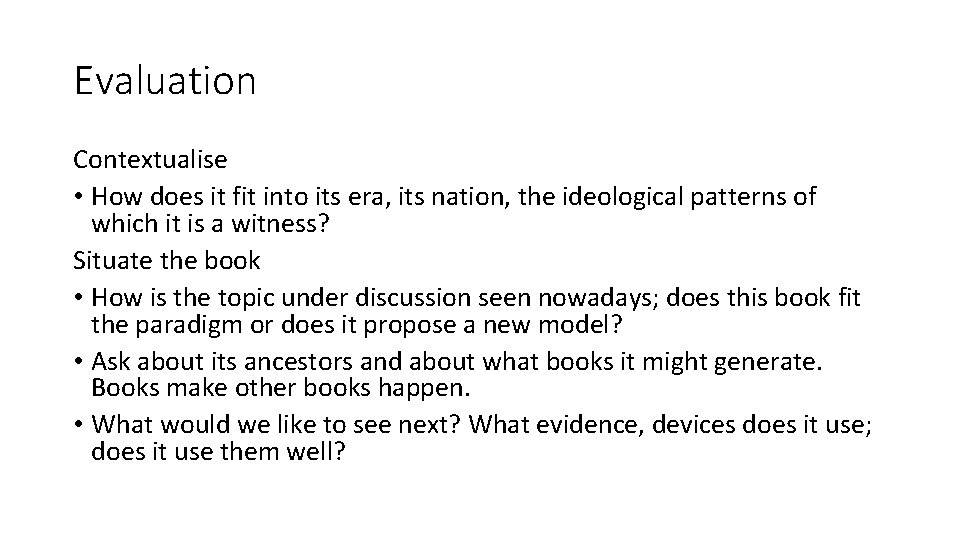
Evaluation Contextualise • How does it fit into its era, its nation, the ideological patterns of which it is a witness? Situate the book • How is the topic under discussion seen nowadays; does this book fit the paradigm or does it propose a new model? • Ask about its ancestors and about what books it might generate. Books make other books happen. • What would we like to see next? What evidence, devices does it use; does it use them well?
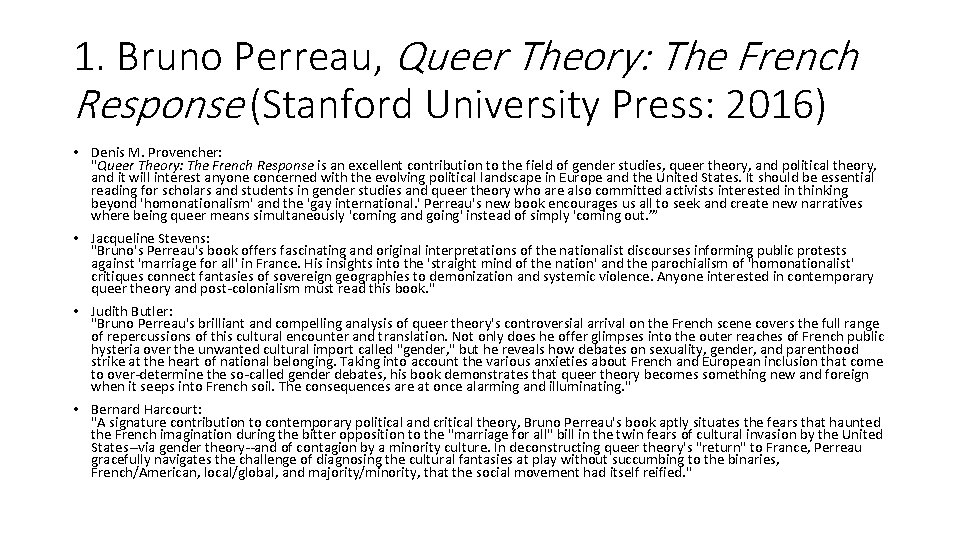
1. Bruno Perreau, Queer Theory: The French Response (Stanford University Press: 2016) • Denis M. Provencher: "Queer Theory: The French Response is an excellent contribution to the field of gender studies, queer theory, and political theory, and it will interest anyone concerned with the evolving political landscape in Europe and the United States. It should be essential reading for scholars and students in gender studies and queer theory who are also committed activists interested in thinking beyond 'homonationalism' and the 'gay international. ' Perreau's new book encourages us all to seek and create new narratives where being queer means simultaneously 'coming and going' instead of simply 'coming out. ’” • Jacqueline Stevens: "Bruno's Perreau's book offers fascinating and original interpretations of the nationalist discourses informing public protests against 'marriage for all' in France. His insights into the 'straight mind of the nation' and the parochialism of 'homonationalist' critiques connect fantasies of sovereign geographies to demonization and systemic violence. Anyone interested in contemporary queer theory and post-colonialism must read this book. " • Judith Butler: "Bruno Perreau's brilliant and compelling analysis of queer theory's controversial arrival on the French scene covers the full range of repercussions of this cultural encounter and translation. Not only does he offer glimpses into the outer reaches of French public hysteria over the unwanted cultural import called "gender, " but he reveals how debates on sexuality, gender, and parenthood strike at the heart of national belonging. Taking into account the various anxieties about French and European inclusion that come to over-determine the so-called gender debates, his book demonstrates that queer theory becomes something new and foreign when it seeps into French soil. The consequences are at once alarming and illuminating. " • Bernard Harcourt: "A signature contribution to contemporary political and critical theory, Bruno Perreau's book aptly situates the fears that haunted the French imagination during the bitter opposition to the "marriage for all" bill in the twin fears of cultural invasion by the United States--via gender theory--and of contagion by a minority culture. In deconstructing queer theory's "return" to France, Perreau gracefully navigates the challenge of diagnosing the cultural fantasies at play without succumbing to the binaries, French/American, local/global, and majority/minority, that the social movement had itself reified. "
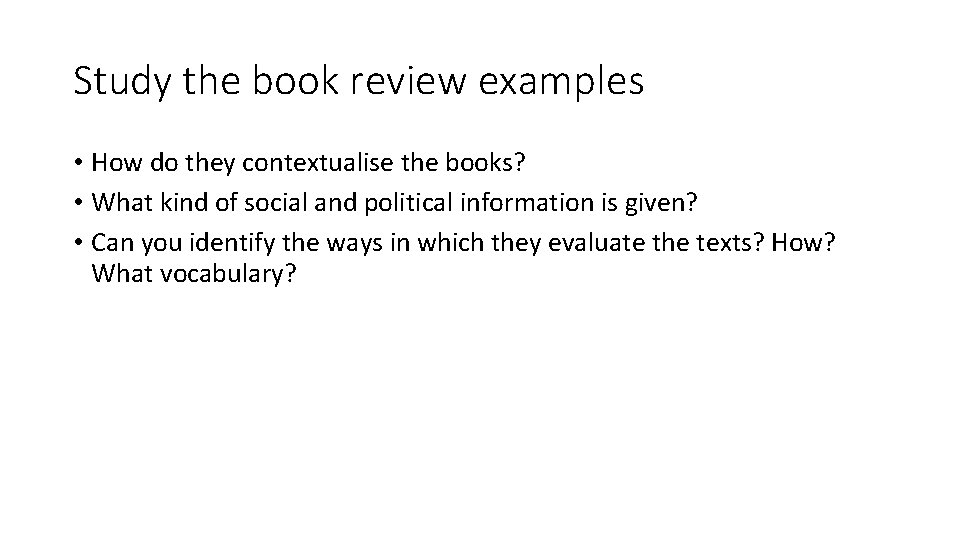
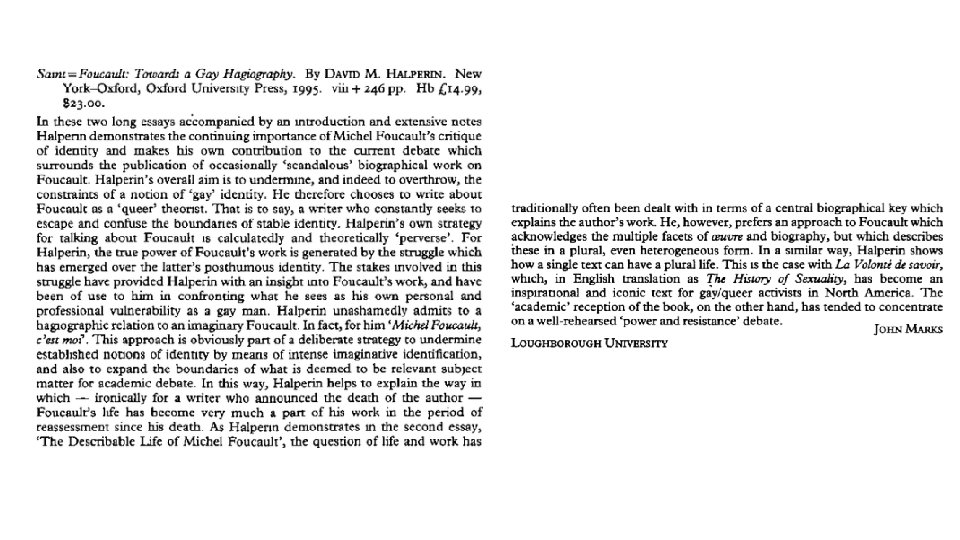
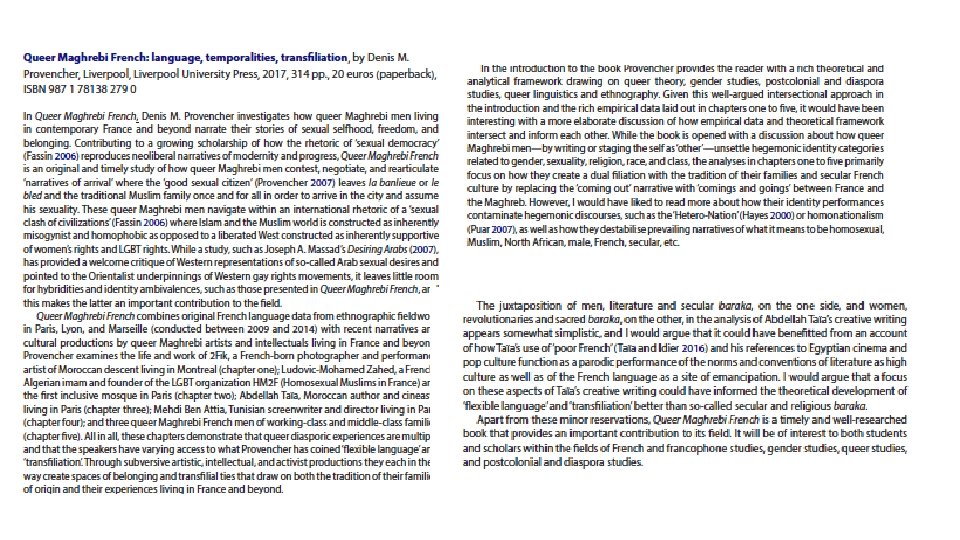
Study the book review examples • How do they contextualise the books? • What kind of social and political information is given? • Can you identify the ways in which they evaluate the texts? How? What vocabulary?
- Slides: 11