
How to Develop a Program Logic Model Learning
- Slides: 36
How to Develop a Program Logic Model
Learning objectives By the end of this presentation, you will be able to: • Describe what a logic model is, and how it can be useful to your daily program operations • Identify the key components of a logic model • Develop a logic model for your program • Use a logic model for evaluation planning
Overview of presentation • A program’s theory of change and logic model • Uses of logic models • Components of a logic model • How to read a logic model • How to develop a logic model • How to apply logic models to evaluation
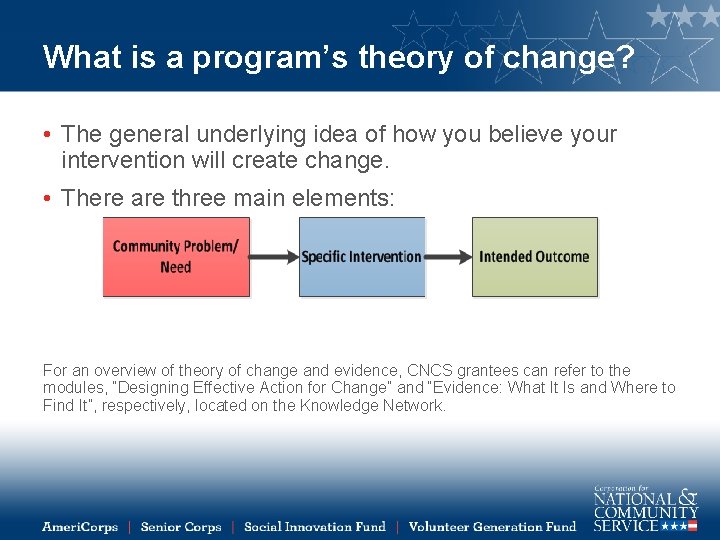
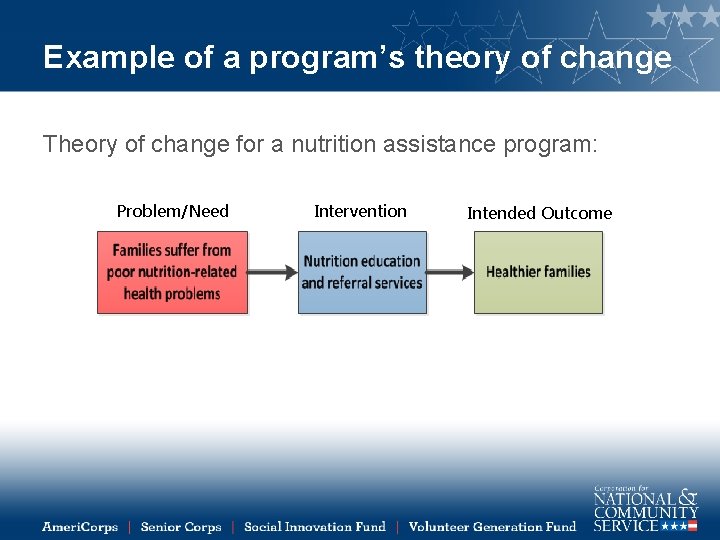
What is a program’s theory of change? • The general underlying idea of how you believe your intervention will create change. • There are three main elements: For an overview of theory of change and evidence, CNCS grantees can refer to the modules, “Designing Effective Action for Change” and “Evidence: What It Is and Where to Find It”, respectively, located on the Knowledge Network.
Example of a program’s theory of change Theory of change for a nutrition assistance program: Problem/Need Intervention Intended Outcome
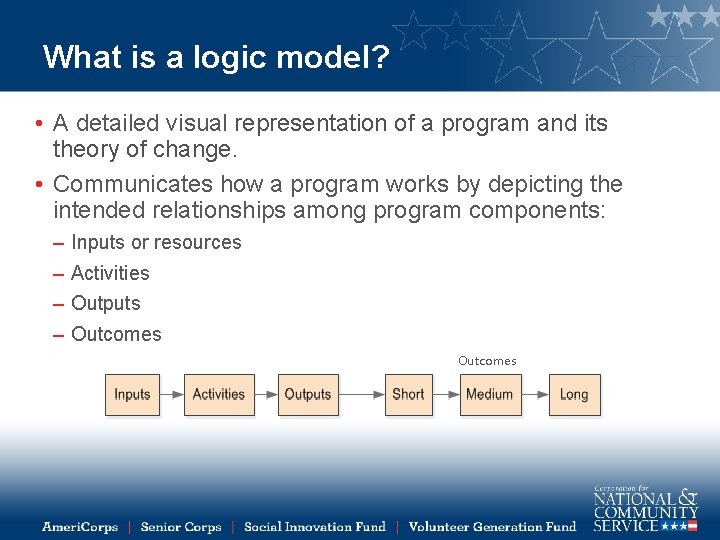
What is a logic model? • A detailed visual representation of a program and its theory of change. • Communicates how a program works by depicting the intended relationships among program components: – – Inputs or resources Activities Outputs Outcomes
Why develop a logic model? • Generate a clear and shared understanding of how a program works • Support program planning and improvement • Serve as foundation for evaluation
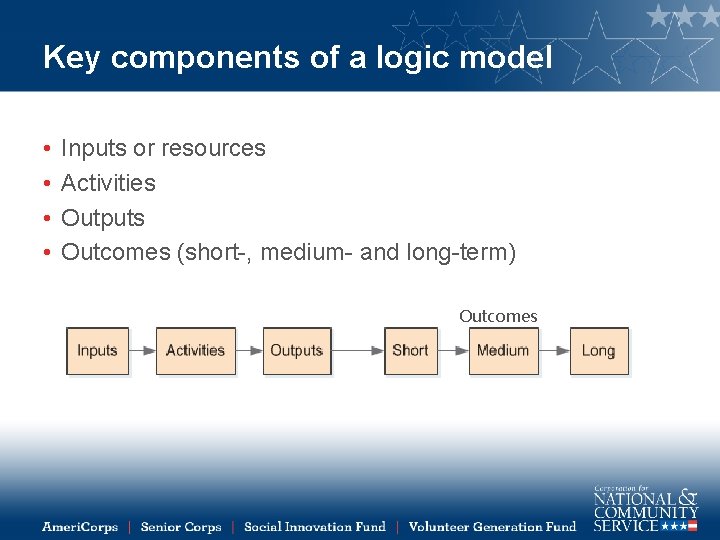
Key components of a logic model • • Inputs or resources Activities Outputs Outcomes (short-, medium- and long-term) Outcomes
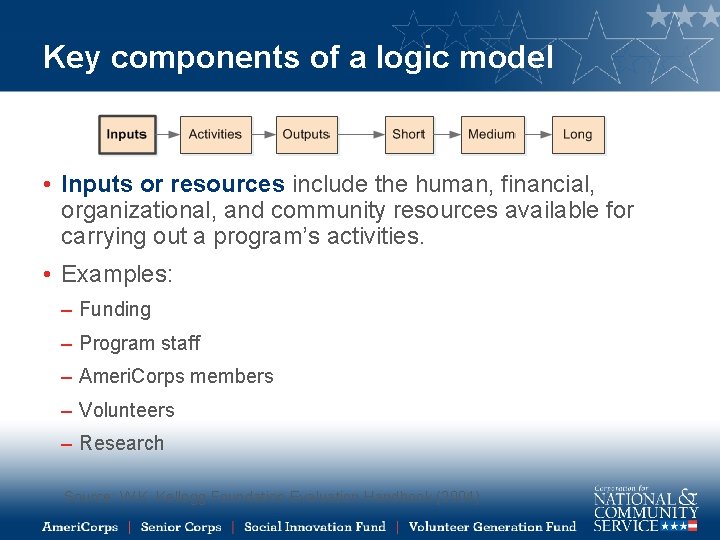
Key components of a logic model • Inputs or resources include the human, financial, organizational, and community resources available for carrying out a program’s activities. • Examples: – Funding – Program staff – Ameri. Corps members – Volunteers – Research Source: W. K. Kellogg Foundation Evaluation Handbook (2004)
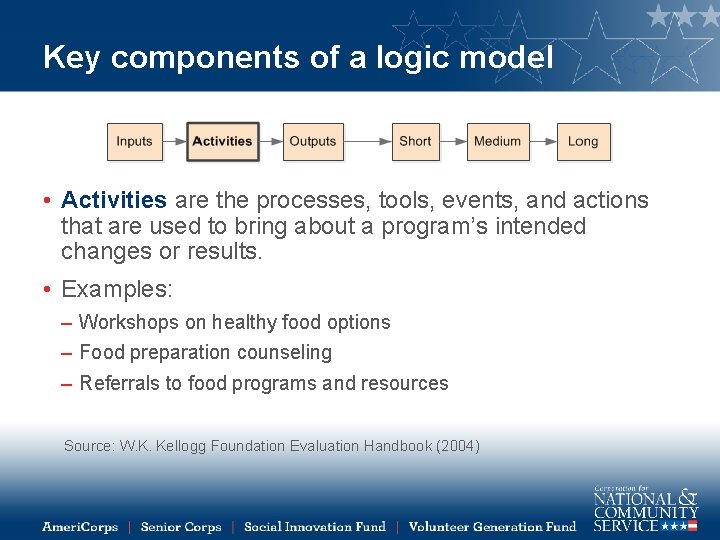
Key components of a logic model • Activities are the processes, tools, events, and actions that are used to bring about a program’s intended changes or results. • Examples: – Workshops on healthy food options – Food preparation counseling – Referrals to food programs and resources Source: W. K. Kellogg Foundation Evaluation Handbook (2004)
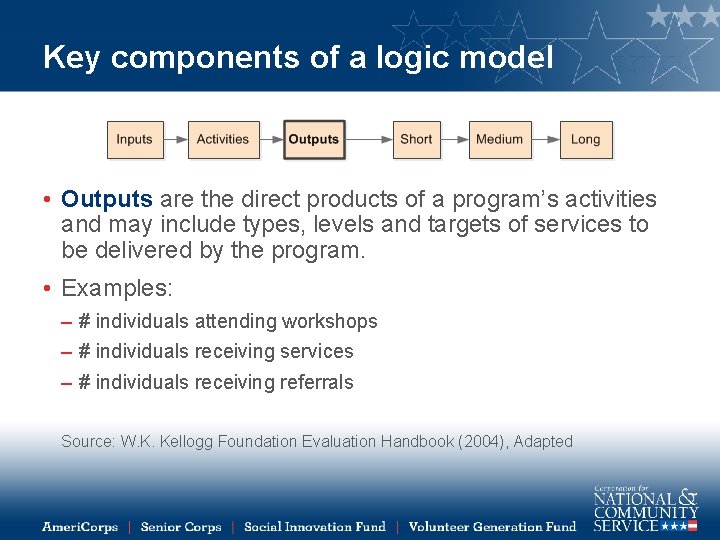
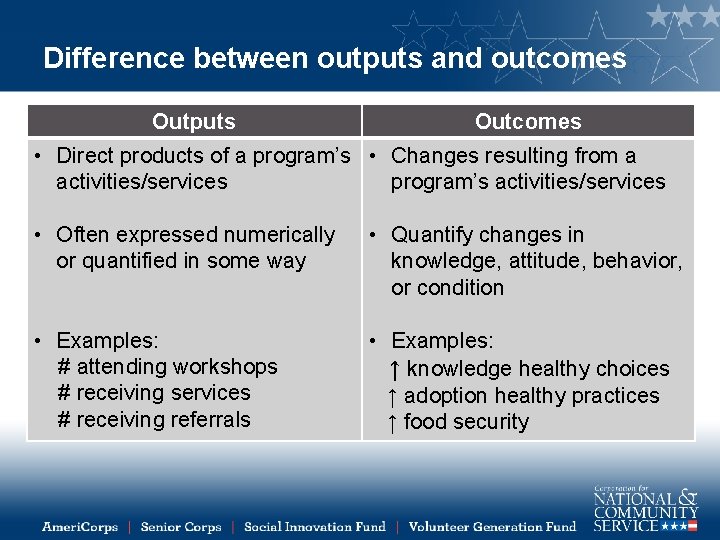
Key components of a logic model • Outputs are the direct products of a program’s activities and may include types, levels and targets of services to be delivered by the program. • Examples: – # individuals attending workshops – # individuals receiving services – # individuals receiving referrals Source: W. K. Kellogg Foundation Evaluation Handbook (2004), Adapted
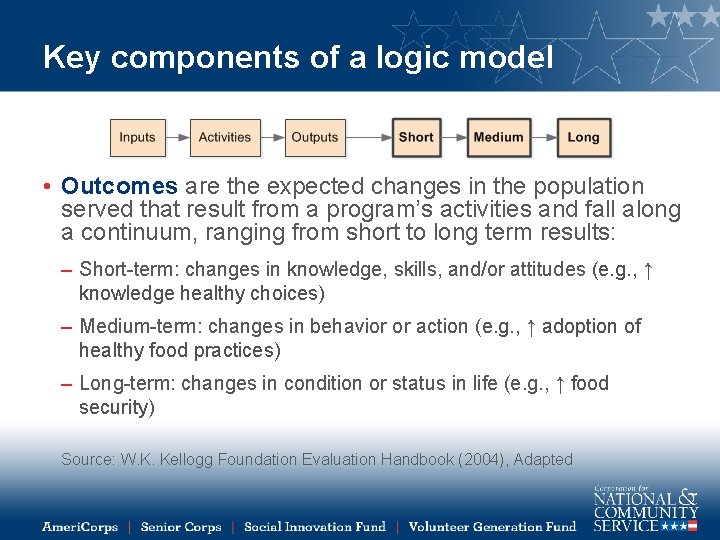
Key components of a logic model • Outcomes are the expected changes in the population served that result from a program’s activities and fall along a continuum, ranging from short to long term results: – Short-term: changes in knowledge, skills, and/or attitudes (e. g. , ↑ knowledge healthy choices) – Medium-term: changes in behavior or action (e. g. , ↑ adoption of healthy food practices) – Long-term: changes in condition or status in life (e. g. , ↑ food security) Source: W. K. Kellogg Foundation Evaluation Handbook (2004), Adapted
Difference between outputs and outcomes Outputs Outcomes • Direct products of a program’s • Changes resulting from a activities/services program’s activities/services • Often expressed numerically or quantified in some way • Quantify changes in knowledge, attitude, behavior, or condition • Examples: # attending workshops # receiving services # receiving referrals • Examples: ↑ knowledge healthy choices ↑ adoption healthy practices ↑ food security
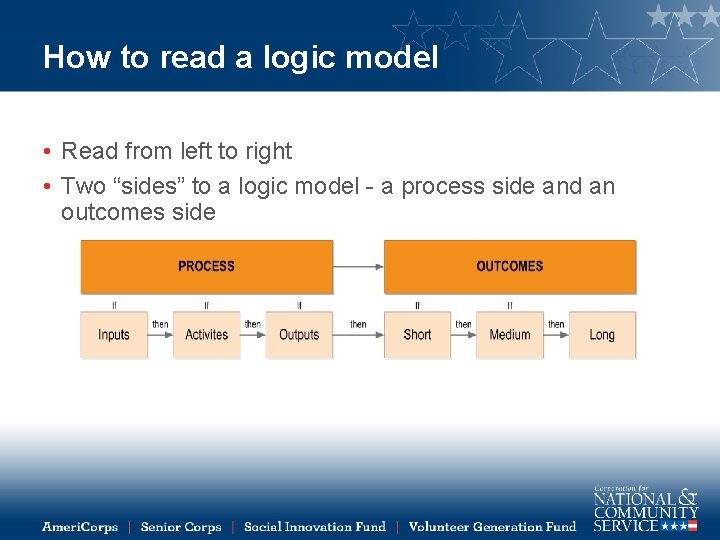
How to read a logic model • Read from left to right • Two “sides” to a logic model - a process side and an outcomes side
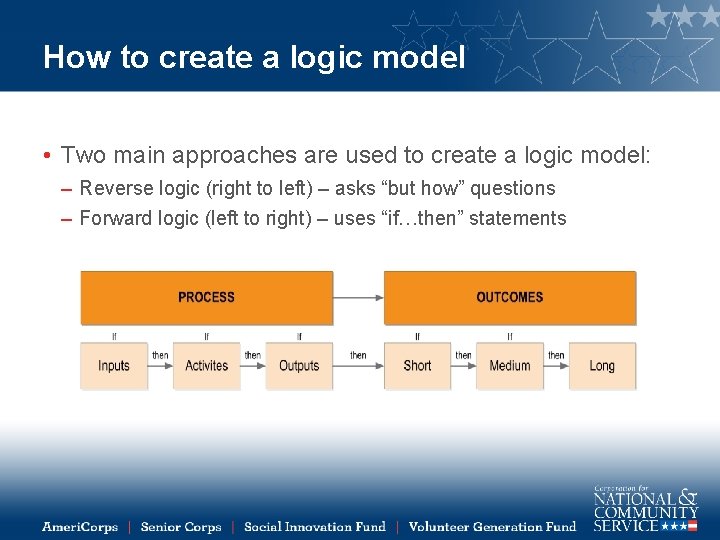
How to create a logic model • Two main approaches are used to create a logic model: – Reverse logic (right to left) – asks “but how” questions – Forward logic (left to right) – uses “if…then” statements
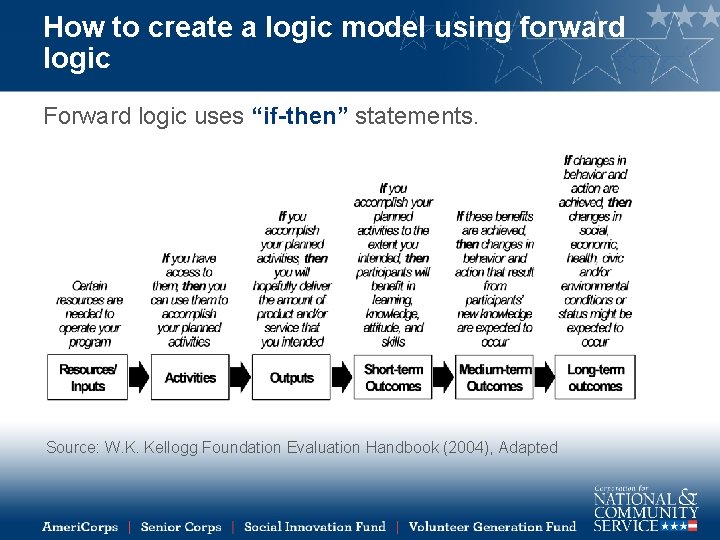
How to create a logic model using forward logic Forward logic uses “if-then” statements. Source: W. K. Kellogg Foundation Evaluation Handbook (2004), Adapted
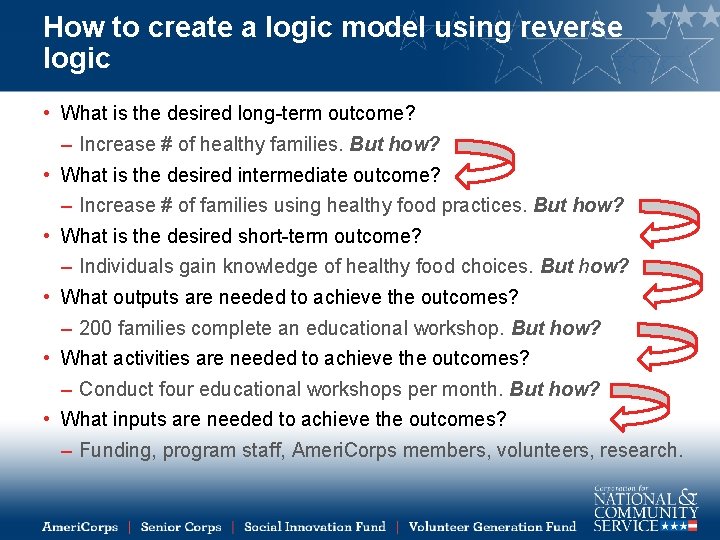
How to create a logic model using reverse logic • What is the desired long-term outcome? – Increase # of healthy families. But how? • What is the desired intermediate outcome? – Increase # of families using healthy food practices. But how? • What is the desired short-term outcome? – Individuals gain knowledge of healthy food choices. But how? • What outputs are needed to achieve the outcomes? – 200 families complete an educational workshop. But how? • What activities are needed to achieve the outcomes? – Conduct four educational workshops per month. But how? • What inputs are needed to achieve the outcomes? – Funding, program staff, Ameri. Corps members, volunteers, research.
Group exercise: Develop a logic model for a wildlife conservation program Exercise #1 A wildlife conservation program is designed to create healthy, productive, and sustainable ecosystems for the benefit of wildlife in areas of need. What might this program’s logic model look like?
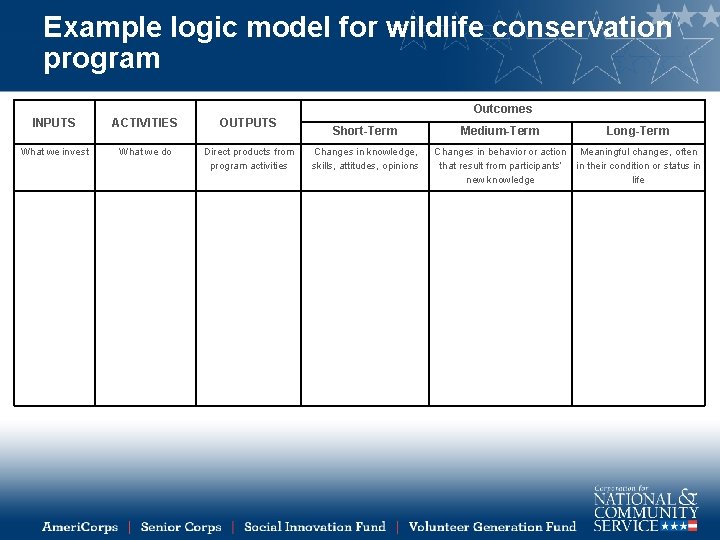
Example logic model for wildlife conservation program Outcomes INPUTS ACTIVITIES OUTPUTS What we invest What we do Direct products from program activities Short-Term Changes in knowledge, skills, attitudes, opinions Medium-Term Long-Term Changes in behavior or action Meaningful changes, often that result from participants’ in their condition or status in new knowledge life
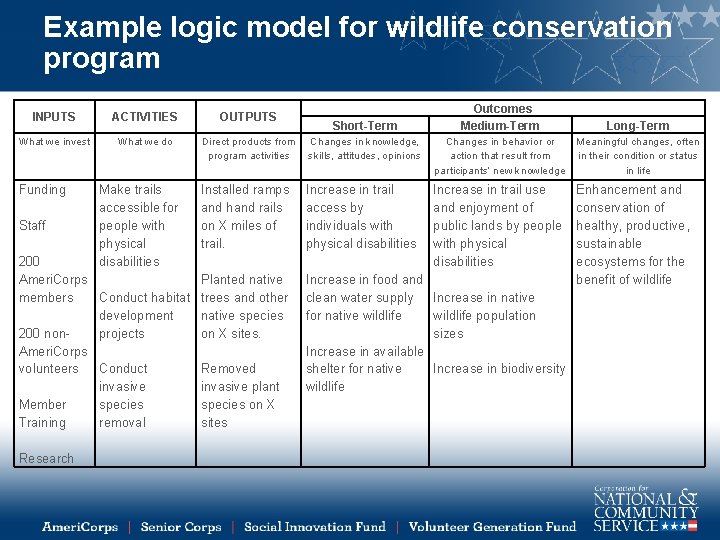
Example logic model for wildlife conservation program INPUTS ACTIVITIES What we invest What we do Funding Staff 200 Ameri. Corps members Make trails accessible for people with physical disabilities Conduct habitat development 200 nonprojects Ameri. Corps volunteers Conduct invasive Member species Training removal Research Outcomes Medium-Term Long-Term Direct products from Changes in knowledge, program activities skills, attitudes, opinions Changes in behavior or action that result from participants’ new knowledge Meaningful changes, often in their condition or status in life Installed ramps and hand rails on X miles of trail. Increase in trail access by individuals with physical disabilities Increase in trail use and enjoyment of public lands by people with physical disabilities Planted native trees and other native species on X sites. Increase in food and clean water supply for native wildlife Increase in available shelter for native wildlife Enhancement and conservation of healthy, productive, sustainable ecosystems for the benefit of wildlife OUTPUTS Removed invasive plant species on X sites Short-Term Increase in native wildlife population sizes Increase in biodiversity
Developing a logic model Exercise #2 • In each column of the logic model template, identify the following key components for your program: – Inputs – Activities – Outputs – Outcomes (short-, medium- and long-term)
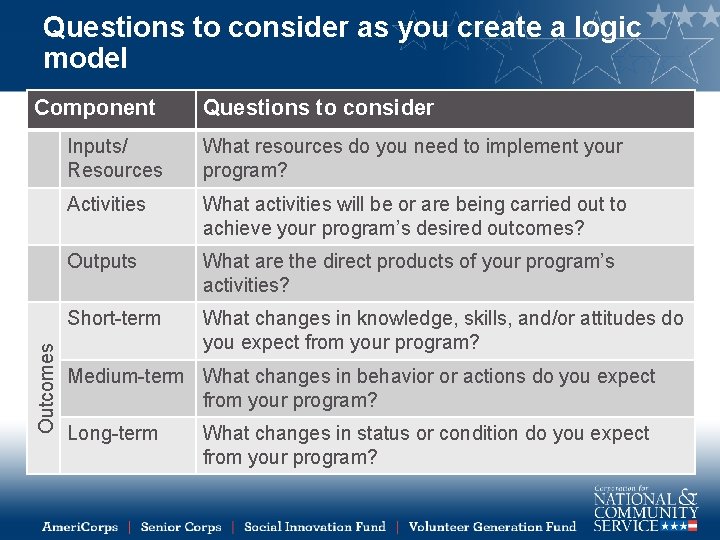
Questions to consider as you create a logic model Outcomes Component Questions to consider Inputs/ Resources What resources do you need to implement your program? Activities What activities will be or are being carried out to achieve your program’s desired outcomes? Outputs What are the direct products of your program’s activities? Short-term What changes in knowledge, skills, and/or attitudes do you expect from your program? Medium-term What changes in behavior or actions do you expect from your program? Long-term What changes in status or condition do you expect from your program?
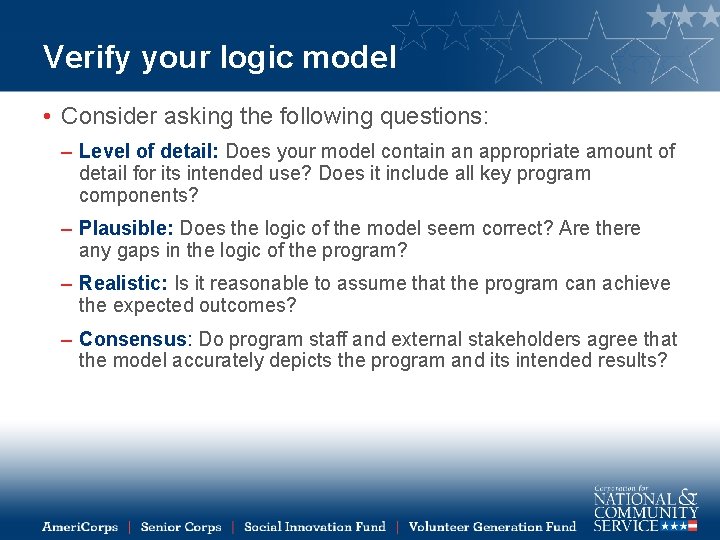
Verify your logic model • Consider asking the following questions: – Level of detail: Does your model contain an appropriate amount of detail for its intended use? Does it include all key program components? – Plausible: Does the logic of the model seem correct? Are there any gaps in the logic of the program? – Realistic: Is it reasonable to assume that the program can achieve the expected outcomes? – Consensus: Do program staff and external stakeholders agree that the model accurately depicts the program and its intended results?
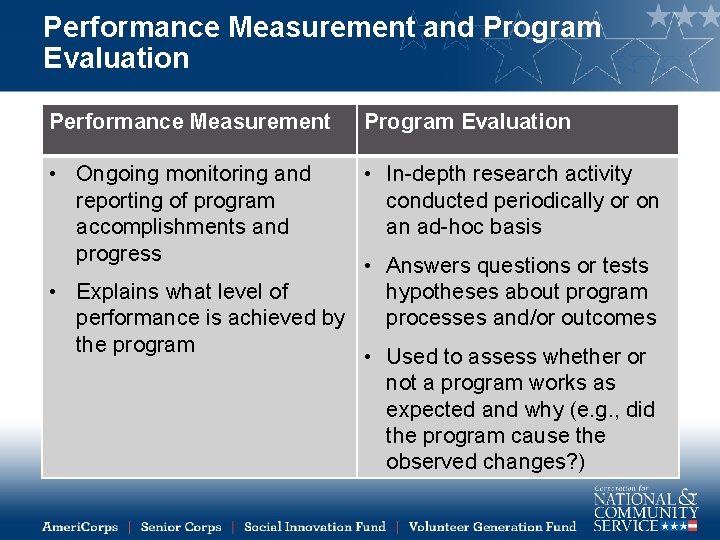
Performance Measurement and Program Evaluation Performance Measurement Program Evaluation • Ongoing monitoring and reporting of program accomplishments and progress • In-depth research activity conducted periodically or on an ad-hoc basis • Answers questions or tests • Explains what level of hypotheses about program performance is achieved by processes and/or outcomes the program • Used to assess whether or not a program works as expected and why (e. g. , did the program cause the observed changes? )
Logic models as a performance measurement tool • A logic model can serve as a framework for planning performance measurement activities. It can help to: – Identify components of your program to include in performance measurement – Identify indicators and the measures of progress/performance that align with program components
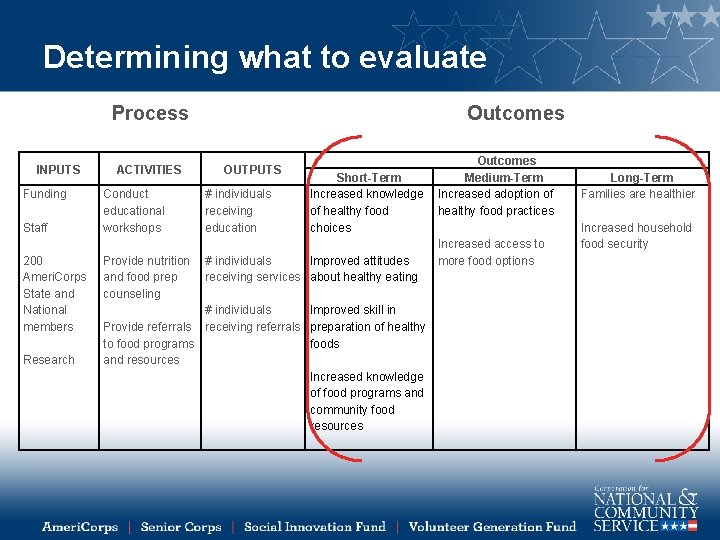
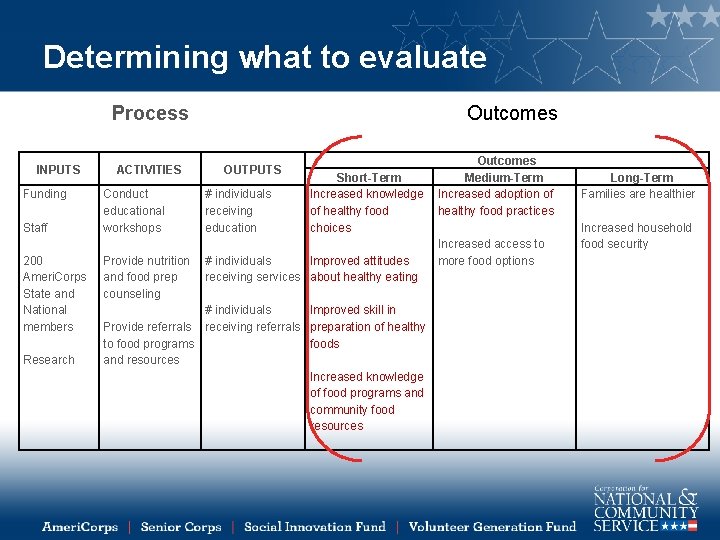
Logic models as an evaluation tool • A logic model can serve as a framework for your evaluation plan. It can help you focus your evaluation by identifying: – Questions want/need answered – Aspects of program to evaluate – Type of evaluation design – Information to collect – Measures and data collection methods – Evaluation timeframe
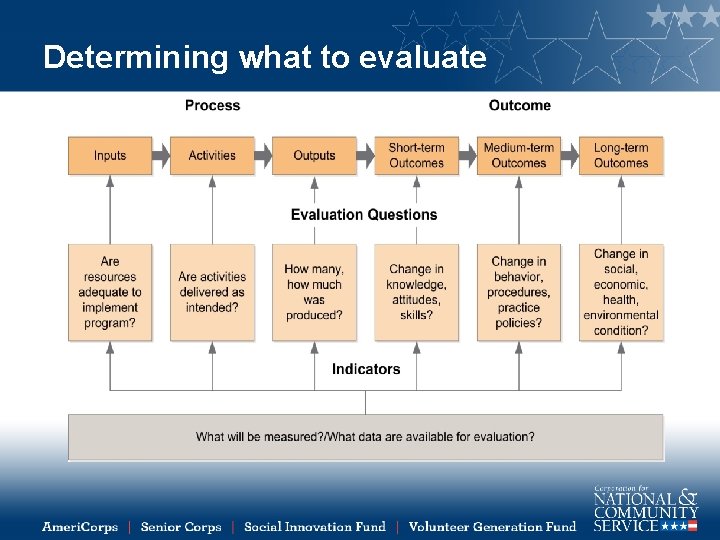
Determining what to evaluate
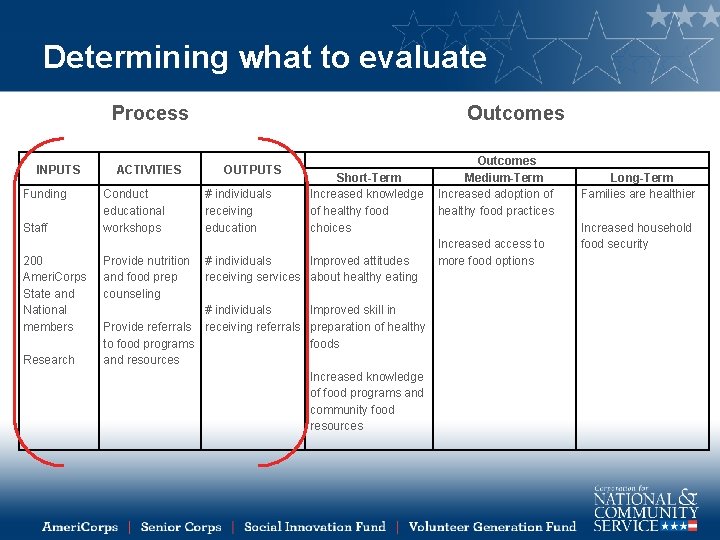
Determining what to evaluate Process INPUTS Funding Staff 200 Ameri. Corps State and National members Research Outcomes Short-Term Medium-Term Conduct # individuals Increased knowledge Increased adoption of educational receiving of healthy food practices workshops education choices Increased access to Provide nutrition # individuals Improved attitudes more food options and food prep receiving services about healthy eating counseling # individuals Improved skill in Provide referrals receiving referrals preparation of healthy to food programs foods and resources Increased knowledge of food programs and community food resources ACTIVITIES OUTPUTS Long-Term Families are healthier Increased household food security
Determining what to evaluate Process Outcomes INPUTS Funding Staff 200 Ameri. Corps State and National members Research Outcomes Short-Term Medium-Term Conduct # individuals Increased knowledge Increased adoption of educational receiving of healthy food practices workshops education choices Increased access to Provide nutrition # individuals Improved attitudes more food options and food prep receiving services about healthy eating counseling # individuals Improved skill in Provide referrals receiving referrals preparation of healthy to food programs foods and resources Increased knowledge of food programs and community food resources ACTIVITIES OUTPUTS Long-Term Families are healthier Increased household food security
Determining what to evaluate Process Outcomes INPUTS Funding Staff 200 Ameri. Corps State and National members Research Outcomes Short-Term Medium-Term Conduct # individuals Increased knowledge Increased adoption of educational receiving of healthy food practices workshops education choices Increased access to Provide nutrition # individuals Improved attitudes more food options and food prep receiving services about healthy eating counseling # individuals Improved skill in Provide referrals receiving referrals preparation of healthy to food programs foods and resources Increased knowledge of food programs and community food resources ACTIVITIES OUTPUTS Long-Term Families are healthier Increased household food security
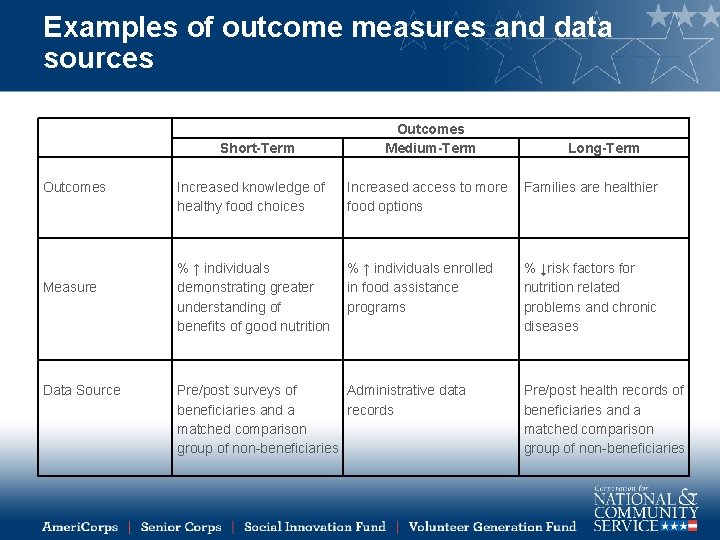
Examples of outcome measures and data sources Short-Term Outcomes Measure Data Source Increased knowledge of healthy food choices Outcomes Medium-Term Long-Term Increased access to more Families are healthier food options % ↑ individuals enrolled demonstrating greater in food assistance understanding of programs benefits of good nutrition % ↓risk factors for nutrition related problems and chronic diseases Pre/post surveys of Administrative data beneficiaries and a records matched comparison group of non-beneficiaries Pre/post health records of beneficiaries and a matched comparison group of non-beneficiaries
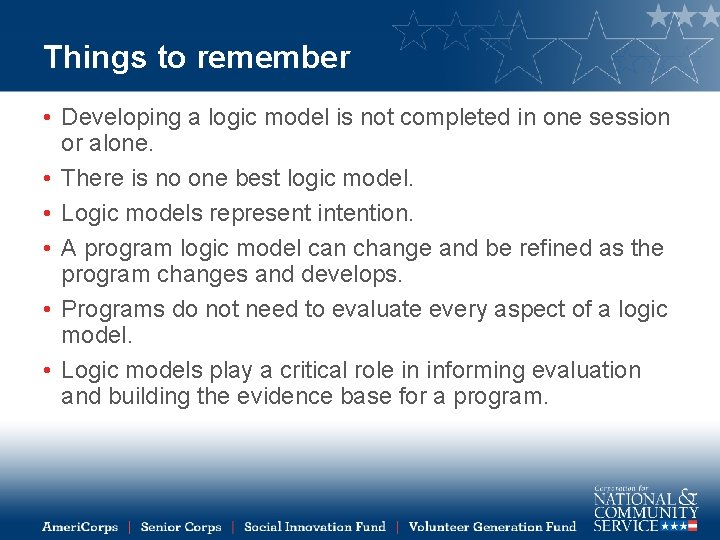
Things to remember • Developing a logic model is not completed in one session or alone. • There is no one best logic model. • Logic models represent intention. • A program logic model can change and be refined as the program changes and develops. • Programs do not need to evaluate every aspect of a logic model. • Logic models play a critical role in informing evaluation and building the evidence base for a program.
Resources for logic model development W. K. Kellogg Foundation Logic Model Development Guide http: //www. wkkf. org/resourcedirectory/resource/2006/02/wk-kellogg-foundationlogic-model-development-guide Innovation Network Logic Model Workbook http: //www. innonet. org/client_docs/File/logic_mode l_workbook. pdf
Resources for logic model development University of Wisconsin Extension: Program Development and Evaluation http: //www. uwex. edu/ces/pdande/evaluation/evallo gicmodel. html CDC Program Evaluation Resources: http: //www. cdc. gov/eva. L/resources/index. htm Measuring Program Outcomes: A Practical Approach (United Way) Developing and Working with Program Logic Models (Bureau of Justice Assistance)
Questions?
CNCS Resources Evaluation Resources: https: //www. nationalserviceresources. gov/evaluationamericorps Performance Measurement Core Curriculum: https: //www. nationalserviceresources. gov/npm/trainingresources