
How to Design an Experiment Part II MODULE

- Slides: 10
How to Design an Experiment: Part II MODULE 2 EXPERIMENTAL PSYCHOLOGY GUIDED-INQUIRY LEARNING Module 2: How to Design an Experiment: Part II © 2012 -2020, Dr. A. Geliebter & Dr. B. Rumain, Touro College & University System
Learning Objectives • You will consider an experiment where there are three levels of one independent variable (IV). • Using an independent variable (IV) of dosage, you will determine the smallest dose that is effective. • You will consider an experiment where there are two dependent variables.
Vocabulary • Multivariate
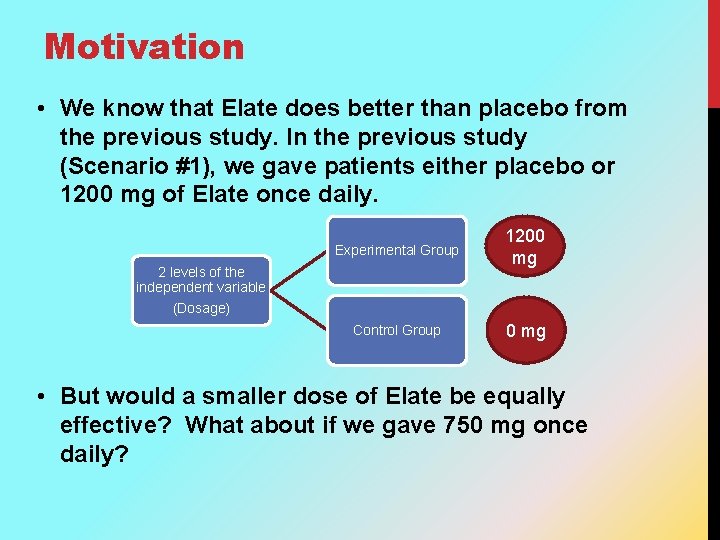
Motivation • We know that Elate does better than placebo from the previous study. In the previous study (Scenario #1), we gave patients either placebo or 1200 mg of Elate once daily. Experimental Group 1200 mg Control Group 0 mg 2 levels of the independent variable (Dosage) • But would a smaller dose of Elate be equally effective? What about if we gave 750 mg once daily?
Motivation • If that dose worked equally well it would be the optimal dose since it involves getting the same benefit without ingesting more medication. (More medication can mean more side effects. ) • Below is a study with 60 patients to test the optimal dosage.
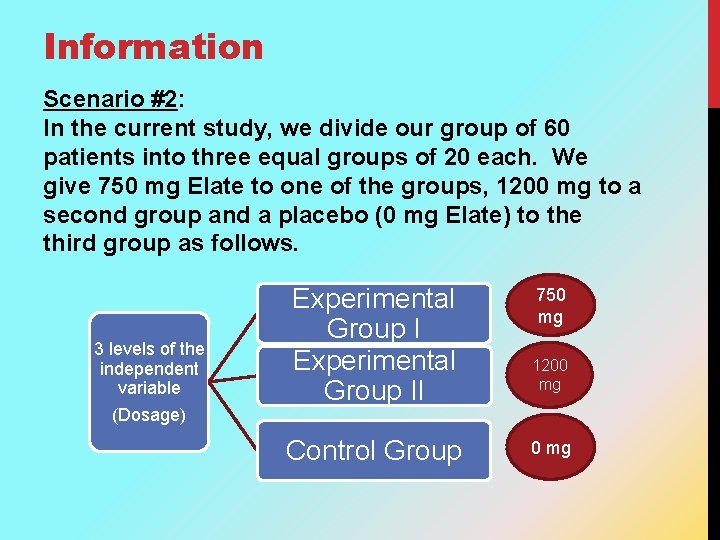
Information Scenario #2: In the current study, we divide our group of 60 patients into three equal groups of 20 each. We give 750 mg Elate to one of the groups, 1200 mg to a second group and a placebo (0 mg Elate) to the third group as follows. 3 levels of the independent variable (Dosage) Experimental Group II Control Group 750 mg 1200 mg
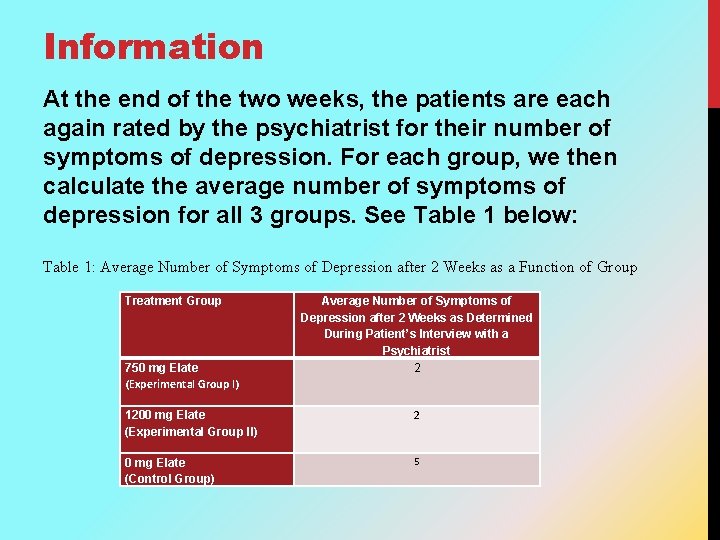
Information At the end of the two weeks, the patients are each again rated by the psychiatrist for their number of symptoms of depression. For each group, we then calculate the average number of symptoms of depression for all 3 groups. See Table 1 below: Table 1: Average Number of Symptoms of Depression after 2 Weeks as a Function of Group Treatment Group 750 mg Elate (Experimental Group I) Average Number of Symptoms of Depression after 2 Weeks as Determined During Patient’s Interview with a Psychiatrist 2 1200 mg Elate (Experimental Group II) 2 0 mg Elate (Control Group) 5
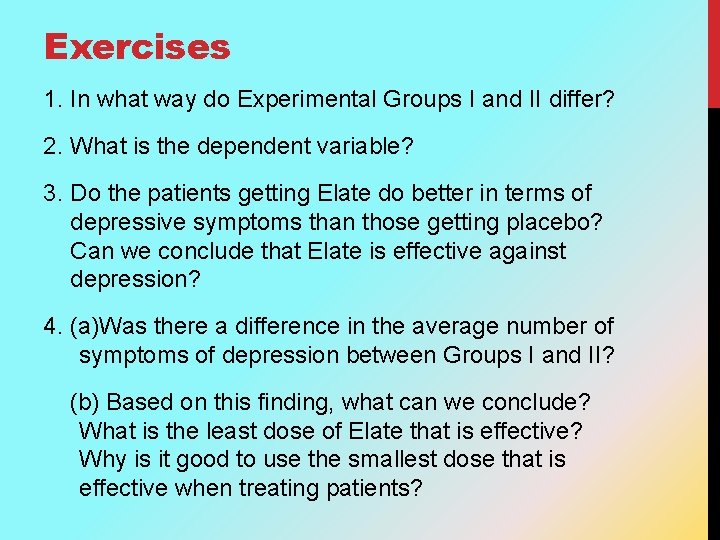
Exercises 1. In what way do Experimental Groups I and II differ? 2. What is the dependent variable? 3. Do the patients getting Elate do better in terms of depressive symptoms than those getting placebo? Can we conclude that Elate is effective against depression? 4. (a)Was there a difference in the average number of symptoms of depression between Groups I and II? (b) Based on this finding, what can we conclude? What is the least dose of Elate that is effective? Why is it good to use the smallest dose that is effective when treating patients?
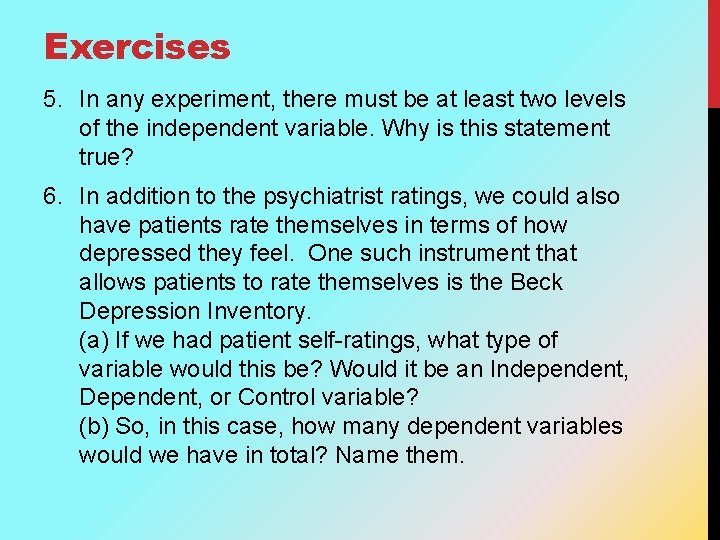
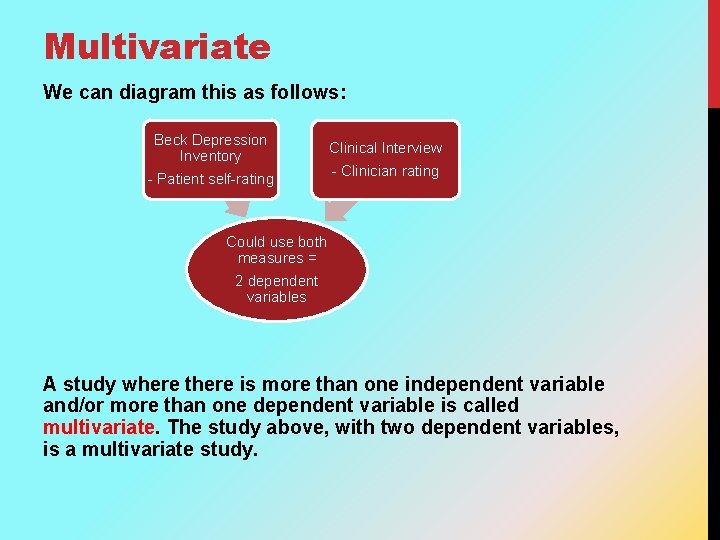
Exercises 5. In any experiment, there must be at least two levels of the independent variable. Why is this statement true? 6. In addition to the psychiatrist ratings, we could also have patients rate themselves in terms of how depressed they feel. One such instrument that allows patients to rate themselves is the Beck Depression Inventory. (a) If we had patient self-ratings, what type of variable would this be? Would it be an Independent, Dependent, or Control variable? (b) So, in this case, how many dependent variables would we have in total? Name them.
Multivariate We can diagram this as follows: Beck Depression Inventory - Patient self-rating Clinical Interview - Clinician rating Could use both measures = 2 dependent variables A study where there is more than one independent variable and/or more than one dependent variable is called multivariate. The study above, with two dependent variables, is a multivariate study.