
HOW TO DESIGN A TECHNOLOGYENRICHED LEARNING ENVIRONMENT TO
- Slides: 28
HOW TO DESIGN A TECHNOLOGY-ENRICHED LEARNING ENVIRONMENT TO FOSTER COLLABORATIVE LEARNING? PLATE TECTONICS: A BLURRED LEARNING APPROACH AUTHORS: SCHOOL 21. 0 KORTRIJK - BELGIUM MARIEKE PIETERS, WIM BARBAIX, MATHIAS VERMEULEN, MATHILDE VANGEEL, MIEKE VANDEWAETERE SEPTEMBER 16 TH, 2015
USERS 5 th & 6 th graders in total: 6 classgroups (about 130 pupils) that receive the same learning materials during the same period.
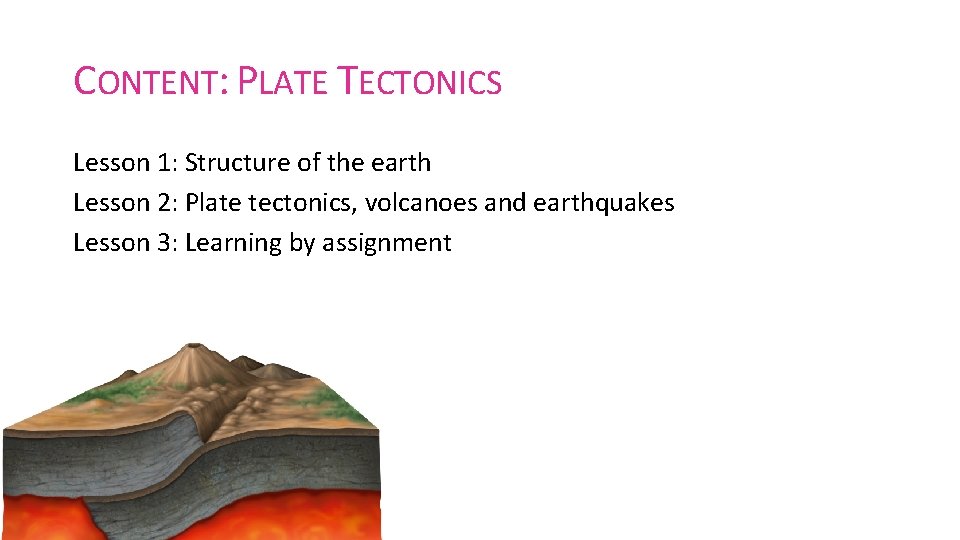
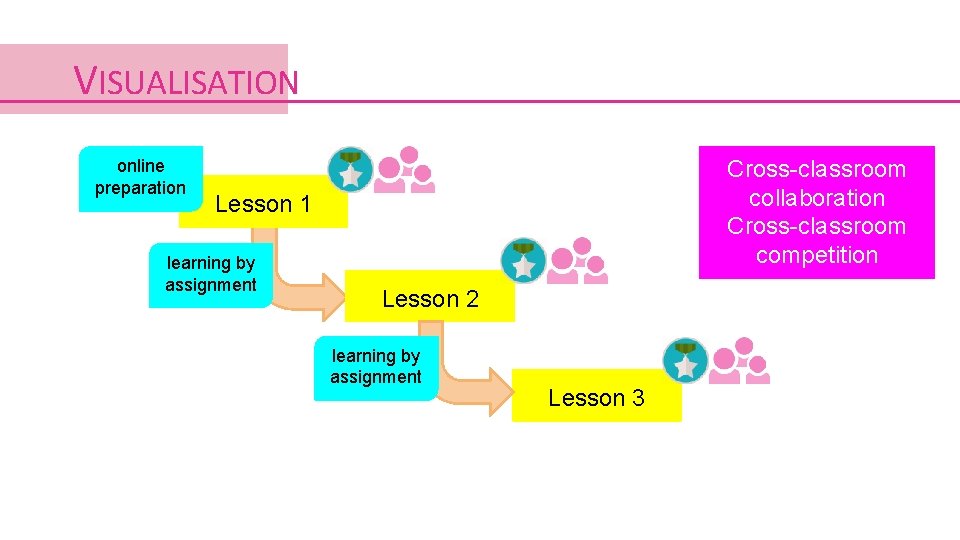
CONTENT: PLATE TECTONICS Lesson 1: Structure of the earth Lesson 2: Plate tectonics, volcanoes and earthquakes Lesson 3: Learning by assignment
INSTRUCTIONAL DESIGN KEY COMPONENTS (1/3) ▪ Blended/blurred learning: ▪ “what can be learned outside the classroom should be learned there. ” ▪ classroom sessions aim for deeper understanding, making adjustments, identify and clear misunderstanding & misconceptions, explore difficulties, interact with peers as to enrich the framework from which one is reasoning, thinking and acting. ▪ Varied task practice as key to strong anchoring of newly learned knowledge and skills ▪ Personalized learning (including instruction, tasks and feedback) for higher engagement and motivation
INSTRUCTIONAL DESIGN KEY COMPONENTS (2/3) ▪ Gaming elements for inter- and intrapersonal competition, social rewarding. Not necessarily for fun. ▪ Team-based learning: collaboration (F 2 F and distance, synchronous and asynchronous): without predefined group or member roles. ▪ Learner control: learner-paced within instructor-defined time slots (deadlines) ▪ Decreasing support as a learner’s knowledge increases (4 components instructional design (4 C/ID) model; van Merriënboer et al. , 2002) ▪ Starting from Smartschool® - the school’s CMS.
INSTRUCTIONAL DESIGN KEY COMPONENTS (3/3) ▪ Activation of already available knowledge ▪ Just-in-time information when the learner needs it (adaptive and system-controlled) / asks for it (adaptive but learner-controlled) as to avoid (cognitive) overload ▪ Part-task practice if required (on demand? ) ▪ Stimulating self-regulated learning ▪ Gamification & augmented reality ▪ Learning communities
VISUALISATION online preparation Cross-classroom collaboration Cross-classroom competition Lesson 1 learning by assignment Lesson 2 learning by assignment Lesson 3
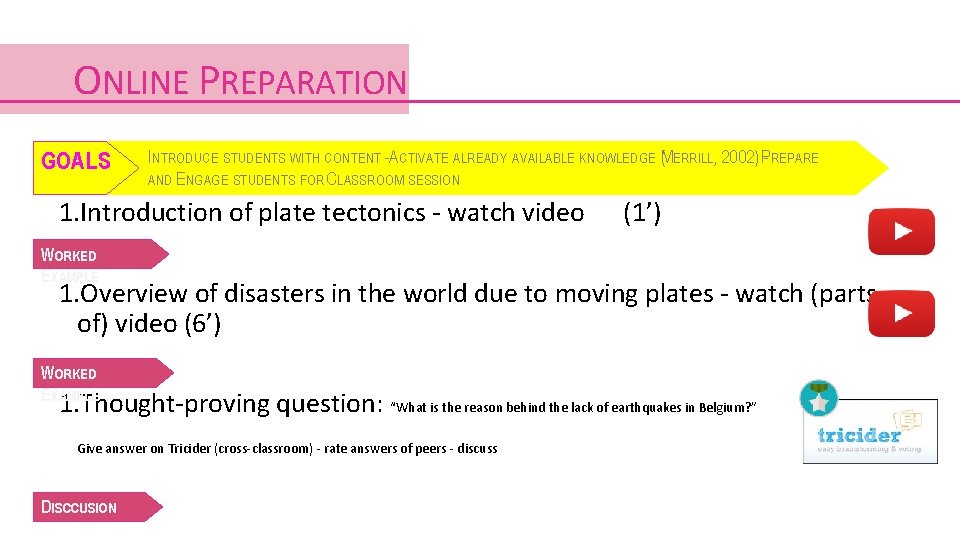
ONLINE PREPARATION GOALS INTRODUCE STUDENTS WITH CONTENT -ACTIVATE ALREADY AVAILABLE KNOWLEDGE (MERRILL, 2002) P- REPARE AND ENGAGE STUDENTS FOR CLASSROOM SESSION 1. Introduction of plate tectonics - watch video (1’) WORKED EXAMPLE 1. Overview of disasters in the world due to moving plates - watch (parts of) video (6’) WORKED EXAMPLE 1. Thought-proving question: “What is the reason behind the lack of earthquakes in Belgium? ” Give answer on Tricider (cross-classroom) - rate answers of peers - discuss DISCCUSION
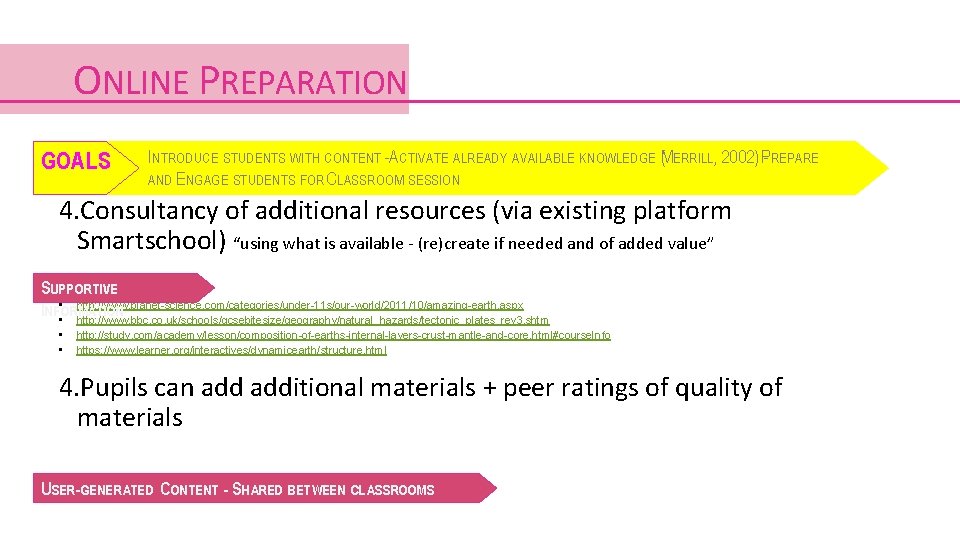
ONLINE PREPARATION GOALS INTRODUCE STUDENTS WITH CONTENT -ACTIVATE ALREADY AVAILABLE KNOWLEDGE (MERRILL, 2002) P- REPARE AND ENGAGE STUDENTS FOR CLASSROOM SESSION 4. Consultancy of additional resources (via existing platform Smartschool) “using what is available - (re)create if needed and of added value” SUPPORTIVE • http: //www. planet-science. com/categories/under-11 s/our-world/2011/10/amazing-earth. aspx INFORMATION • http: //www. bbc. co. uk/schools/gcsebitesize/geography/natural_hazards/tectonic_plates_rev 3. shtm • • http: //study. com/academy/lesson/composition-of-earths-internal-layers-crust-mantle-and-core. html#course. Info https: //www. learner. org/interactives/dynamicearth/structure. html 4. Pupils can additional materials + peer ratings of quality of materials USER-GENERATED CONTENT - SHARED BETWEEN CLASSROOMS
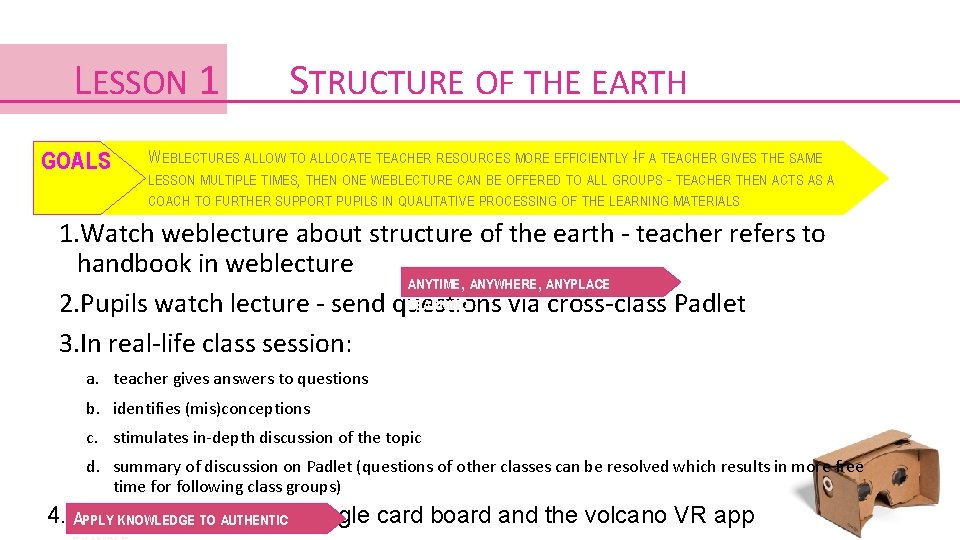
LESSON 1 GOALS STRUCTURE OF THE EARTH WEBLECTURES ALLOW TO ALLOCATE TEACHER RESOURCES MORE EFFICIENTLY -IF A TEACHER GIVES THE SAME LESSON MULTIPLE TIMES, THEN ONE WEBLECTURE CAN BE OFFERED TO ALL GROUPS - TEACHER THEN ACTS AS A COACH TO FURTHER SUPPORT PUPILS IN QUALITATIVE PROCESSING OF THE LEARNING MATERIALS 1. Watch weblecture about structure of the earth - teacher refers to handbook in weblecture ANYTIME, ANYWHERE, ANYPLACE LEARNING 2. Pupils watch lecture - send questions via cross-class Padlet 3. In real-life class session: a. teacher gives answers to questions b. identifies (mis)conceptions c. stimulates in-depth discussion of the topic d. summary of discussion on Padlet (questions of other classes can be resolved which results in more free time for following class groups) 4. Awalk in a volcano by google card board and the volcano VR app PPLY KNOWLEDGE TO AUTHENTIC
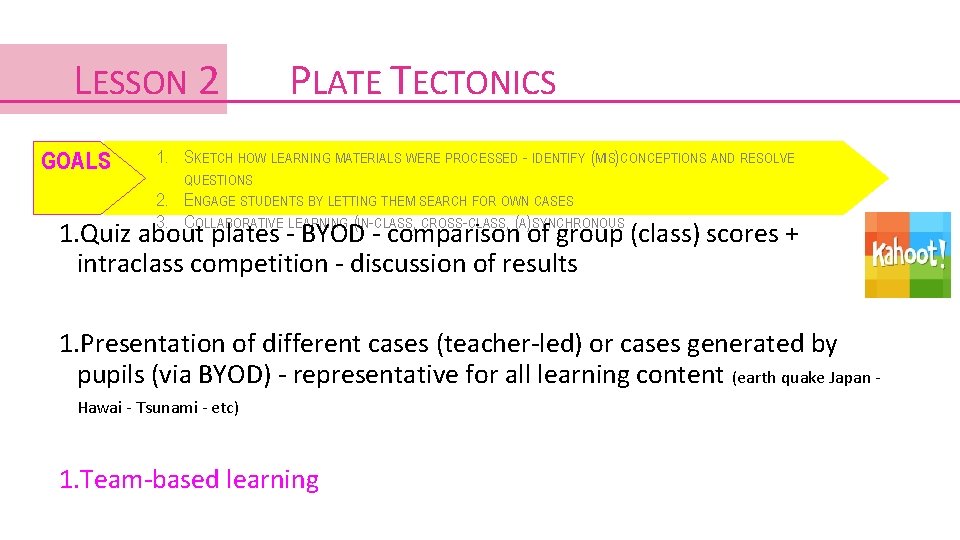
LESSON 2 GOALS PLATE TECTONICS 1. SKETCH HOW LEARNING MATERIALS WERE PROCESSED - IDENTIFY (MIS)CONCEPTIONS AND RESOLVE QUESTIONS 2. ENGAGE STUDENTS BY LETTING THEM SEARCH FOR OWN CASES 3. COLLABORATIVE LEARNING (IN-CLASS, CROSS-CLASS, (A)SYNCHRONOUS 1. Quiz about plates - BYOD - comparison of group (class) scores + intraclass competition - discussion of results 1. Presentation of different cases (teacher-led) or cases generated by pupils (via BYOD) - representative for all learning content (earth quake Japan Hawai - Tsunami - etc) 1. Team-based learning
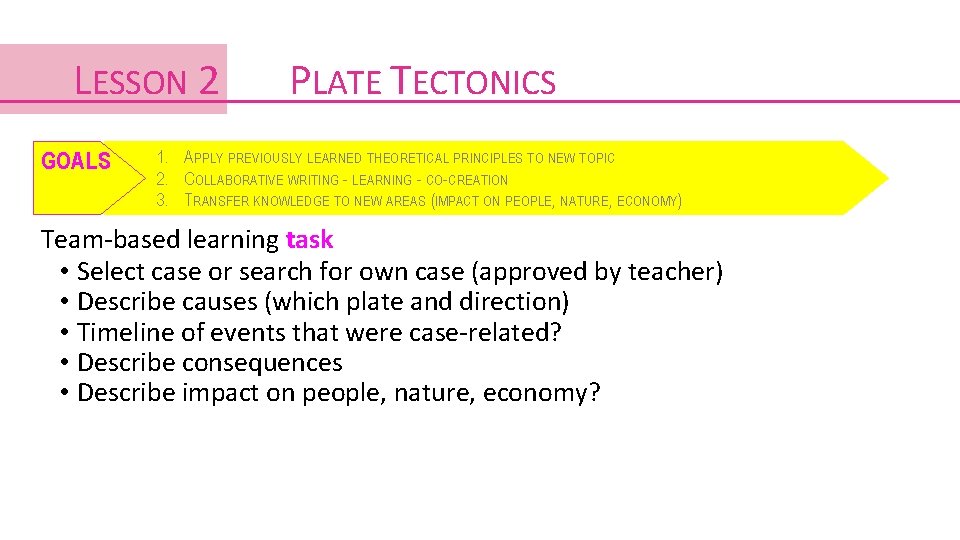
LESSON 2 GOALS PLATE TECTONICS 1. APPLY PREVIOUSLY LEARNED THEORETICAL PRINCIPLES TO NEW TOPIC 2. COLLABORATIVE WRITING - LEARNING - CO-CREATION 3. TRANSFER KNOWLEDGE TO NEW AREAS (IMPACT ON PEOPLE, NATURE, ECONOMY) Team-based learning task • Select case or search for own case (approved by teacher) • Describe causes (which plate and direction) • Timeline of events that were case-related? • Describe consequences • Describe impact on people, nature, economy?
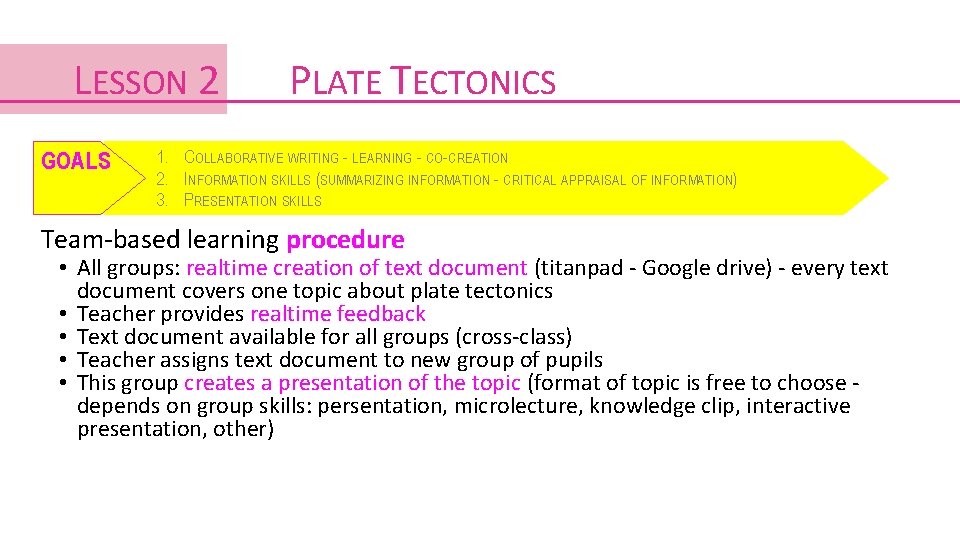
LESSON 2 GOALS PLATE TECTONICS 1. COLLABORATIVE WRITING - LEARNING - CO-CREATION 2. INFORMATION SKILLS (SUMMARIZING INFORMATION - CRITICAL APPRAISAL OF INFORMATION) 3. PRESENTATION SKILLS Team-based learning procedure • All groups: realtime creation of text document (titanpad - Google drive) - every text document covers one topic about plate tectonics • Teacher provides realtime feedback • Text document available for all groups (cross-class) • Teacher assigns text document to new group of pupils • This group creates a presentation of the topic (format of topic is free to choose depends on group skills: persentation, microlecture, knowledge clip, interactive presentation, other)
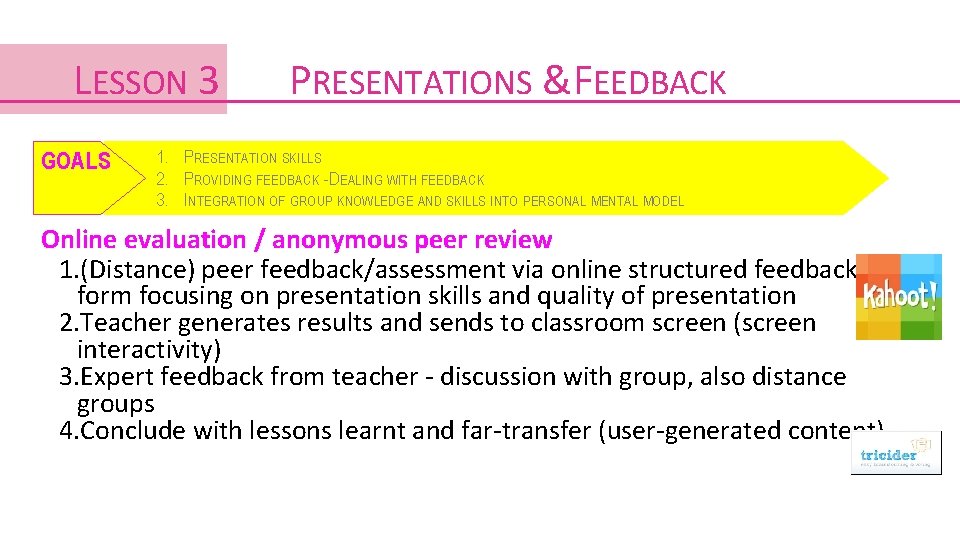
LESSON 3 GOALS PRESENTATIONS &FEEDBACK 1. PRESENTATION SKILLS 2. PROVIDING FEEDBACK - DEALING WITH FEEDBACK 3. INTEGRATION OF GROUP KNOWLEDGE AND SKILLS INTO PERSONAL MENTAL MODEL Online evaluation / anonymous peer review 1. (Distance) peer feedback/assessment via online structured feedback form focusing on presentation skills and quality of presentation 2. Teacher generates results and sends to classroom screen (screen interactivity) 3. Expert feedback from teacher - discussion with group, also distance groups 4. Conclude with lessons learnt and far-transfer (user-generated content)
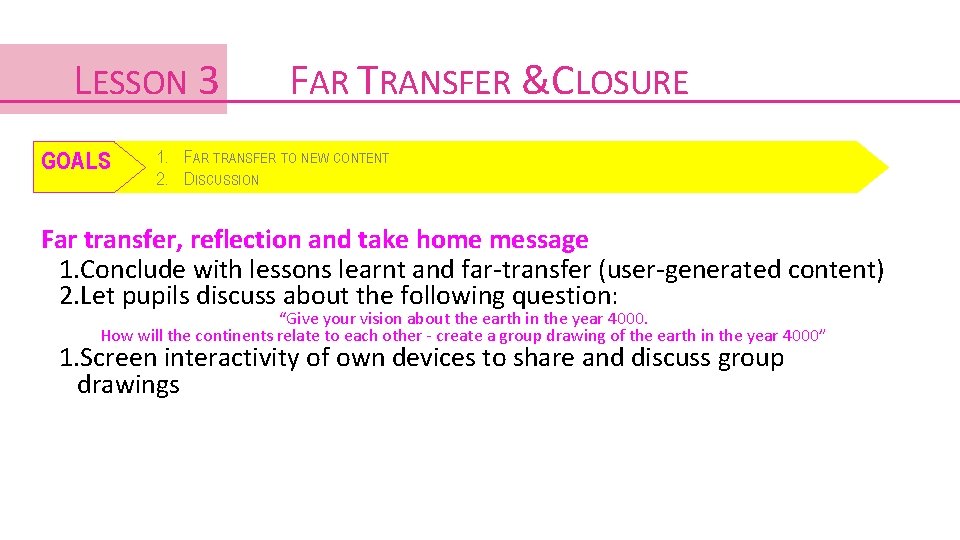
LESSON 3 GOALS FAR TRANSFER &CLOSURE 1. FAR TRANSFER TO NEW CONTENT 2. DISCUSSION Far transfer, reflection and take home message 1. Conclude with lessons learnt and far-transfer (user-generated content) 2. Let pupils discuss about the following question: “Give your vision about the earth in the year 4000. How will the continents relate to each other - create a group drawing of the earth in the year 4000” 1. Screen interactivity of own devices to share and discuss group drawings
NEXT STEPS
EVALUATION METHODS BY TEACHER Measuring effectiveness: • knowledge gains (pre post online quiz about plate tectonics) • near transfer comparison (compare the exam scores with scores of last year) • far transfer comparison: qualitative discussion with other teachers (skills like presenting, creating materials, etc. )
BRIDGING THE GAP
BRIDGING THE GAP Content language integrated learning & teaching • Let pupils read a text document or watch videos in other language support by language teacher • Distance collaboration with pupils/classes in e. g. Haïti as to cocreate learning content about consequences of earth quakes
WHY USING THIS SCENARIO?
ADDED VALUE FOR TEACHER • Based on sound instructional design principles (collaborative learning and self-regulated learning) • Fosters engagement and interest of pupils • Co-creation of learning materials (works inspiring for teachers) • More variations in tasks, lessons (all groups have different results) • Better allocation of teacher’s resources via weblectures (more efficient allocation of time) • Teacher has the space for more in-depth discussion of learning materials • Teacher has the time to provide more personalized instruction
ADDED VALUE FOR PUPILS • Development of skills that are needed in future worklife (collaboration, information processing, dealing with technology) • Fosters engagement and interest of pupils • Co-creation of learning materials - self-supporting and selfregulating learner • More variations in tasks, lessons: varied task practice results in better performance • More links with real-life examples and recent examples • Studying time is reduced as time-on-task increases • Teacher has the time to provide more personalized instruction
MINIMAL REQUIREMENTS
MINIMAL REQUIREMENTS • Pupils bring their own device • Network and security issues (at school, at home) • Prior checks of compatibility of tools with OS (Windows, i. OS) • Prior checks of compatibility of tools with browsers
OTHER COURSES?
IMPLEMENTATION OPPORTUNITIES • Blended approach can be implemented on other topics because: • • • Combination of online and offline communication Individual and collaborative learning Peer review CLIL(T) Gamification • It is best to start with topics that have a visual content
SUPPORTING LITERATURE ▪Clark, R. C. , & Mayer, R. E. (2003). E-learning and the Science of Instruction. San Francisco: Jossey-Bass. ▪Deterding, S. , Sicart, M. , Nacke, L. , OʼHara, K. , and Dixon, D. Gamification: Using game-design elements in nongaming contexts. Proc. CHI EA ‘ 11, ACM Press (2011), 2425 -2428. ▪Frick, T. , Chadha, R. , Watson and Zlatkovska, E. (2010). Improving Course Evaluations to Improve Instruction and Complex Learning in Higher Educational Technology Research and Development, 58 (2), 115 -136. ▪Gardner, J. , (2011). How Award-winning Professors in Higher Education Use Merrill’s First Principles of Instruction. International Journal of Instructional Technology and Distance Learning, 8(5), p. 3 -16) ▪Kapp, K. (2012) The Gamification of Learning and Instruction: Game-Based Methods and Strategies for Training and Education. San Francisco: Pfeiffer. ISBN: 978 -1 -118 -09634 -5. 336 pages. ▪Mayer, R. E. (Ed. ). (2005). The Cambridge Handbook of Multimedia Learning. New York: Cambridge University Press. ▪Merrill, M. D. (2002). First principles of instruction. Educational Technology Research and Development, 50 (3), 43 -59 ▪van Merriënboer, J. J. G. , Clark, R. E. , and de Croock, M. B. M. (2002). Blueprints for complex learning: The 4 C/ID-model. Educ. Technol. , Res. Dev. 50 (2): 39– 64. ▪van Merriënboer, J. J. G. , & Kirschner, P. A. (2007). Ten Steps to Complex Learning. A Systematic Approach to Four-Component Instructional Design. New Jersey: Lawrence Erlbaum Associates.
CONTACT AUTHORS: SCHOOL 21. 0 KORTRIJK - BELGIUM MARIEKE PIETERS, WIM BARBAIX, MATHIAS VERMEULEN, MATHILDE VANGEEL, MIEKE VANDEWAETERE SEPTEMBER 16 TH, 2015