
How to describe trends in line graphs Review

How to describe trends in line graphs 国际教育学院 郭一帆
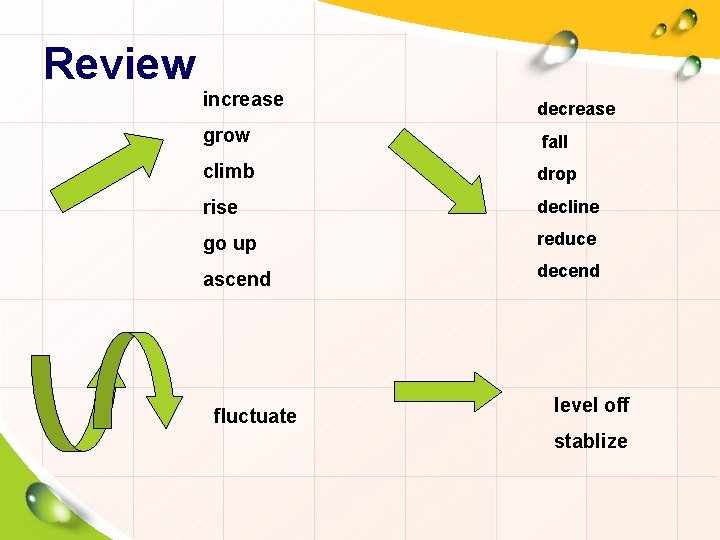
Review increase decrease grow fall climb drop rise decline go up reduce ascend decend fluctuate level off stablize


Target—Essential Sentence Patterns 1. subject+verb+adverb+figures+time 2. There be +a+adjective+noun+in+subject 3. A period of time+sees+a+adj. +n. +in+subject
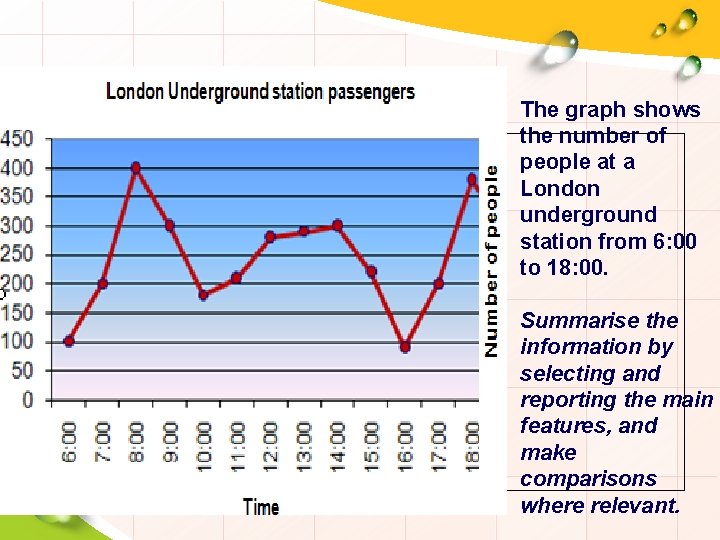
The graph shows the number of people at a London underground station from 6: 00 to 18: 00. Summarise the information by selecting and reporting the main features, and make comparisons where relevant.

Recognize the trends Number of people Increase , grow, climb, rise shoot up/rocket Decrease, fall, drop, decline plunge/plummet Level off, stabilize Time
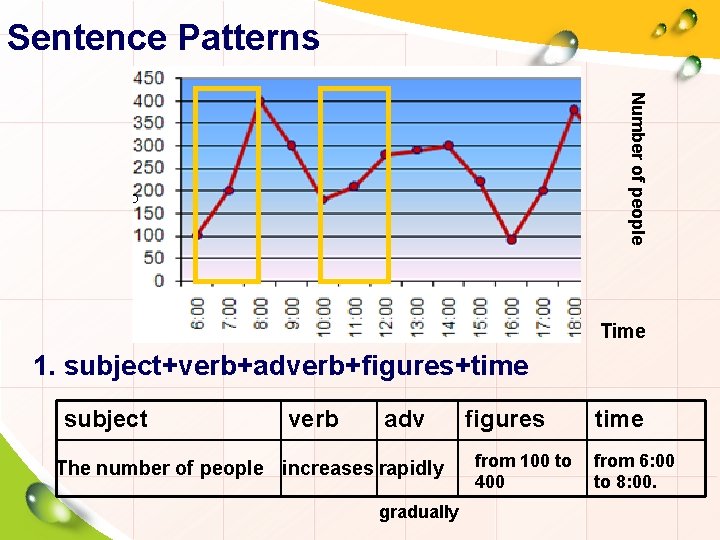
Sentence Patterns Number of people Time 1. subject+verb+adverb+figures+time subject verb adv The number of people increases rapidly gradually figures from 100 to 400 time from 6: 00 to 8: 00.
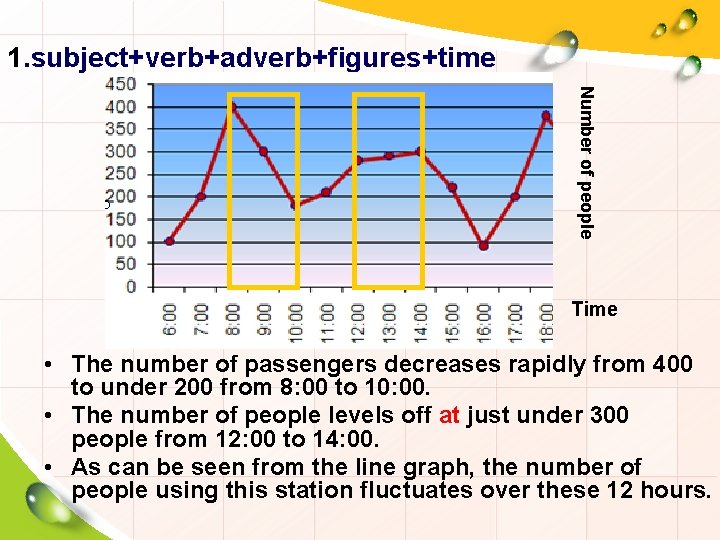
1. subject+verb+adverb+figures+time Number of people Time • The number of passengers decreases rapidly from 400 to under 200 from 8: 00 to 10: 00. • The number of people levels off at just under 300 people from 12: 00 to 14: 00. • As can be seen from the line graph, the number of people using this station fluctuates over these 12 hours.
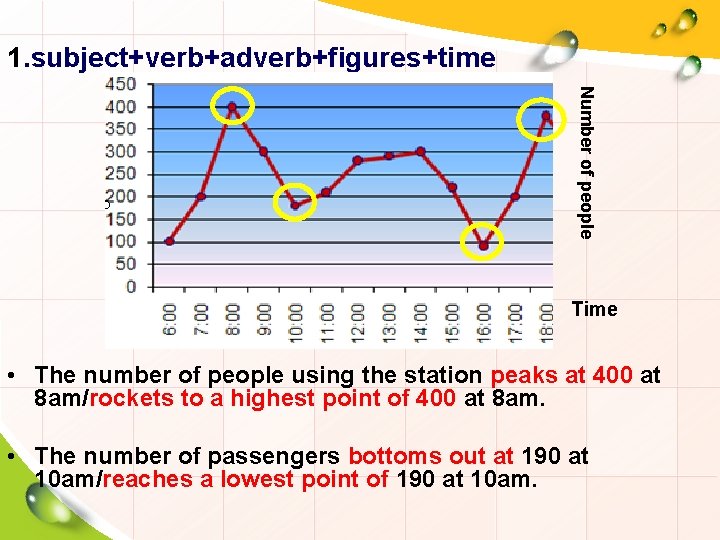
1. subject+verb+adverb+figures+time Number of people Time • The number of people using the station peaks at 400 at 8 am/rockets to a highest point of 400 at 8 am. • The number of passengers bottoms out at 190 at 10 am/reaches a lowest point of 190 at 10 am.

IELTS Official Criteria Lexical resources Grammatical range and accuracy Band 5 uses a limited range of vocabulary, but this is minimally adequate for the task… uses only a limited range of structures… Band 6 uses an adequate range of vocabulary for the task… uses a mix of simple and complex sentence forms Band 7 uses a sufficient range of vocabulary to allow some flexbility and precision… Uses less common lexical items… uses a variety of complex structures… ----IELTS Writing Task 1 Writing Band Description

2. There be +a+adjective+noun+in+subject Verb+adverb Increase/decrease rapidly grow/fall dramatically Adjective+noun a rapid increase/decrease a dramatic growth climb/decline sharply a sharp climb/decline rise/drop greatly a great rise/drop Not obvious trends Adverbs Adjectives slightly steadily gradually slowly slight steady gradual slow

Sentence Patterns Number of people Time 2. There be +a+adjective+noun+in+subject There be a adj. n. in subject There is rapid increase in the number of people a
2. There be +a+adjective+noun+in+subject The number of passengers increases gradually from 190 to 280 from 10 am to 12 am. • There is a gradual increase in the number of passengers from 190 to 280 from 10 am to 12 am. The number of passengers decreases dramatically from 400 to under 200 from 8: 00 to 10: 00. There is a dramatic decrease in the number of people using the station from 400 to 200 between 8 am and 10 am.
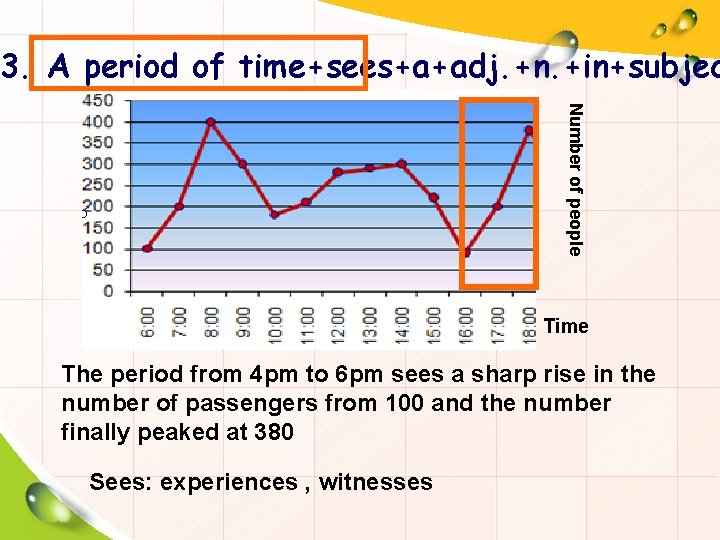
3. A period of time+sees+a+adj. +n. +in+subjec Number of people Time The period from 4 pm to 6 pm sees a sharp rise in the number of passengers from 100 and the number finally peaked at 380 Sees: experiences , witnesses
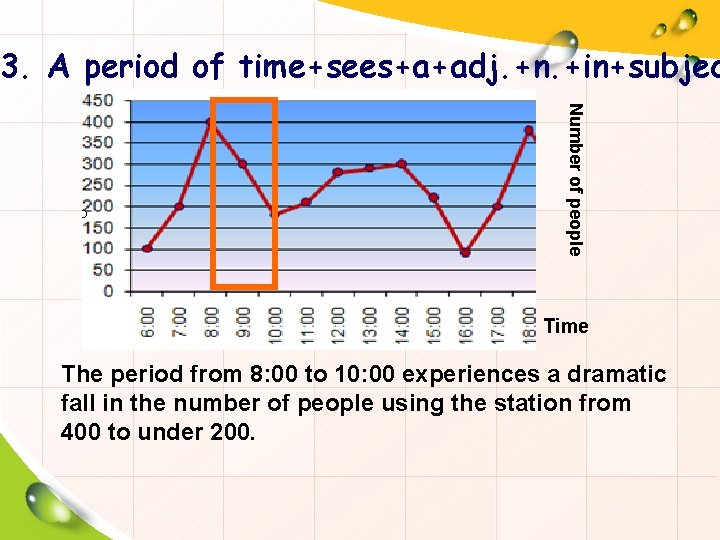
3. A period of time+sees+a+adj. +n. +in+subjec Number of people Time The period from 8: 00 to 10: 00 experiences a dramatic fall in the number of people using the station from 400 to under 200.

London Underground Station Passengers Number of people Time According to the line graph, the number of people using this station fluctuates over these 16 hours. More specifically, at first at 6 am the number of people at the station stands at only 100. Then, the number shoots up over the next two hours, peaking at 400 at 8 am. And then, the next two hours experience a rapid decline, with the number bottoming out at 190 at 10 am. There is a slight growth in the following two hours, with 280 people using the station at midday. Numbers between 12: 00 and 14: 00 level off at just under 300 people. The number plunges to only 100 from 2 pm to 4 pm. The period from 4 pm to 6 pm experiences a sharp rise again, with 6 pm arriving at 380 people.

London Underground Station Passengers Number of people Time According to the line graph, the number of people using this station fluctuates over these 16 hours. More specifically, at first at 6 am the number of people at the station stands at only 100. Then, the number shoots up over the next two hours, peaking at 400 at 8 am. And then, the next two hours experience a rapid decline, with the number bottoming out at 190 at 10 am. There is a slight growth in the following two hours, with 280 people using the station at midday. Numbers between 12: 00 and 14: 00 level off at just under 300 people. The number plunges to only 100 from 2 pm to 4 pm. The period from 4 pm to 6 pm experiences a sharp rise again, with 6 pm arriving at 380 people.
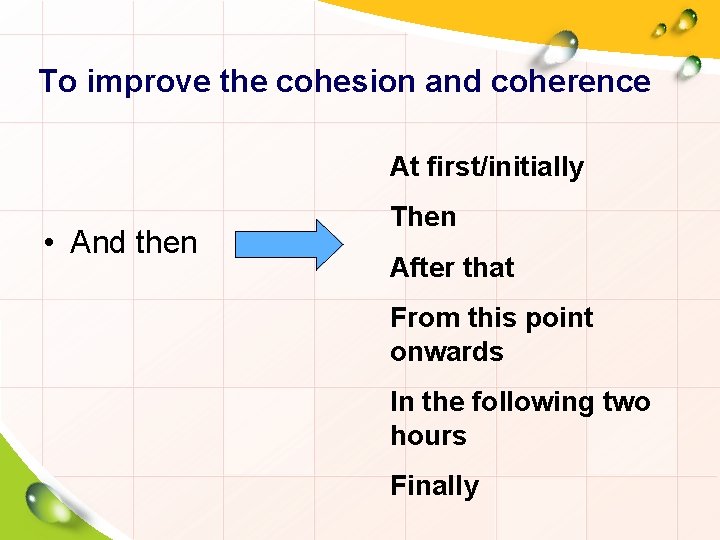
To improve the cohesion and coherence At first/initially • And then Then After that From this point onwards In the following two hours Finally
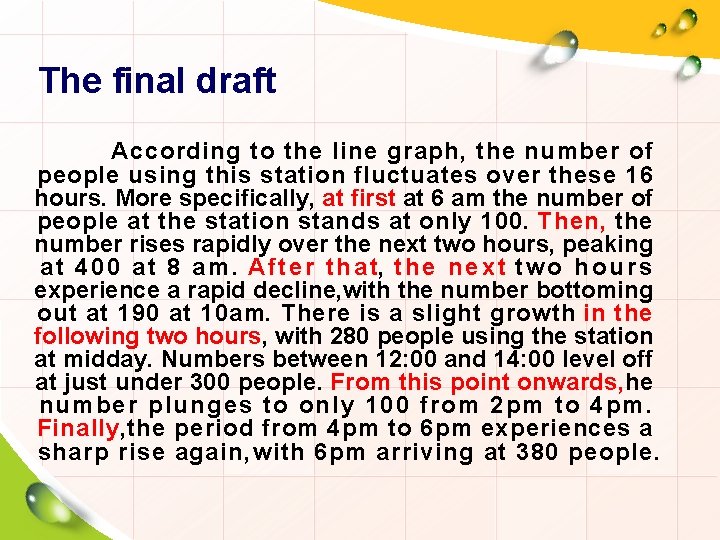
The final draft According to the line graph, the number of people using this station fluctuates over these 16 hours. More specifically, at first at 6 am the number of people at the station stands at only 100. Then, the number rises rapidly over the next two hours, peaking a t 4 0 0 a t 8 a m. A f t e r t h a t, t h e n e x t t w o h o u r s experience a rapid decline, with the number bottoming out at 190 at 10 am. There is a slight growth in the following two hours, with 280 people using the station at midday. Numbers between 12: 00 and 14: 00 level off at just under 300 people. From this point onwards, he number plunges to only 100 from 2 pm to 4 pm. Finally, the period from 4 pm to 6 pm experiences a sharp rise again, with 6 pm arriving at 380 people.

Homework Try to select the main features in the next chart and write a short report. • Dubai Gold Sales 2002 Millions of Dirhams

Thank You!
- Slides: 21