
HOW TO DELIVER A WEBINAR Good practice is
HOW TO DELIVER A WEBINAR ‘Good practice is good practice, irrespective of how and where it is delivered. ’ Brown, G. & Parkin, D. (2020). Design and Delivery – Creating Socially Distanced Campuses and Education Project Leadership Intelligence Report [online] Available at: https: //connect. advancehe. ac. uk/topics/18107/media_center/folders/4 ed 8609 b-8 ac 746 d 1 -95 eb-f 84 d 446952 d 0 Accessed 16 June, 2020. p. 9 Online Workshop/Webinar Charlie Reis Director PGCert June 2020
OBJECTIVES OF THIS SESSION This session is for staff to discuss the challenges of and tips for delivering webinars. Really, it is up to you to provide the content for the session, but structure and reflective questions have been provided. We will cover: 1. Interaction & student participation; 2. Managing online break out groups; 3. Performance as teaching; 4. Physical interaction – modelling feedback and co -creation of artefacts.
WELCOME Please address: 1. What challenges have you encountered in delivering webinars? 2. How did you address your challenges? 3. What would you like to improve? If we spend the hour talking about your ideas, that is an hour well spent; the ppt is available at: https: //ice. xjtlu. edu. cn/course/view. php? id=1605§ion=12.
INTERACTION & STUDENT PARTICIPATION
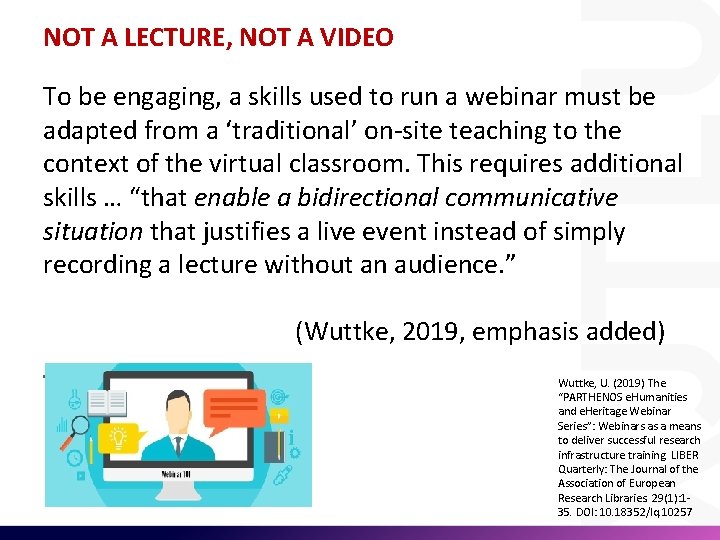
NOT A LECTURE, NOT A VIDEO To be engaging, a skills used to run a webinar must be adapted from a ‘traditional’ on-site teaching to the context of the virtual classroom. This requires additional skills … “that enable a bidirectional communicative situation that justifies a live event instead of simply recording a lecture without an audience. ” (Wuttke, 2019, emphasis added) Wuttke, U. (2019) The “PARTHENOS e. Humanities and e. Heritage Webinar Series”: Webinars as a means to deliver successful research infrastructure training. LIBER Quarterly: The Journal of the Association of European Research Libraries. 29(1): 135. DOI: 10. 18352/lq. 10257
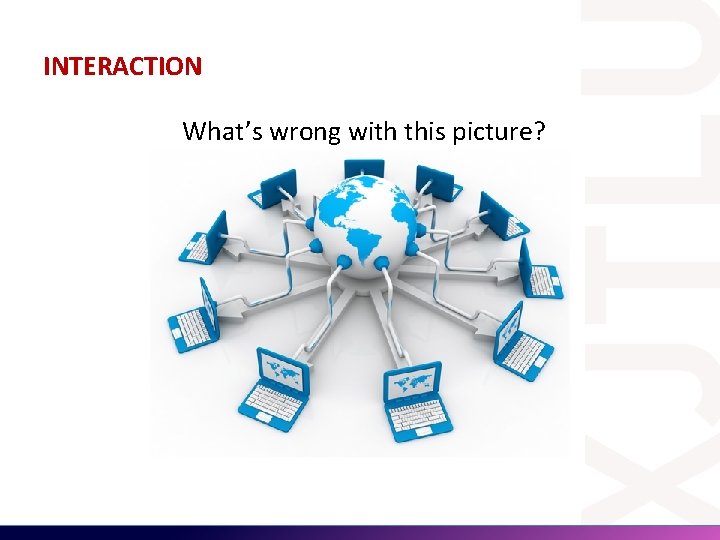
INTERACTION What’s wrong with this picture?
INTERACTION Online teaching should be more interactive because of design necessities. There needs to be two-way communication! Use the chat to agree or disagree and add comments, contexts, and experiences. NB: When delivering webinars, such as this one, I am constantly using the chat for interaction as a model of good practice [hopefully].
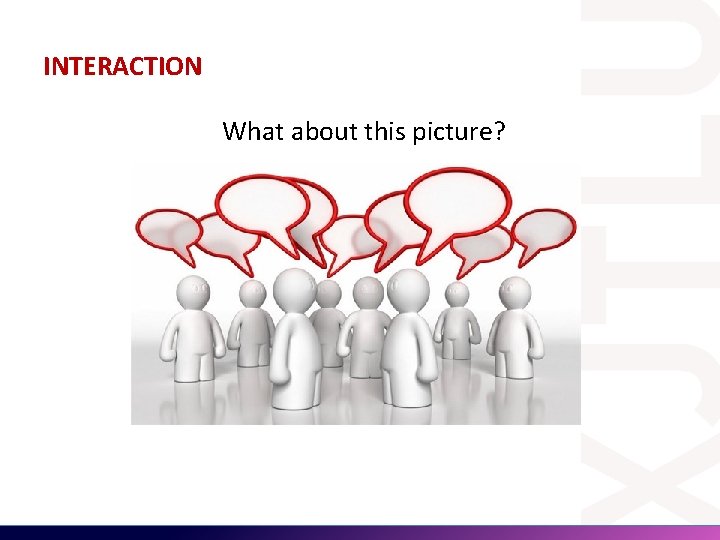
INTERACTION What about this picture?
INTERACTION AND INTERACTIVITY Interaction is what happens, interactivity is the technological support for interaction (Wagner, 1997), but bells and whistles are often just a cacophony when dealing with student understanding and learning. Focus on interaction, and let that guide how you use interactivity features. What are some ideas about interaction in hosting webinars? Wagner, E. D. (1997). Interactivity: From agents to outcomes. New Directions for Teaching and Learning, 71, 19 -26.
INTERACTION Ideally, interaction should be near continual; however the reality is that your students might not be too communicative. • • Ask them!!@!! Make sure interaction is built-in every ten minutes Streamline feedback (chat, polls, 1’s and 2’s, emojis) Call on students by name/group • More. .
INTERACTION – FROM ENGAGEMENT PPT Management of a learning environment depends on students knowledge of and comfort with your expectations of their behaviour. • Model interactions • Vary interactions – – student-teacher student-student-content student-self – student-research – student-assessment -- Verbal -- Written -- Image -- Critical/questioning -- Giving examples/applications

BREAKOUT GROUPS
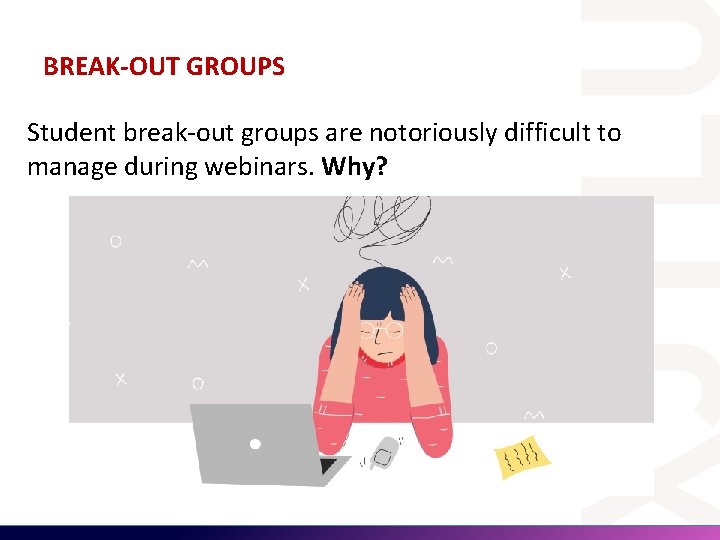
BREAK-OUT GROUPS Student break-out groups are notoriously difficult to manage during webinars. Why?
BREAKOUT GROUPS ONLINE You have to tell them to get ready, turn on mics, and that they have limited time to do a clear task as a group. You have to check that they understand how to get into the room, how to communicate with one another, and what they are responsible for doing beforehand. You have to check task completion and student perceptions of learning afterward.
BREAK-OUT GROUPS “A course with a predictable pattern of operation and sequence of events provides the online learner with the structure they need to succeed. ”(Ragan, n. d. ) 1. Often the times are overly-long; 2. There is little oversight; and 3. Students have vague ideas about what they are supposed to do. Ragan, (n. d. ) 10 Principles in Effective Online Teaching: Best Practices in Distance Education. Faculty Focus. [online] available at: https: //www. facultyfocus. com/wp-content/uploads/2015/02/10 Principles-of-Effective-Online-Teaching. pdf Accessed: 22 June, 2020. 1. Fix times as with any task and keep them short; 2. Move virtually from room to room and monitor the chat; 3. Be very clear about the task and roles, perhaps providing checklists.
MODELING BREAKOUT GROUPS ACTIVITY ONLINE Remember might be doubting their abilities to succeed (motivate and lead cognitively), especially when put into break out groups? What would you model engagement in break out groups? Do all groups need a leader? Breakout room tutorial video: https: //video. xjtlu. edu. cn/Mediasite/Play/13442 cbeed e 54 bfdaf 5 d 9 fabb 6 f 1 aafd 1 d.
STRATEGIES FOR ONLINE BREAK OUT GROUPS • Model the type of responses and feedback you want students to give each other. • Draw students out in discussions – require a position and justification. • Provide an example when someone makes a point and ask them if the example makes sense. • Provide a definition or characteristic of the thing when someone provides an example and ask… • Ask them to go further, elaborate, or think of the topic from another angle—anything that helps them revisit what they’ve learned and make it stick.

PERFORMANCE
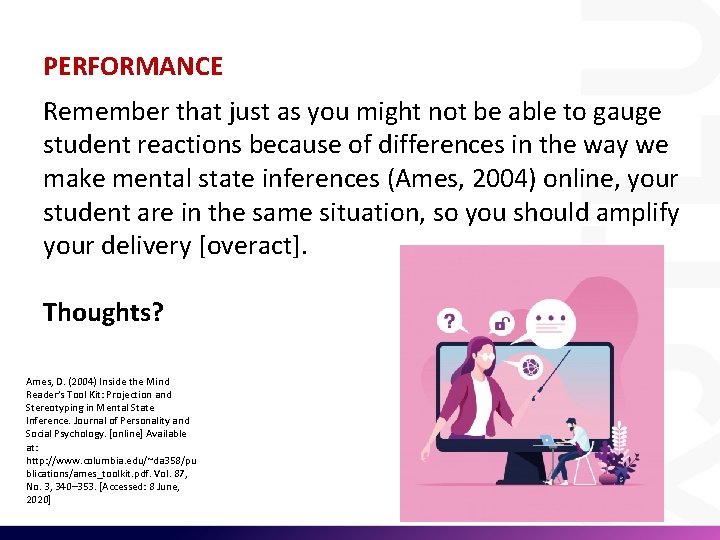
PERFORMANCE Remember that just as you might not be able to gauge student reactions because of differences in the way we make mental state inferences (Ames, 2004) online, your student are in the same situation, so you should amplify your delivery [overact]. Thoughts? Ames, D. (2004) Inside the Mind Reader’s Tool Kit: Projection and Stereotyping in Mental State Inference. Journal of Personality and Social Psychology. [online] Available at: http: //www. columbia. edu/~da 358/pu blications/ames_toolkit. pdf. Vol. 87, No. 3, 340– 353. [Accessed: 8 June, 2020]
PERFORMANCE Just at TV is not radio with pictures, webinars are not just lectures with internet. You are going to have to be an engaging speaker to hold student’s interest in your content delivery. What are your performance considerations?
PERFORMANCE Think of your performance as a part scaffolding or signposting language. Quality speakers use verbal (and physical, and linguistic) cues to highlight the structure, sense and importance of what they are saying. • Change your voice and register/low down and get louder for important points; • Bring your face closer to the camera; • Show excitement about your discipline; • Use appealing visuals; More?
PERFORMANCE Good teachers do several things (after Ramsden, 2003): 1. Deliver value; • A commitment to making it absolutely clear what has to be understood at what level and why (less content is more content); 2. Reach people, not talk at them; • • Explainly and provide relevant applications and examples; Respect people and promote autonomy; 3. Interact and respond; • • • Flexibility to answer questions and chase learning; Appropriate to the level of your students; Using teaching methods and academic tasks that require students to learn actively, responsibly and co-operatively; 4. Have a personality. • • • Be stimulating and interesting, just like your subject; Instill a love of your discipline; Talk about your own learning of what you are teaching. Ramsden, P. (2003). Learning to teach in higher education (2 nd ed. ). London & New York: Routledge Falmer.
STRATEGIES FOR INCREASING ENGAGEMENT IN LEARNING ONLINE Keep in mind instructor presence and humanness Being Present • Interact and respond; • Feedback and feedforward; • Revise for support as necessary. Being Human • Say hi before getting down to business; • Have a personality/share yourself; • Be understanding; • Allow students to discuss what is important to them.
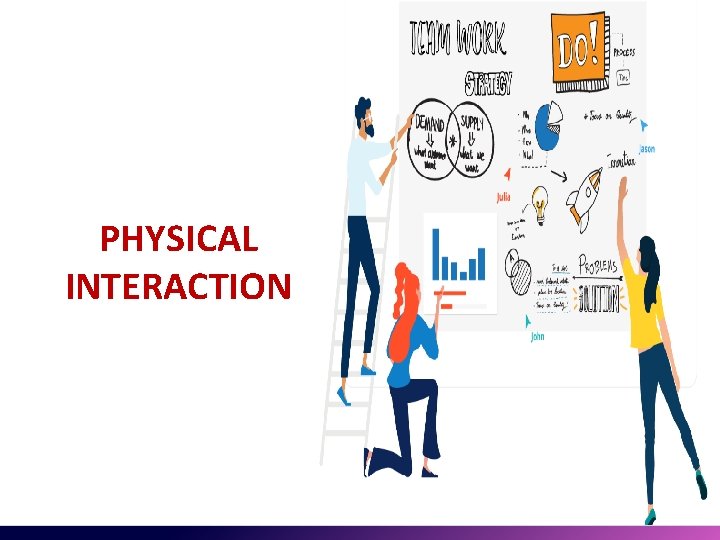
PHYSICAL INTERACTION
PHYSICAL INTERACTION This is not an oxymoron. Instructors who are doing things physically through changing and commenting on a shared visual report much higher levels of engagement. This is modelling as well as feedback, and so should use examples, case studies, student work, and group (whole-class) work as templates. How are you doing this? Are you using student feedback? What has the result been?
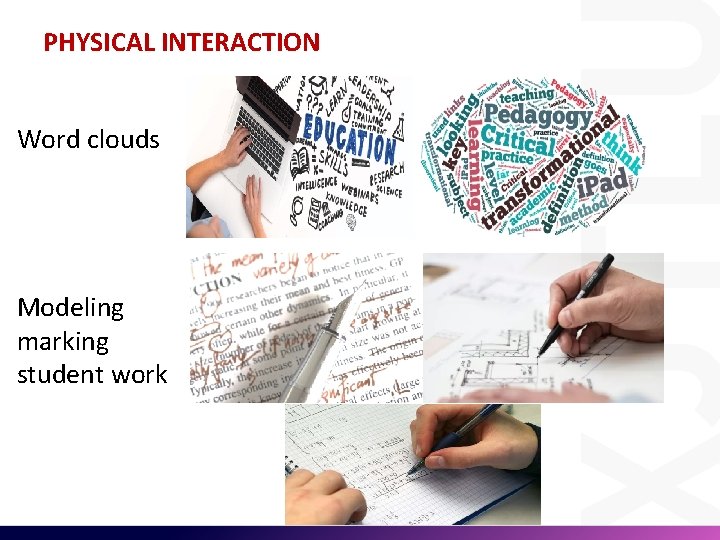
PHYSICAL INTERACTION Word clouds Modeling marking student work
PHYSICAL INTERACTION While I am sure there is no shortage of ways we can think of for students to interact through sharing text, like forums and comments, what are some other ways they can physically participate in learning while online?
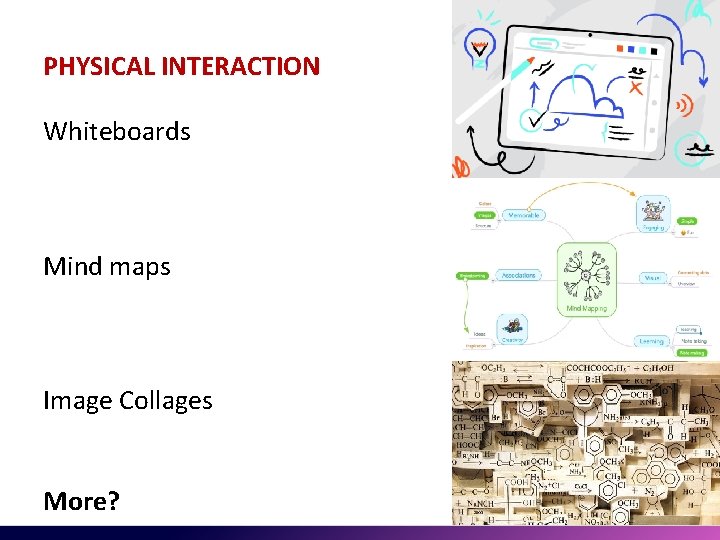
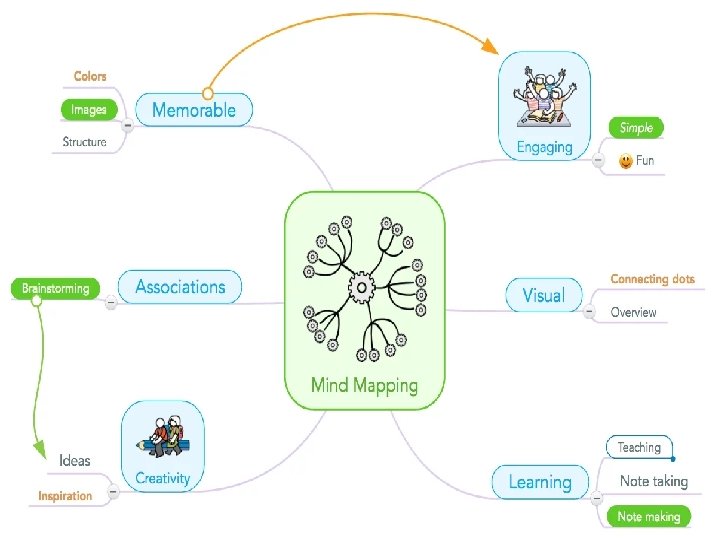
PHYSICAL INTERACTION Whiteboards Mind maps Image Collages More?
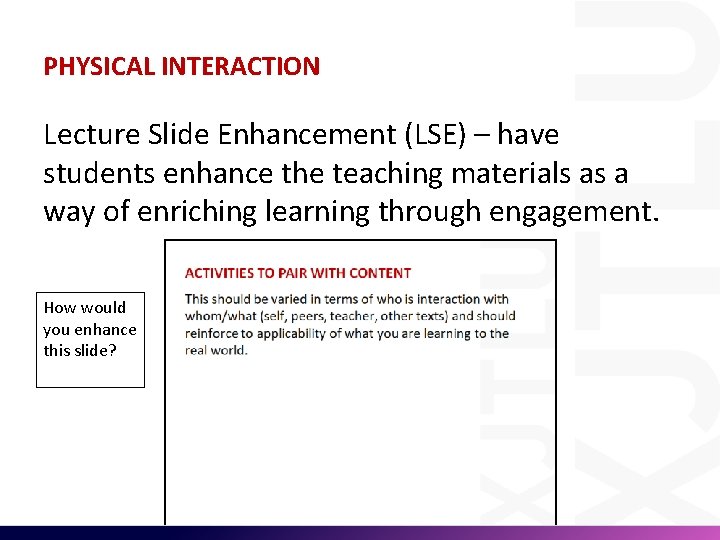
PHYSICAL INTERACTION Lecture Slide Enhancement (LSE) – have students enhance the teaching materials as a way of enriching learning through engagement. How would you enhance this slide?
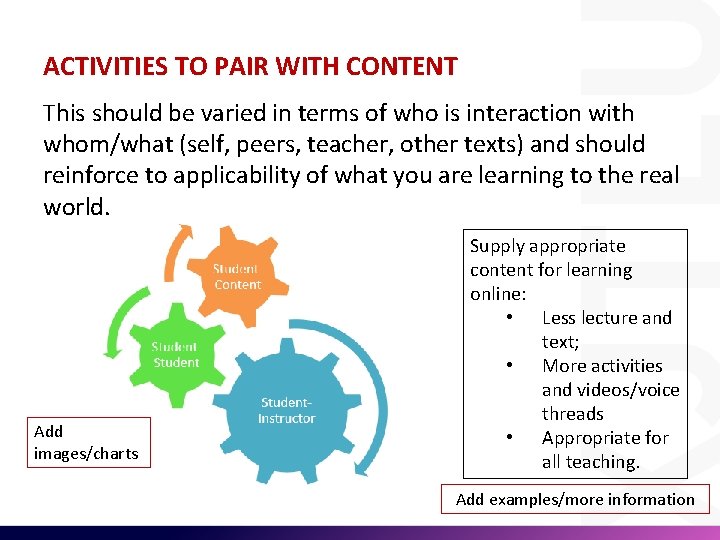
ACTIVITIES TO PAIR WITH CONTENT This should be varied in terms of who is interaction with whom/what (self, peers, teacher, other texts) and should reinforce to applicability of what you are learning to the real world. Add images/charts Supply appropriate content for learning online: • Less lecture and text; • More activities and videos/voice threads • Appropriate for all teaching. Add examples/more information
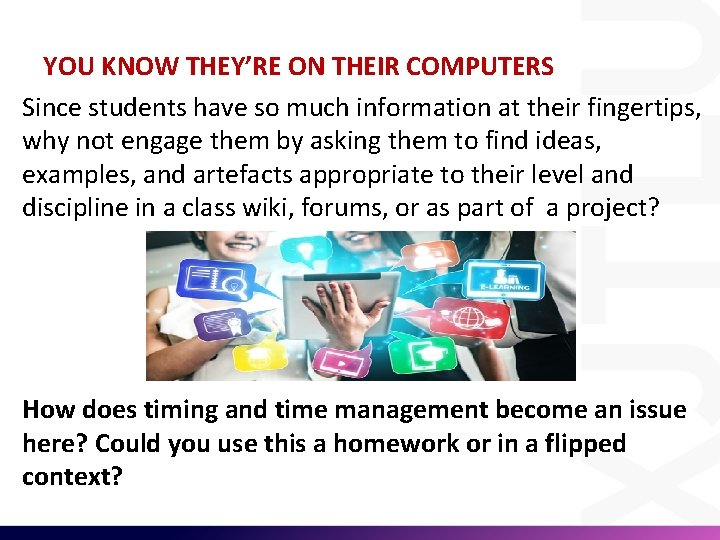
YOU KNOW THEY’RE ON THEIR COMPUTERS Since students have so much information at their fingertips, why not engage them by asking them to find ideas, examples, and artefacts appropriate to their level and discipline in a class wiki, forums, or as part of a project? How does timing and time management become an issue here? Could you use this a homework or in a flipped context?
REVIEW This session dealt with (and hopefully modelled) how to deliver a webinar. We considered: 1. Interaction & student participation; 2. Managing online break out groups; 3. Performance as teaching; 4. Physical interaction – modelling feedback and cocreation of artefacts. As a final activity, please post in the chat at least two things you will try/consider in delivering future webinars.
WEB RESOURCES You can always email me at charlie. reis@xjtlu. edu. cn. We have also created a page for getting started thinking about online pedagogies: https: //ice. xjtlu. edu. cn/course/view. php? id=1605§ion=12; for external audiences: https: //connect. xjtlu. edu. cn/view. php? t=ZSG 2 Hc 4 x. PKq. Y 0 my 3 Q 5 Bw.

THANK YOU VISIT US FOLLOW US WWW. XJTLU. EDU. CN @XJTLU
- Slides: 35