
How to Deliver a Great TED Talk Summary
- Slides: 64
How to Deliver a Great TED Talk Summary Notes from the book by Akash Karia Amazon Books 2012 ISBN: 1484021851
Six Elements of a Great Presentation • Simple • Unexpected • Concrete • Credible • Stories
Simple • How to find your core message • How to create your Power Phrase • Rhetorical techniques to make your Power Phrase memorable • The simple ABC-C structure for presentations • The opening mistakes to avoid • Five Opening Gambits to create an attentiongrabbing opening
Simple Continued • How to make your structure clear using a Roadmap • Ten anchors to make your presentation memorable • How to craft a compelling conclusion
How to find your core message • TED speakers are people who are passionate about their messages. • If you have a message that you genuinely believe in, delivering your speech will be easy because the passion will fuel the excitement. • I your audience was to forget everything else that you said, what is the one single thing that you would want them to remember?
Identifying and writing down your core message • Two key benefits • Helps you decide what to keep and what to throw out • Helps the audience remember and understand your message.
Creating a repeatable Power Phrase • Use one or a combination of the following rhetorical techniques • Contrast • Chiasmus • Rhyme • Alliteration
Contrast • Use contrast to make your phrase catchy • Using opposites such as light and darkness is effective
Chiasmus • This is a rhetorical device in which the order of the words in the second of two paired phrases is the reverse order in the first phrase. • Example: “Ask not what your country can do for you-ask what you can do for your country. ”
Rhyme • Rhyme is easy to remember • People perceive rhyming statements to be truer than non-rhyming statements
Alliteration • Repetition of an initial consonant sound • “If you can dream it, you can do it. ” –Walt Disney
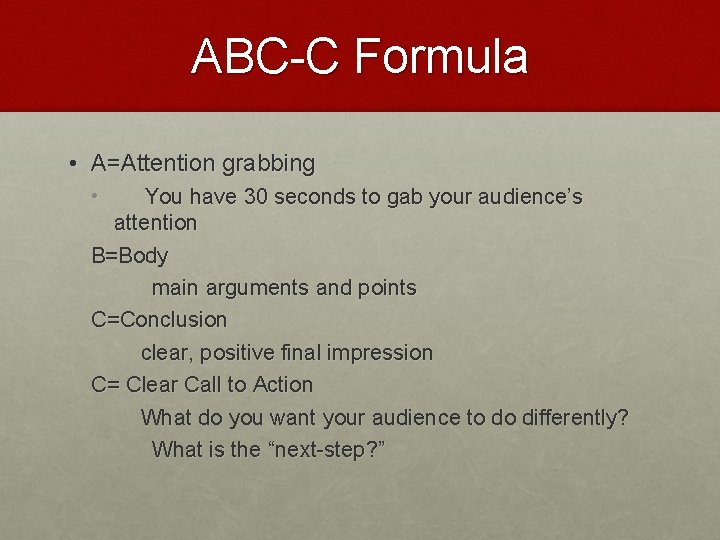
ABC-C Formula • A=Attention grabbing • You have 30 seconds to gab your audience’s attention B=Body main arguments and points C=Conclusion clear, positive final impression C= Clear Call to Action What do you want your audience to do differently? What is the “next-step? ”
Speech Structures • Problem Solution • Chronological • Step-by-Step • Features/Benefits
Problem/Solution Structure • Open with an attention grabbing description of a problem • Build up the pain and have the audience wanting a solution • Present your solution to alleviate the pain and offer advantages of the solution • In the conclusion, restate the problem and the consequences of not solving it. • Remind the audience the advantages of your solution and add a call to action
Chronological Structure • Organize and explain events in order
Step-by-Step Structure • Walk your audience through the different steps of an event
Features/Benefits Structure • Most presenters focus on the features of a product. • Steve Jobs of Apple was a master of selling the benefits of those features. • Audiences remember the benefits
Five Brilliant Ways to Start your Presentation • Start with a Story • Use Questions to Create Knowledge Gaps • Quotable Quotes • Interesting/Startling Statement • Call-Back
Start with a Story • The best speakers are master storytellers. • A well-told story will be remembered • Stories captivate people • Stories make connections between the listeners and the speaker
Use Questions to Create Knowledge Gaps • Questions creates a knowledge gap between what the listeners know and what they don’t know • Questions create curiosity and people are hard-wired with desire to fill the knowledge gap
Quotable Quotes • A short quote that illustrates your main point will create support for your speech. • Keep it short • Make sure it is relevant • Check the source • Quote a well known authority • Choose a quote that has not been over-used
Interesting/Startling Statement • You don’t have to be shocking • Intriguing statements create mystery • Interesting, startling, or intriguing statements back up your core message
Call-Back • Refer back to something that happened before or during the event • It personalizes the speech and lets the audience members know that the speech is customized for them
Include a Big Promise • The big promise can win people’s time, attention, and money.
Include a Pain Statement • Gain pleasure- People take action if they gain some benefit • Avoid pain or loss- People are motivated to avoid pain than they are to gain benefit of an equal amount.
Include a Roadmap • Include a short roadmap as part of your opening to let the audience know how your presentation is structured.
Building the Body of your Presentation • Tie your point to an anchor to make it stick • 8 anchors to hook your points • • • Anecdotes Acronyms Analogies/Similes or Metaphors Activities Academic research Statistics Case Studies Product Demonstrations Customer Testimonials Quotes
Anecdotes • Tell a story- they are memorable
Acronyms • If you have a list of points, an acronym can help the audience remember them. • Example: BRASS to a soldier is the techniques to shoot a gun- breathe, relax, aim, slack, and squeeze
Activities • If you are giving a workshop, seminar or presentation, you might split up the audience and give them an activity to find a creative solution to a problem. • It gets your audience physically mooving and doing something. • It reinforces your poit.
Analogies, Similes or Metaphors • They anchor a subject with what the audience is already familiar with and creates a connection to the new information you are sharing.
Statistics • Makes your points memorable • Provides evidence that your points are true
Academic Research • Anchors your points • Adds credibility
Case Studies • Case studies highlight major points and provide insights on why a strategy worked and what could have been done better.
Product Demonstrations • Win your audience’s trust and makes your points memorable.
Customer testimonials • Video testimonials are best or use photos of clients • Include names • Be specific
Quotes • Borrow credibility from a third-party source • Anchors your message • Makes it memorable
Crafting a Compelling Conclusion • Signaling you are closing • Summarizing your main points • Linking it to the conference • Providing hope for a better future • Providing a clear call to action • Selling the benefits
Signaling your closing • The audience knows the speech is wrapping up and the main points will be summarized and there may be some call to action. • The audience pays attention
Summarizing your main points • Reinforces your points • Take 2 -3 minutes
Linking it to the conference • It leaves a lasting impression
Call to Action • Be realistic of what you can expect from your audience • Include only one call to action
Selling the benefits • Summarize the benefits your audience will get if they act on what they have learned from your speech.
Part Two Unexpected • Using shocking statistics and facts to grab the audiences attention • Offer the audience something new or unconventional • Create a WOW moment
Using statistics and facts • Shocking statistics captures your audience • Add credibility • Memorable • Relate it to the audience • Compare and contrast • Make it visual
Offer the audience something new • Talk about something new • Look at an old topic from a new perspective • Argue against conventional wisdom • Dig out stories fro academic research • Interview interesting people for a good story • Use personal stories
Create a WOW moment • Demonstrate a remarkable product or use a prop to make your idea more concrete • Do something that will get your audience buzzing
Part Three: Concrete • Use specific, concrete language • Bringing your characters to life by providing specific details • Turning your stories into mental movies • Use analogies, metaphors and examples to turn abstract ideas into images
Use specific, Concrete Language • Use specific , concrete language • Bring characters to life by using details about their appearance • Give sensory information • Show, don’t tell
Turning your stories into mental movies • Visual- what could you see? • Auditory- what could you hear? • Kinesthetic- what could you feel? • Smell- what could you smell? • Pack in as many senses as possible • Keep your descriptions short
Use analogies, metaphors and examples • What can this idea be compared to?
Part Four: Credible Build your credibility during your introduction Add internal credibility to your messages
Build your credibility • Build your credibility during your introduction. • Share credentials • Add internal credibility to your messages. Share your struggles before your successes
Part Fiv. E: Emotional • Addressing the elephant in the room • Uniting people towards a common goal • Uniting people by focusing on a common enemy • Highlighting the problem and building their pain • Building the we-connection
Use compelling Visuals • Use a Powerpoint only if you have lots of visuals to display • If you and your Powerpoint are saying the same thing, one of you is not needed • Use large stunning pictures • Use large fonts • Only one idea per slide
Arousing their Curiosity • Don’t take their curiosity for granted • Tease before you reveal an important point of information • Tease about what is coming in the next segment before any breaks in your presentation
How to add Humor • Create an expectation, then suddenly break it • Poke fun at yourself using self-deprecating humor • Playfully over-exaggerate to get a laugh
Use Rhetorical Questions • Ask your audience to imagine • Ask your audience to reflect • Reflect on your audience’s thoughts • Ask your audience to compare
Part Six: Story • Importance of Storytelling • 5 C’s of great stories • Delivery techniques for dynamic storytelling
Stories are Powerful • Engage your audience emotionally • Create mental movies in your audience’s mind • Make abstract ideas visual
The 5 C’s of Great Stories • Characters • Conflict • Cure • Change in Character • Carryout message
Delivery Techniques for Dynamic Storytelling • Pause before you begin • Smile • Make Eye Contact • Get rid of filler words • Gesture naturally • Use posture to bring your characters to life
Delivery Techniques continued • Keep facial expressions congruent with your story • Show, don’t tell • Bigger audience means a bigger you • Match the audience’s energy level • Make full use of the stage • Use vocal variety
8 Ways to prepare • Rehearse your talk • Get some exercise to release endorphins • Walk around the room you will be speaking in • Get familiar with the stage • Test the equipment • Rehearse your opening • Listen to music • Visualize success