
How to Define Design Space Lynn Torbeck Overview

How to Define Design Space Lynn Torbeck
Overview • • Why is a definition important? Definitions of Design Space. Deconstructing Q 8 Definition. Basic science, Cause and Effect SIPOC Process Analysis Three Levels of Application. Case Study with Example.
Why is this Important? ICH Q 8 is in its final version. Design Space is defined in Q 8. Many presenters are using the term. All are repeating the same definition. Many presenters don’t understand the statistical implications of the issue. Need for a detailed ‘Operational Definition’
Regulatory Impact “Design space is proposed by the applicant and is subject to regulatory assessment and approval. ” “Working within the design space is not considered a change. ” “Movement out of the design space is considered to be a change and would normally initiate a regulatory post approval change process. ” This is a big deal, it needs to be done correctly ! The economic impact of this can be huge.
Potential Benefits Real process understanding and knowledge, not just tables of raw data. Reduced rejects, deviations, discrepancies, lost time, scrap and rework. Fewer 483 citations and warning letters. Fewer investigations and CAPA. Freedom to operate with design space

ICH Q 8 Definition “The multidimensional combination and interaction of input variables and process parameters that have been demonstrated to provide assurance of quality. ” This is not universally understood by all parties involved. We need to harmonize several viewpoints, statistical, scientific, engineering and regulatory.

Deconstructing the Definition Need to deconstruct the definition to get to a day to day working Operational Definition that can be implemented. Need enough detail to write a Standard Operating Procedure or SOP. Need to see an example of what it looks like.
Multidimensional Also called multivariable or multivariate More than one variable at a time is considered. The practice of holding the world constant while only considering onefactor-at-a-time has been shown to be grossly inefficient and ineffective.
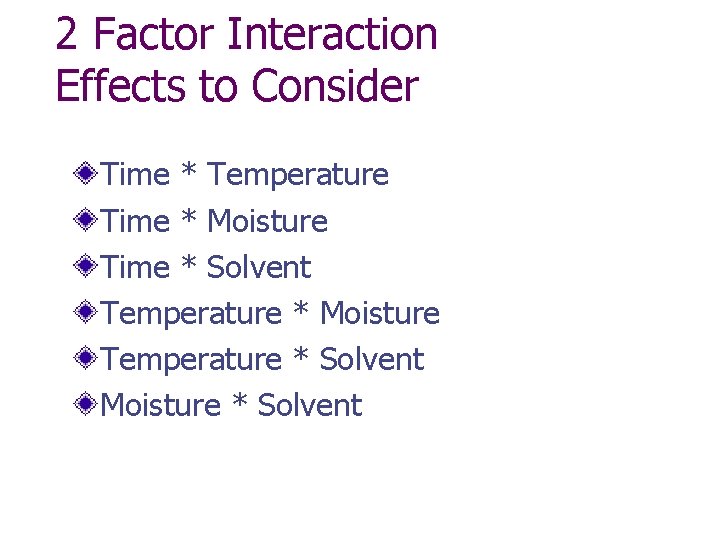
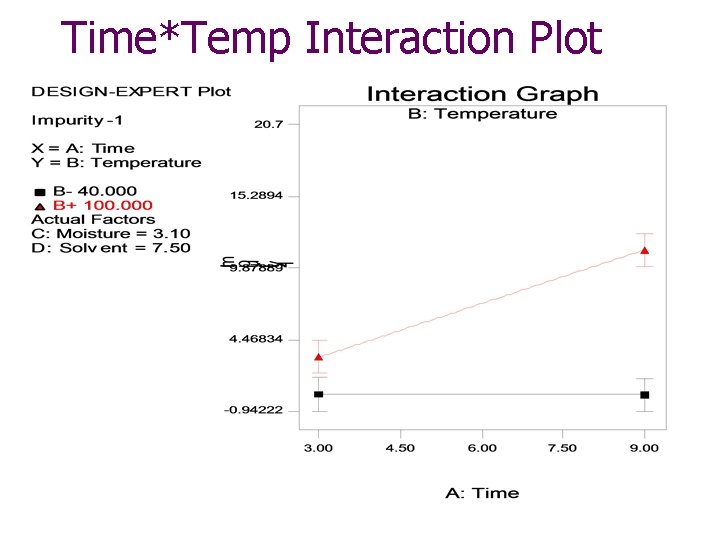
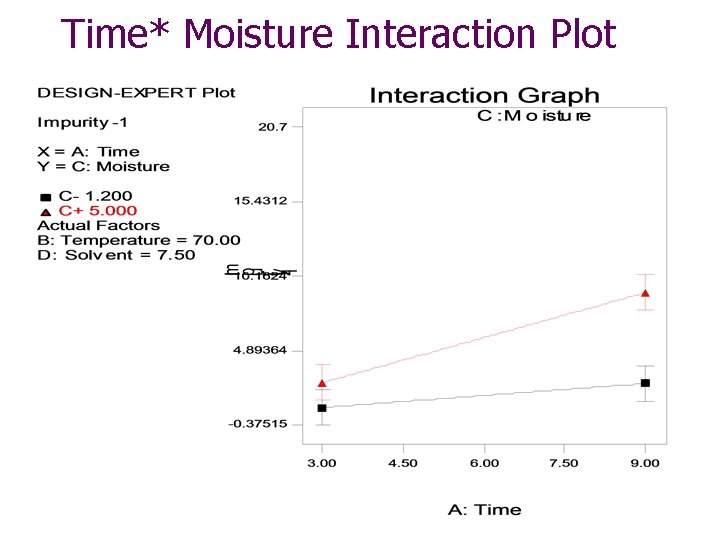
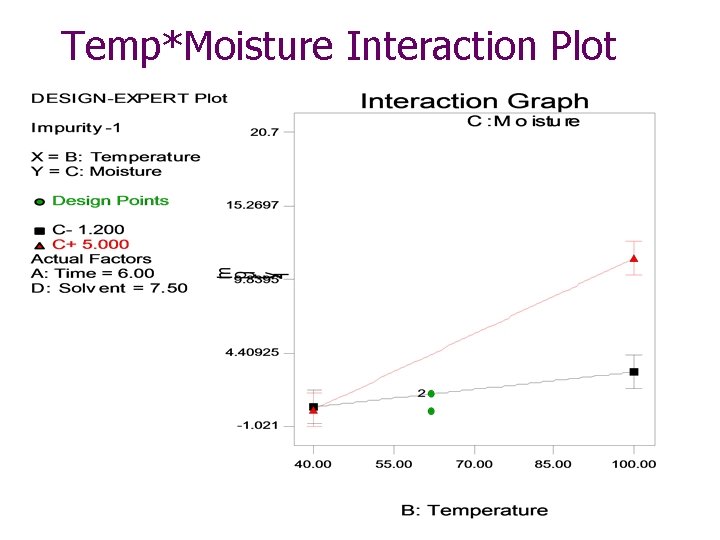
Interaction Defined in the PAT guidance “Interactions essentially are the inability of one factor to produce the same effect on the response at different levels of another factor. ” Interactions are the joint action of two or more factors working together.

Example Interaction
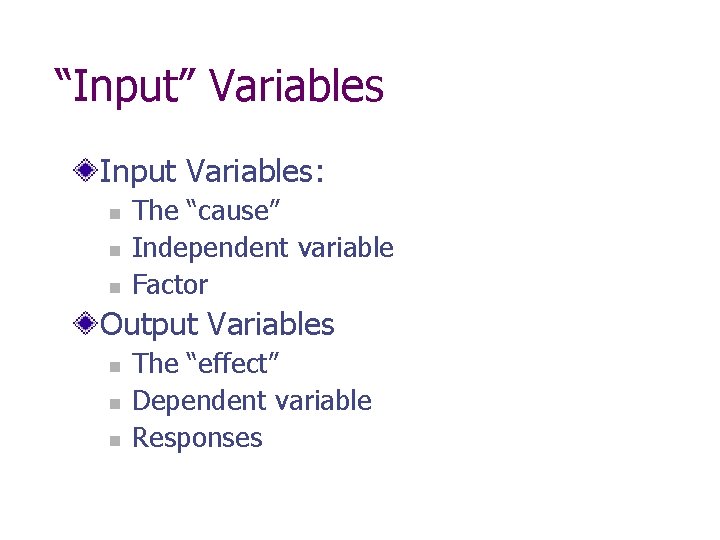
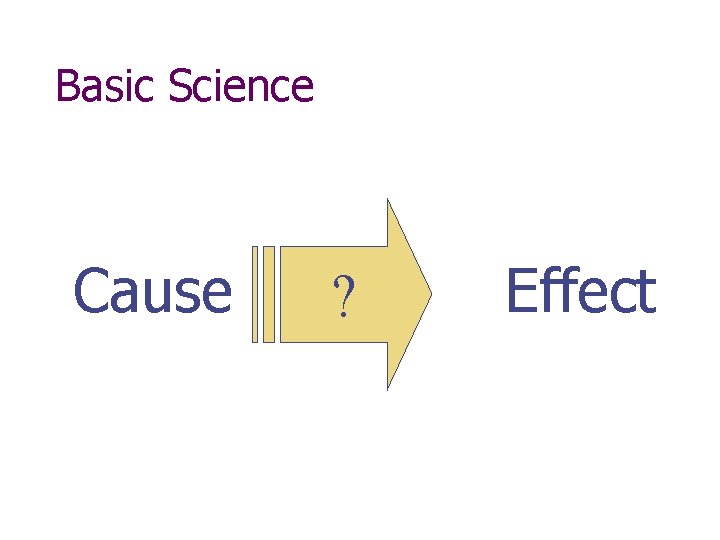
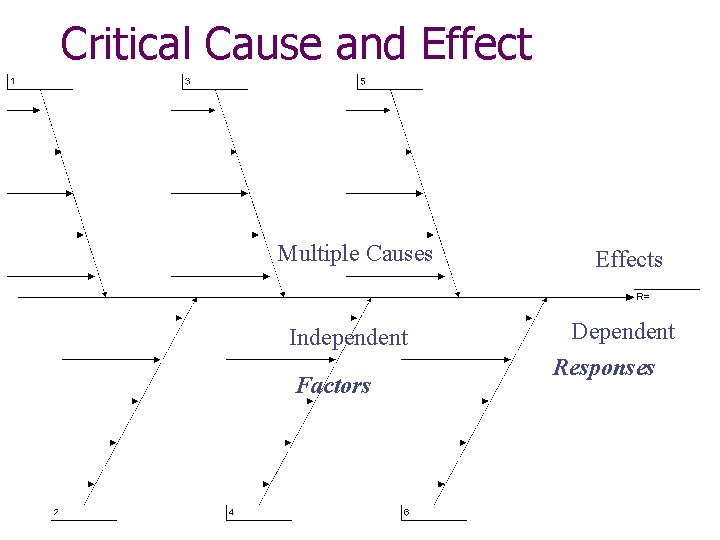
“Input” Variables Input Variables: n n n The “cause” Independent variable Factor Output Variables n n n The “effect” Dependent variable Responses
Assurance of Quality Assurance is a high probability of meeting: n n n Safety Strength Quality Identity Purity For all measured quality characteristics.
Basic Science Cause ? Effect
Critical Cause and Effect Multiple Causes Independent Factors Effects Dependent Responses
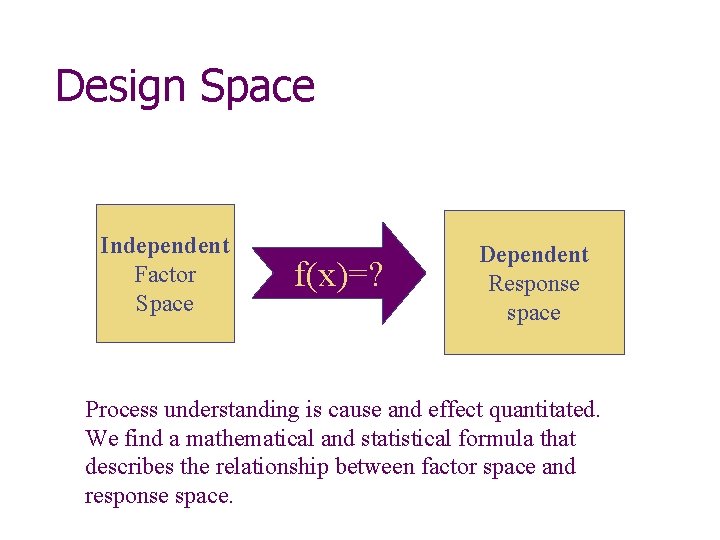
Design Space Independent Factor Space ? Dependent Response Space
Design Space FACTOR SPACE N dimension X’s X 1 X 2 X 3 X 4 X 5 XN RESPONSE SPACE M dimension Y’s Y 1 Y 2 Y 3 Y 4 Y 5 YM
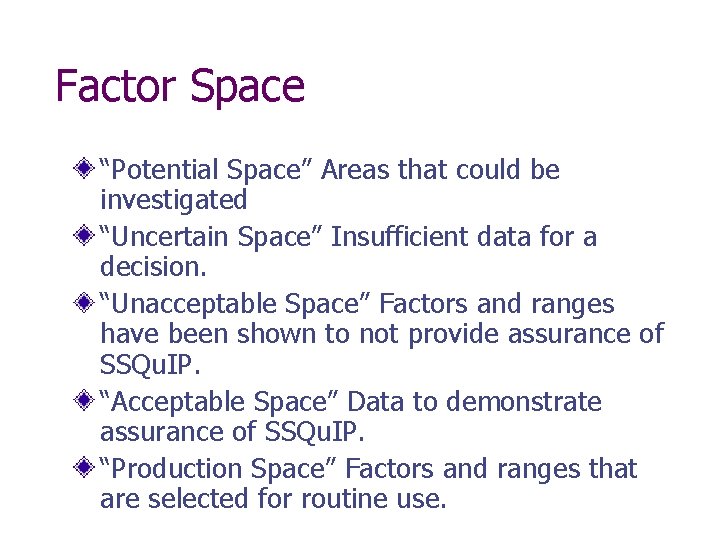
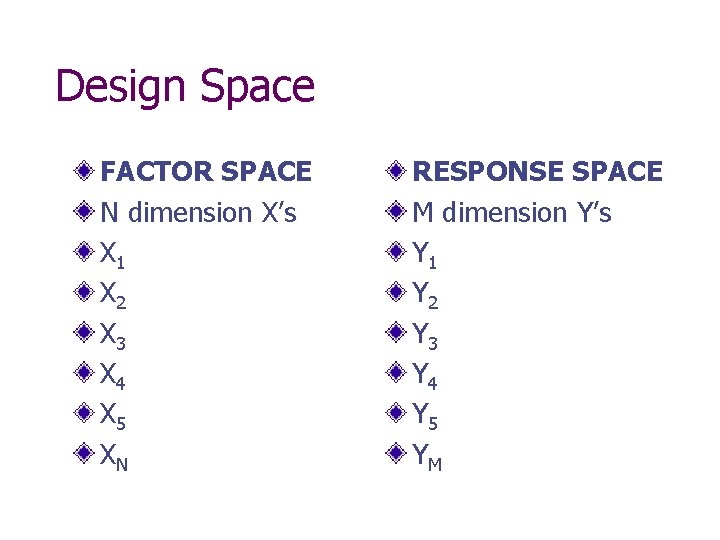
Factor Space “Potential Space” Areas that could be investigated “Uncertain Space” Insufficient data for a decision. “Unacceptable Space” Factors and ranges have been shown to not provide assurance of SSQu. IP. “Acceptable Space” Data to demonstrate assurance of SSQu. IP. “Production Space” Factors and ranges that are selected for routine use.
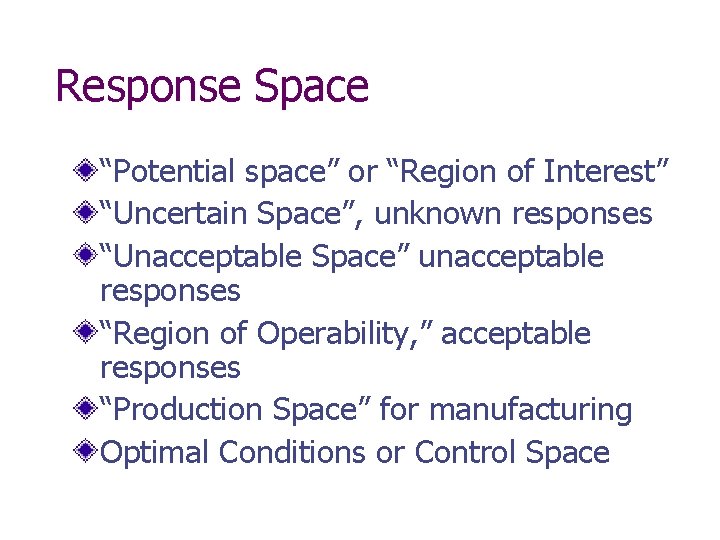
Response Space “Potential space” or “Region of Interest” “Uncertain Space”, unknown responses “Unacceptable Space” unacceptable responses “Region of Operability, ” acceptable responses “Production Space” for manufacturing Optimal Conditions or Control Space
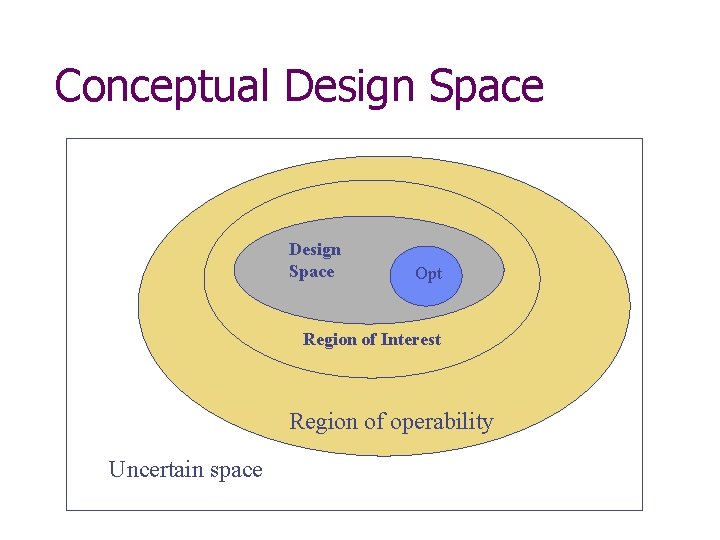
Conceptual Design Space Opt Region of Interest Region of operability Uncertain space
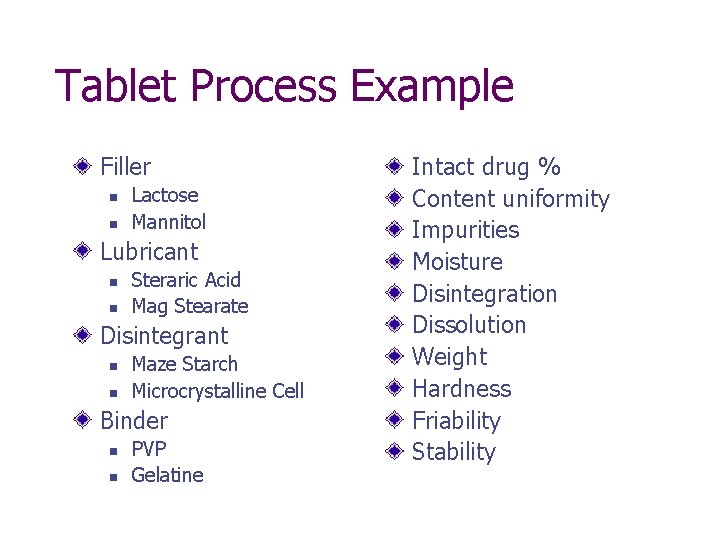
Tablet Process Example Filler n n Lactose Mannitol Lubricant n n Steraric Acid Mag Stearate Disintegrant n n Maze Starch Microcrystalline Cell Binder n n PVP Gelatine Intact drug % Content uniformity Impurities Moisture Disintegration Dissolution Weight Hardness Friability Stability
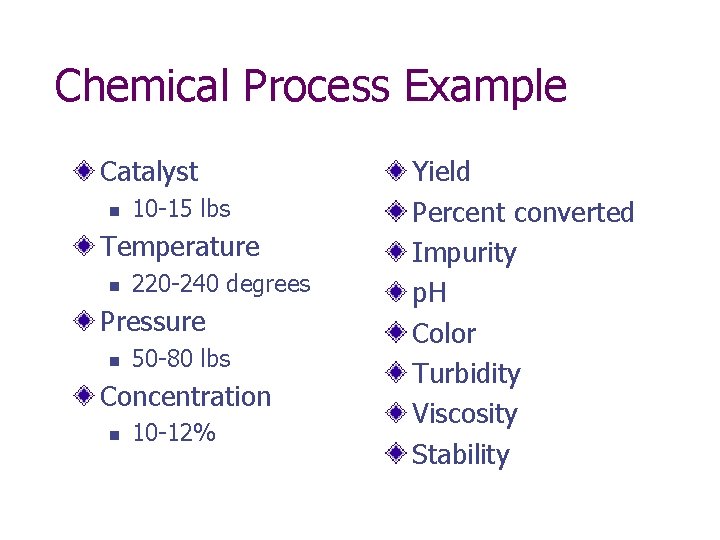
Chemical Process Example Catalyst n 10 -15 lbs Temperature n 220 -240 degrees Pressure n 50 -80 lbs Concentration n 10 -12% Yield Percent converted Impurity p. H Color Turbidity Viscosity Stability
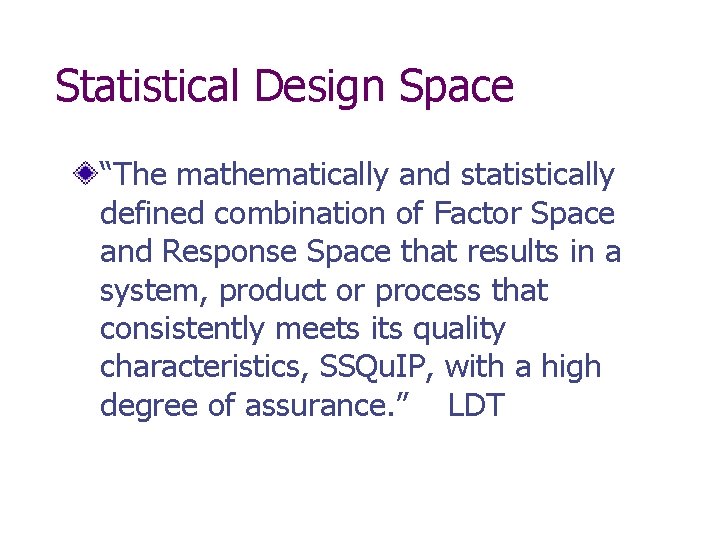
Statistical Design Space “The mathematically and statistically defined combination of Factor Space and Response Space that results in a system, product or process that consistently meets its quality characteristics, SSQu. IP, with a high degree of assurance. ” LDT
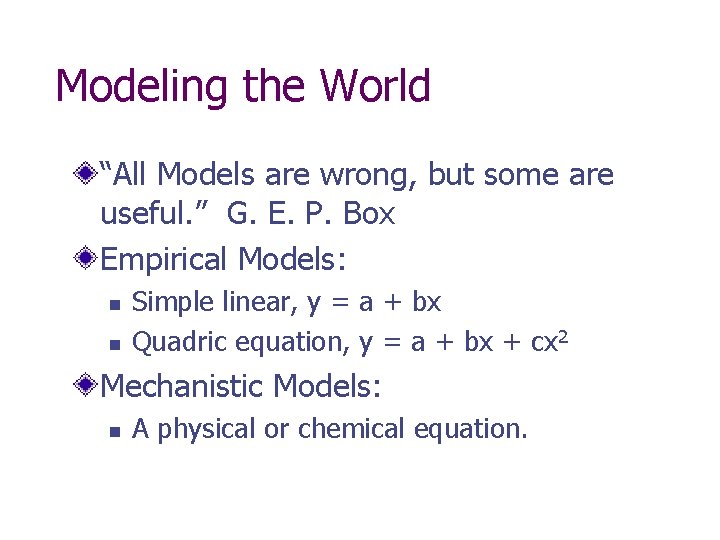
Modeling the World “All Models are wrong, but some are useful. ” G. E. P. Box Empirical Models: n n Simple linear, y = a + bx Quadric equation, y = a + bx + cx 2 Mechanistic Models: n A physical or chemical equation.
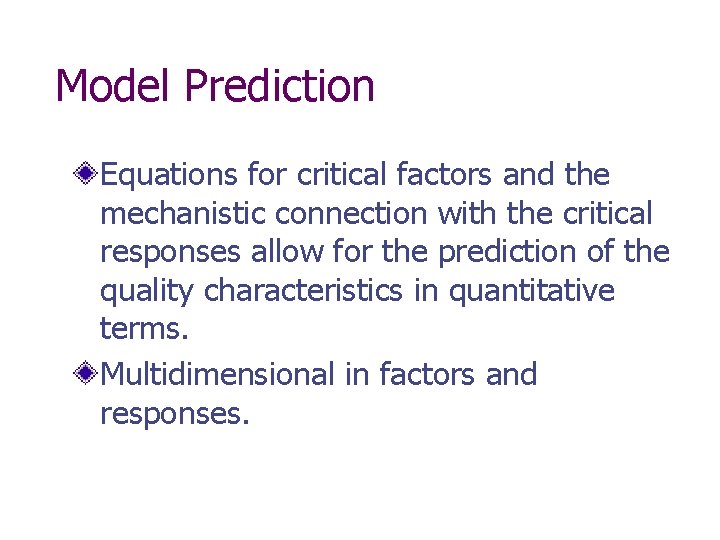
Model Prediction Equations for critical factors and the mechanistic connection with the critical responses allow for the prediction of the quality characteristics in quantitative terms. Multidimensional in factors and responses.
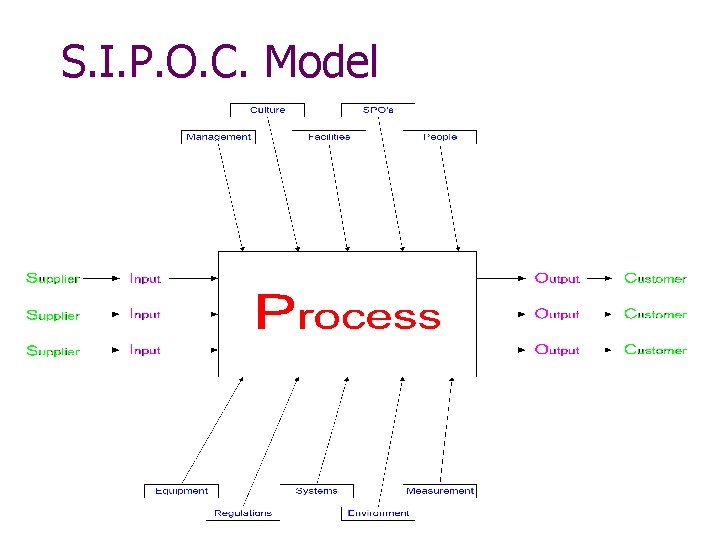
S. I. P. O. C. Model
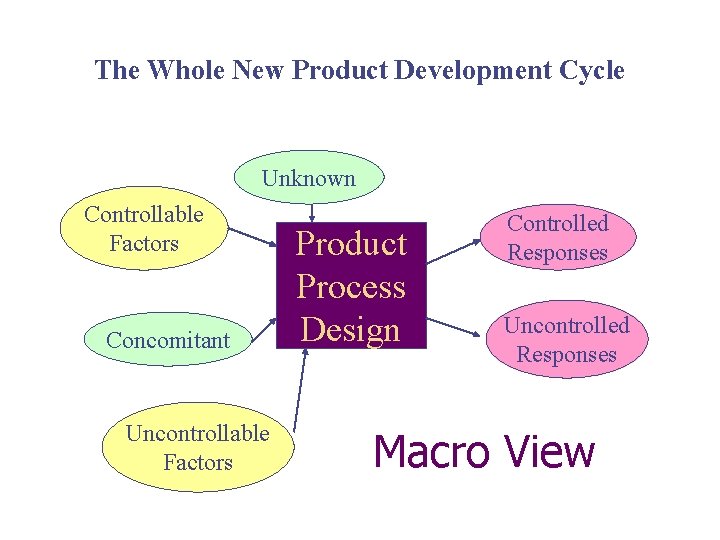
The Whole New Product Development Cycle Unknown Controllable Factors Concomitant Uncontrollable Factors Product Process Design Controlled Responses Uncontrolled Responses Macro View
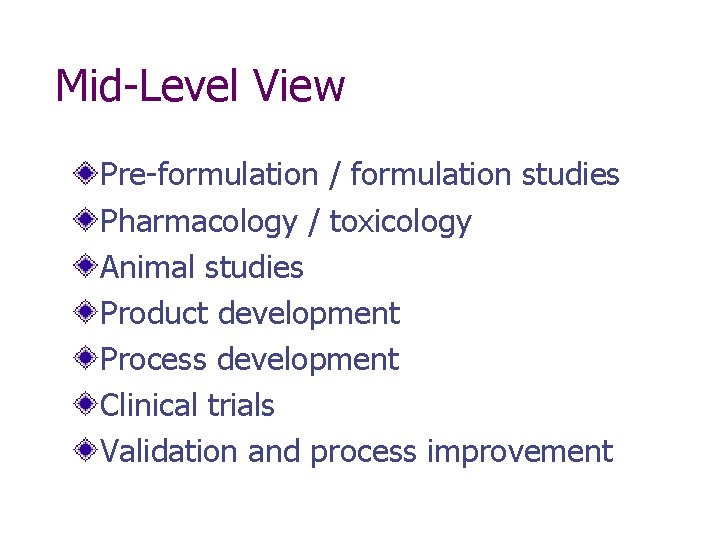
Mid-Level View Pre-formulation / formulation studies Pharmacology / toxicology Animal studies Product development Process development Clinical trials Validation and process improvement
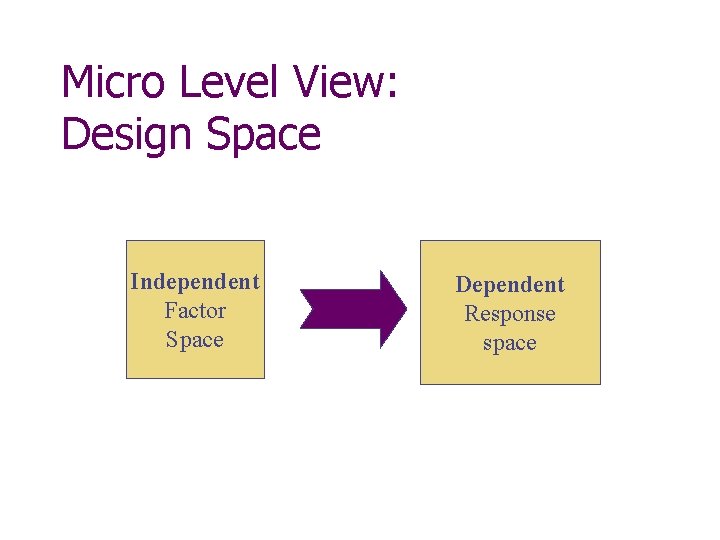
Micro Level View: Design Space Independent Factor Space Dependent Response space
Existing Products Design Space can be inferred by using existing information and historical data. Retrospective process capability studies. Annual Product Review analysis Comparison of historical data to specs Risk management and assessment, Q 9
Factor Space ASTM E 1325 -2002 “That portion of the experiment space restricted to the range of levels of the factors to be studied in the experiment …” AKA, “Design Regions” n The Cambridge Dictionary of Statistics. w B. S. Everitt, Cambridge University Press
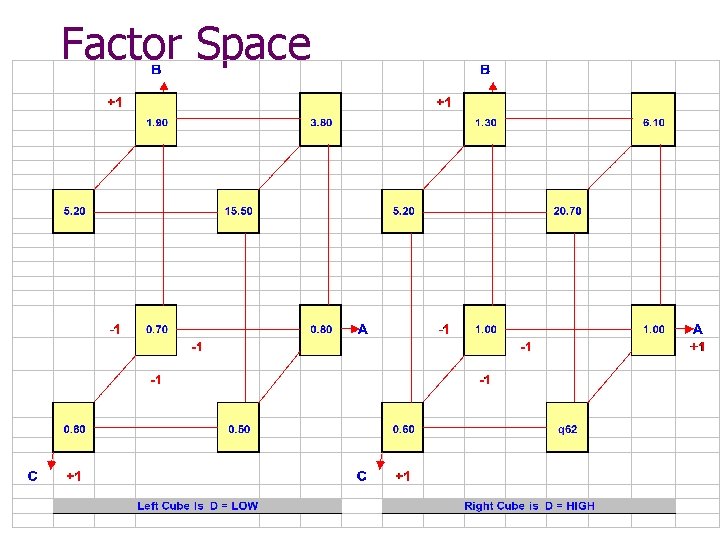
Quick Dry Example Five batches of product had been lost to an impurity exceeding the criteria The criteria for impurity 1 was NMT 1. 0% Four factors studied. Four responses.
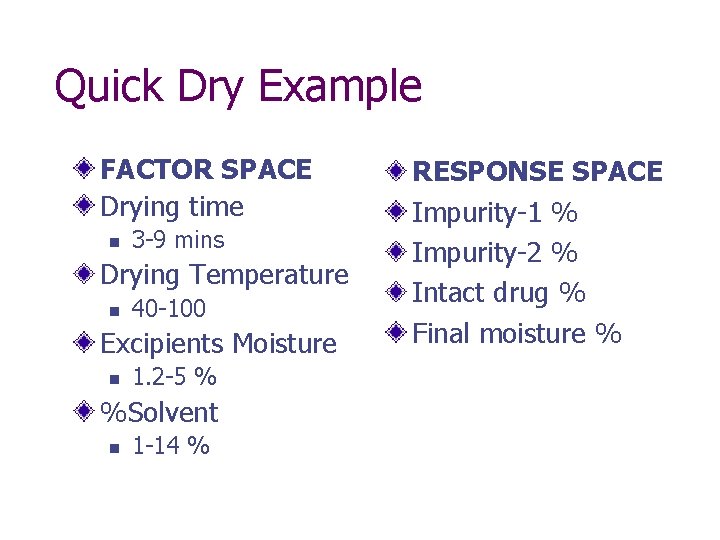
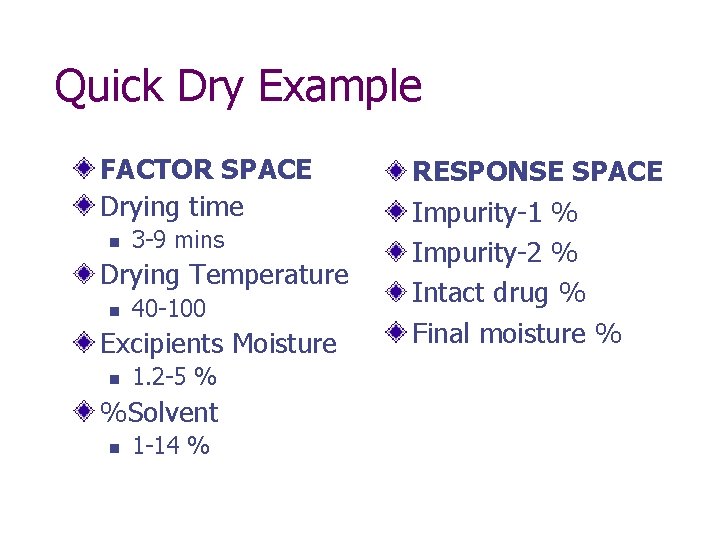
Quick Dry Example FACTOR SPACE Drying time n 3 -9 mins Drying Temperature n 40 -100 Excipients Moisture n 1. 2 -5 % %Solvent n 1 -14 % RESPONSE SPACE Impurity-1 % Impurity-2 % Intact drug % Final moisture %
Factor Space
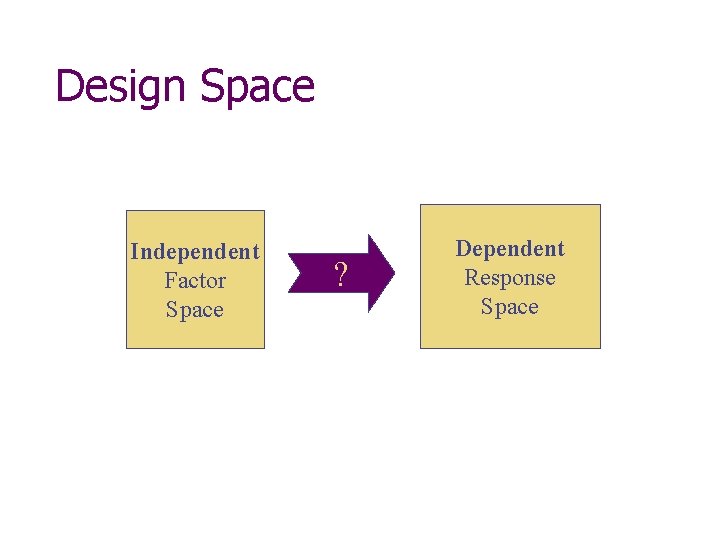
Design Space Independent Factor Space f(x)=? Dependent Response space Process understanding is cause and effect quantitated. We find a mathematical and statistical formula that describes the relationship between factor space and response space.
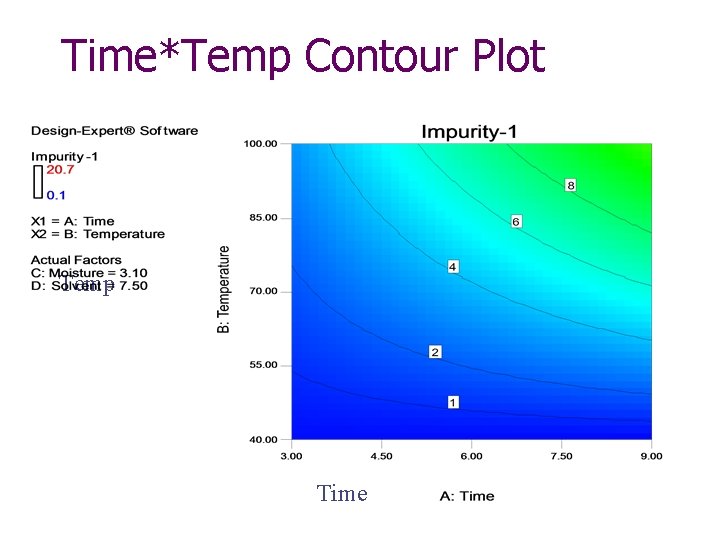
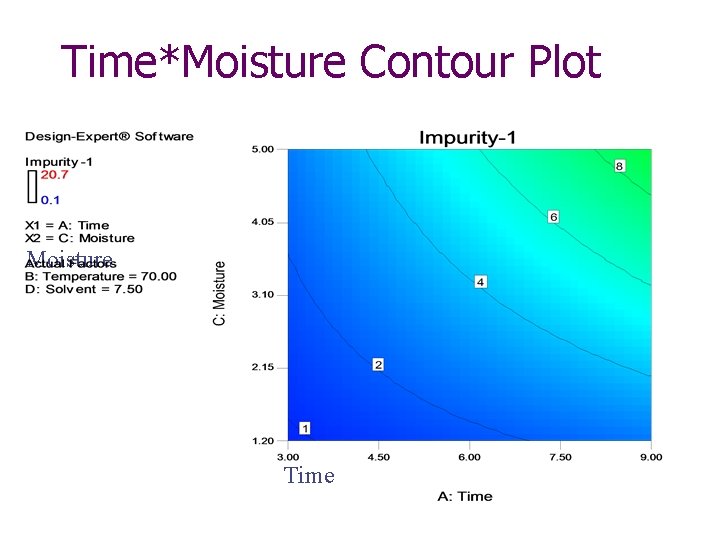
2 Factor Interaction Effects to Consider Time * Temperature Time * Moisture Time * Solvent Temperature * Moisture Temperature * Solvent Moisture * Solvent
Time*Temp Interaction Plot
Time* Moisture Interaction Plot
Temp*Moisture Interaction Plot
Time*Temp Contour Plot Temp Time
Time*Moisture Contour Plot Moisture Time
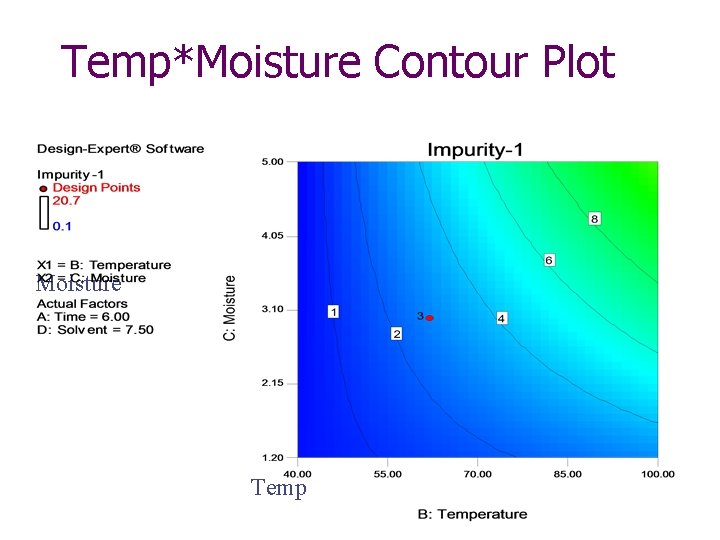
Temp*Moisture Contour Plot Moisture Temp

Time*Temp Surface
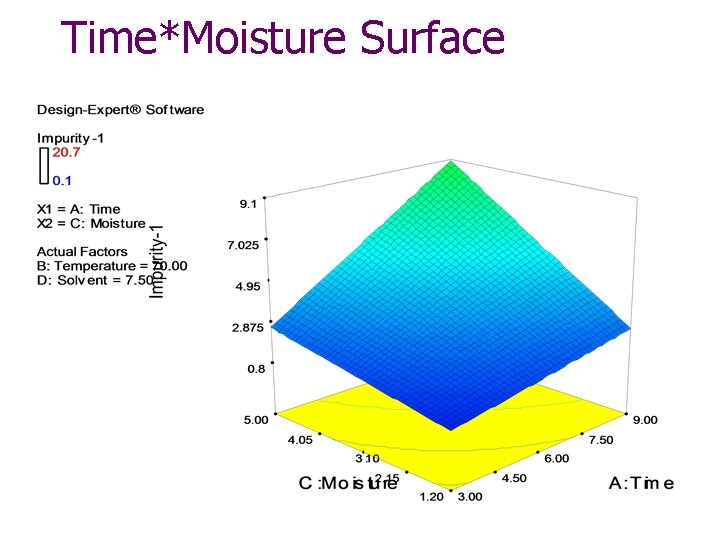
Time*Moisture Surface
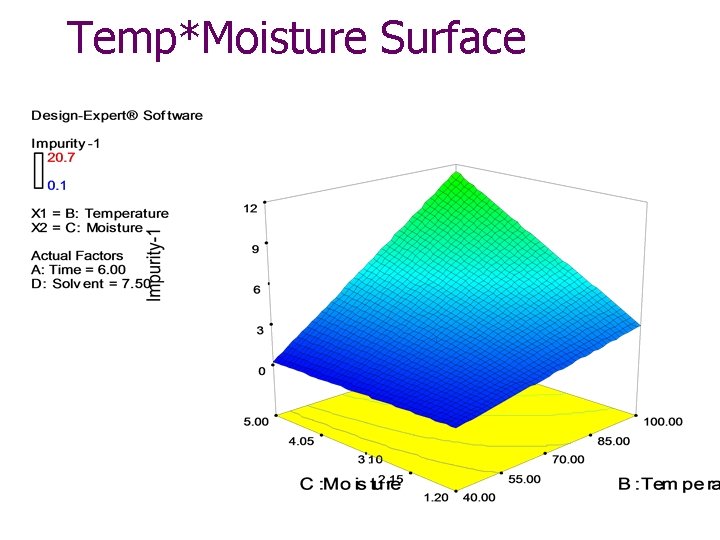
Temp*Moisture Surface
Quick Dry Example FACTOR SPACE Drying time n 3 -9 mins Drying Temperature n 40 -100 Excipients Moisture n 1. 2 -5 % %Solvent n 1 -14 % RESPONSE SPACE Impurity-1 % Impurity-2 % Intact drug % Final moisture %
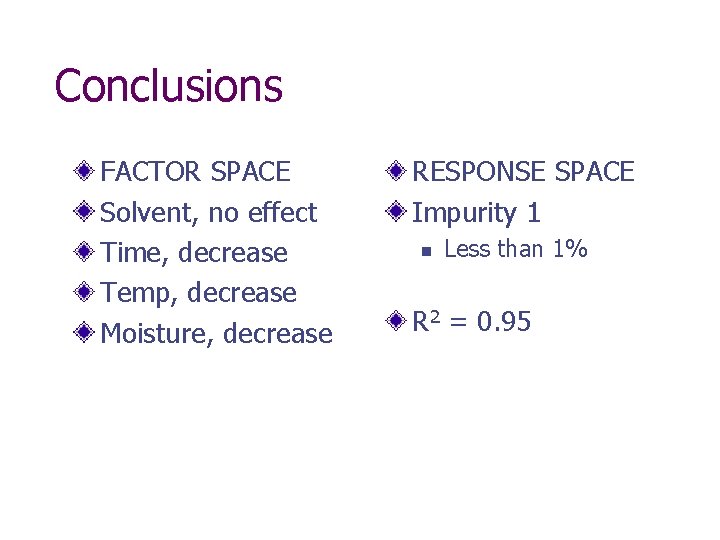
Conclusions FACTOR SPACE Solvent, no effect Time, decrease Temp, decrease Moisture, decrease RESPONSE SPACE Impurity 1 n Less than 1% R 2 = 0. 95
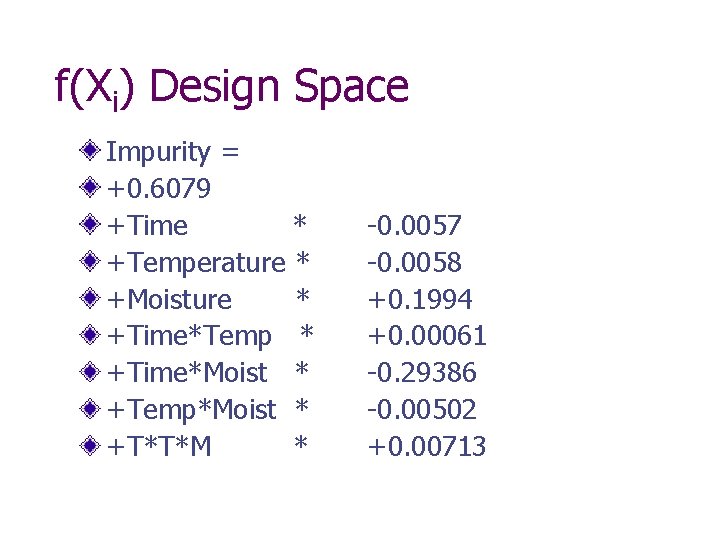
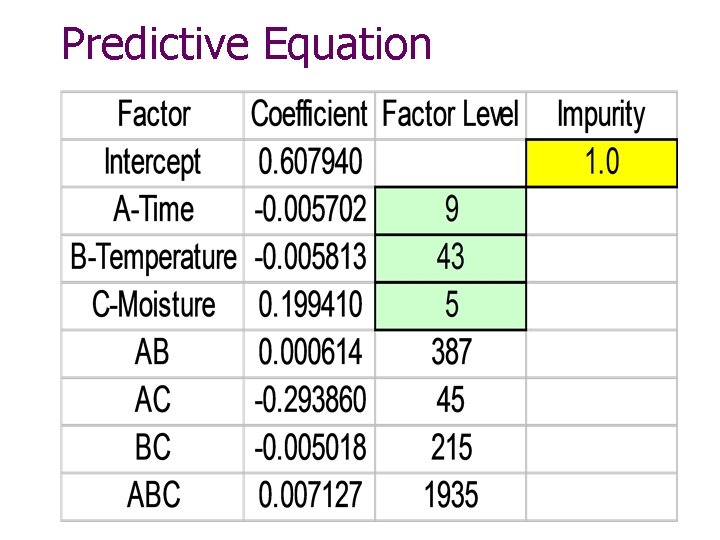
f(Xi) Design Space Impurity = +0. 6079 +Time * +Temperature * +Moisture * +Time*Temp * +Time*Moist * +Temp*Moist * +T*T*M * -0. 0057 -0. 0058 +0. 1994 +0. 00061 -0. 29386 -0. 00502 +0. 00713
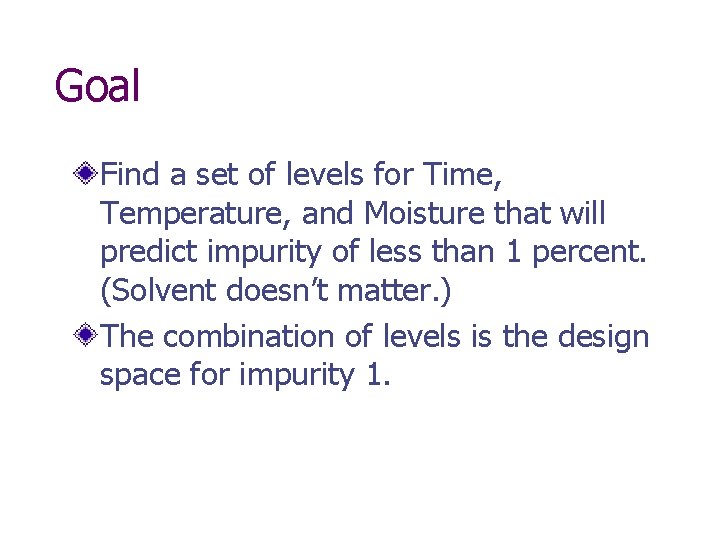
Goal Find a set of levels for Time, Temperature, and Moisture that will predict impurity of less than 1 percent. (Solvent doesn’t matter. ) The combination of levels is the design space for impurity 1.
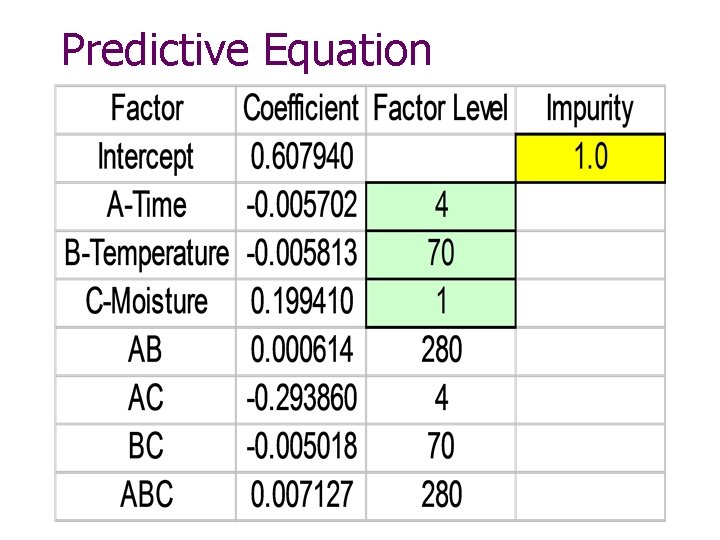
Predictive Equation
Predictive Equation
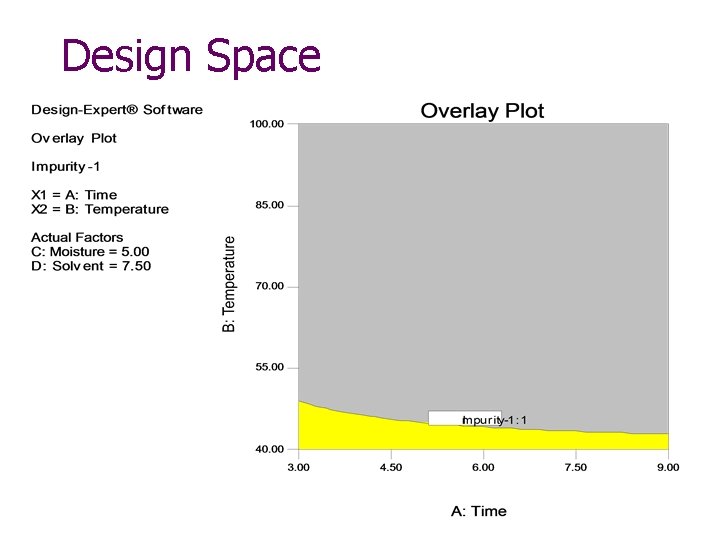
Design Space
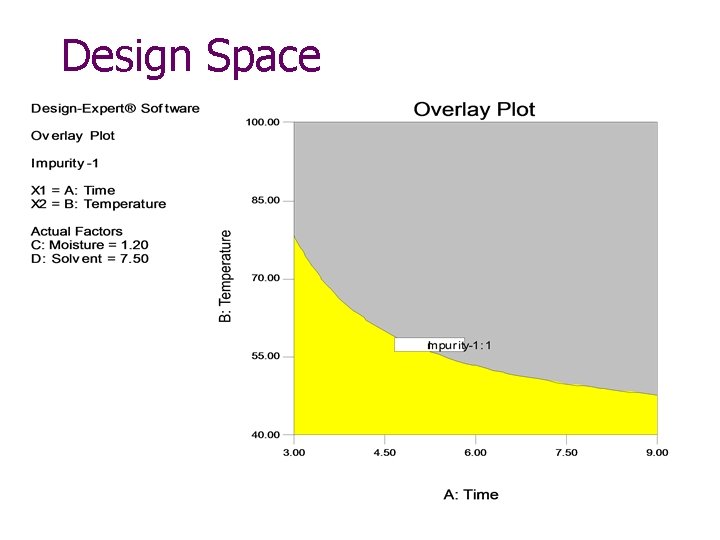
Design Space
Multidimensional Specifications should not be set one factor at a time. We need to consider all responses together. We need to do the same analysis for impurity 2, intact drug and final moisture and then overlay the four solutions to find the design space that will meet all of the criteria at the same time.
Scale-Up Scale-up may not be linear Assume that the basic equations will apply Assume the design space will be somewhat robust and rugged. Need to do confirmation experiments to confirm assumptions. Or reestablish the design space.
Design Space Conclusions ICH Q 8 and the FDA are asking for designed experiments and predictive equations for each aspect of a new product. Descriptions need to be mathematical and statistical equations. Empirical equations are the most common, but a few mechanistic equations may be possible.
Design Space Conclusions This is a new and perhaps confusing issue for the pharmaceutical industry. To implement this approach will require designed experiments with overlays of multiple responses for each new product. Sometimes retrospective studies of existing products can be done with historical data.
- Slides: 56