
How to Create Learning Targets and Performance Scales



- Slides: 12
How to Create Learning Targets and Performance Scales
Select the standard O We know that there is not enough time to discuss every standard in a PLC. O Take a few moments and discuss which standard you feel is the over arching standard for the unit. O Eventually you’ll do this with 2 -4 standards, but for now… start with one standard. O What, hands down, do the students need to know to be successful?
Resources to Get Started
6 -Step Process for Creating Learning Targets & Scales After your team prioritizes a standard. . 1. Circle the verbs and underline the nouns/phrases in the standard. 2. Chunk the standard. 3. Unpack the foundational targets. 4. Determine the level of complexity of the targets. 5. Place the targets in the scale. 6. Create the cognitively complex target and place it at the 4. 0 level.
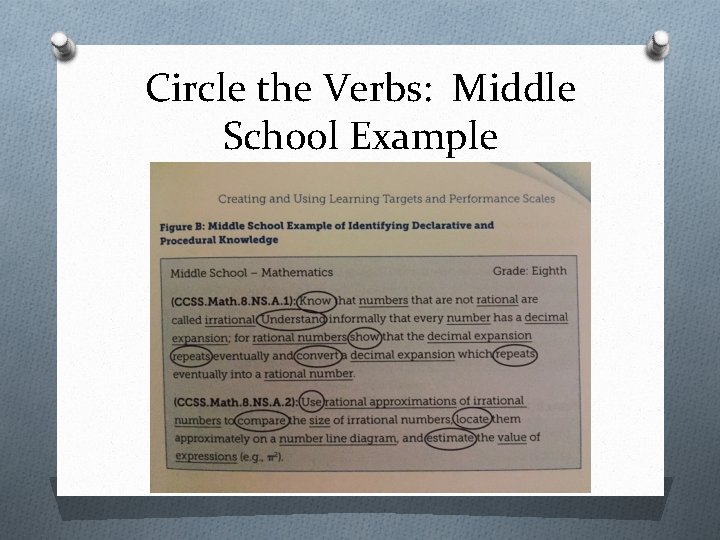
Circle the Verbs: Middle School Example
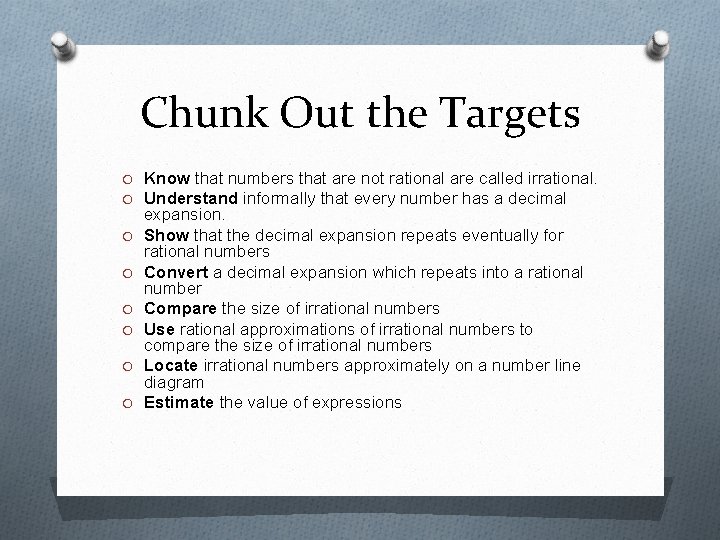
Chunk Out the Targets O Know that numbers that are not rational are called irrational. O Understand informally that every number has a decimal O O O expansion. Show that the decimal expansion repeats eventually for rational numbers Convert a decimal expansion which repeats into a rational number Compare the size of irrational numbers Use rational approximations of irrational numbers to compare the size of irrational numbers Locate irrational numbers approximately on a number line diagram Estimate the value of expressions
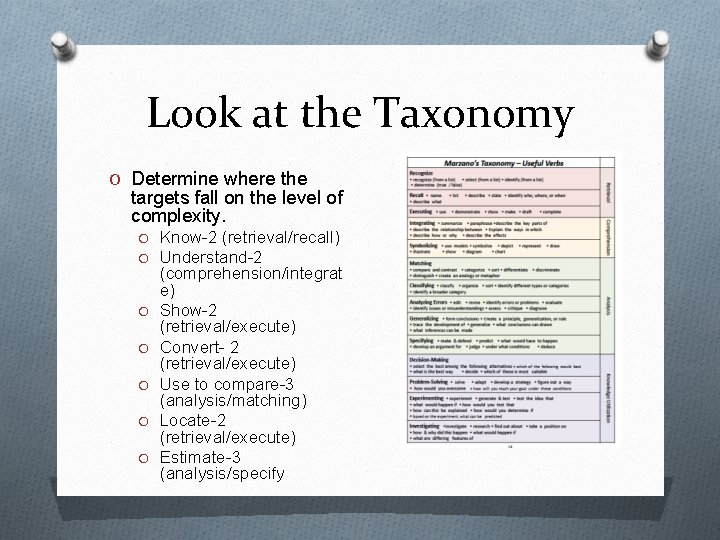
Look at the Taxonomy O Determine where the targets fall on the level of complexity. O Know-2 (retrieval/recall) O Understand-2 O O O (comprehension/integrat e) Show-2 (retrieval/execute) Convert- 2 (retrieval/execute) Use to compare-3 (analysis/matching) Locate-2 (retrieval/execute) Estimate-3 (analysis/specify
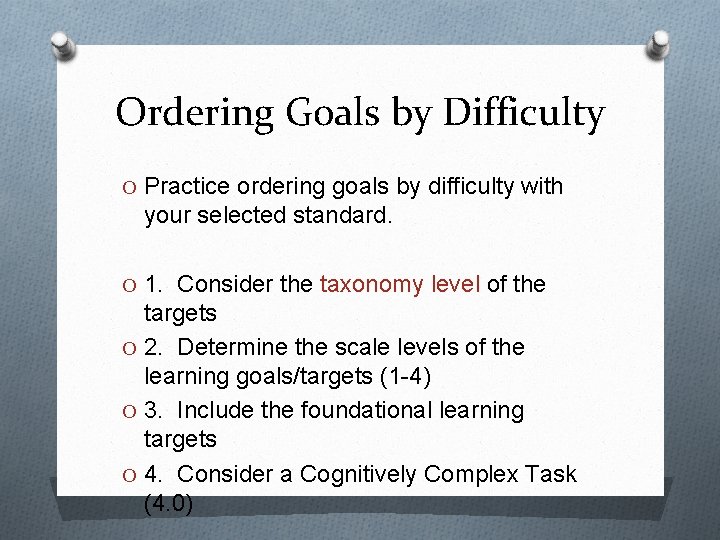
Ordering Goals by Difficulty O Practice ordering goals by difficulty with your selected standard. O 1. Consider the taxonomy level of the targets O 2. Determine the scale levels of the learning goals/targets (1 -4) O 3. Include the foundational learning targets O 4. Consider a Cognitively Complex Task (4. 0)
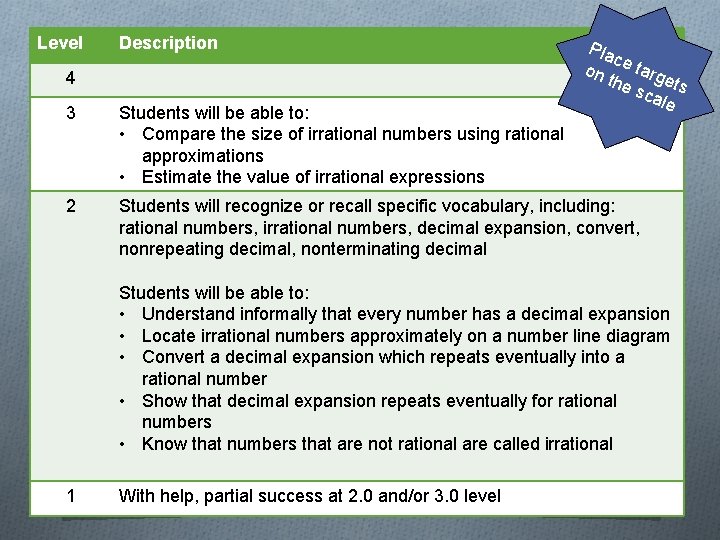
Level Description 4 Pla c on e targ the e sca ts le 3 Students will be able to: • Compare the size of irrational numbers using rational approximations • Estimate the value of irrational expressions 2 Students will recognize or recall specific vocabulary, including: rational numbers, irrational numbers, decimal expansion, convert, nonrepeating decimal, nonterminating decimal Students will be able to: • Understand informally that every number has a decimal expansion • Locate irrational numbers approximately on a number line diagram • Convert a decimal expansion which repeats eventually into a rational number • Show that decimal expansion repeats eventually for rational numbers • Know that numbers that are not rational are called irrational 1 With help, partial success at 2. 0 and/or 3. 0 level
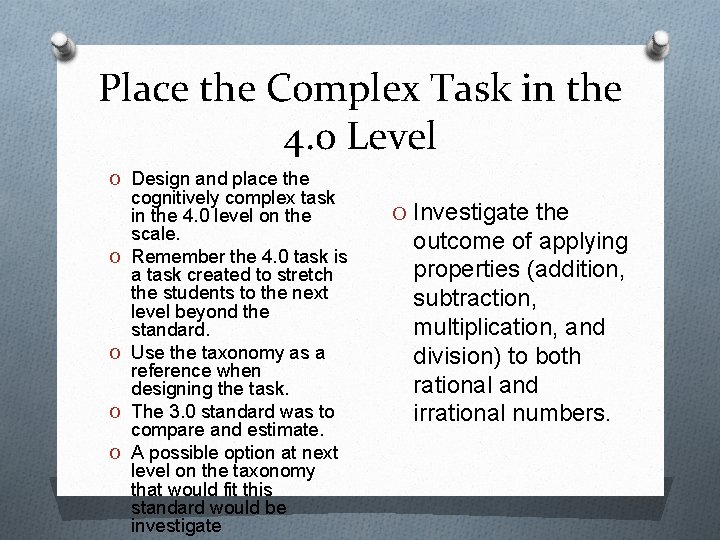
Place the Complex Task in the 4. 0 Level O Design and place the O O cognitively complex task in the 4. 0 level on the scale. Remember the 4. 0 task is a task created to stretch the students to the next level beyond the standard. Use the taxonomy as a reference when designing the task. The 3. 0 standard was to compare and estimate. A possible option at next level on the taxonomy that would fit this standard would be investigate O Investigate the outcome of applying properties (addition, subtraction, multiplication, and division) to both rational and irrational numbers.
Level Description 4. 0 e h t e ale c c a s l P the n o et targ 4 Students will be able to: • Investigate the outcome of applying properties (addition, subtraction, multiplication, and division) to both rational and irrational numbers 3 Students will be able to: • Compare the size of irrational numbers using rational approximations • Estimate the value of irrational expressions 2 Students will recognize or recall specific vocabulary, including: rational numbers, irrational numbers, decimal expansion, convert, nonrepeating decimal, nonterminating decimal Students will be able to: • Understand informally that every number has a decimal expansion • Locate irrational numbers approximately on a number line diagram • Convert a decimal expansion which repeats eventually into a rational number • Show that decimal expansion repeats eventually for rational numbers • Know that numbers that are not rational are called irrational 1 With help, partial success at 2. 0 and/or 3. 0 level
That’s all there is to it!