
How to Create and Use Meaningful IHPs for
- Slides: 53
How to Create and Use Meaningful IHPs for Students with Chronic Conditions Teresa Du. Chateau, DNP, RN, CPNP WISHe. S Project Coordinator WASN District 6 2015
Objectives � The learner will be able to explain how to develop outcome measures (indicators) as part of the student’s individual health plan � The learner will be able to identify ways to use outcome measures to guide case management/care activities � The learner will be able to articulate ways to use outcome measures to evaluate the care provided to students
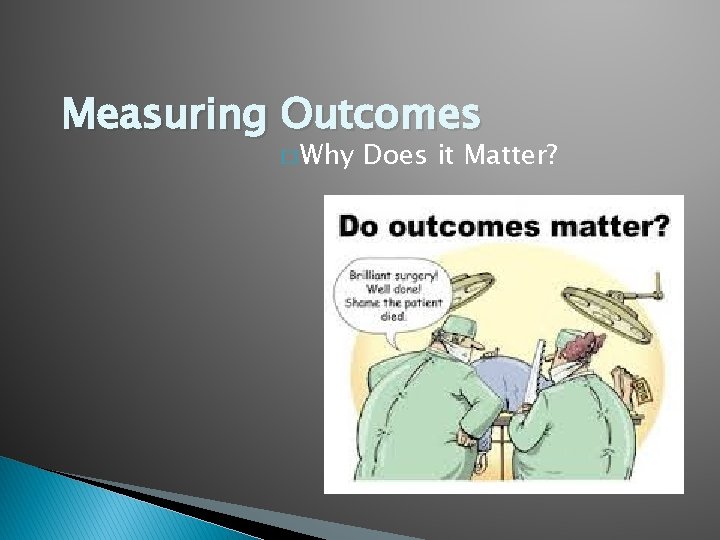
Measuring Outcomes � Why Does it Matter?
Why Do Outcomes Matter? � Determine the impact school nurses have on students managing their chronic conditions (particularly diabetes and asthma) � Example: Follow a standard, evidence-based practice of care/case management and measure the impact on: ◦ ◦ A 1 C Decreased time out of class Decreased emergencies Absenteeism (NASN, 2014)
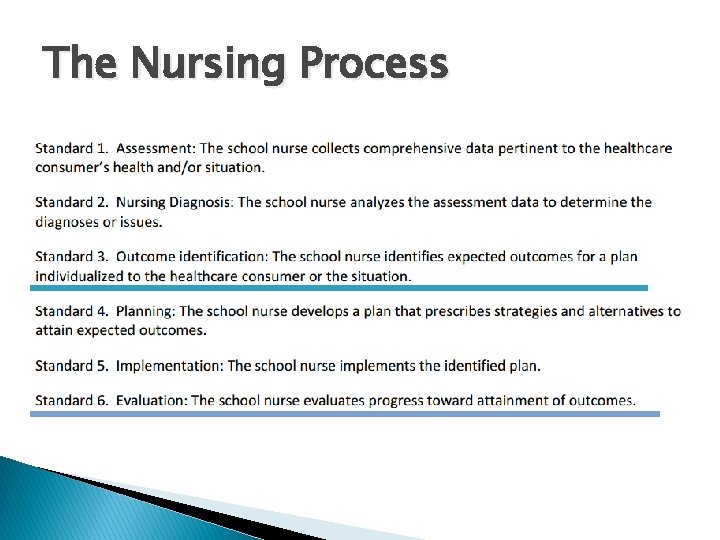
The Nursing Process
Integral Part of IHP � It is the responsibility of the school nurse to implement and evaluate the IHP at least yearly and as changes in health status occur to determine the need for revision and evidence of desired student outcomes (NASN, 2013)
Where do you Start?
Assessment � Developing Goals
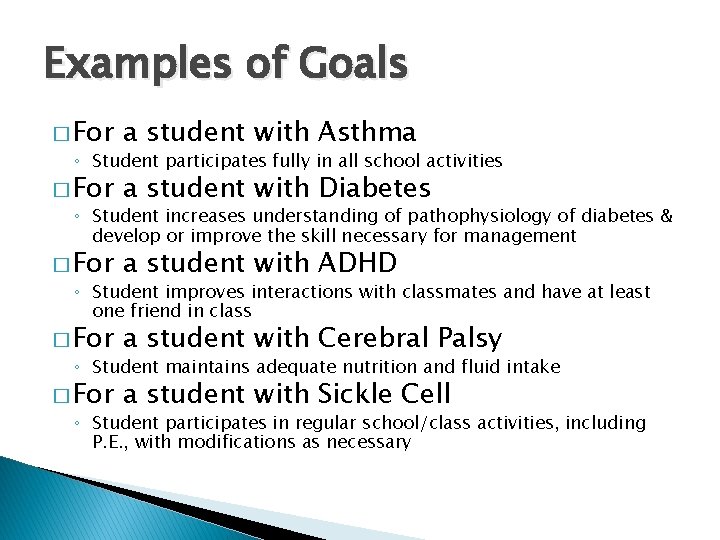
Examples of Goals � For a student with Asthma ◦ Student participates fully in all school activities � For a student with Diabetes ◦ Student increases understanding of pathophysiology of diabetes & develop or improve the skill necessary for management � For a student with ADHD ◦ Student improves interactions with classmates and have at least one friend in class � For a student with Cerebral Palsy ◦ Student maintains adequate nutrition and fluid intake � For a student with Sickle Cell ◦ Student participates in regular school/class activities, including P. E. , with modifications as necessary
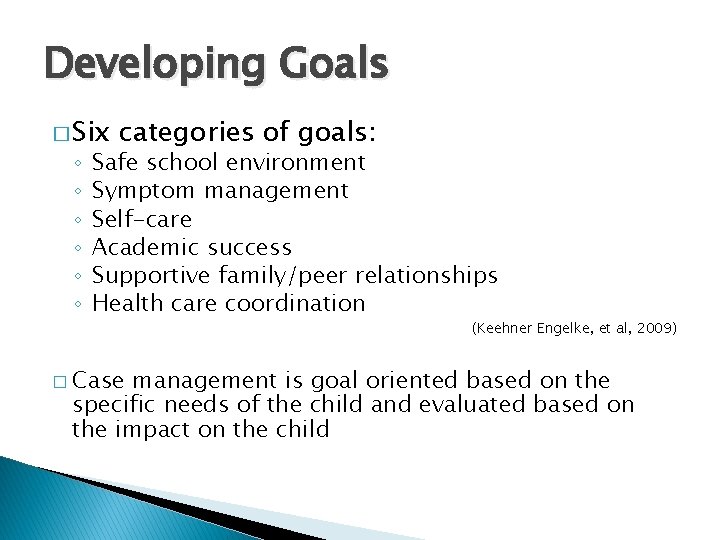
Developing Goals � Six ◦ ◦ ◦ categories of goals: Safe school environment Symptom management Self-care Academic success Supportive family/peer relationships Health care coordination (Keehner Engelke, et al, 2009) � Case management is goal oriented based on the specific needs of the child and evaluated based on the impact on the child
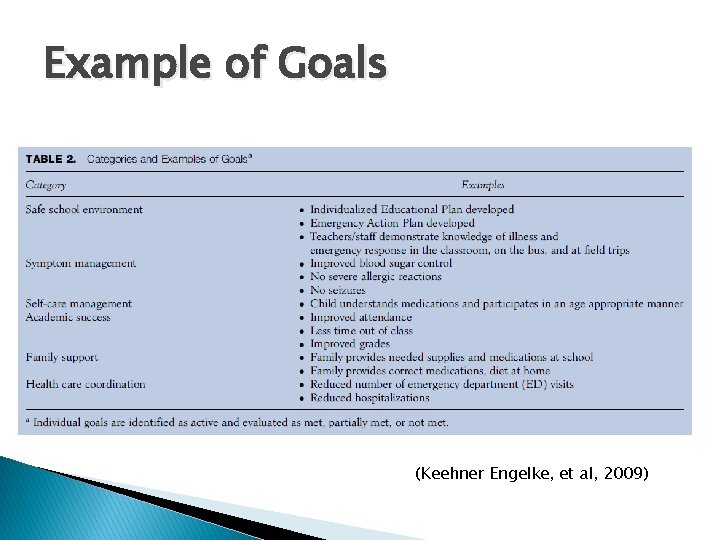
Example of Goals (Keehner Engelke, et al, 2009)
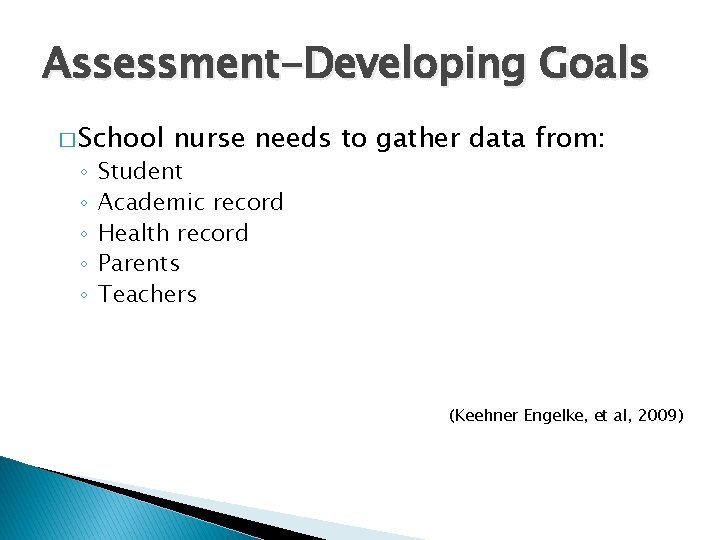
Assessment-Developing Goals � School ◦ ◦ ◦ nurse needs to gather data from: Student Academic record Health record Parents Teachers (Keehner Engelke, et al, 2009)
Attendance and Grades � The academic record is important in identifying those children whose illness is affecting their school performance � Problems related to: ◦ ◦ ◦ Grades Attendance Time out of class End-of-grade (EOG) testing Participation in school activities are possible indicators for case management (Keehner Engelke, et al, 2009)
Outcome Measurements
End in Mind � Start with the end in mind ◦ What are you trying to evaluate? ◦ Do you have a baseline measurement to evaluate the effectiveness of the intervention?
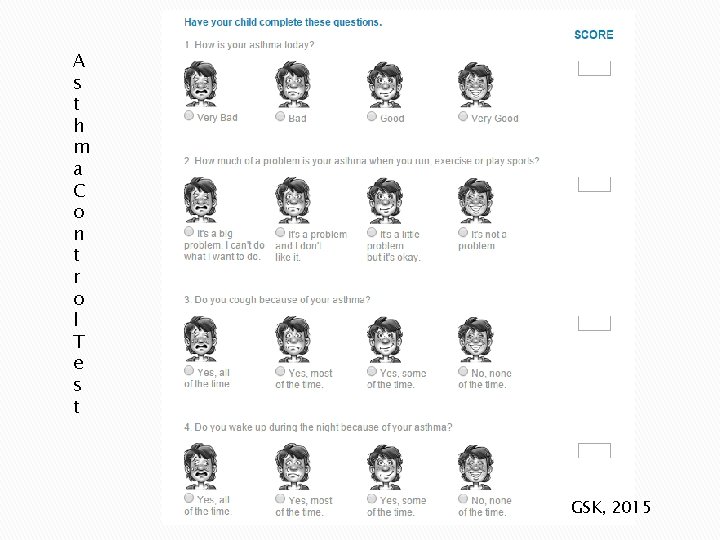
Asthma � For a student with Asthma ◦ Student participates fully in all school activities Outcome Measurement: ◦ ◦ Number of absences from physical education class Number of absences from school related to asthma Asthma Control Test score Number of times prn albuterol was administered each month
A s t h m a C o n t r o l T e s t GSK, 2015
Reduction in Symptoms � Significant such as: reduction in specific symptoms ◦ Chest tightness ◦ Wheezing ◦ Asthma attacks ◦ Students reported fewer problems with using their inhaler, being responsible for the medications, and controlling their asthma (Keehner Engelke, 2014)
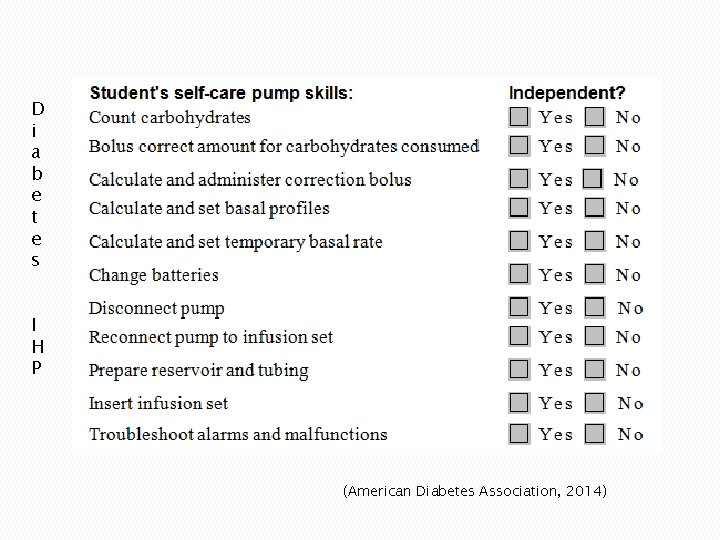
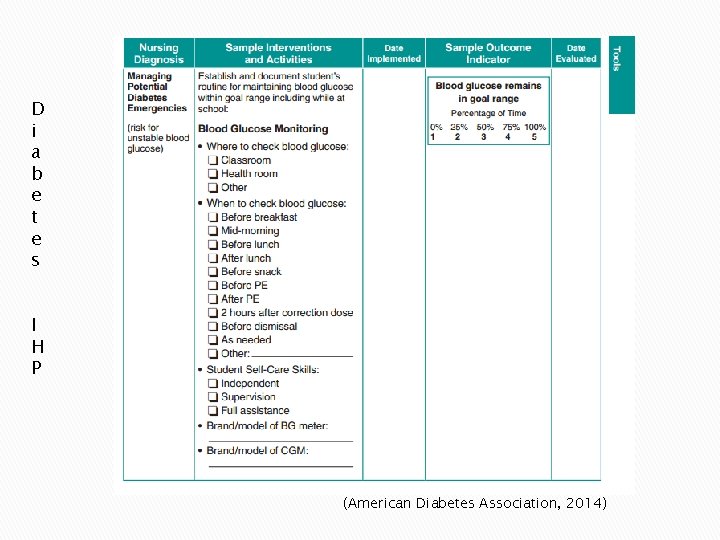
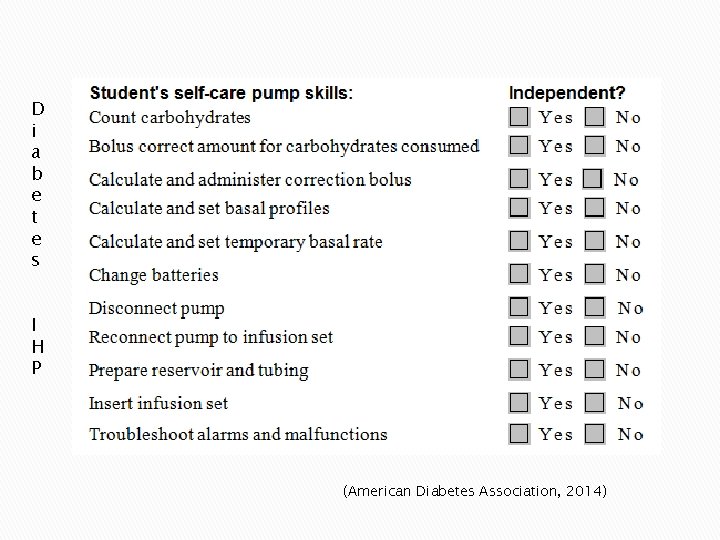
Diabetes � For a student with Diabetes ◦ Student increases understanding of pathophysiology of diabetes ◦ Student develops or improves the skill necessary for management Outcome Measurement: ◦ Student verbalization of diabetes pathophysiology ◦ Demonstration of diabetes management skills
D i a b e t e s I H P (American Diabetes Association, 2014)
D i a b e t e s I H P (American Diabetes Association, 2014)
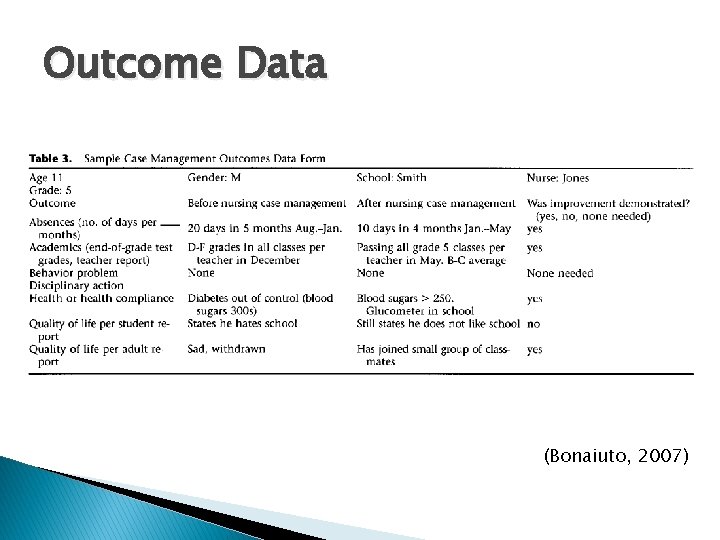
Outcome Data (Bonaiuto, 2007)
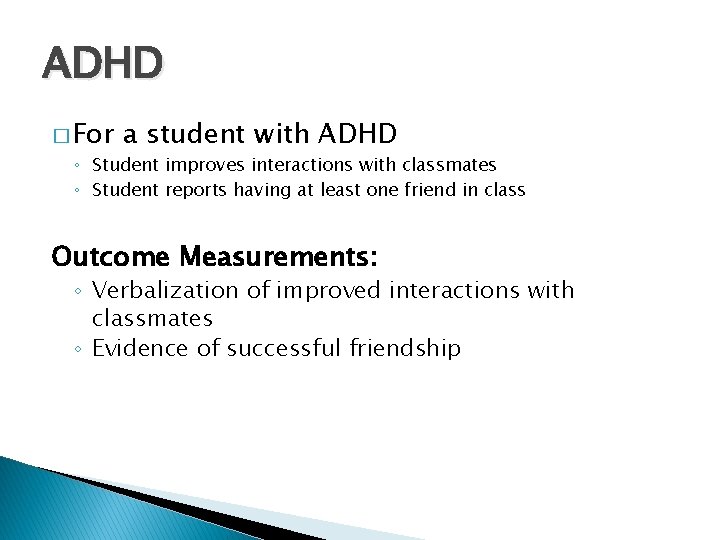
ADHD � For a student with ADHD ◦ Student improves interactions with classmates ◦ Student reports having at least one friend in class Outcome Measurements: ◦ Verbalization of improved interactions with classmates ◦ Evidence of successful friendship
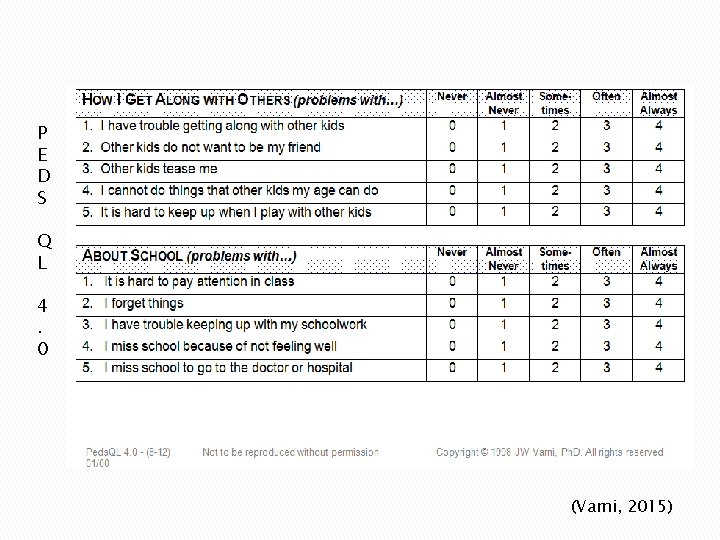
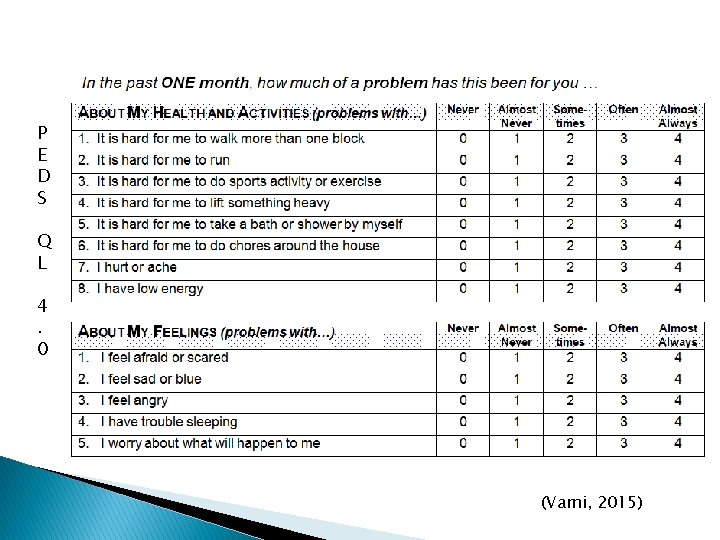
P E D S Q L 4. 0 (Varni, 2015)
P E D S Q L 4. 0 (Varni, 2015)
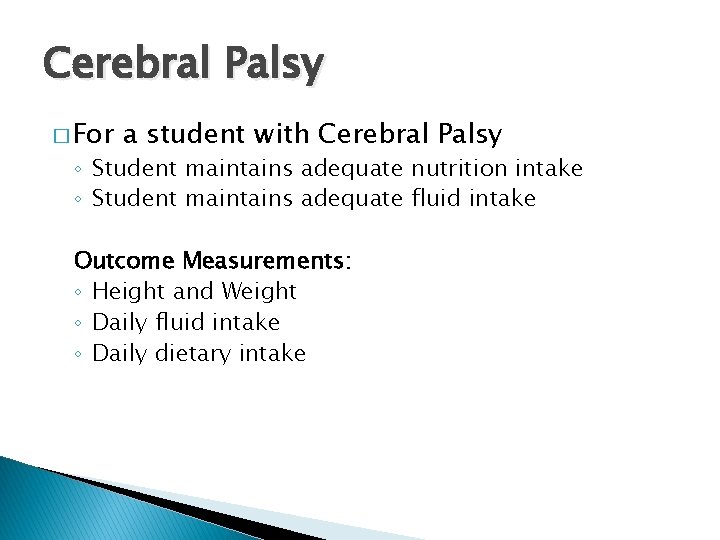
Cerebral Palsy � For a student with Cerebral Palsy ◦ Student maintains adequate nutrition intake ◦ Student maintains adequate fluid intake Outcome Measurements: ◦ Height and Weight ◦ Daily fluid intake ◦ Daily dietary intake
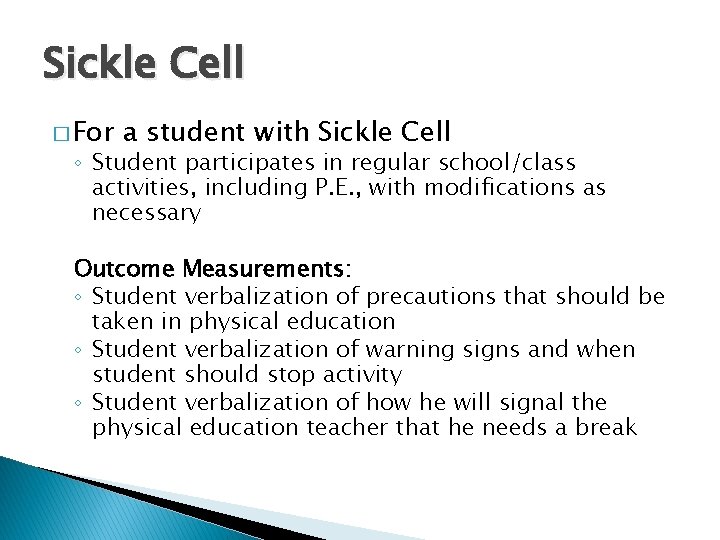
Sickle Cell � For a student with Sickle Cell ◦ Student participates in regular school/class activities, including P. E. , with modifications as necessary Outcome Measurements: ◦ Student verbalization of precautions that should be taken in physical education ◦ Student verbalization of warning signs and when student should stop activity ◦ Student verbalization of how he will signal the physical education teacher that he needs a break
Working SMART
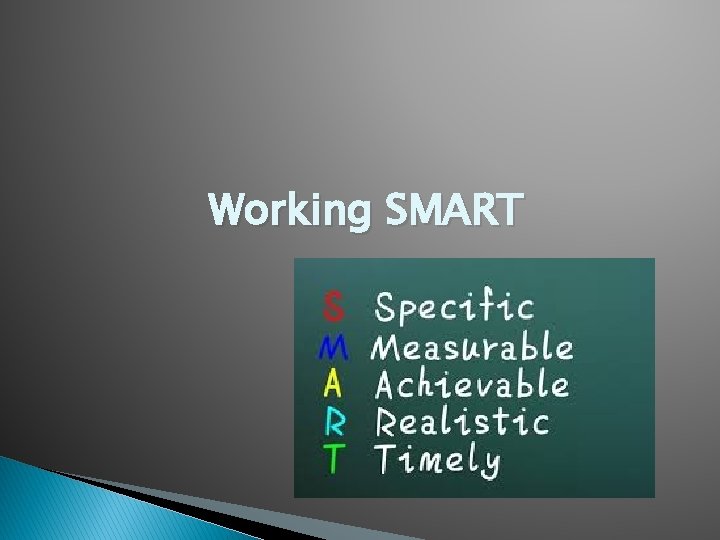
Make Your Goals SMART � SMART ◦ ◦ ◦ Specific Measurable Action-oriented Realistic Time-limited
Diabetes � For a student with Diabetes ◦ Student increases understanding of pathophysiology of diabetes ◦ Student develops or improves the skill necessary for self-management Outcome Measurement: ◦ Student verbalization of diabetes pathophysiology ◦ Demonstration of diabetes management skills
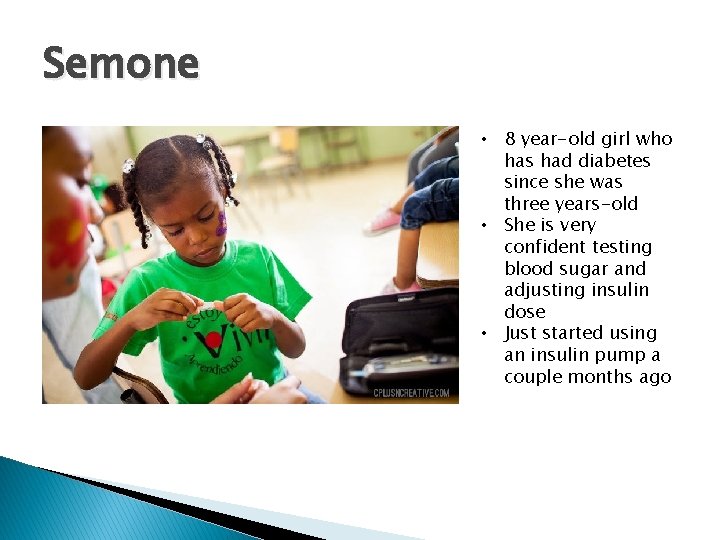
Semone • 8 year-old girl who has had diabetes since she was three years-old • She is very confident testing blood sugar and adjusting insulin dose • Just started using an insulin pump a couple months ago
SMART Goals and Outcomes Outcome Measurement: ◦ By the completion of the first semester Semone will demonstrate an increase in competence completing the following skills related to her diabetes management �Review the basal rate on insulin pump to ensure it is accurate �Set insulin pump to give prescribed bolus �Reconnect pump to infusion set
D i a b e t e s I H P (American Diabetes Association, 2014)
Intervention � At every blood glucose testing and insulin administration demonstrate or review the following: ◦ Set insulin pump to give prescribed bolus ◦ Review the basal rate on insulin pump to ensure it is accurate ◦ Reconnect pump to infusion set
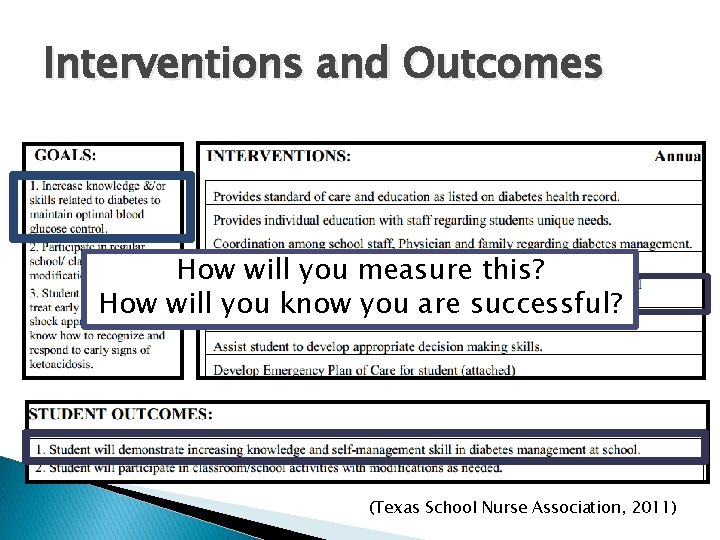
Interventions and Outcomes How will you measure this? How will you know you are successful? (Texas School Nurse Association, 2011)
Sickle Cell � Outcome Measures: ◦ Student verbalization of precautions that should be taken in physical education ◦ Student verbalization of warning signs and when student should stop activity ◦ Physical education attendance ◦ Student report of participation in physical education class ◦ Teacher report of student participation in physical education class
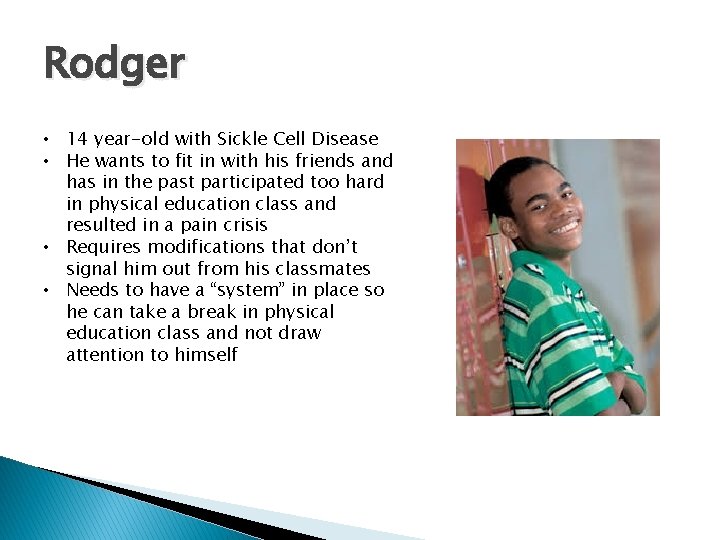
Rodger • 14 year-old with Sickle Cell Disease • He wants to fit in with his friends and has in the past participated too hard in physical education class and resulted in a pain crisis • Requires modifications that don’t signal him out from his classmates • Needs to have a “system” in place so he can take a break in physical education class and not draw attention to himself
Sickle Cell � For a student with Sickle Cell ◦ Student participates in regular school/class activities, including P. E. , with modifications as necessary Outcome Measurements: ◦ Student verbalization of precautions that should be taken in physical education ◦ Student verbalization of warning signs and when student should stop activity ◦ Student verbalization of how he will signal the physical education teacher that he needs a break
SMART Goals and Outcomes Outcome Measurement: ◦ Prior to the start of physical education class at second semester, Rodger will: �Verbalize the precautions that need to be taken in physical education class �Verbalize the warning signs that indicate he needs to stop exercising �Verbalize how he will signal the physical education teacher that he needs a break �Student will have no pain crisis as a result of overexertion in physical education class
Interventions � In December the school nurse will meet with Rodger to review: ◦ Signs and symptoms of a pain crisis ◦ Actions that trigger a pain crisis ◦ Modifications that can be taken to help prevent pain crisis ◦ How Rodger will signal the teacher that he needs a break during physical education class ◦ What Rodger should do if the teacher does not respond
Interventions � During the semester that Rodger is participating in physical education class the school nurse will: ◦ Check in with Rodger and the physical education teacher weekly during the first month of class to ensure that everyone is aware of the modifications ◦ Check in with Rodger at least twice during the semester to review the modification plan ◦ Review physical education attendance to ensure that Rodger is attending class
Using Outcomes to Guide Interventions
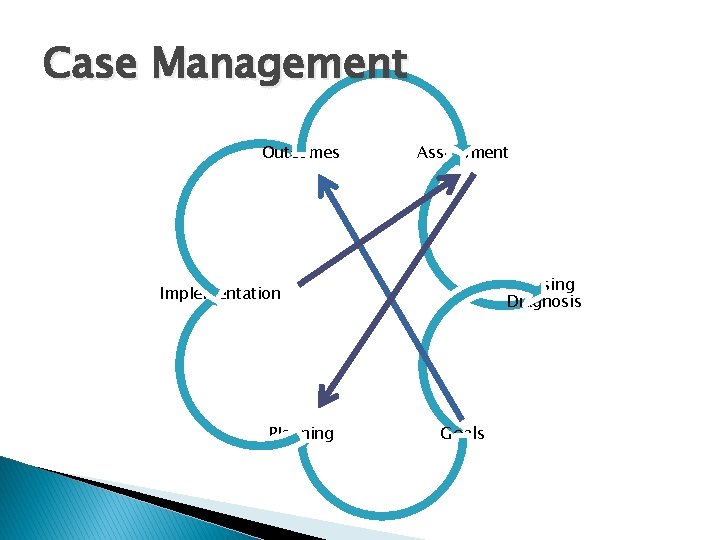
Case Management Outcomes Assessment Nursing Diagnosis Implementation Planning Goals
Other Outcome Measures
Improved Quality of Life � One outcome that seems to be relevant to most children enrolled in case management is an improvement in quality of life � We have consistently found that children: ◦ Feel that they understand manage their illness better ◦ They worry less about the long-term complications of their illness ◦ They are more open about discussing their illness with others (Keehner Engelke, et al, 2009)
Impact on Absences and ER � Levy, Heffner, Stewart, and Beeman (2006) completed a randomized control trial and found that students with asthma who received case management by school nurses had: ◦ Fewer absences ◦ Emergency department visits ◦ Hospitalizations than students who received usual care � The case management included: ◦ Weekly education and monitoring using a standardized curriculum ◦ Follow-up with school personnel, health care providers, and parents including phone calls to parents in the evening The nurses who provided the case management were fulltime asthma case managers and each nurse covered four schools
Absences, ER and GPA � Gerald et al. (2006) developed a case management program for students with asthma that involved: ◦ Case detection ◦ Medical management by study physicians ◦ Education of teachers, students, and parents � Role of the nurse included oversight of the asthma action plan � Only 7 school nurses in the district which had over 13, 000 children
Absences, ER and GPA � The ◦ ◦ study found that there was no change in: Attendance Grade point average (GPA) Emergency department visits Hospitalizations for children enrolled in the project � The authors note that the study was difficult to conduct because school personnel were overburdened and could not provide the intervention consistently � In addition, documenting academic outcomes was impossible because schools did not count absences in the same manner and so measures of attendance were unreliable (Keehner Engelke, et al, 2009)
Overburdened � We intended to train teachers at each school to conduct the educational classes for the children ◦ Teachers were overburdened with academic duties and were not able to participate � These time constraints also prevented the teachers from assisting with the collection of pre- and posttest data (Gerald, et al. , 2006)
Limitations with the Research � No electronic data collection � Didn’t collect baseline data � No standard way to track absences in the school district � Had to rely on teacher report for grades and behavior � Lack of a standard outcomes documentation form
Tracking Healthcare Utilization � This study had difficulty tracking healthcare utilization � Found that children used many different names and identities upon entering the health care system and were, therefore, difficult to track � The social security numbers that parents provided to study staff often did not match those given to health care providers (Gerald, et al. , 2006)
References � � � � � American Diabetes Association. (2014). Diabetes Medical Management Plan. Available at: http: //main. diabetes. org/dorg/PDFs/schools/dmmp-form. doc Bonaiuto, M. M. , (2007). School Nurse Case Management: Achieving Health and Educational Outcomes. The Journal of School Nursing, 23(4), 202 -209. Forrest, C. B. , Bevans, K. B. , Riley, A. W. , Crespo R. , and Louis, T. A. (2010). School Outcomes of Children With Special Health Care Needs. Pediatrics, 128(2), 303 -312. Gerald, L. B. , Redden, D. , Wittich, A. R. , Hains, C. , Turner-Henson, A. , Hemstreet, M. P. , et al. (2006). Outcomes for a comprehensive school-based asthma management program. Journal of School Health, 76, 291 -296. GSK. (2015). Childhood Asthma Control Test. Available at: http: //www. asthma. com/resources/childasthma-control-result-25. html Keehner Engelke, M. , Guttu, M. and Warren, M. B. (2009). Defining, Delivering, and Documenting the Outcomes of Case Management by School Nurses. The Journal of School Nursing, 25, 417 Keehner Engelke, M. , Guttu, M. , Warren, M. B. , and Swanson, M. (2008). School Nurse Case Management for Children With Chronic Illness: Health, Academic, and Quality of Life Outcomes. The Journal of School Nursing, 24: 205 Keehner Engelke, M. , Swanson, M. , & Guttu, M. (2014). Process and Outcomes of School Nurse Case Management for Students With Asthma. The Journal of School Nursing, 30(3) 196 -205. Mc. Daniel, K. H. , Overman, M. , Guttu, M. and Keehner Engelke, M. (2013). School Nurse Evaluations: Making the Process Meaningful and Motivational. The Journal of School Nursing , 29: 19.
References � � � � Levy, M. , Heffner, B. , Stewart, T. , & Beeman, G. (2006). The efficacy of asthma case management in an urban school district in reducing school absences and hospitalizations for asthma. Journal of School Health, 76, 320 -324. National Association of School Nurses. (2014). Research Priorities for School Nursing. Available at: http: //www. nasn. org/Research. Prioritiesfor. School. Nursing National Association of School Nurses. (2013). Individualized Healthcare Plans, The Role of the School Nurse. Available at: http: //www. nasn. org/Policy. Advocacy/Position. Papersand. Reports/NASNPosition. Stat ements. Full. View/tabid/462/smid/824/Article. ID/32/Default. aspx Texas School Nurse Association. (2011). Diabetes IHP. Available at: http: //txsno. org/files/Diabetes. IHP. pdf Texas School Nurse Association. (2011). Sickle Cell Disease Sample IHP. Available at: http: //txsno. org/files/Sickle. Cell. IHP. pdf Varni, J. W. (2015). Peds. QL Measurement Model for the Pediatrics Quality of Life Inventory. Available at: http: //www. pedsql. org/pedsql 13. html Weismuller, P. C. , Grasska, M. A. , Alexander, M. , White, C. G. , Kramer, P. (2007). Elementary School Nurse Interventions: Attendance and Health Outcomes. The Journal of School Nursing, 23(2), 111 -118.