
How to Create and Teach an Orientation Course
- Slides: 22
How to Create and Teach an Orientation Course Celeste Spier, MA Coordinator, College of Arts &Sciences Advising Center University of Nebraska. Lincoln
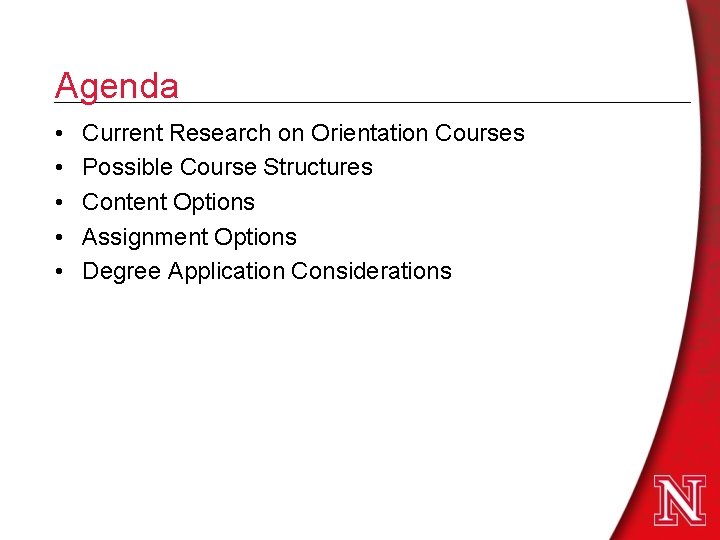
Agenda • • • Current Research on Orientation Courses Possible Course Structures Content Options Assignment Options Degree Application Considerations
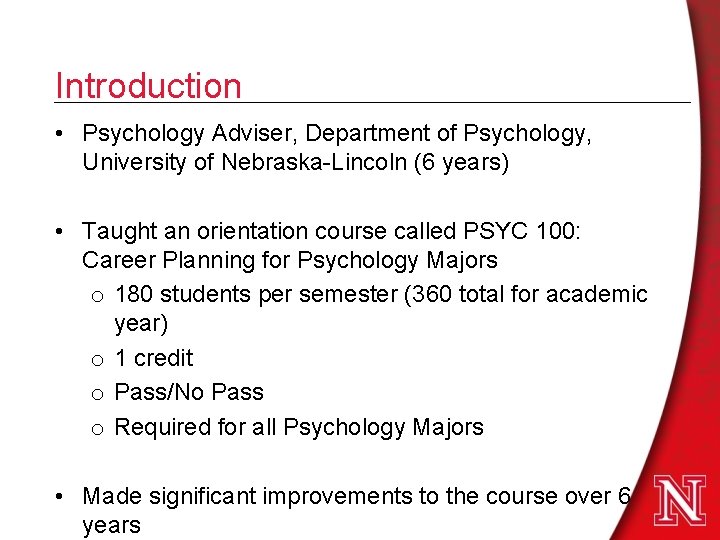
Introduction • Psychology Adviser, Department of Psychology, University of Nebraska-Lincoln (6 years) • Taught an orientation course called PSYC 100: Career Planning for Psychology Majors o 180 students per semester (360 total for academic year) o 1 credit o Pass/No Pass o Required for all Psychology Majors • Made significant improvements to the course over 6 years
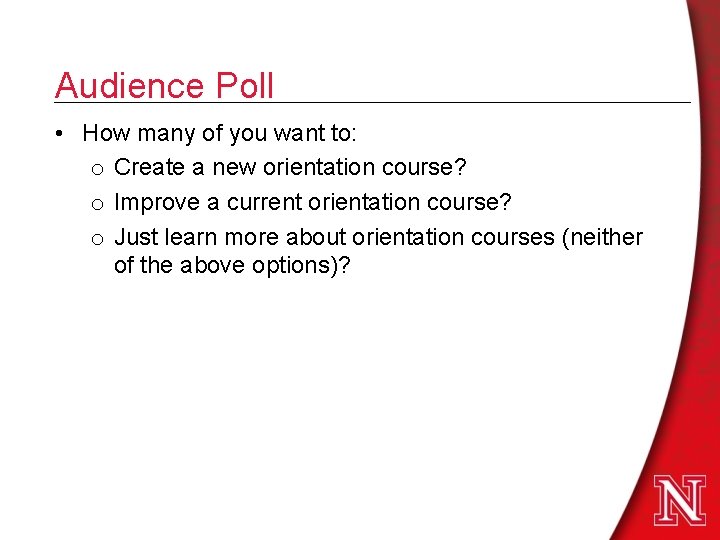
Audience Poll • How many of you want to: o Create a new orientation course? o Improve a current orientation course? o Just learn more about orientation courses (neither of the above options)?
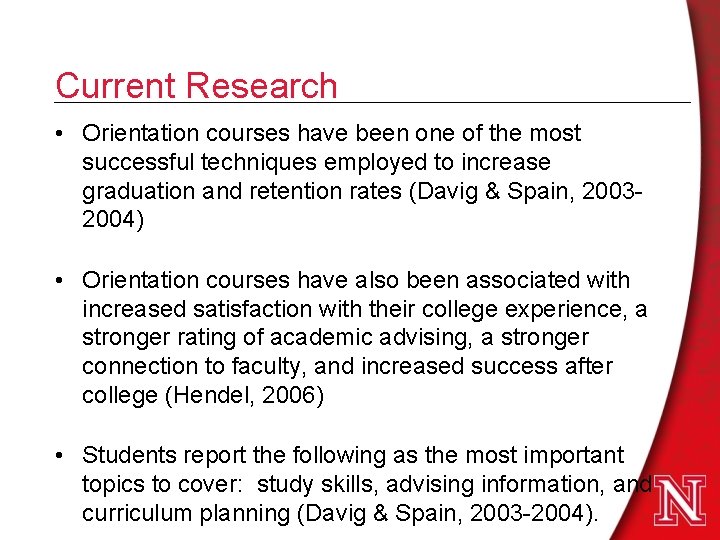
Current Research • Orientation courses have been one of the most successful techniques employed to increase graduation and retention rates (Davig & Spain, 20032004) • Orientation courses have also been associated with increased satisfaction with their college experience, a stronger rating of academic advising, a stronger connection to faculty, and increased success after college (Hendel, 2006) • Students report the following as the most important topics to cover: study skills, advising information, and curriculum planning (Davig & Spain, 2003 -2004).
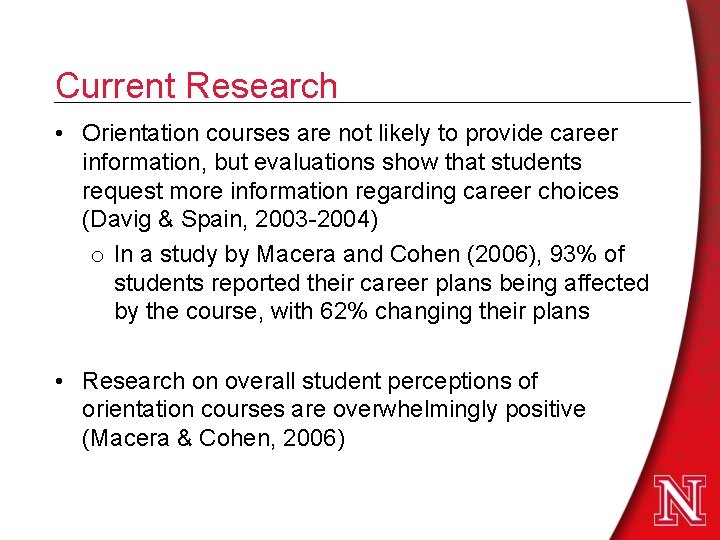
Current Research • Orientation courses are not likely to provide career information, but evaluations show that students request more information regarding career choices (Davig & Spain, 2003 -2004) o In a study by Macera and Cohen (2006), 93% of students reported their career plans being affected by the course, with 62% changing their plans • Research on overall student perceptions of orientation courses are overwhelmingly positive (Macera & Cohen, 2006)
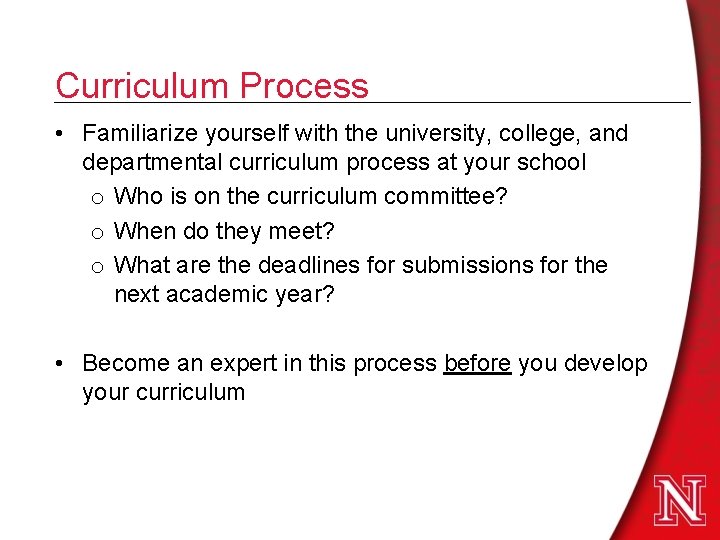
Curriculum Process • Familiarize yourself with the university, college, and departmental curriculum process at your school o Who is on the curriculum committee? o When do they meet? o What are the deadlines for submissions for the next academic year? • Become an expert in this process before you develop your curriculum
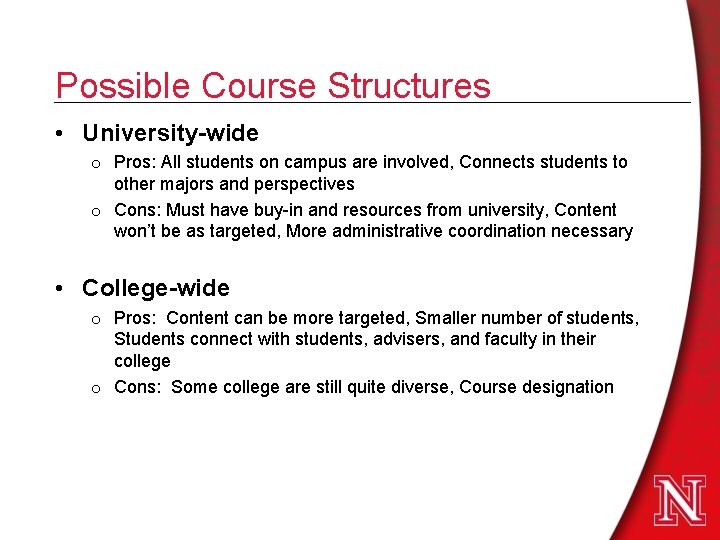
Possible Course Structures • University-wide o Pros: All students on campus are involved, Connects students to other majors and perspectives o Cons: Must have buy-in and resources from university, Content won’t be as targeted, More administrative coordination necessary • College-wide o Pros: Content can be more targeted, Smaller number of students, Students connect with students, advisers, and faculty in their college o Cons: Some college are still quite diverse, Course designation
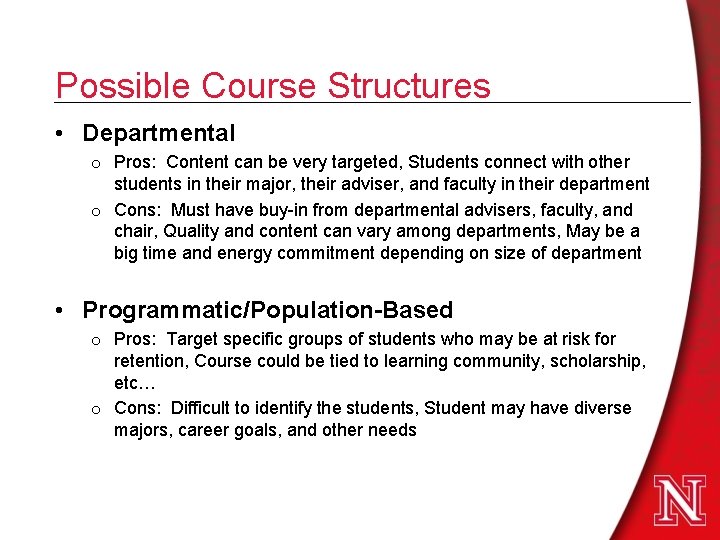
Possible Course Structures • Departmental o Pros: Content can be very targeted, Students connect with other students in their major, their adviser, and faculty in their department o Cons: Must have buy-in from departmental advisers, faculty, and chair, Quality and content can vary among departments, May be a big time and energy commitment depending on size of department • Programmatic/Population-Based o Pros: Target specific groups of students who may be at risk for retention, Course could be tied to learning community, scholarship, etc… o Cons: Difficult to identify the students, Student may have diverse majors, career goals, and other needs
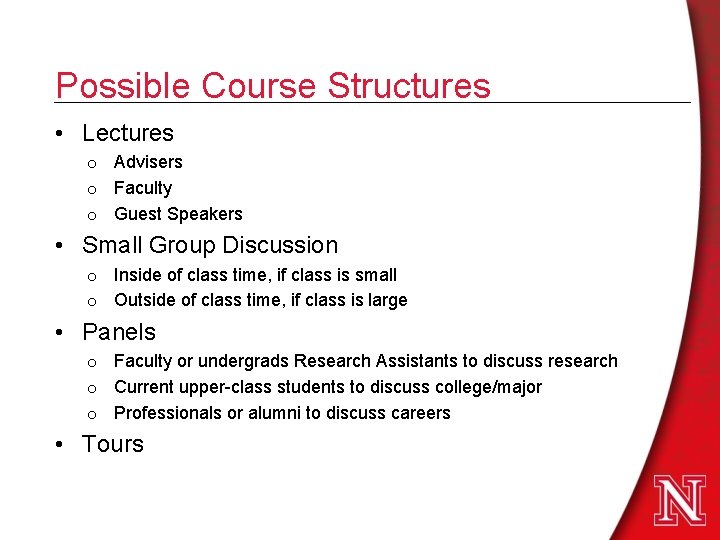
Possible Course Structures • Lectures o Advisers o Faculty o Guest Speakers • Small Group Discussion o Inside of class time, if class is small o Outside of class time, if class is large • Panels o Faculty or undergrads Research Assistants to discuss research o Current upper-class students to discuss college/major o Professionals or alumni to discuss careers • Tours
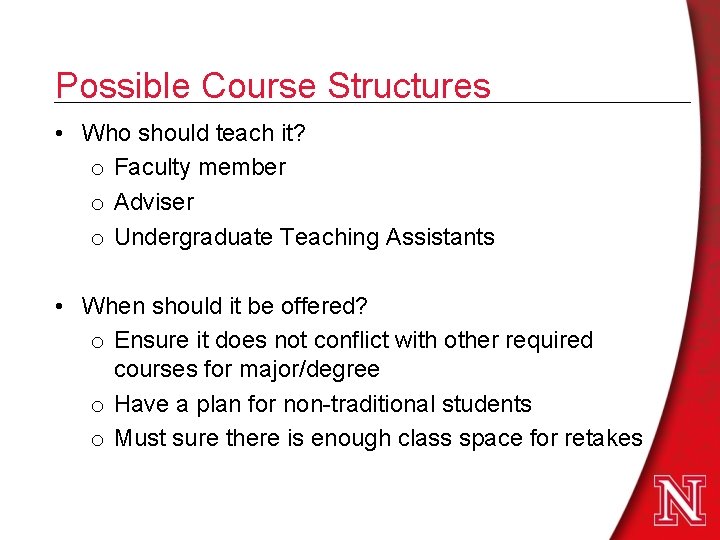
Possible Course Structures • Who should teach it? o Faculty member o Adviser o Undergraduate Teaching Assistants • When should it be offered? o Ensure it does not conflict with other required courses for major/degree o Have a plan for non-traditional students o Must sure there is enough class space for retakes
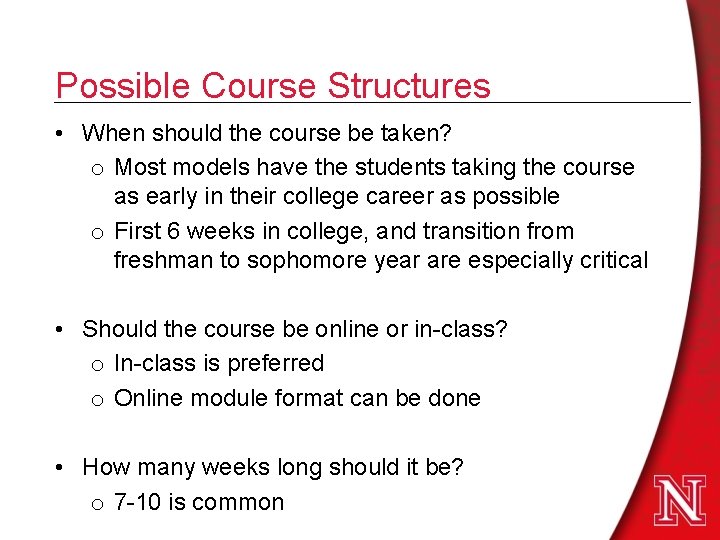
Possible Course Structures • When should the course be taken? o Most models have the students taking the course as early in their college career as possible o First 6 weeks in college, and transition from freshman to sophomore year are especially critical • Should the course be online or in-class? o In-class is preferred o Online module format can be done • How many weeks long should it be? o 7 -10 is common
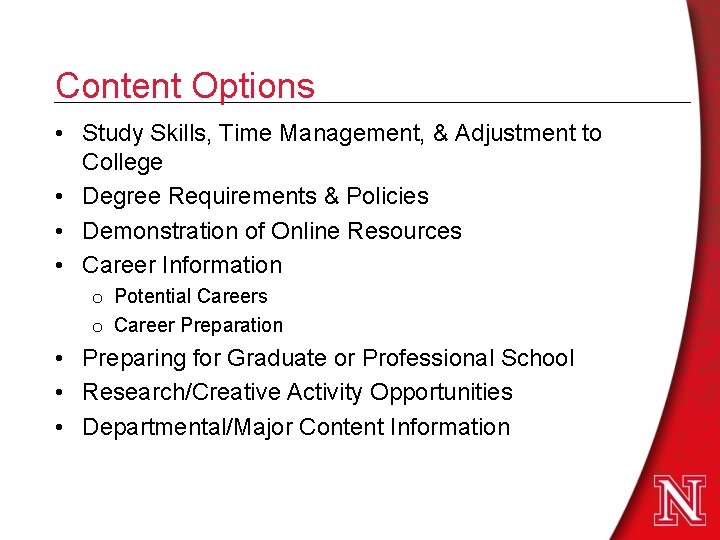
Content Options • Study Skills, Time Management, & Adjustment to College • Degree Requirements & Policies • Demonstration of Online Resources • Career Information o Potential Careers o Career Preparation • Preparing for Graduate or Professional School • Research/Creative Activity Opportunities • Departmental/Major Content Information
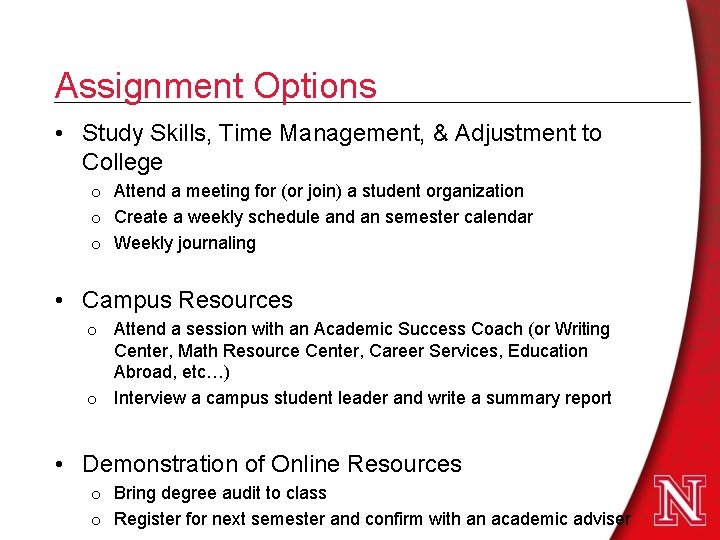
Assignment Options • Study Skills, Time Management, & Adjustment to College o Attend a meeting for (or join) a student organization o Create a weekly schedule and an semester calendar o Weekly journaling • Campus Resources o Attend a session with an Academic Success Coach (or Writing Center, Math Resource Center, Career Services, Education Abroad, etc…) o Interview a campus student leader and write a summary report • Demonstration of Online Resources o Bring degree audit to class o Register for next semester and confirm with an academic adviser
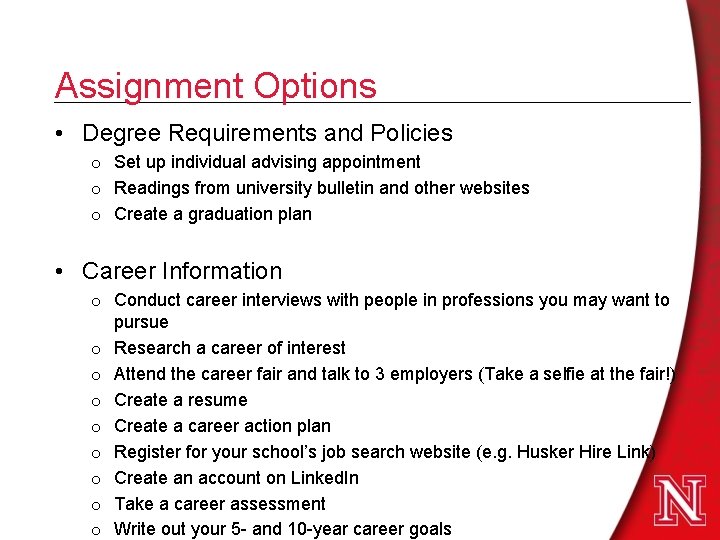
Assignment Options • Degree Requirements and Policies o Set up individual advising appointment o Readings from university bulletin and other websites o Create a graduation plan • Career Information o Conduct career interviews with people in professions you may want to pursue o Research a career of interest o Attend the career fair and talk to 3 employers (Take a selfie at the fair!) o Create a resume o Create a career action plan o Register for your school’s job search website (e. g. Husker Hire Link) o Create an account on Linked. In o Take a career assessment o Write out your 5 - and 10 -year career goals
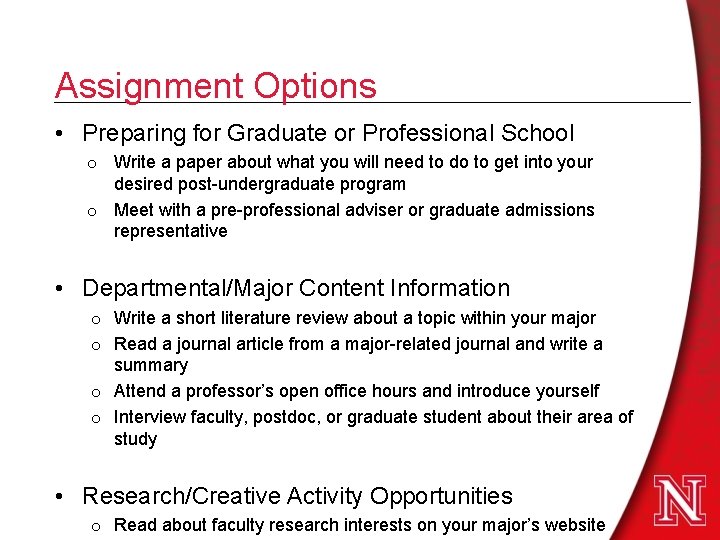
Assignment Options • Preparing for Graduate or Professional School o Write a paper about what you will need to do to get into your desired post-undergraduate program o Meet with a pre-professional adviser or graduate admissions representative • Departmental/Major Content Information o Write a short literature review about a topic within your major o Read a journal article from a major-related journal and write a summary o Attend a professor’s open office hours and introduce yourself o Interview faculty, postdoc, or graduate student about their area of study • Research/Creative Activity Opportunities o Read about faculty research interests on your major’s website
Assignment Options • General Assignments o o Write a reflection paper to demonstrate doing an activity listed Require attendance Quizzes and Exams Textbook
Degree Application Considerations • Required or Optional o If optional, you end up “preaching to the crowd” • Letter Grade or Pass/No Pass • Credit or Non-Credit o 0 or 1 credit (1 -1. 5 hours per week) o Avoid the combination of optional and 0 credit • Policy for Waiving the Course o o Non-traditional students 2 nd majors (if course is departmental) Transfer students Upper-Class students
Questions • What questions do you have at this point?
Small Group Discussion • Break into small groups of your choice • Potential discussion questions o What concerns do you have about developing an orientation course? o What barriers have you run into when trying to develop an orientation course? o What improvements would you like to make in your current orientation course? o What have you already done that could be shared as a best practice?
References Davig, W. B. & Spain, J. W. (2003 -2004). Impact on freshmen retention of orientation course content: Proposed persistence model. Journal of College Student Retention, 5(3), 305 -323. Hendel, D. D. (2006 -2007). Efficacy of participating in a first-year seminar on student satisfaction and retention. Journal of College Student Retention, 8(4), 413 -423. Macera, M. H. & Cohen, S. H. (2006). Psychology as a profession: An effective career exploration and orientation course for undergraduate psychology majors. The Career Development Quarterly, 54.
Thank you. Celeste Spier, MA Coordinator, College of Arts & Sciences Advising Center University of Nebraska-Lincoln cspier 2@unl. edu © 2007 The Board of Regents of the University of Nebraska. All rights reserved.