
How to conduct a Functional Behavioral Assessment FBA
How to conduct a Functional Behavioral Assessment FBA Presenters: Sabrina Hinton Preschool Director 1

Functional Behavioral Assessment (FBA) An FBA is designed to assess the causes of a student’s challenging behavior and to make recommendations on corresponding reports and subsequent behavioral intervention plans. 2
To conduct a FBA, you need to identify: ü Problem behavior in concrete and observable terms ü Strength of the problem behavior to establish baseline data ü Conditions under which the problem behavior occurs (including the events that trigger and reinforce the problem behavior) ü Probable reasons for or causes of the problem behavior (including biological, social, cognitive, affective, and environmental factors). 3
A FBA is Required When: • A special education student’s behavior results in certain disciplinary actions. • Prior to placing a student in a “Behavioral Disabilities Program” in the NPS, and to create a Behavioral Disciplinary Plan (BIP). • As a result of a Manifestation Determination meeting when a student behavior is a result of their disabling condition (when no FBA was previously conducted). 4
An FBA Should Also Be Considered When: Children are referred for a special education evaluation and/or students currently classified who: • Behave in ways that “interfere” with their education or with the education of others. • Exhibit aggressive, destructive, noncompliant, selfinjurious, or dangerous behaviors. • At the onset of the behavior rather than waiting until the student is removed from the setting in which the problem behavior occurred. • When a student is in need of a more restrictive placement because of behavioral concerns, I. e. Behavioral Disabilities Program (BD). • To create a behavior intervention plan (BIP) or revise a BIP. 5
4 Steps for Conducting a FBA 1. Identify challenging behavior in concrete and observable terms and the instruments to assist in this process. Measure the challenging behavior to establish base-line data, and perform assessments. Evaluate data collected. Develop a hypothesis that describes why the behavior is occurring. Note: Once the FBA is complete, the IEP team, or other practitioner’s should: 2. 3. 4. • – – – Develop recommendations and/or create a BIP to improve the problem behavior. Implementation of a BIP. Evaluate the plan and modify as needed. 6
STEP ONE Identify challenging behavior in concrete and observable terms and the instruments to assist in this process. 7
Tool Box For Step One Ø Ø Ø Teacher Questionnaire Parent Questionnaire Problem Behavior Questionnaire Functional Assessment Interview (FAI) Behavioral Assistant Scales for Children, 2 nd Edition (BASC- 2) Ø Child Depression Inventory (CDI) 8
Questions To Be Answered. . . 1. What are the antecedents of the challenging behavior (e. g. , setting events that elicit the behavior)? 2. What are the consequences for the challenging behavior, which may reinforce it? 3. What does the student gain? 4. What does the student avoid? 9
Describing the Problem Behavior? 1. 2. 3. 4. Note the type of problem behavior Note where the problem behavior occurs Note when the problem behavior occurs Note characteristics of the setting and events related to the problem behavior 5. Note situations or personal events that might induce the behavior: include actions of others that increase or trigger the behavior. 6. Note the consequences associated with the problem behavior. 10
Type of Problem Behaviors? ü Head banging ü Being physically aggressive ü Being truant ü Biting ü Crying ü Defying authority ü Destroying property ü Pushing, pulling others ü Running away ü Threatening others ü Throwing things ü Inappropriate sexual behavior ü Failing to complete assignments ü Failure to follow directions ü Failure to remain seated ü Fighting ü Yelling ü Cursing ü Talking out of turn ü Use of inappropriate language 11
Where does the Problem Behaviors occur? ü Auditorium ü Bus stop ü Cafeteria ü Classroom (Reading, Writing, Math) ü Computer room ü Hallway ü Bathroom ü Library ü Special classrooms ü Walkways 12
When does the Problem Behaviors Occur? a) Subjects being taught (history writing, reading, math, etc. ) b) Time of day (before school. Morning, afternoon) c) Instructional activity, or lack of, (individual assignments, group activity, small group d) Nonacademic activity (changing class, playground, lunch) 13
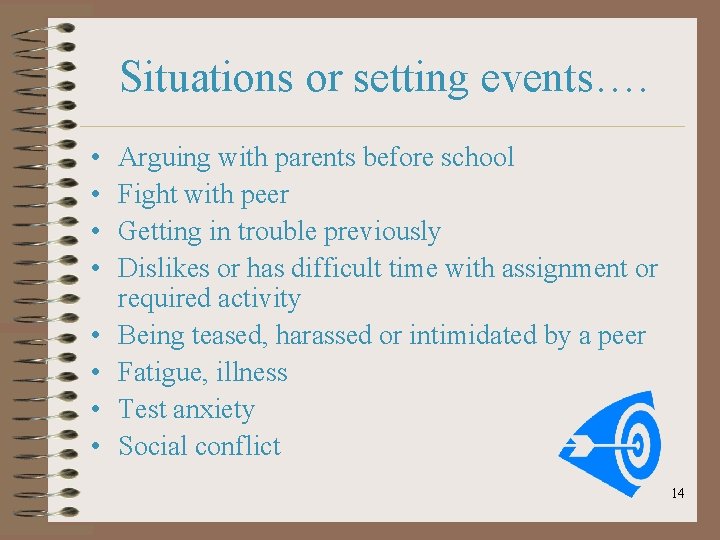
Situations or setting events…. • • Arguing with parents before school Fight with peer Getting in trouble previously Dislikes or has difficult time with assignment or required activity Being teased, harassed or intimidated by a peer Fatigue, illness Test anxiety Social conflict 14
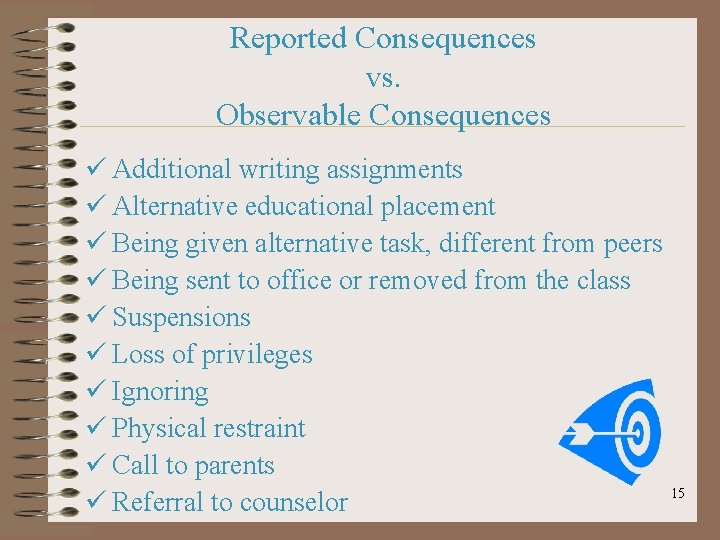
Reported Consequences vs. Observable Consequences ü Additional writing assignments ü Alternative educational placement ü Being given alternative task, different from peers ü Being sent to office or removed from the class ü Suspensions ü Loss of privileges ü Ignoring ü Physical restraint ü Call to parents 15 ü Referral to counselor
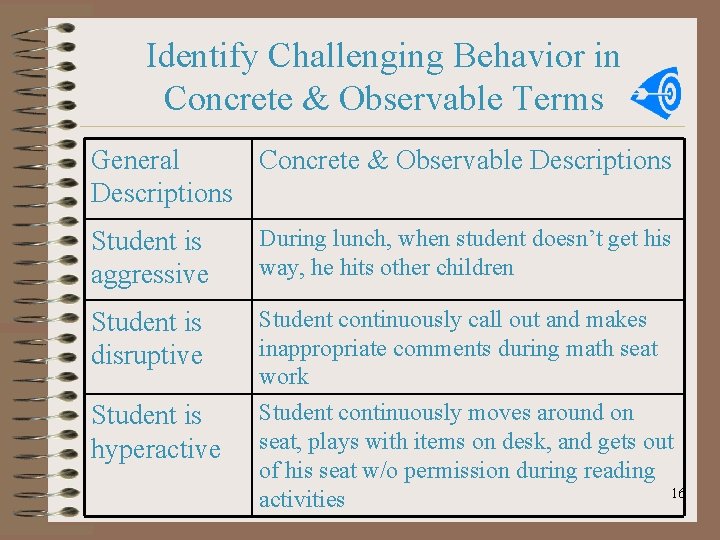
Identify Challenging Behavior in Concrete & Observable Terms General Concrete & Observable Descriptions Student is aggressive During lunch, when student doesn’t get his way, he hits other children Student is disruptive Student continuously call out and makes inappropriate comments during math seat work Student is hyperactive Student continuously moves around on seat, plays with items on desk, and gets out of his seat w/o permission during reading 16 activities
Step One Group Activity Case Study 17
STEP TWO Measure the challenging behavior to establish base-line data, and perform assessments. 18
Tool Box for Step Two ØFunctional Assessment Observation Form ØA-B-C observation form ØBASC POP or BASC SOS ØSattler’s Functional Behavioral Assessment Recording Form ØStudent Directed Functional Assessment Interview 19
Questions to be answered… • What is the strength of the challenging behavior (e. g. , frequency, duration, strength, etc. )? • How does student’s challenging behavior compare to his or her peers? • How does the student’s challenging behavior vary across settings? 20
Direct Means • • • Classroom observation(s)- varied settings & times Observe systematic behaviors, focusing on those environments in which they occur Observe the student in several different settings, during different types of activities, and at different times during the day 21
Determining whether a student’s behavior is considerable different than that of his or her peers? Identifiable factors to consider: q. Settings q. Tasks q. Reward contingencies (I. e. negative reinforcement, such as escaping tasks and responsibilities. 22
Step Two Group Activity Practice Observation 1. Divide into 4 groups 2. Assign each group a target behavior from video 3. Play video 23
STEP THREE Evaluate data collected 24
Tool Box for Step Three • Student Directed Functional Assessment Interview • Evaluate Teacher data • Graph/chart the data 25
Questions to be answered. . . • What patterns of antecedent events and/or consequences are connected to the student’s challenging behavior? • What is the student gaining or avoiding? • What are the antecedent events that elicit the behavior and what are the consequences that reinforce the behavior (A-B-C’s)? • Do skills and/or performance deficits contribute to the challenging behavior? 26
STEP FOUR Develop a hypotheses that describes why the behavior is occurring 27
Questions a Hypotheses Should Answer? • Based on previous steps, evaluation of the data, the hypotheses should attempt to explain the relationship between the problem behavior and the situation(s) in which the behavior occurs. • Is the student engaging in the challenging behavior to gain and/or avoid something? If so, what? • Is the student engaging in the challenging behavior because of corresponding reinforcements? If so, what are they? • Is the student engaging in the challenging behavior because of a skill(s) and/or performance deficit? If so what are the deficits? 28
Hypotheses should include: 1. 2. 3. 4. Relevant student background factors associated with the problem behavior Relevant environmental factors associated to the problem behavior, Functions or purpose (escape, avoidance, control) How others react to problem behavior 5. 6. 7. 8. 9. Level of understanding of problem behavior from teachers, parents, peers, etc. Students attitude about learning environment (likes or dislikes school? ) Student attitude about parents Cognitive and motivational ability the student has for coping with the problem behavior Students family, school and community strengths and resources for change. 29
Step Four Group Activity Creating an Hypotheses 30
Setting Event Matt’s problem behavior takes place when he is asked to write, read, or use higherorder thinking skills. 31
Hypothesized behaviors? He talks with his peers when he is not supposed to, leaves his seat without permission, yells, and refuses to do assigned activities…. 32
Why? in order to get out of tasks that are challenging to him (escape). 33
Final Group Activity Break into SLT’s (5 groups) Will be assigned a vignette As a group complete the 4 steps of an FBA (20 minutes) Pick a person to report out Each group will report out (10 minutes) 34
Distractible and Hyperactivity Student Sara is a 6 year old 1 nd grade student who is being seen because she is said to be in constant motion, which disrupts teaching and learning. In addition, Sara is said to be unable to pay attention in class. Despite many reported interventions, such as individual assistance and parent conferences Sara’s behavior has not improved. You are being asked to conduct a FBA to identify the causes for Sara’s hyperactive and disruptive behavior. 35
Withdrawn Student Joseph is a 10 year old 6 th grade student who is being seen because he never participates in class discussions and has no friends. This withdrawn behavior frequently results in day-dreaming, which takes Joseph off task and has a negative effect on school performance. Despite many reported interventions, such as counseling as and parent conferences Joseph’s behavior has not improved. You are being asked to conduct an FBA to identify the causes for Joseph’s withdrawn behavior. 36
Verbally Threatening and Defiant Kara a 10 year old 4 th grade student who is being seen because she reportedly constantly threatens peers and defies school authorities. Despite many reported interventions, such as counseling, suspensions, and parent conferences Kara’s behavior has not improved. You are asked to conduct a FBA to identify the causes for Kara’s threatening and defiant behavior. 37
Sexually Inappropriate Student Yazaida is a 9 year old 5 th grade student who is being seen because she frequently engages in sexually inappropriate verbal and physical behavior. Despite many reported interventions, such as counseling and parent conferences. Yazaida continues to make lewd and provocative gestures and statements to both boys and girls. You are being asked to conduct an FBA to identify the causes for Yazaida’s sexually inappropriate behavior. 38
Physically Aggressive Student Nathan is a 14 year old 9 th grade student who is being seen because he reportedly constantly hits, throws things and pushes other students. Despite many reported interventions, such as detentions, suspensions, and parent conferences Nathan’s behavior has not improved. You are being asked to conduct a FBA to identify the causes for Nathan’s physical agression. 39
Next Steps. . . Develop recommendations and/or create a BIP to improve the problem behavior. Implementation of a BIP. Evaluate the plan and modify as needed. 40
Next Step. . . Develop recommendations and/or create a BIP to improve the problem behavior. 41
Questions to be answered. . . • What pro social replacement behaviors are already in the students repertoire? • Which reinforces & punishers are effective with the student? • What environmental changes are needed to prevent the problem behavior from occurring and encouraging positive behavior? • How to change antecedents that elicit and consequences that reinforce challenging behavior? • Which skills does the student need to replace problem behaviors with appropriate behaviors? • What positive strategies can be utilized to prevent challenging behaviors occurring and increase pro social 42 replacement behaviors?
Next steps. . . Implementation of the BIP 43
How to implement the BIP? 1. 2. 3. 4. Be consistent Set boundaries Monitor effectiveness Monitor implementation 44
Next Steps. . . Evaluate the plan and modify as needed. 45
Evaluate & Modify • Plans are always in constant evaluation • If it is not working revise and re-implement • Periodically interview the student, teacher(s), and parents. • Observe the student and administer additional assessments if needed. 46
CONCLUSION Questions & Answers 47
References Sattler, J. , & Hoge, R. (2006). Assessment of children, behavioral, social and clinical foundations (4 th ed. ). California: Jerome M. Sattler Publisher, Inc. O'Neill, Robert E. , Horner, Robert H. , Albin, Richard W. , Storey, Keith & Sprague, Jeffery R. (1997). Functional assessment and program development for problem behavior: A practical handbook. Brooks/Cole Publishing Company. 48
- Slides: 48