
How to compute the Born effective charge tensor
How to compute the Born effective charge tensor Javier Junquera
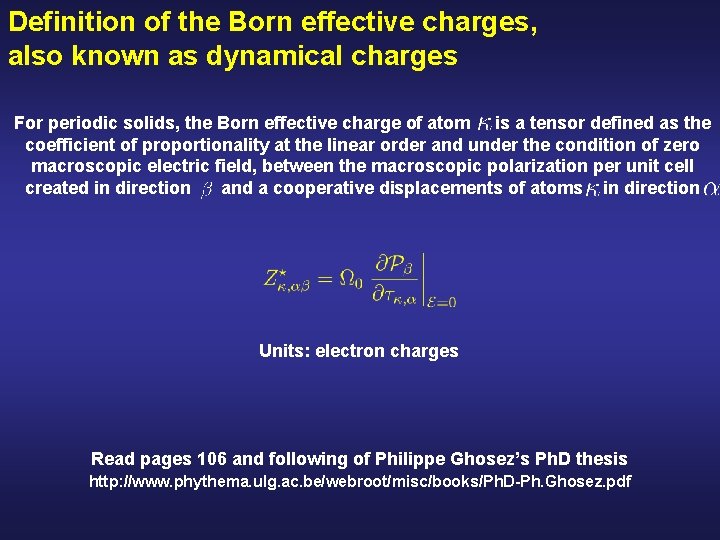
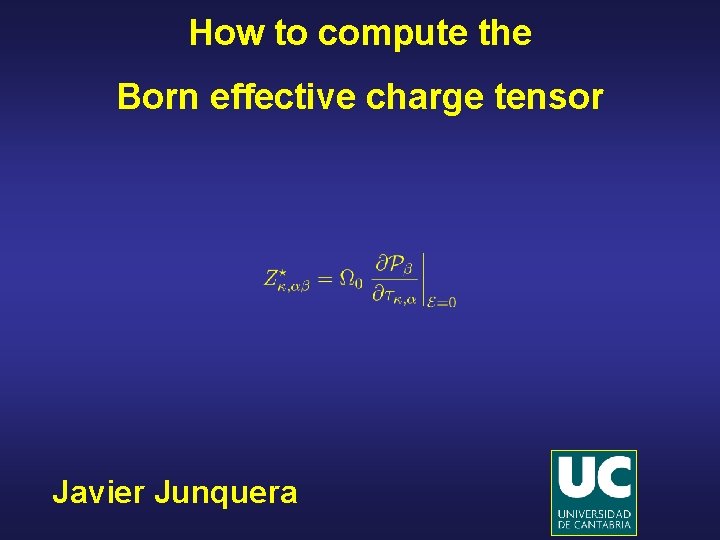
Definition of the Born effective charges, also known as dynamical charges For periodic solids, the Born effective charge of atom is a tensor defined as the coefficient of proportionality at the linear order and under the condition of zero macroscopic electric field, between the macroscopic polarization per unit cell created in direction and a cooperative displacements of atoms in direction Units: electron charges Read pages 106 and following of Philippe Ghosez’s Ph. D thesis http: //www. phythema. ulg. ac. be/webroot/misc/books/Ph. D-Ph. Ghosez. pdf
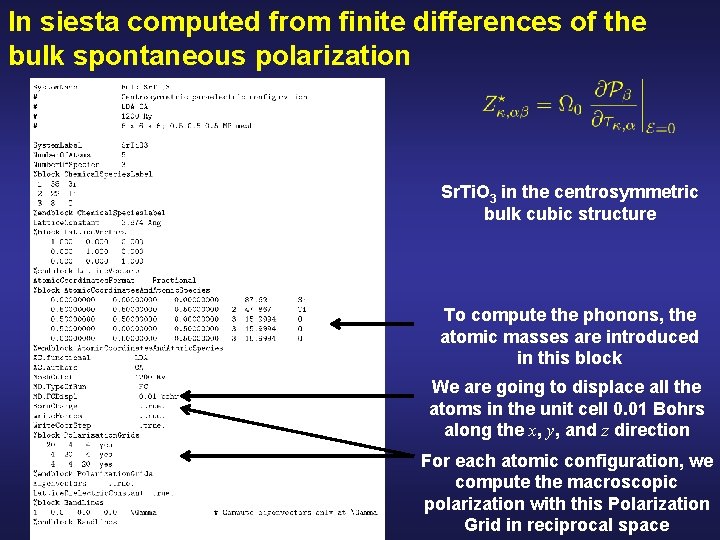
In siesta computed from finite differences of the bulk spontaneous polarization Sr. Ti. O 3 in the centrosymmetric bulk cubic structure To compute the phonons, the atomic masses are introduced in this block We are going to displace all the atoms in the unit cell 0. 01 Bohrs along the x, y, and z direction For each atomic configuration, we compute the macroscopic polarization with this Polarization Grid in reciprocal space
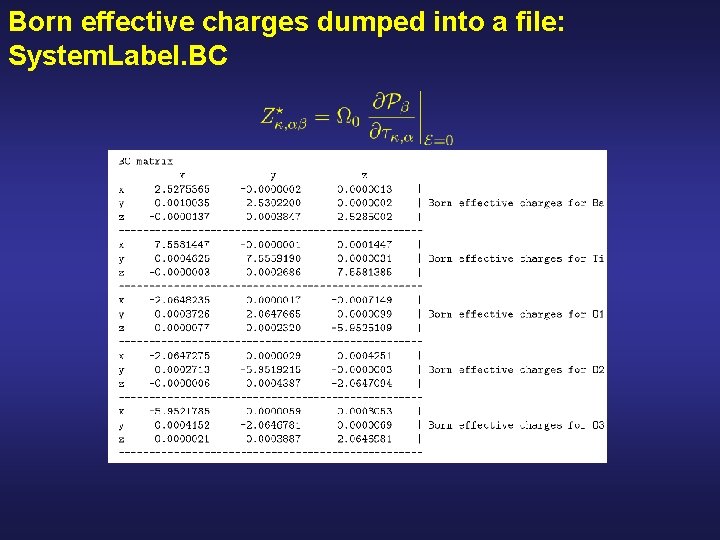
Born effective charges dumped into a file: System. Label. BC
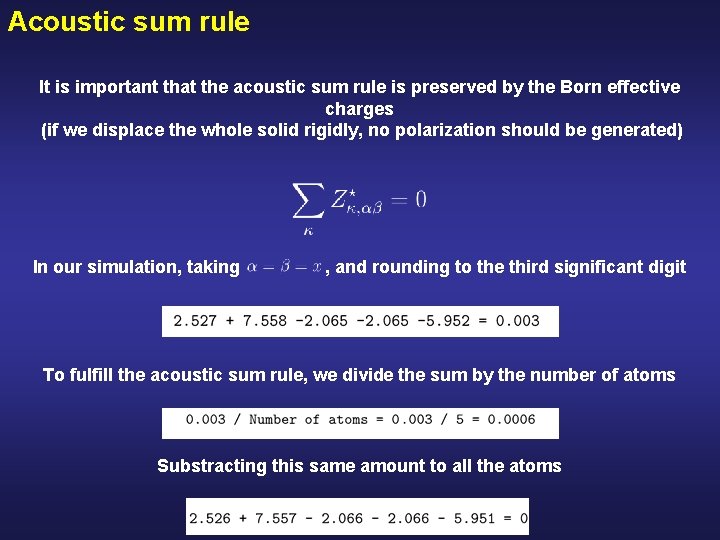
Acoustic sum rule It is important that the acoustic sum rule is preserved by the Born effective charges (if we displace the whole solid rigidly, no polarization should be generated) In our simulation, taking , and rounding to the third significant digit To fulfill the acoustic sum rule, we divide the sum by the number of atoms Substracting this same amount to all the atoms
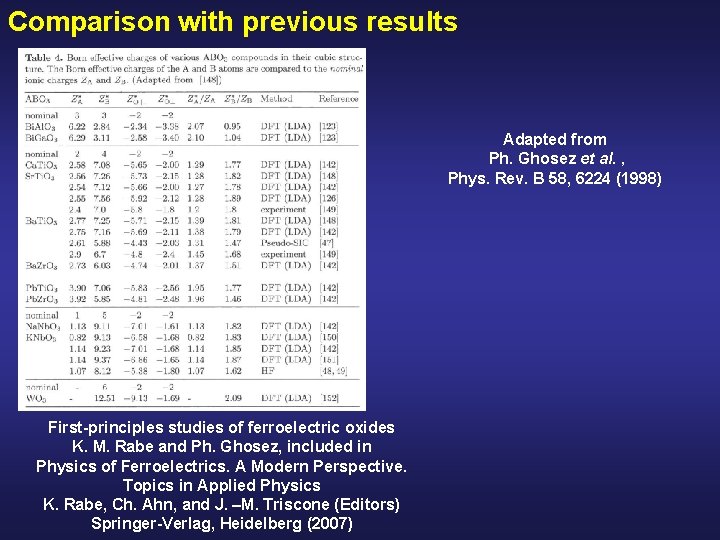
Comparison with previous results Adapted from Ph. Ghosez et al. , Phys. Rev. B 58, 6224 (1998) First-principles studies of ferroelectric oxides K. M. Rabe and Ph. Ghosez, included in Physics of Ferroelectrics. A Modern Perspective. Topics in Applied Physics K. Rabe, Ch. Ahn, and J. –M. Triscone (Editors) Springer-Verlag, Heidelberg (2007)
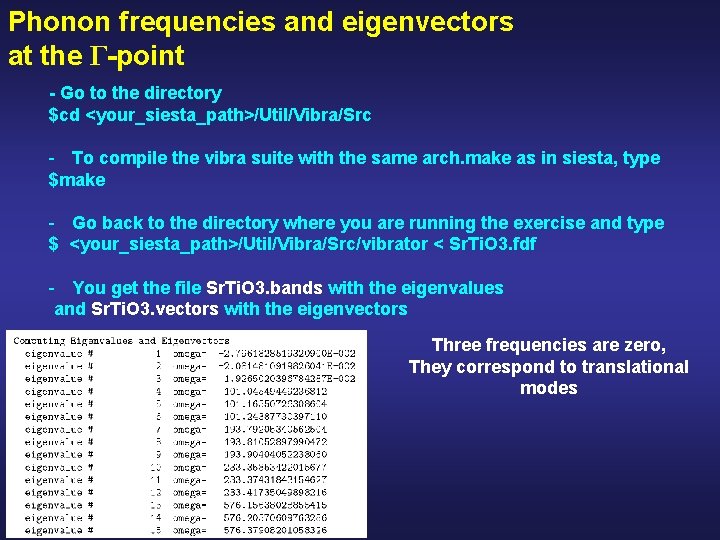
Phonon frequencies and eigenvectors at the Γ-point - Go to the directory $cd <your_siesta_path>/Util/Vibra/Src - To compile the vibra suite with the same arch. make as in siesta, type $make - Go back to the directory where you are running the exercise and type $ <your_siesta_path>/Util/Vibra/Src/vibrator < Sr. Ti. O 3. fdf - You get the file Sr. Ti. O 3. bands with the eigenvalues and Sr. Ti. O 3. vectors with the eigenvectors Three frequencies are zero, They correspond to translational modes
- Slides: 7