
How to Compare Adjectives Comparation of Adjectives If
- Slides: 14
How to Compare Adjectives
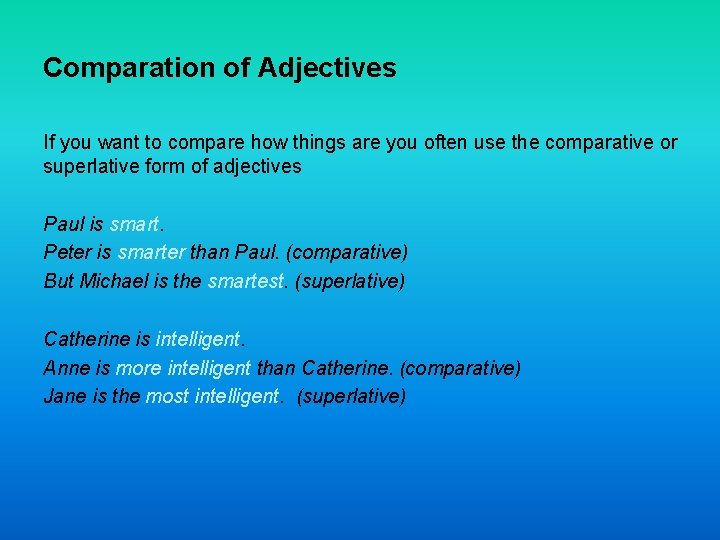
Comparation of Adjectives If you want to compare how things are you often use the comparative or superlative form of adjectives Paul is smart. Peter is smarter than Paul. (comparative) But Michael is the smartest. (superlative) Catherine is intelligent. Anne is more intelligent than Catherine. (comparative) Jane is the most intelligent. (superlative)
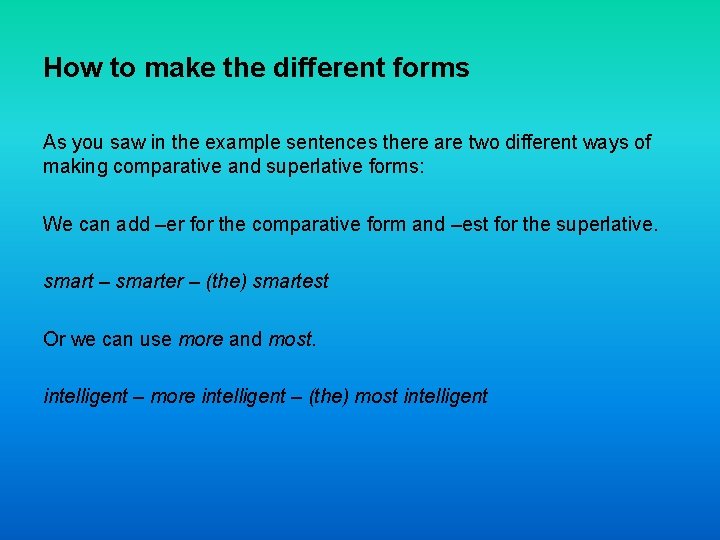
How to make the different forms As you saw in the example sentences there are two different ways of making comparative and superlative forms: We can add –er for the comparative form and –est for the superlative. smart – smarter – (the) smartest Or we can use more and most. intelligent – more intelligent – (the) most intelligent
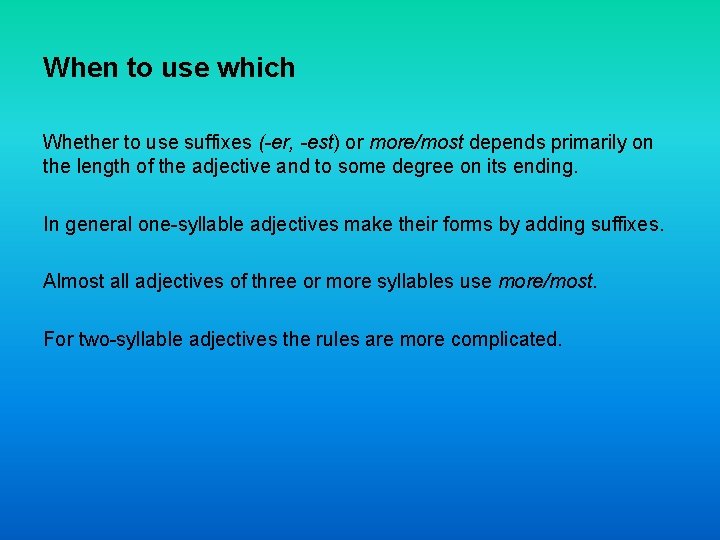
When to use which Whether to use suffixes (-er, -est) or more/most depends primarily on the length of the adjective and to some degree on its ending. In general one-syllable adjectives make their forms by adding suffixes. Almost all adjectives of three or more syllables use more/most. For two-syllable adjectives the rules are more complicated.
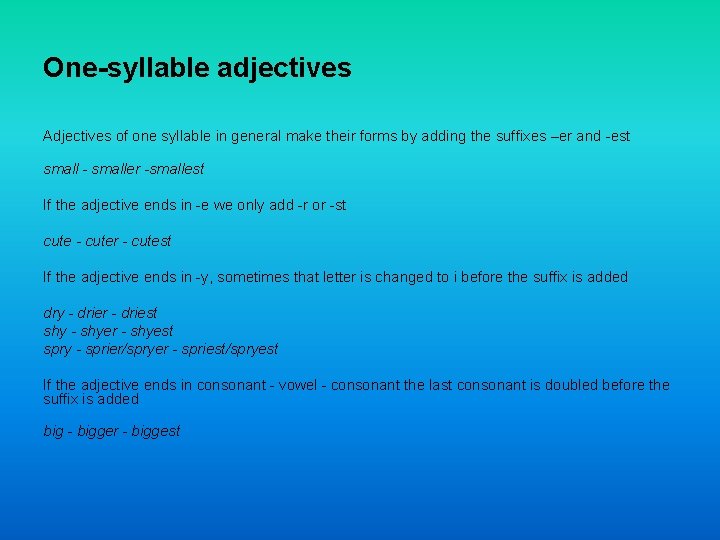
One-syllable adjectives Adjectives of one syllable in general make their forms by adding the suffixes –er and -est small - smaller -smallest If the adjective ends in -e we only add -r or -st cute - cuter - cutest If the adjective ends in -y, sometimes that letter is changed to i before the suffix is added dry - drier - driest shy - shyer - shyest spry - sprier/spryer - spriest/spryest If the adjective ends in consonant - vowel - consonant the last consonant is doubled before the suffix is added big - bigger - biggest
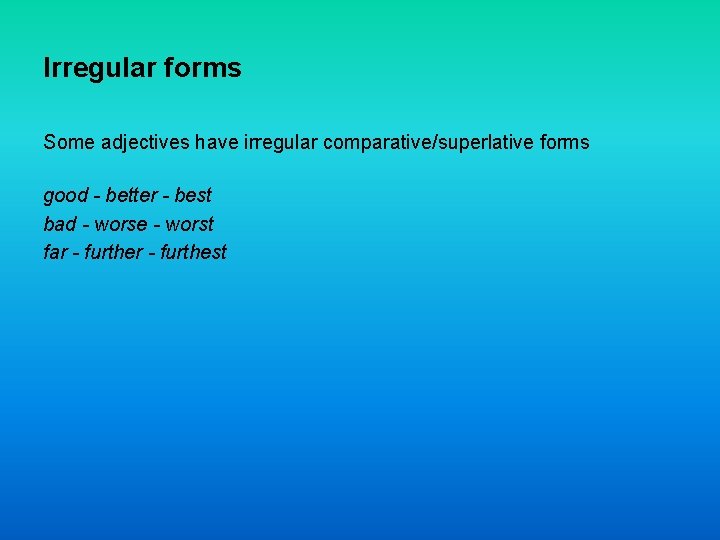
Irregular forms Some adjectives have irregular comparative/superlative forms good - better - best bad - worse - worst far - furthest
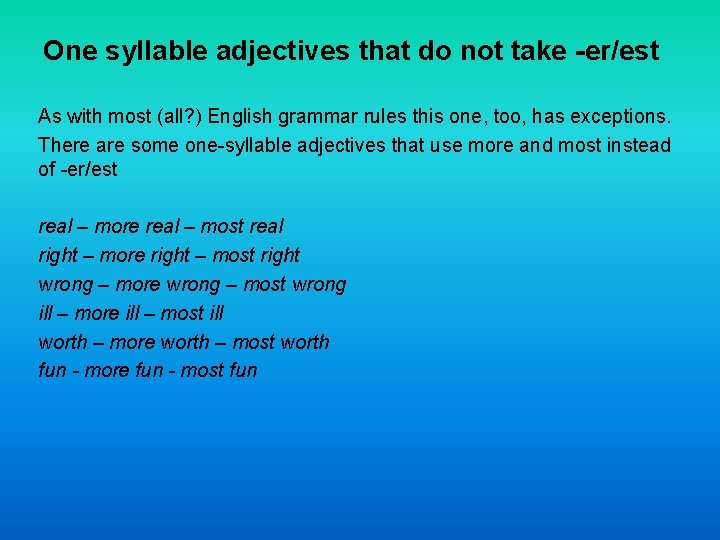
One syllable adjectives that do not take -er/est As with most (all? ) English grammar rules this one, too, has exceptions. There are some one-syllable adjectives that use more and most instead of -er/est real – more real – most real right – more right – most right wrong – more wrong – most wrong ill – more ill – most ill worth – more worth – most worth fun - more fun - most fun
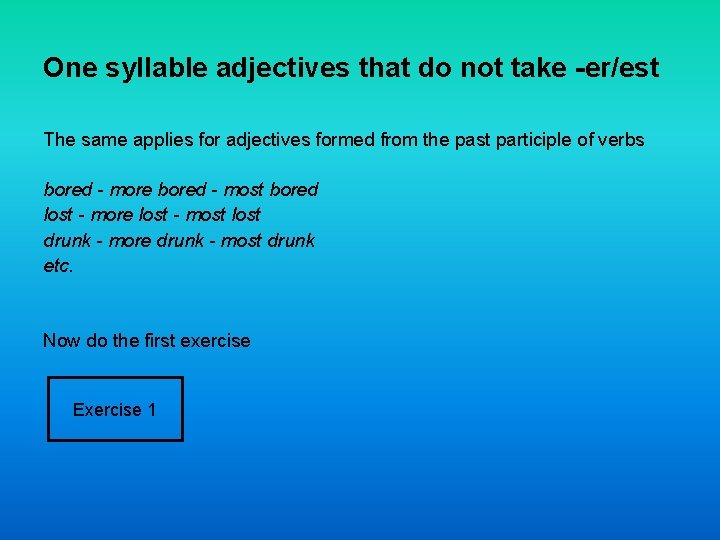
One syllable adjectives that do not take -er/est The same applies for adjectives formed from the past participle of verbs bored - more bored - most bored lost - more lost - most lost drunk - more drunk - most drunk etc. Now do the first exercise Exercise 1
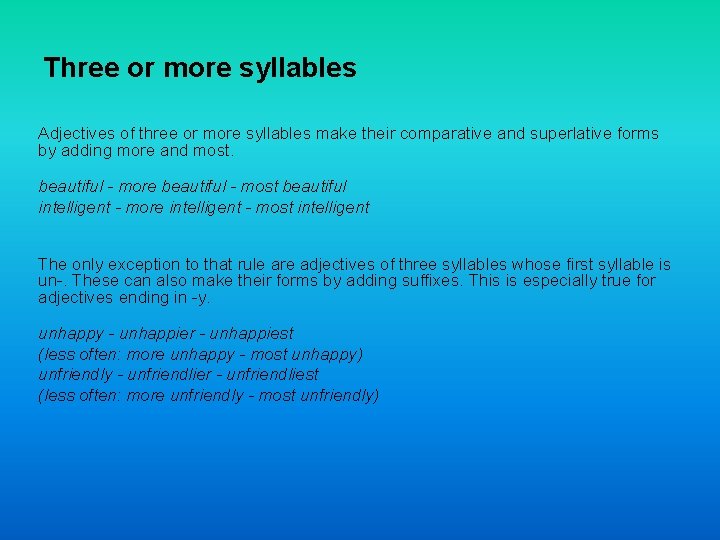
Three or more syllables Adjectives of three or more syllables make their comparative and superlative forms by adding more and most. beautiful - more beautiful - most beautiful intelligent - more intelligent - most intelligent The only exception to that rule are adjectives of three syllables whose first syllable is un-. These can also make their forms by adding suffixes. This is especially true for adjectives ending in -y. unhappy - unhappier - unhappiest (less often: more unhappy - most unhappy) unfriendly - unfriendlier - unfriendliest (less often: more unfriendly - most unfriendly)
Now do exercise 2 Exercise 2
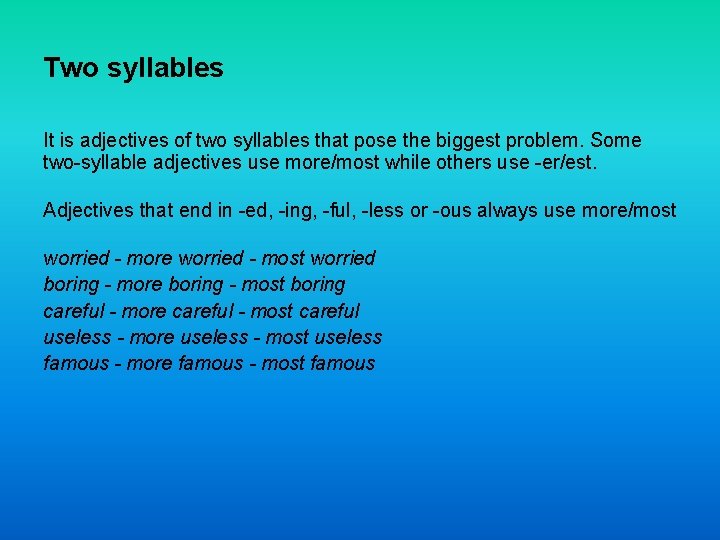
Two syllables It is adjectives of two syllables that pose the biggest problem. Some two-syllable adjectives use more/most while others use -er/est. Adjectives that end in -ed, -ing, -ful, -less or -ous always use more/most worried - more worried - most worried boring - more boring - most boring careful - more careful - most careful useless - more useless - most useless famous - more famous - most famous
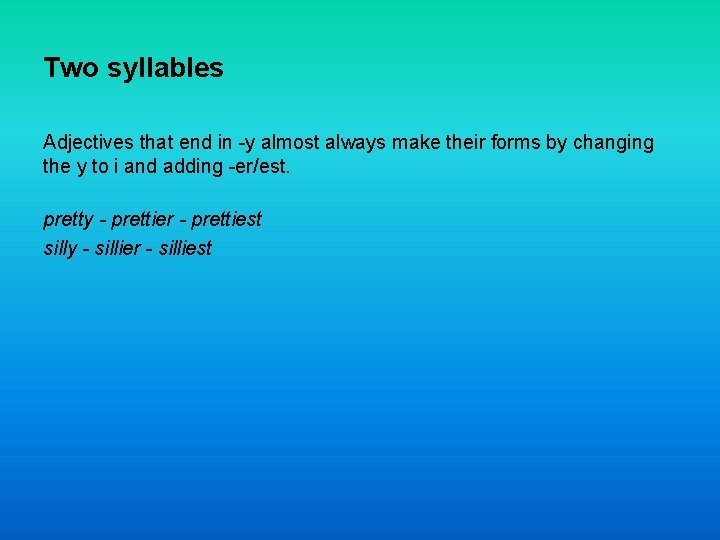
Two syllables Adjectives that end in -y almost always make their forms by changing the y to i and adding -er/est. pretty - prettier - prettiest silly - sillier - silliest
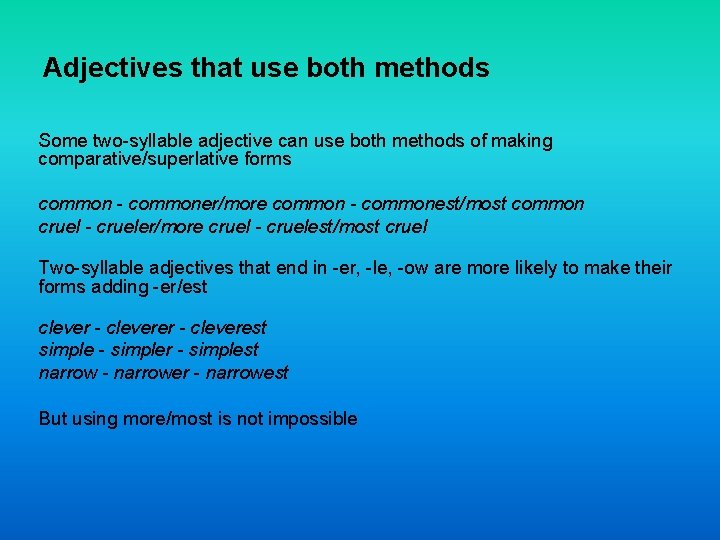
Adjectives that use both methods Some two-syllable adjective can use both methods of making comparative/superlative forms common - commoner/more common - commonest/most common cruel - crueler/more cruel - cruelest/most cruel Two-syllable adjectives that end in -er, -le, -ow are more likely to make their forms adding -er/est clever - cleverest simple - simpler - simplest narrow - narrower - narrowest But using more/most is not impossible
Now do exercise 3 Exercise 3