
How to Collaborate Effectively Appalachian Higher Education Network
How to Collaborate Effectively Appalachian Higher Education Network Martin Blank Director, Coalition for Community Schools Institute for Educational Leadership June 28, 2017 www. communityschools. org 1
Context for Collaboration • In a tumultuous swiftly changing environment, in a world of multiple colliding systems, the hierarchical position of leaders within their own system is of limited value, because some of the most critically important tasks require lateral leadership -- cross boundary leadership --involving groups over whom they have no control.
Context for Collaboration (2) • Leaders who do not collaborate are not serving the long-term interests of their constituents. • Leaders must live harmoniously with the systems that impinge on their institution. • Leaders work across boundaries not only to achieve the goals of their own system, but to help our communities and our nation to survive and flourish.

What is Collaboration? • Collaboration: An unnatural act among consenting adults • Collaboration: Entities recognize none can succeed without others. Each has unique capabilities others need. • Collaboration: Tailor made for needs, problems, and opportunities that manifest novelty, complexity, uncertainty, and interdependent relationships.

Cooperation v. Collaboration • Partners using a cooperative strategy to work together to meet their individual goals. • Partners using a collaborative strategy establish common goals and agree to their personal and institutional power to achieve them.

Your Turn: What does collaboration mean to you?
Keys to Collaboration • Right People at the Table • Trusting Relationships • Open Communications • Jointly defined results/indicators • Shared data • Effective Leadership • Shared Decision-Making – Shared Power an Authority
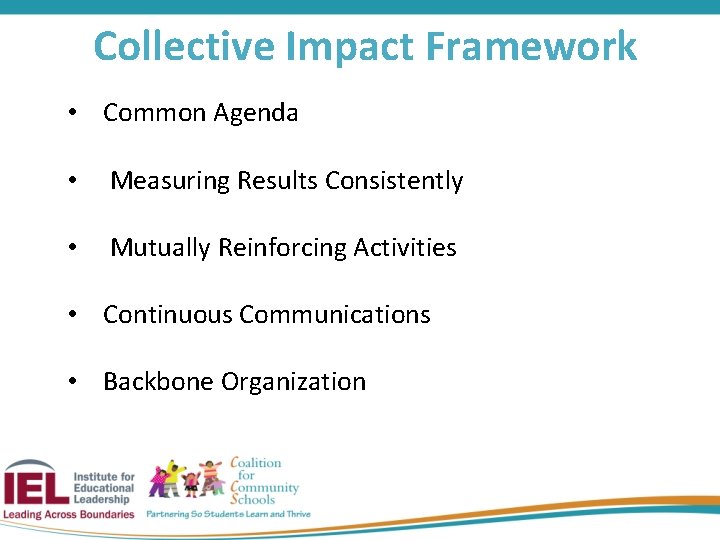
Collective Impact Framework • Common Agenda • Measuring Results Consistently • Mutually Reinforcing Activities • Continuous Communications • Backbone Organization
Your Turn: What have been the keys to successful collaboration in your experience
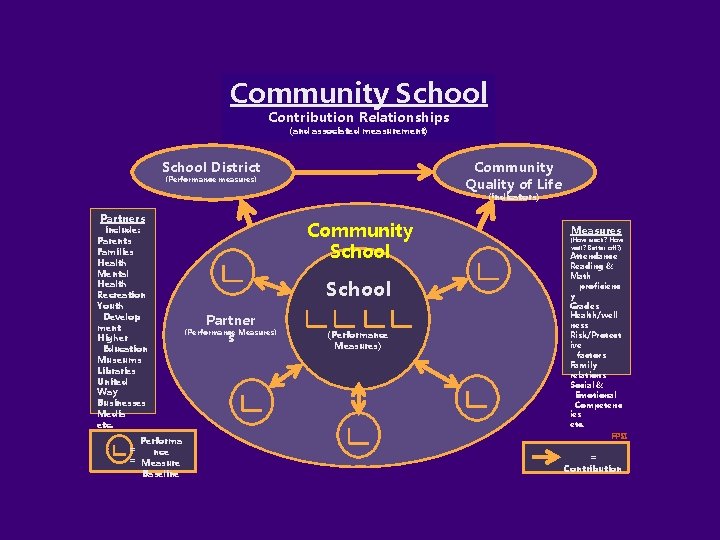
Community School Contribution Relationships (and associated measurement) School District Community Quality of Life (Performance measures) (indicators) Partners include: Parents Families Health Mental Health Recreation Youth Develop ment Higher Education Museums Libraries United Way Businesses Media etc. Performa = nce = Measure Baseline Community School Partner s (Performance Measures) Measures (How much? How well? Better off? ) Attendance Reading & Math proficienc y Grades Health/well ness Risk/Protect ive factors Family relations Social & Emotional Competenc ies etc. FPSI = Contribution
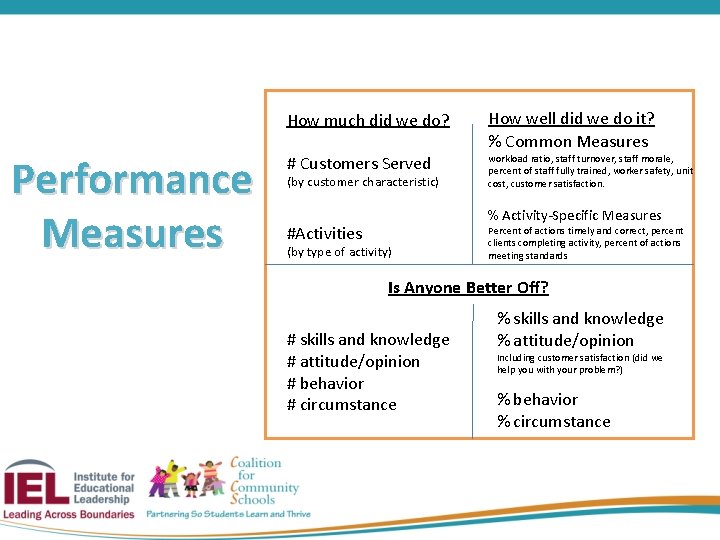
How much did we do? Performance Measures # Customers Served (by customer characteristic) How well did we do it? % Common Measures workload ratio, staff turnover, staff morale, percent of staff fully trained, worker safety, unit cost, customer satisfaction. % Activity-Specific Measures #Activities (by type of activity) Percent of actions timely and correct, percent clients completing activity, percent of actions meeting standards Is Anyone Better Off? # skills and knowledge # attitude/opinion # behavior # circumstance % skills and knowledge % attitude/opinion Including customer satisfaction (did we help you with your problem? ) % behavior % circumstance
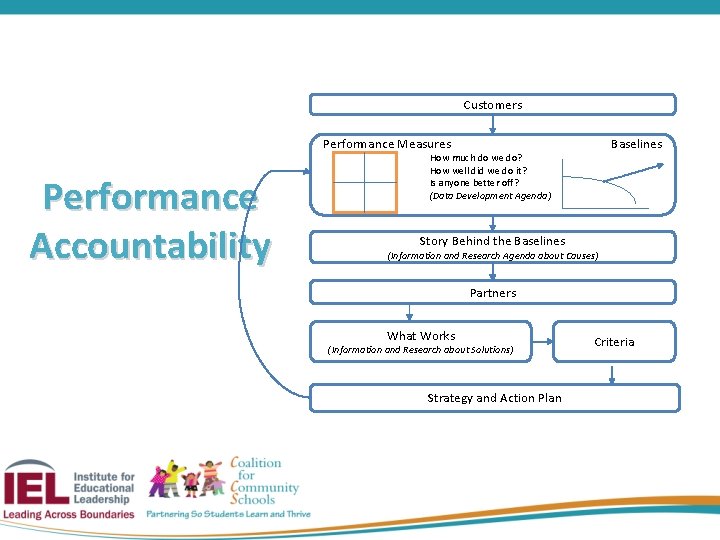
Customers Performance Measures Performance Accountability Baselines How much do we do? How well did we do it? Is anyone better off? (Data Development Agenda) Story Behind the Baselines (Information and Research Agenda about Causes) Partners What Works (Information and Research about Solutions) Strategy and Action Plan Criteria

How to Collaborate Effectively What’s Your Next Step? www. communityschools. org 14
Thank you! Martin Blank Director, Coalition for Community Schools Institute for Educational Leadership Blank. M@iel. org 202 -822 -8405 x 140 www. communityschools. org 15
- Slides: 15