
How to Cite Sources InText on Works Cited
- Slides: 11
How to: Cite Sources In-Text & on Works Cited Pages Presentation by Alice Hong, Anna Linnik, Stephanie Lee, Joseph Jhee, and Stacy Baek
Cite Sources In. Text How to:
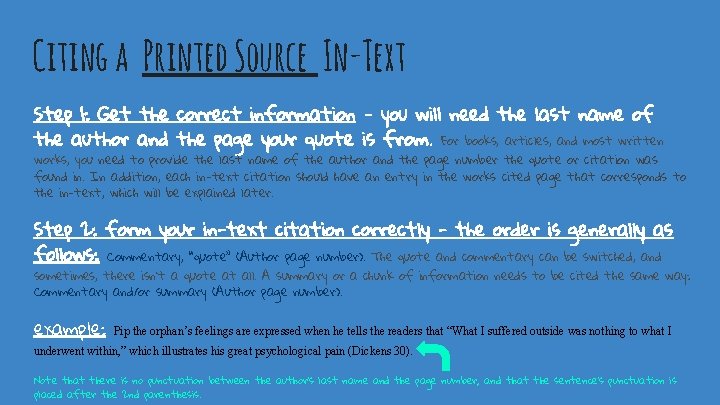
Citing a Printed Source In-Text Step 1: Get the correct information - you will need the last name of the author and the page your quote is from. For books, articles, and most written works, you need to provide the last name of the author and the page number the quote or citation was found in. In addition, each in-text citation should have an entry in the works cited page that corresponds to the in-text, which will be explained later. Step 2: form your in-text citation correctly - the order is generally as follows: Commentary, “quote” (Author page number). The quote and commentary can be switched, and sometimes, there isn’t a quote at all. A summary or a chunk of information needs to be cited the same way: Commentary and/or summary (Author page number). example: Pip the orphan’s feelings are expressed when he tells the readers that “What I suffered outside was nothing to what I underwent within, ” which illustrates his great psychological pain (Dickens 30). Note that there is no punctuation between the author’s last name and the page number, and that the sentence’s punctuation is placed after the 2 nd parenthesis.
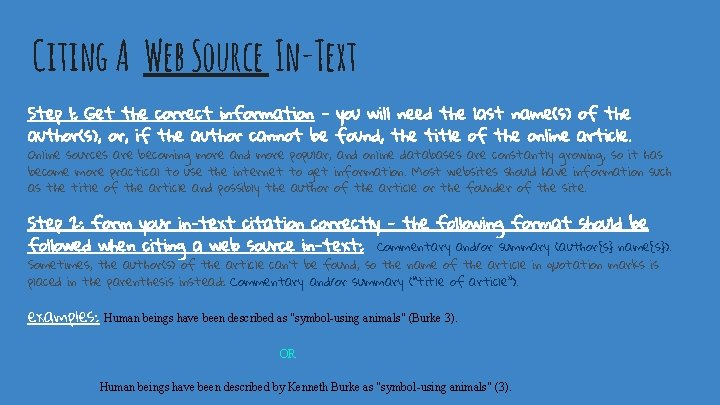
Citing A Web Source In-Text Step 1: Get the correct information - you will need the last name(s) of the author(s), or, if the author cannot be found, the title of the online article. Online sources are becoming more and more popular, and online databases are constantly growing, so it has become more practical to use the internet to get information. Most websites should have information such as the title of the article and possibly the author of the article or the founder of the site. Step 2: form your in-text citation correctly - the following format should be followed when citing a web source in-text: Commentary and/or summary (author{s} name{s}). Sometimes, the author(s) of the article can’t be found, so the name of the article in quotation marks is placed in the parenthesis instead: Commentary and/or summary (“title of article”). examples: Human beings have been described as "symbol-using animals" (Burke 3). OR Human beings have been described by Kenneth Burke as "symbol-using animals" (3).
How to: Cite Sources on a “Works Cited” Page
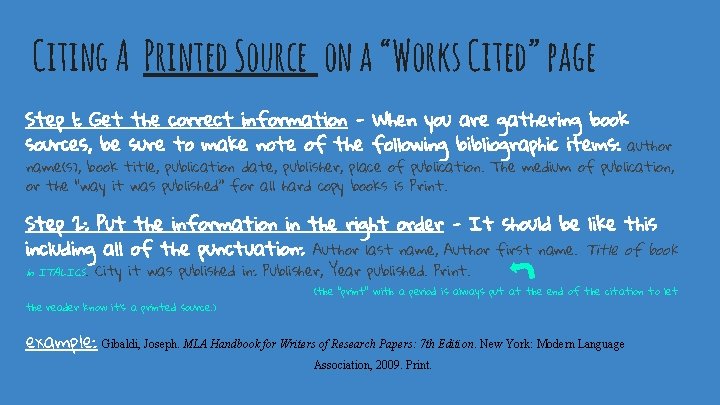
Citing A Printed Source on a “Works Cited” page Step 1: Get the correct information - When you are gathering book sources, be sure to make note of the following bibliographic items: author name(s), book title, publication date, publisher, place of publication. The medium of publication, or the “way it was published” for all hard copy books is Print. Step 2: Put the information in the right order - It should be like this including all of the punctuation: Author last name, Author first name. Title of book in ITALICS. City it was published in: Publisher, Year published. Print. the reader know it’s a printed source. ) (the “print” with a period is always put at the end of the citation to let example: Gibaldi, Joseph. MLA Handbook for Writers of Research Papers: 7 th Edition. New York: Modern Language Association, 2009. Print.
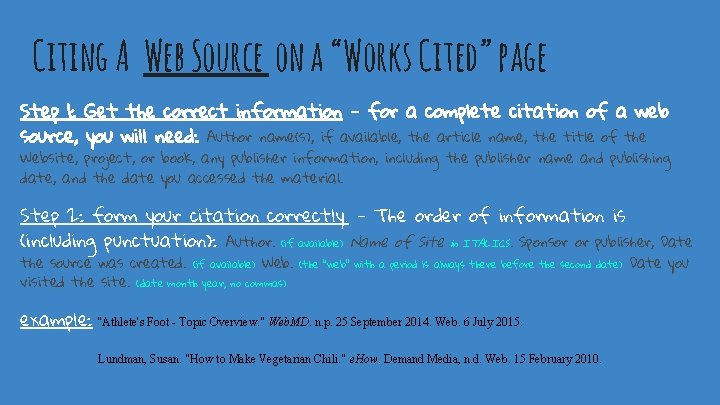
Citing A Web Source on a “Works Cited” page Step 1: Get the correct information - for a complete citation of a web source, you will need: Author name(s), if available, the article name, the title of the Website, project, or book, any publisher information, including the publisher name and publishing date, and the date you accessed the material. Step 2: form your citation correctly. - The order of information is (including punctuation): Author. (if available) Name of Site in ITALICS. Sponsor or publisher, the source was created. (if available) Web. visited the site. (date month year, no commas) (the “web” with a period is always there before the second date) example: "Athlete's Foot - Topic Overview. " Web. MD. n. p. 25 September 2014. Web. 6 July 2015. Lundman, Susan. "How to Make Vegetarian Chili. " e. How. Demand Media, n. d. Web. 15 February 2010. Date you
How to: Connect an In-Text Citation to a “Works Cited” Entry, and the Format of a “Works Cited” Entry
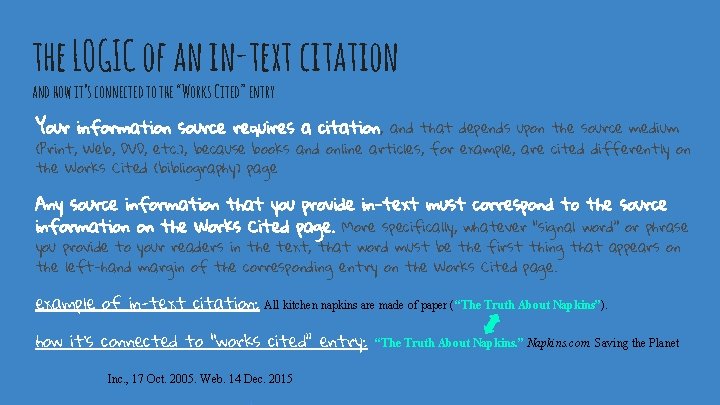
the LOGIC of an in-text citation and how it’s connected to the “Works Cited” entry Your information source requires a citation, and that depends upon the source medium (Print, Web, DVD, etc. ), because books and online articles, for example, are cited differently on the Works Cited (bibliography) page Any source information that you provide in-text must correspond to the source information on the Works Cited page. More specifically, whatever “signal word” or phrase you provide to your readers in the text, that word must be the first thing that appears on the left-hand margin of the corresponding entry on the Works Cited page. example of in-text citation: All kitchen napkins are made of paper (“The Truth About Napkins”). how it’s connected to “works cited” entry: Inc. , 17 Oct. 2005. Web. 14 Dec. 2015 “The Truth About Napkins. ” Napkins. com. Saving the Planet
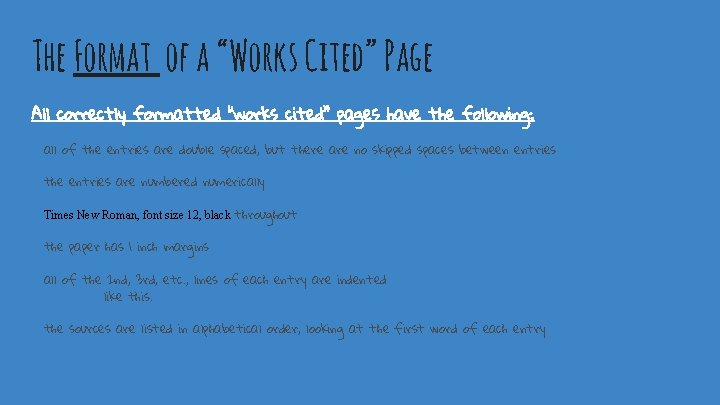
The Format of a “Works Cited” Page All correctly formatted “works cited” pages have the following: all of the entries are double spaced, but there are no skipped spaces between entries the entries are numbered numerically Times New Roman, font size 12, black throughout the paper has 1 inch margins all of the 2 nd, 3 rd, etc. , lines of each entry are indented like this. the sources are listed in alphabetical order, looking at the first word of each entry
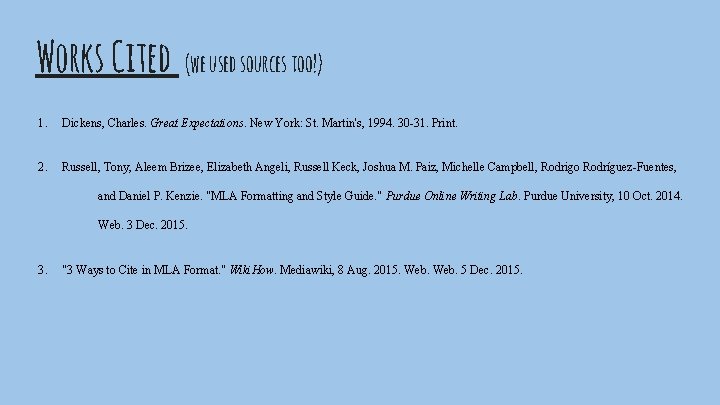
Works Cited (we used sources too!) 1. Dickens, Charles. Great Expectations. New York: St. Martin's, 1994. 30 -31. Print. 2. Russell, Tony, Aleem Brizee, Elizabeth Angeli, Russell Keck, Joshua M. Paiz, Michelle Campbell, Rodrigo Rodríguez-Fuentes, and Daniel P. Kenzie. "MLA Formatting and Style Guide. " Purdue Online Writing Lab. Purdue University, 10 Oct. 2014. Web. 3 Dec. 2015. 3. "3 Ways to Cite in MLA Format. " Wiki. How. Mediawiki, 8 Aug. 2015. Web. 5 Dec. 2015.