
How to Check a Radial Pulse Objectives At

How to Check a Radial Pulse
Objectives At the end of this lesson, you will be able to: 1. Identify safety precautions while checking a radial pulse. 2. Explain reasons to check a radial pulse. 3. Describe the steps to finding and counting a radial pulse. 4. Define the normal pulse for adult, child and infant. 5. Be able to apply these skills as a future healthcare professional and demonstrate +/- 4 beats of accuracy on yourself or a partner/patient.
Safety precautions while checking a radial pulse. 1. 2. 3. 4. 5. Introduce yourself Identify the patient Standard Precautions-wash hands Explain procedure Provide privacy if needed Safety
Reasons to check a radial pulse. 1. The radial pulse is a common pulse to check on the body. 2. Establishes a baseline vital sign for a patient. 3. Various medications require pulse checks before administering. 4. You will be able to determine if your patient has a fast, slow or normal heart rate. Why check a Radial Pulse?
Normal Pulse for… • Adult 60 -100 • Child 80 -120 • Newborn/Infant 120 -160 Beats A Minute
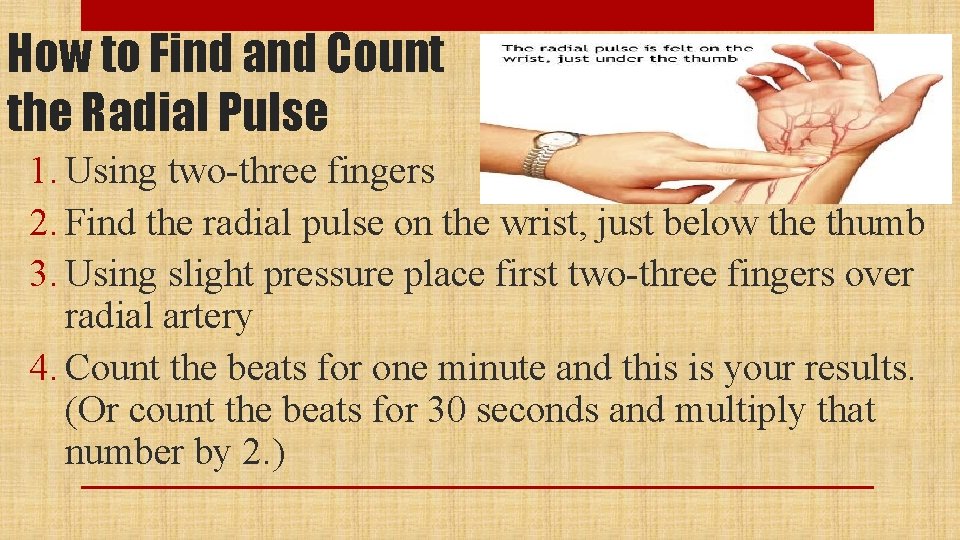
How to Find and Count the Radial Pulse 1. Using two-three fingers 2. Find the radial pulse on the wrist, just below the thumb 3. Using slight pressure place first two-three fingers over radial artery 4. Count the beats for one minute and this is your results. (Or count the beats for 30 seconds and multiply that number by 2. )
Name the 5 safety precautions you will use while checking a radial pulse. Review

Explain some reasons you would check a radial pulse. Review

What is the normal pulse for adult? Review

Describe the 4 steps on how to find and count a radial pulse. Review

Time to practice

Write down the 4 steps to finding a radial pulse on a piece of paper. Exit Question….
- Slides: 12