
How to Calculate Attainment of CO and PO




- Slides: 63
How to Calculate Attainment of CO and PO Prof (Dr. ) J. N. Jha Principal, MIT Muzaffarpur Email: jagadanand@gmail. com
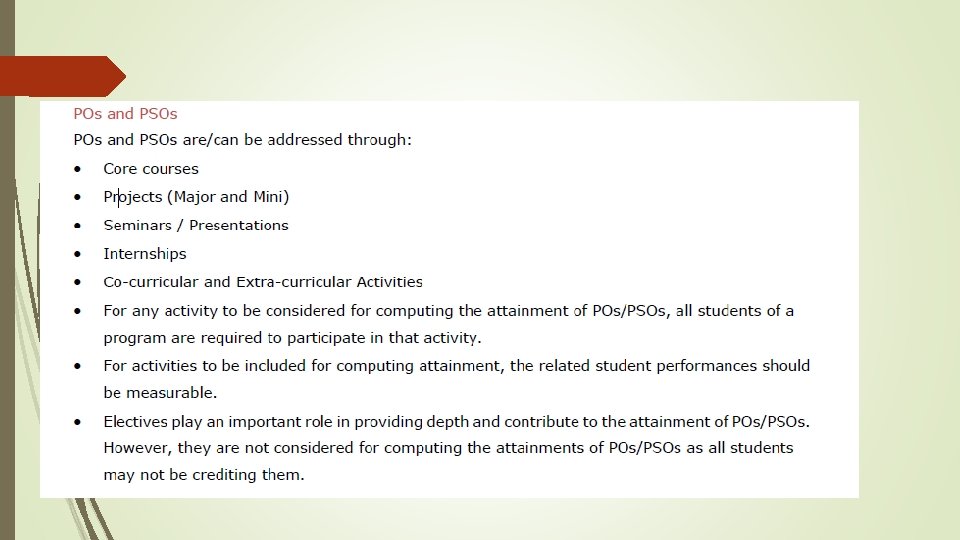
Engineering Programs Graduates of Engineering Programs in India are required Ø To attain the Program Outcomes (POs) identified by the National Board of Accreditation (NBA) Ø To attain Program Specific Outcomes (PSOs) identified by the University or the Department offering the Program. POs and PSOs are to attained Ø through courses, projects, co-curricular and extra-curricular activities (in which performance of the students is evaluated).
Courses are broadly classified Ø Core courses and Electives. Core courses are Classified Ø Engineering/Engineering Science, and Basic Sciences / Humanities / Social Sciences /Management POs and PSOs are to be attained Ø through core courses, project and activities (in which all students Participate- Elective will not be considered). Courses constitute the dominant part of any engineering program.
Students learn well Course Outcome Ø when they are clear about what they should be able to do at the end of a course (Course Outcomes) Ø Assessment is in alignment with what they are expected to do (Assessment in alignment with Course Outcomes) Ø Instructional activities are designed and conducted to facilitate them to acquire and demonstrate what they are expected to do (Alignment among Instruction, Assessment and Course Outcomes)
What are Course Outcomes? Course Outcomes (COs): What the student should be able to do at the end of a course It is an effective ability, including attributes, skills and knowledge to successfully carry out the identified activity Most important aspect of a CO: Should be observable and measurable
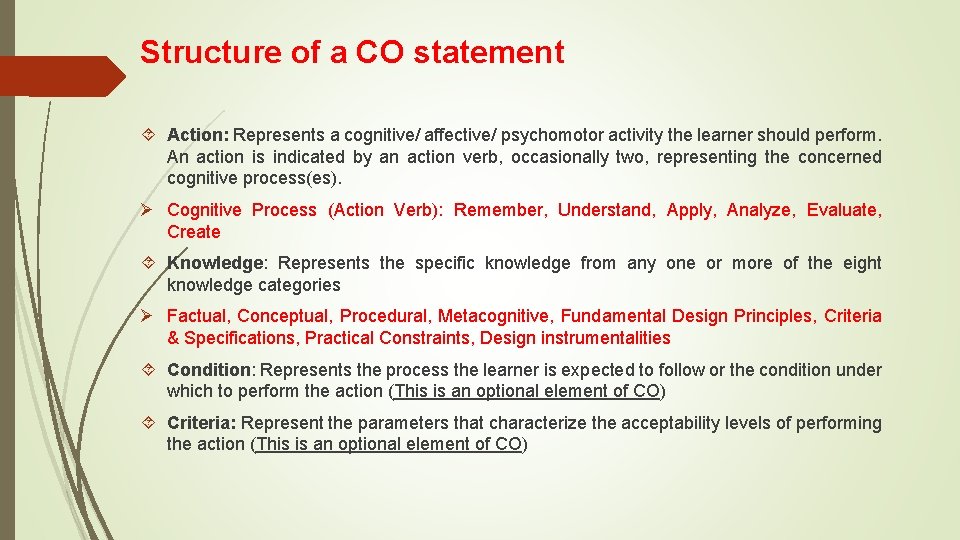
Structure of a CO statement Action: Represents a cognitive/ affective/ psychomotor activity the learner should perform. An action is indicated by an action verb, occasionally two, representing the concerned cognitive process(es). Ø Cognitive Process (Action Verb): Remember, Understand, Apply, Analyze, Evaluate, Create Knowledge: Represents the specific knowledge from any one or more of the eight knowledge categories Ø Factual, Conceptual, Procedural, Metacognitive, Fundamental Design Principles, Criteria & Specifications, Practical Constraints, Design instrumentalities Condition: Represents the process the learner is expected to follow or the condition under which to perform the action (This is an optional element of CO) Criteria: Represent the parameters that characterize the acceptability levels of performing the action (This is an optional element of CO)
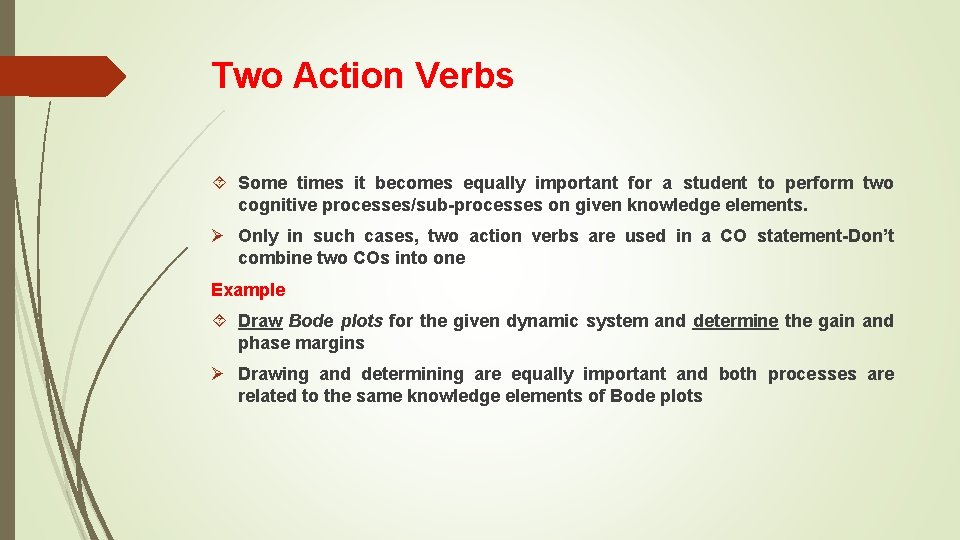
Two Action Verbs Some times it becomes equally important for a student to perform two cognitive processes/sub-processes on given knowledge elements. Ø Only in such cases, two action verbs are used in a CO statement-Don’t combine two COs into one Example Draw Bode plots for the given dynamic system and determine the gain and phase margins Ø Drawing and determining are equally important and both processes are related to the same knowledge elements of Bode plots
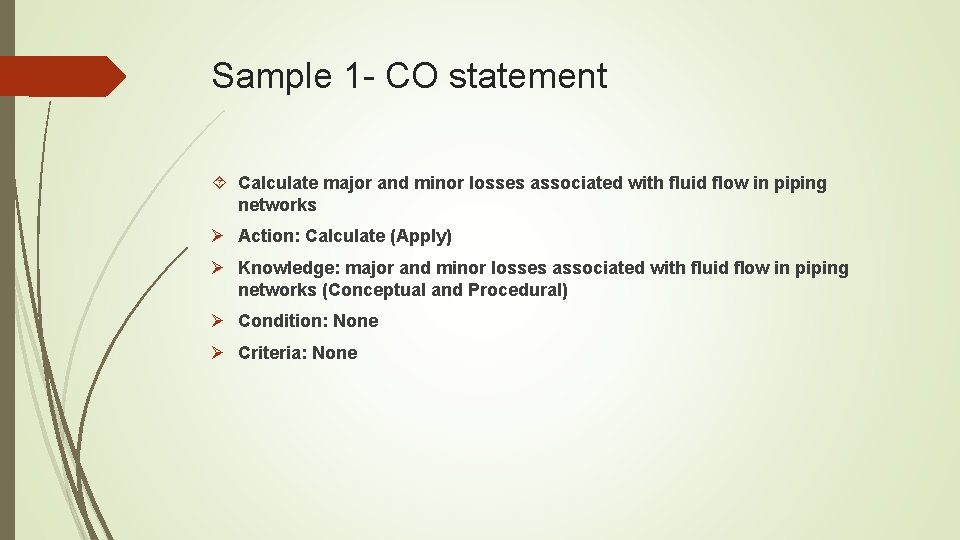
Sample 1 - CO statement Calculate major and minor losses associated with fluid flow in piping networks Ø Action: Calculate (Apply) Ø Knowledge: major and minor losses associated with fluid flow in piping networks (Conceptual and Procedural) Ø Condition: None Ø Criteria: None
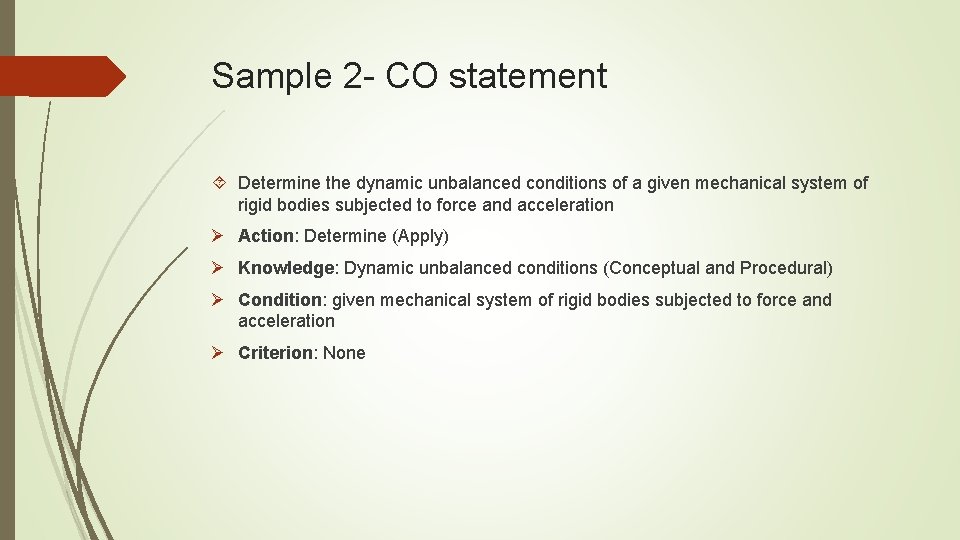
Sample 2 - CO statement Determine the dynamic unbalanced conditions of a given mechanical system of rigid bodies subjected to force and acceleration Ø Action: Determine (Apply) Ø Knowledge: Dynamic unbalanced conditions (Conceptual and Procedural) Ø Condition: given mechanical system of rigid bodies subjected to force and acceleration Ø Criterion: None
Sample 3 - CO statement Understand the effect of all the parameters in voltage controlled oscillators through simulation using TINATI. Ø Action: Understand Ø Knowledge: effect of all the parameters in voltage controlled oscillators (Conceptual) Ø Condition: using simulation using TINATI Ø Criterion: None
Sample 4 - CO statement Determine the root of the given equation, accurate to second decimal place, using Newton-Raphson method Ø Action: Determine (Apply) Ø Knowledge: root of the given equation (Conceptual and Procedural) Ø Condition: using Newton-Raphson method Ø Criterion: accurate to second decimal place
Number of COs for a Course Too small a number of COs do not capture the course in sufficient detail and may not serve instruction design that well. Too many COs make all the processes related to assessment design and computation of attainment of COs messy and demanding. A 3: 0: 0, 3: 1: 0 and 3: 0: 1 courses should have about 6 course outcomes. The number of COs of courses carrying different number of credits can be suitably adjusted
Dos and Don’ts Use only one action verb Do not use words including ‘like’, ‘such as’, ‘different’, ‘various’ ‘etc. ’ with respect to knowledge elements. Enumerate all the relevant knowledge elements. Put in effort to make the CO statement as detailed as possible, and measurable. Do not make it either too abstract or too specific
Check List Does the CO begin with an action verb? Is the CO stated in terms of student performance (rather than teacher performance or course content to be covered)? Is the CO stated as a learning product rather than as a learning process? Is the CO stated at the proper level of generality, and relatively independent of other COs? Is the CO attainable in the given context (students’ background, prerequisite competences, facilities, time available and so on)?
Acceptability of COs Students will execute mini projects Ø Instructional activities are designed to facilitate the attainment of COs by learners, but themselves are not COs Have the concepts of compensators and controllers (P, PD, PID) Ø COs are competencies / behaviors that can be demonstrated; not descriptions of internal changes in the students (though these are necessary) Optimal Generator scheduling for thermal power plants by using software package in the lab Ø No action verb; no way of assessing; no way of determining attainment level; syllabus part is rewritten.
Acceptability of Cos… Cont. Will get knowledge of protection schemes for Generator, Transformer and Induction Motor Ø COs are competencies / behaviors that can be demonstrated; not descriptions of internal changes in the students (though these are necessary) Apply problem solving techniques to find solutions to problems. Ø Too general; no clear way of assessing! Study variety of advanced abstract data type (ADT) and data structures and their Implementations Ø Activity that the student engages in during the Course; not what he / she becomes capable of demonstrating at the end of the course; the word “variety” is not to be used. Know the stress strain relation for a body subjected to loading within elastic limit. Ø Internal change; Not an action that can be demonstrated
Acceptability of Cos… Cont. Students will be able to learn the structure, properties and applications of modern metallic materials, smart materials non-metallic materials and advanced structural ceramics. Ø An outcome? How to assess? Students will be aware of base band signal concepts and different equalizers. Ø Internal change; Not an action that can be demonstrated Get complete knowledge regarding adaptive systems Ø Not an action that can be demonstrated; Internal change; Too ambitious to be realistic?
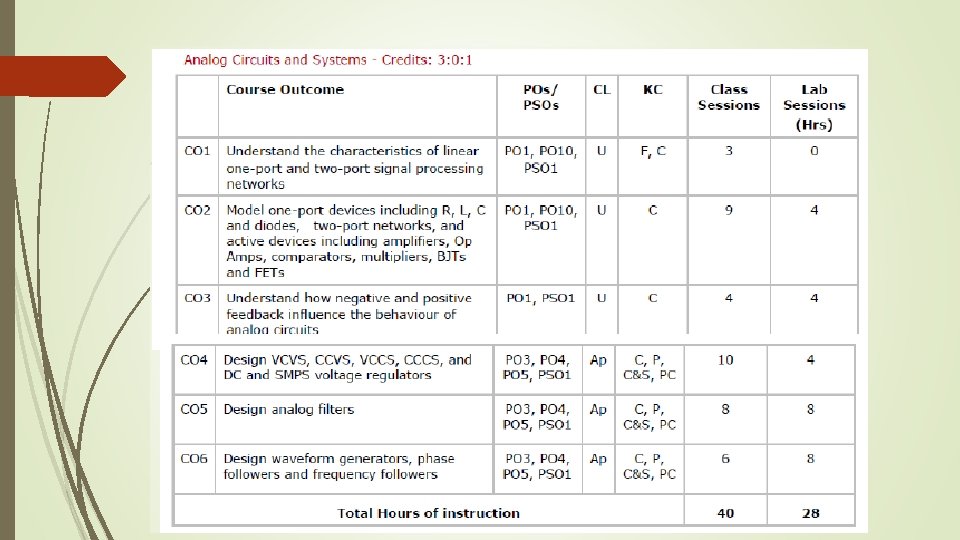
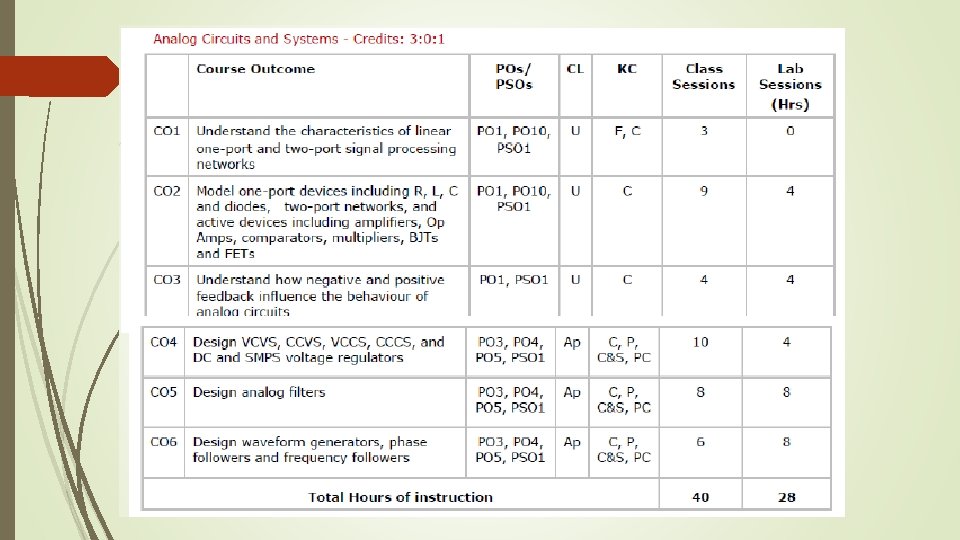
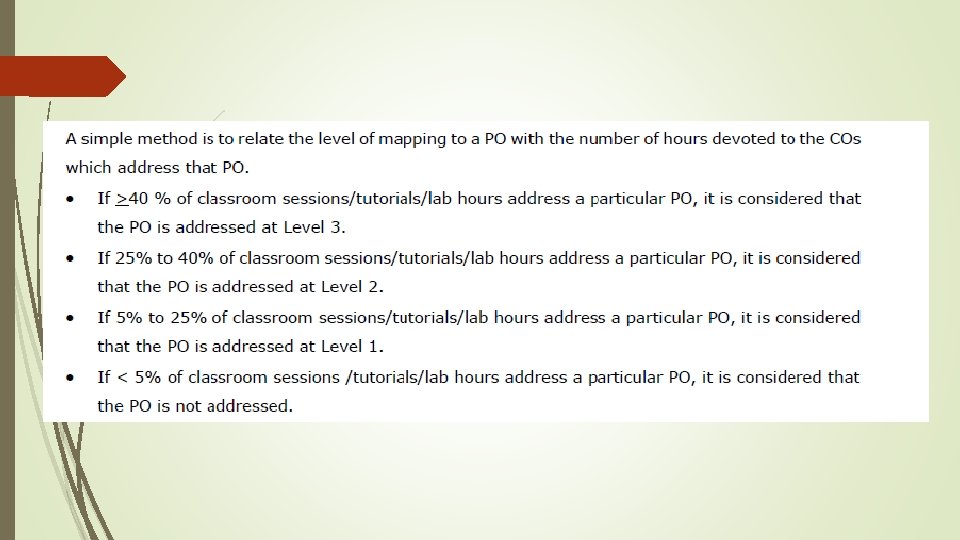
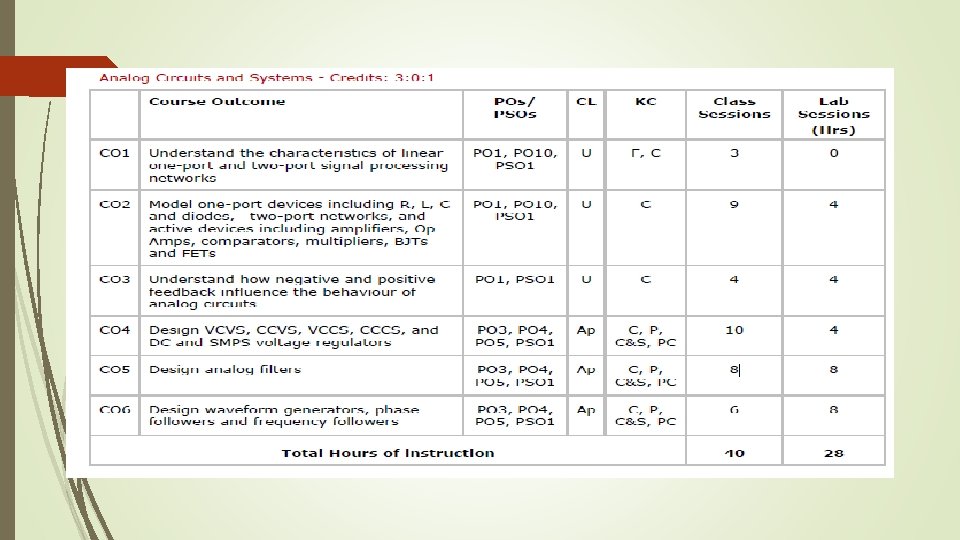
Tagging of Course Outcomes Tag Course Outcomes Ø POs, Ø PSOs, Ø Cognitive Levels, Ø Knowledge Categories addressed, Ø Number of classroom/ laboratory/ field sessions associated with the COs
Tagging of Course Outcomes…Cont. Tagging COs with Classroom Sessions-Different COs may have different number of classroom sessions Tagging COs with Cognitive Levels-CO statement starts with an action verb from one of the cognitive levels Ø (R-Remember, U-Understand, Ap- Apply, An-Analyse, E-Evaluate and C-Create) Tagging COs with Knowledge Categories-CO statement includes one or more categories of knowledge
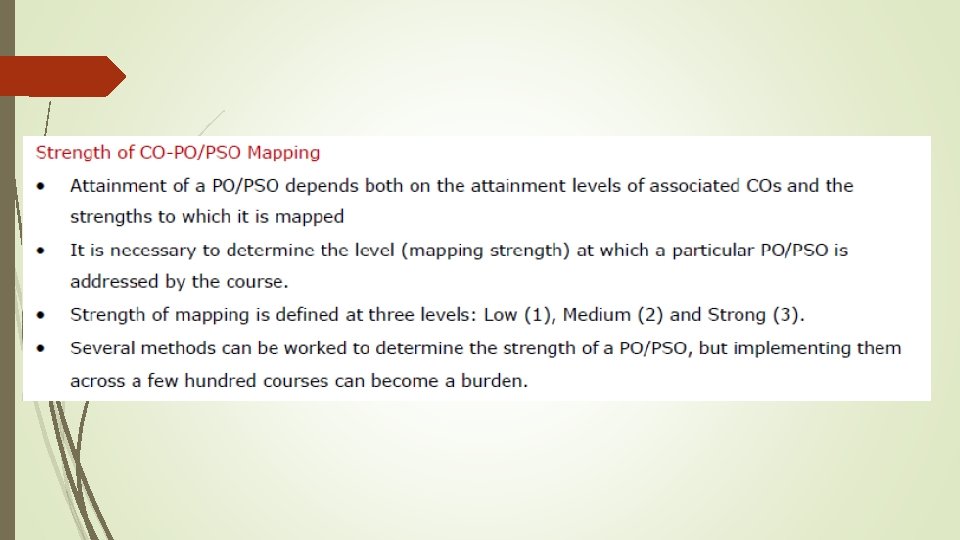
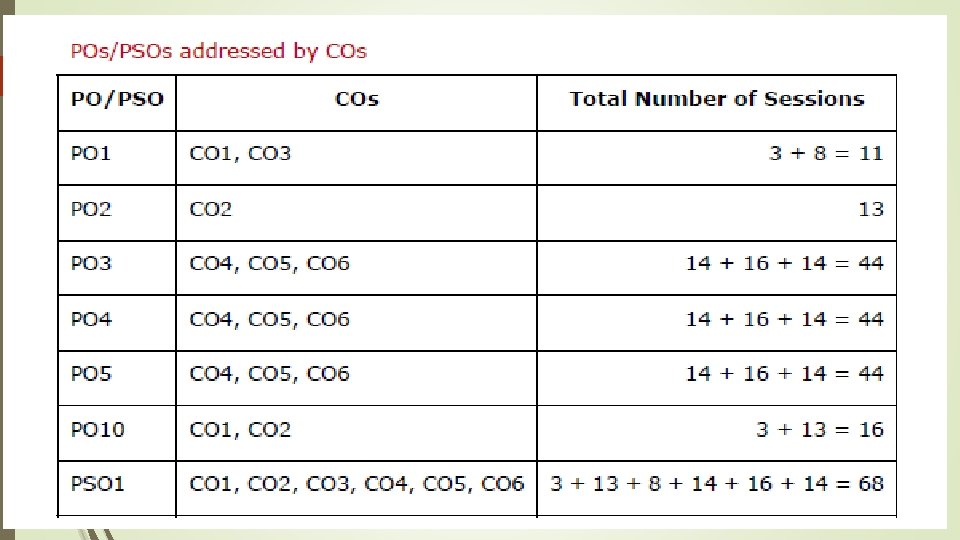
Tagging COs with PSOs/POs- Concern/Grey areas All the COs of a course typically address the same PSO(s). Majority of the courses (non-autonomous institutions): Don’t address strongly any PO other than PO 1 Ø PO 1: Engineering Knowledge Possible that PO 2, PO 3, PO 4, PO 5 are addressed slightly by some courses. Ø PO 2: Problem Analysis Ø PO 3: Design/Development of Solutions Ø PO 4: Conduct Investigations of Complex Problems Ø PO 5: Modern Tool Usage Hardly any course addresses complex engineering problems
Tagging COs with POs- Concern/Grey areas Some specific courses address PO 7, PO 8, PO 9, PO 10 and PO 11 Ø PO 7: Environment and Sustainability Ø PO 8: Ethics Ø PO 9: Individual and Teamwork Ø PO 10: Communication Ø PO 11: Project Management and Finance Projects can potentially address many Pos, (Rubrics-used to evaluate) Department can arrange for some activities outside the curriculum to address some POs Ø PO 6: The Engineer and Society Ø PO 12: Life-Long Learning
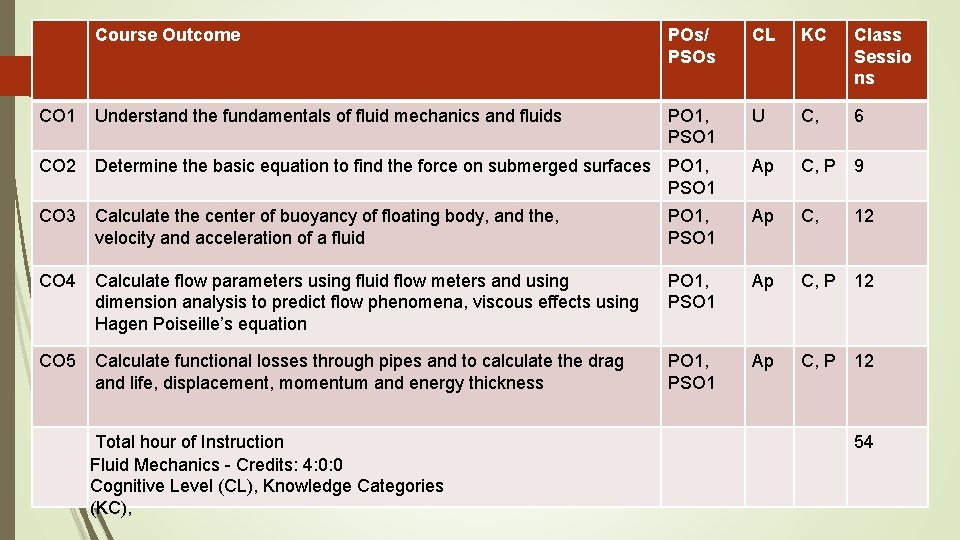
Course Outcome POs/ PSOs CL KC Class Sessio ns CO 1 Understand the fundamentals of fluid mechanics and fluids PO 1, PSO 1 U C, 6 CO 2 Determine the basic equation to find the force on submerged surfaces PO 1, PSO 1 Ap C, P 9 CO 3 Calculate the center of buoyancy of floating body, and the, velocity and acceleration of a fluid PO 1, PSO 1 Ap C, 12 CO 4 Calculate flow parameters using fluid flow meters and using dimension analysis to predict flow phenomena, viscous effects using Hagen Poiseille’s equation PO 1, PSO 1 Ap C, P 12 CO 5 Calculate functional losses through pipes and to calculate the drag and life, displacement, momentum and energy thickness PO 1, PSO 1 Ap C, P 12 Total hour of Instruction Fluid Mechanics - Credits: 4: 0: 0 Cognitive Level (CL), Knowledge Categories (KC), 54
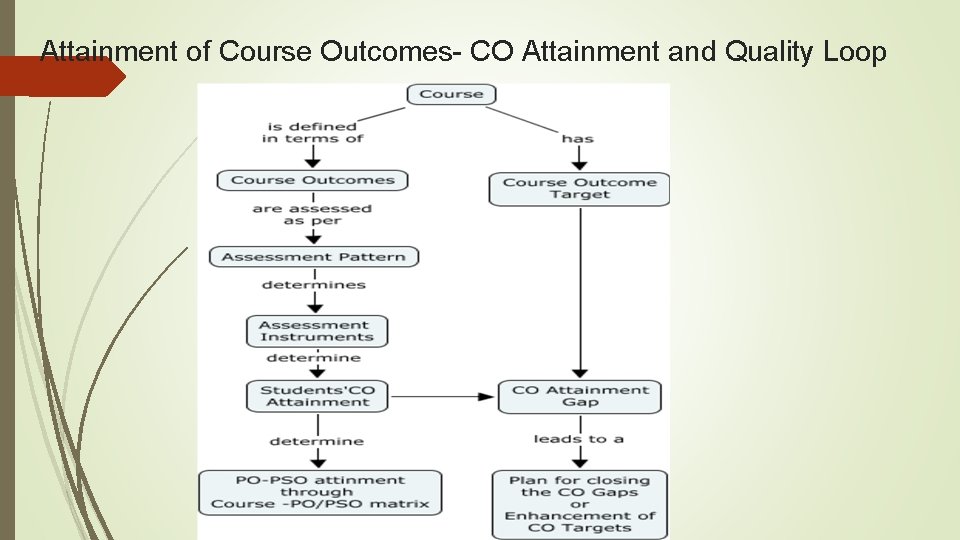
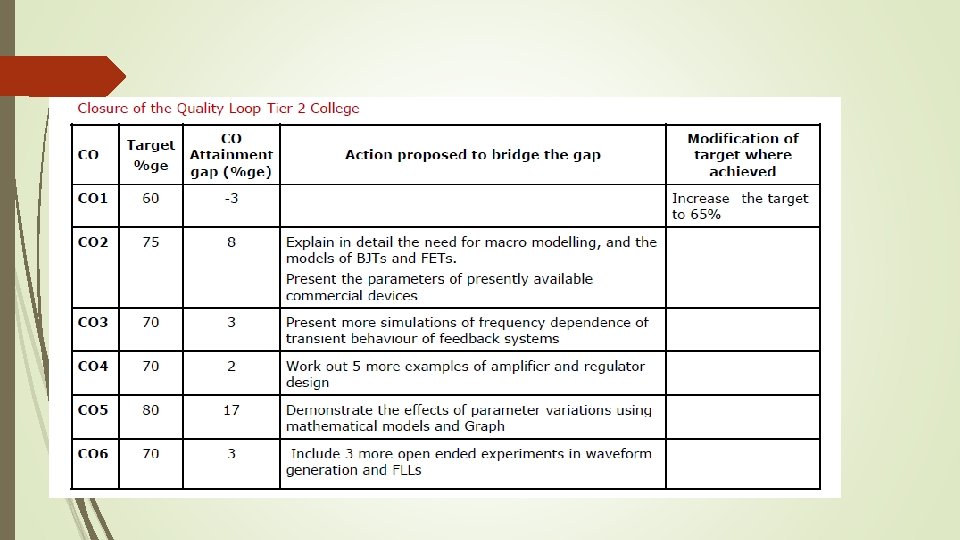
Attainment of Course Outcomes- CO Attainment and Quality Loop
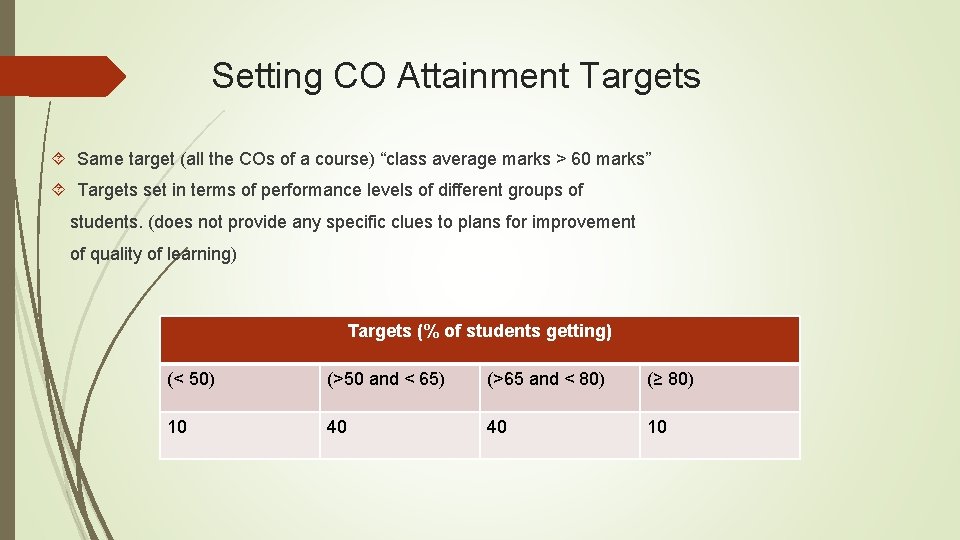
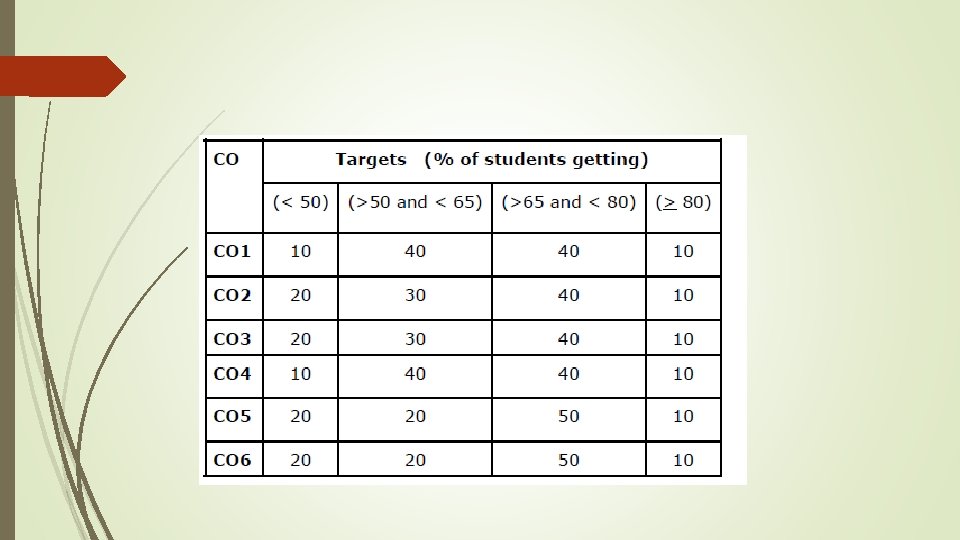
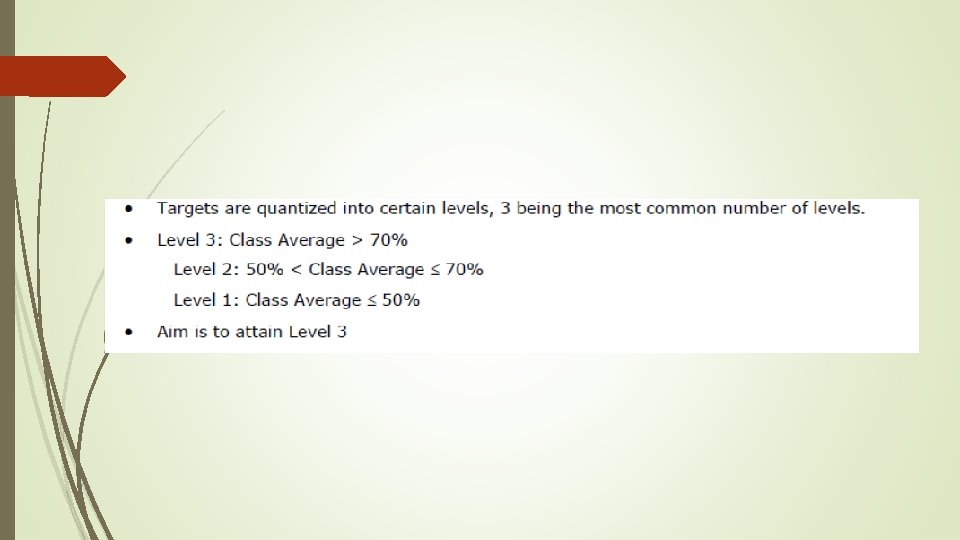
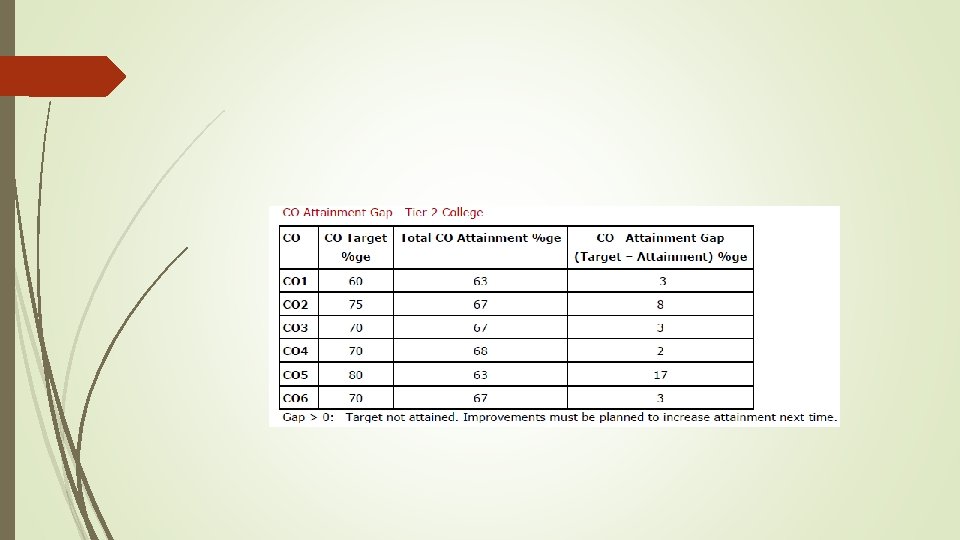
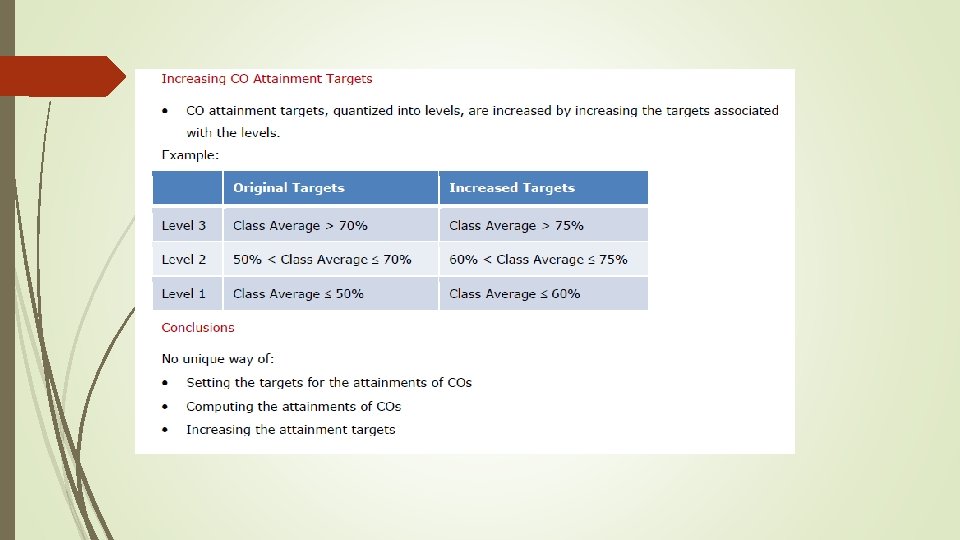
Setting CO Attainment Targets Same target (all the COs of a course) “class average marks > 60 marks” Targets set in terms of performance levels of different groups of students. (does not provide any specific clues to plans for improvement of quality of learning) Targets (% of students getting) (< 50) (>50 and < 65) (>65 and < 80) (≥ 80) 10 40 40 10
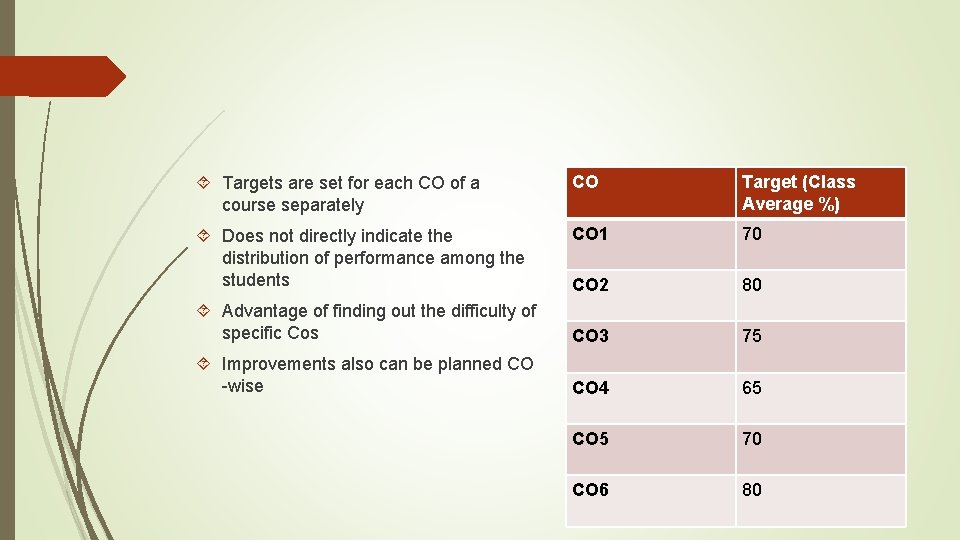
Targets are set for each CO of a course separately CO Target (Class Average %) Does not directly indicate the distribution of performance among the students CO 1 70 CO 2 80 Advantage of finding out the difficulty of specific Cos CO 3 75 Improvements also can be planned CO -wise CO 4 65 CO 5 70 CO 6 80
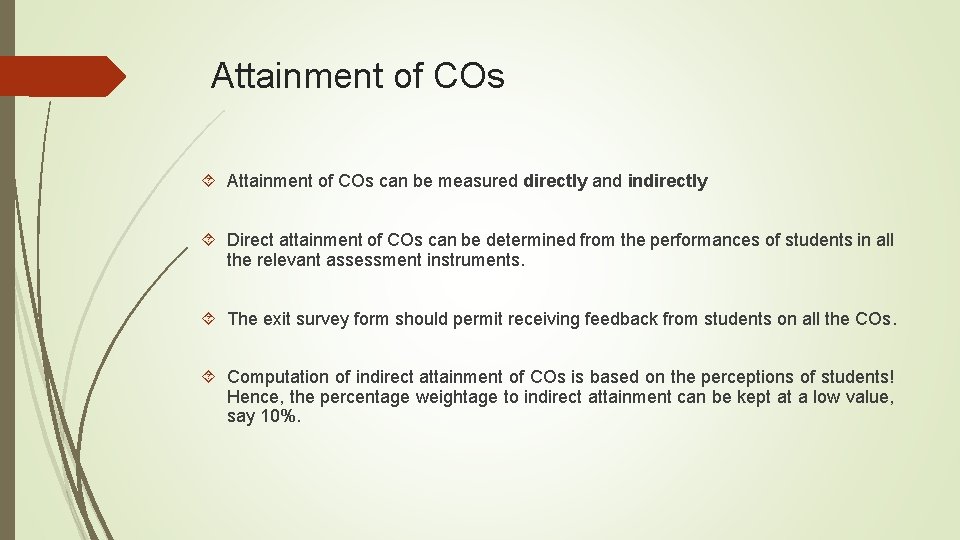
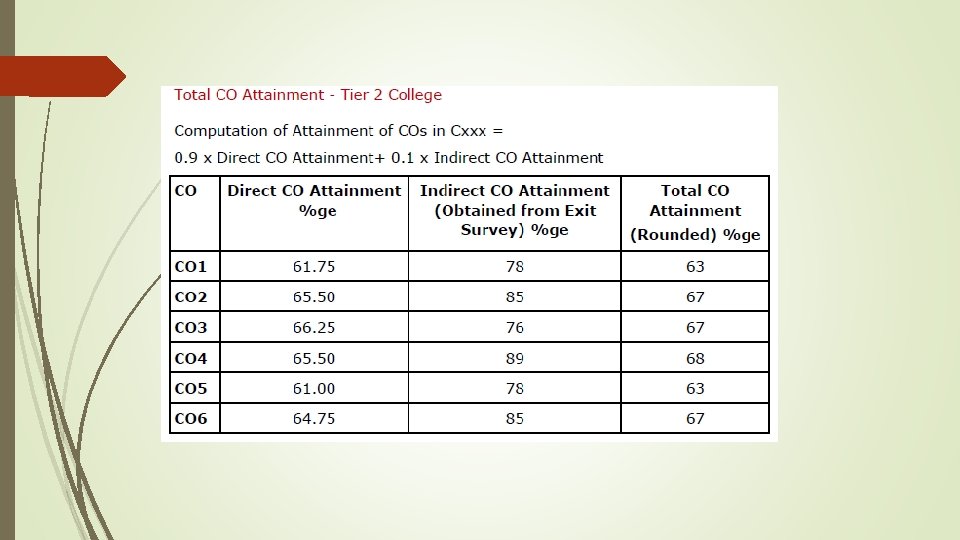
Attainment of COs can be measured directly and indirectly Direct attainment of COs can be determined from the performances of students in all the relevant assessment instruments. The exit survey form should permit receiving feedback from students on all the COs. Computation of indirect attainment of COs is based on the perceptions of students! Hence, the percentage weightage to indirect attainment can be kept at a low value, say 10%.
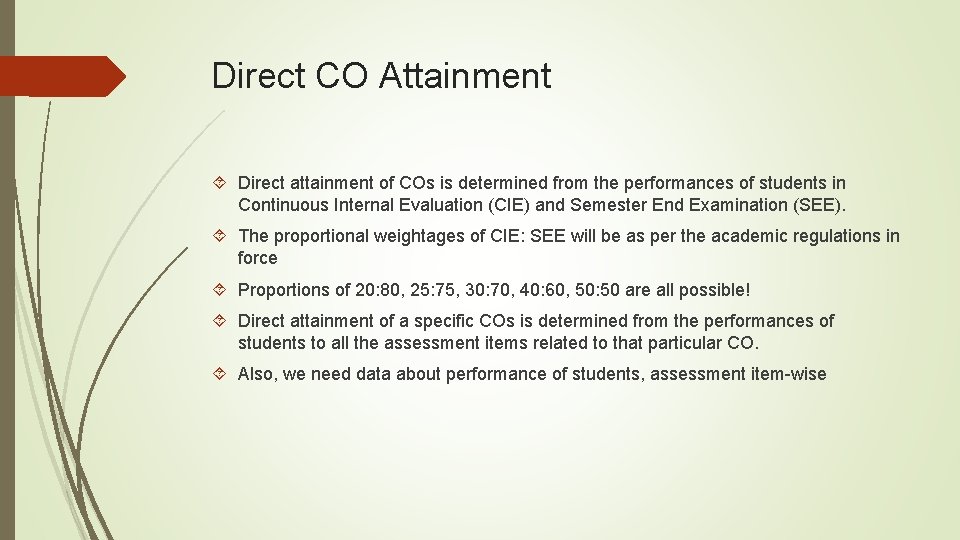
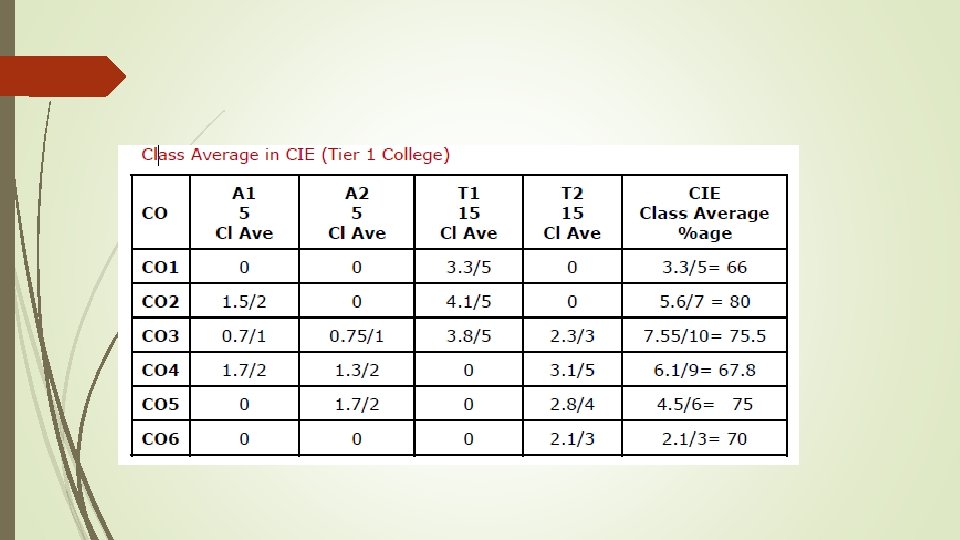
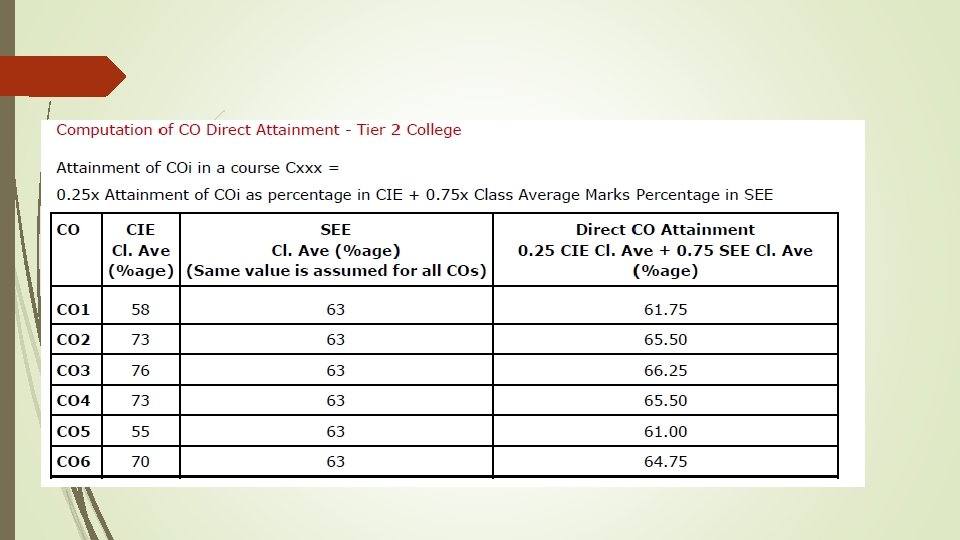
Direct CO Attainment Direct attainment of COs is determined from the performances of students in Continuous Internal Evaluation (CIE) and Semester End Examination (SEE). The proportional weightages of CIE: SEE will be as per the academic regulations in force Proportions of 20: 80, 25: 75, 30: 70, 40: 60, 50: 50 are all possible! Direct attainment of a specific COs is determined from the performances of students to all the assessment items related to that particular CO. Also, we need data about performance of students, assessment item-wise
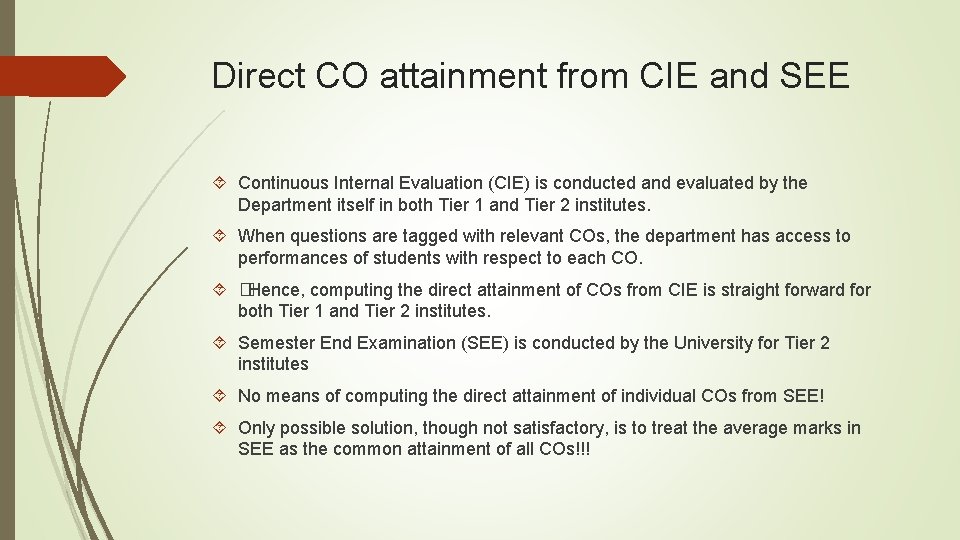
Direct CO attainment from CIE and SEE Continuous Internal Evaluation (CIE) is conducted and evaluated by the Department itself in both Tier 1 and Tier 2 institutes. When questions are tagged with relevant COs, the department has access to performances of students with respect to each CO. �Hence, computing the direct attainment of COs from CIE is straight forward for both Tier 1 and Tier 2 institutes. Semester End Examination (SEE) is conducted by the University for Tier 2 institutes No means of computing the direct attainment of individual COs from SEE! Only possible solution, though not satisfactory, is to treat the average marks in SEE as the common attainment of all COs!!!
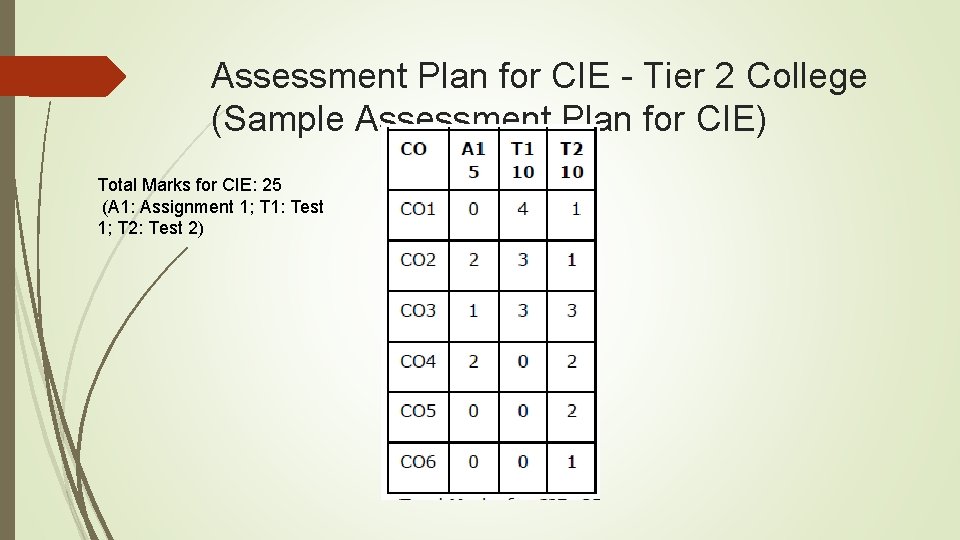
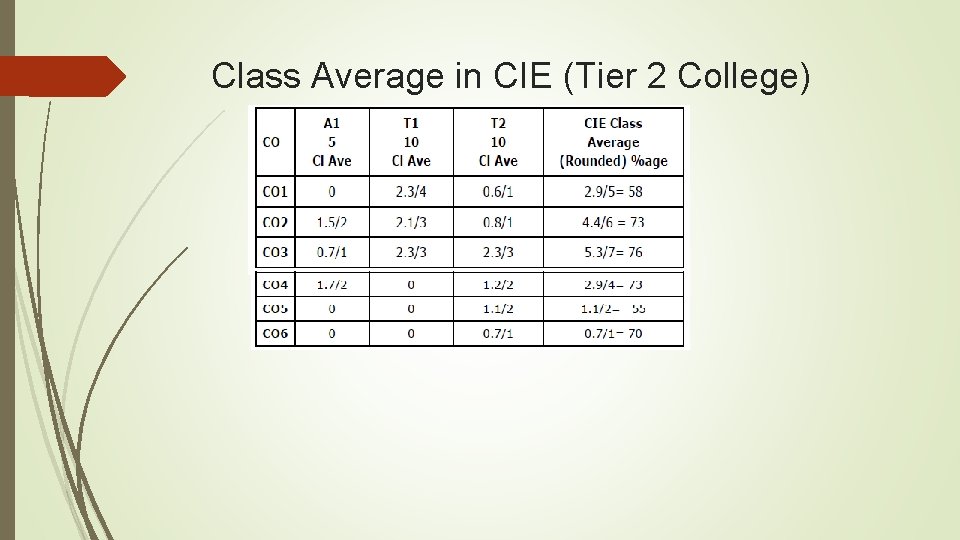
Assessment Plan for CIE - Tier 2 College (Sample Assessment Plan for CIE) Total Marks for CIE: 25 (A 1: Assignment 1; T 1: Test 1; T 2: Test 2)
Class Average in CIE (Tier 2 College)
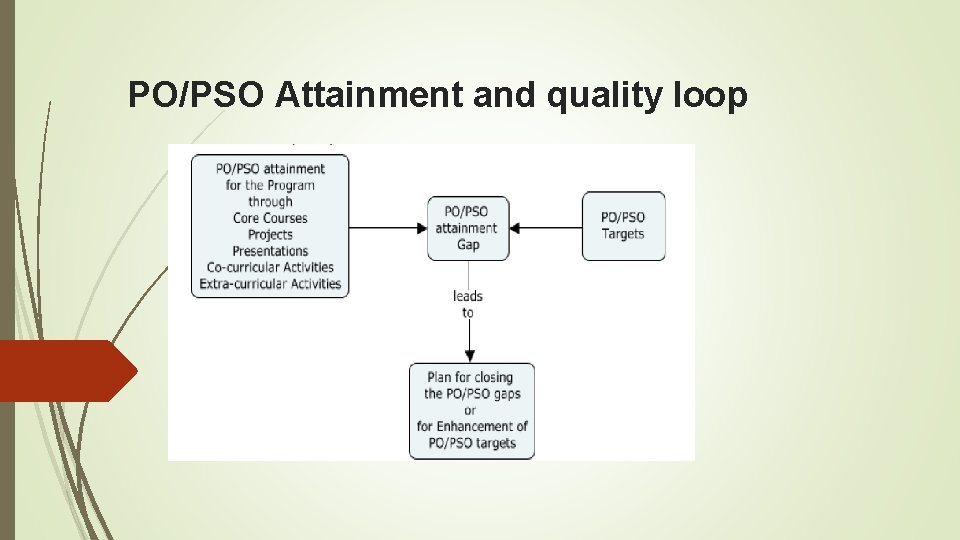
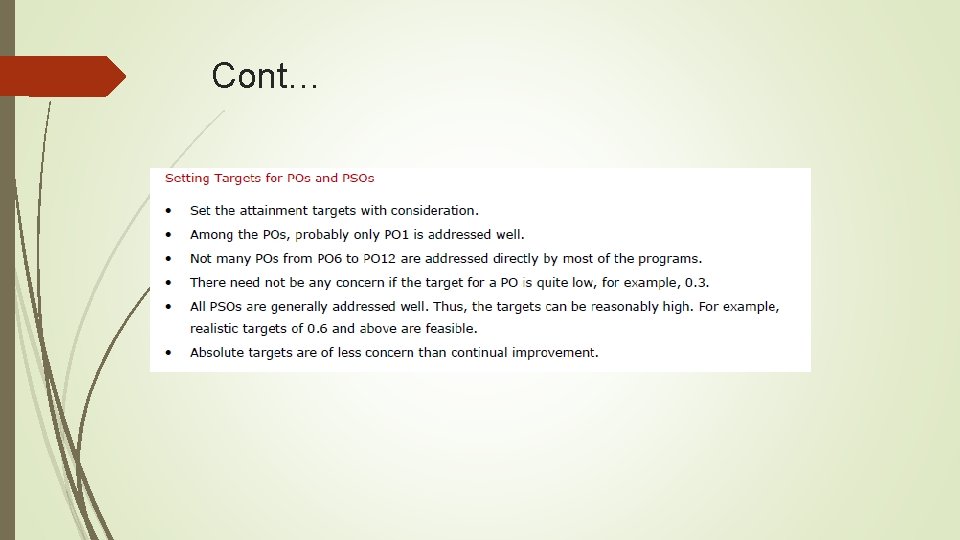
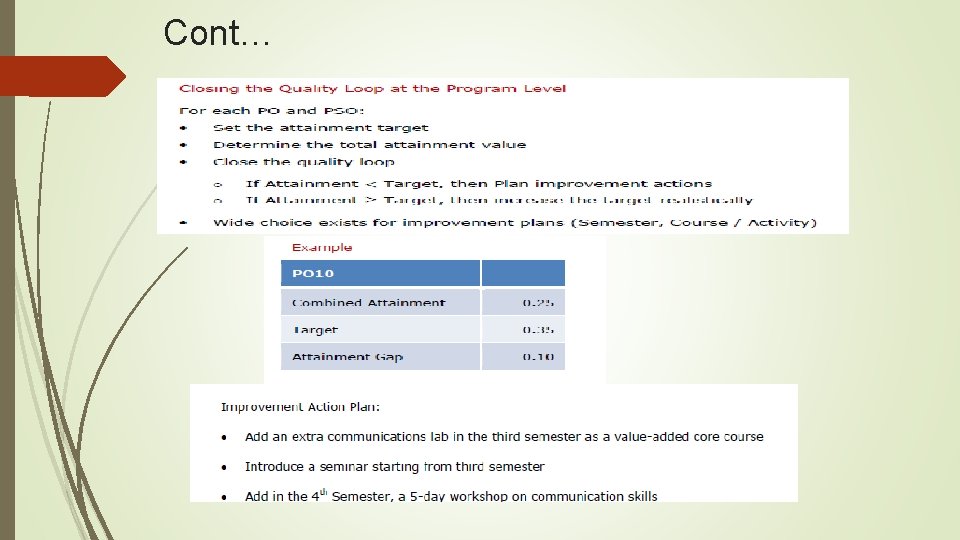
PO/PSO Attainment and quality loop
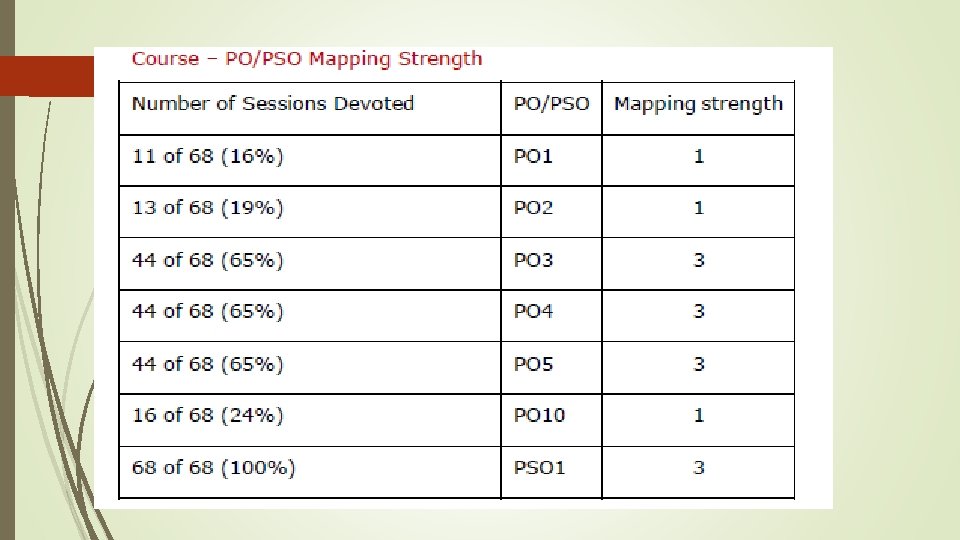
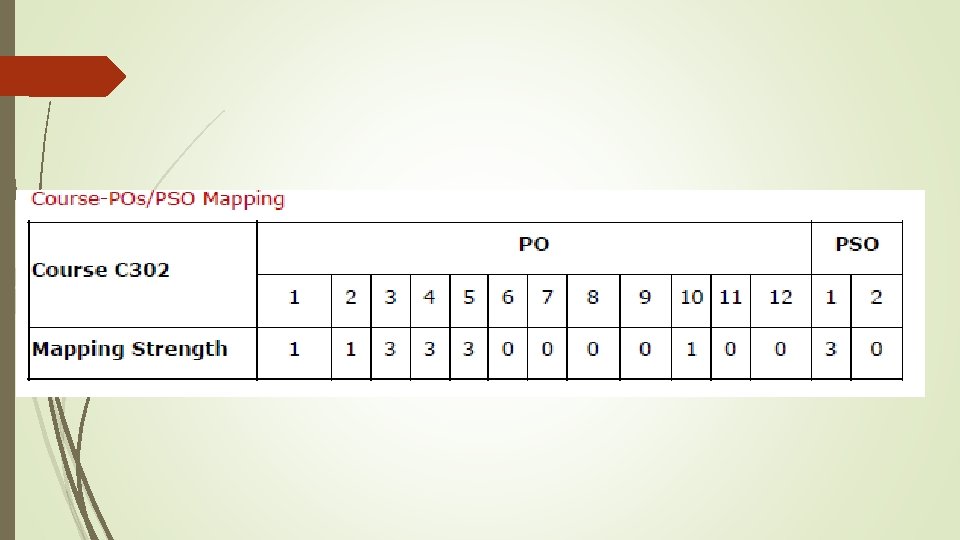
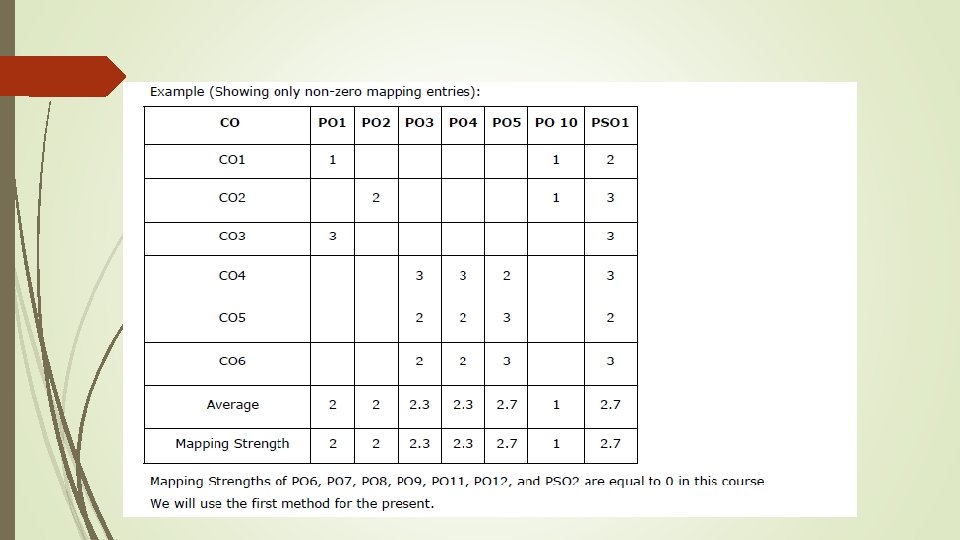
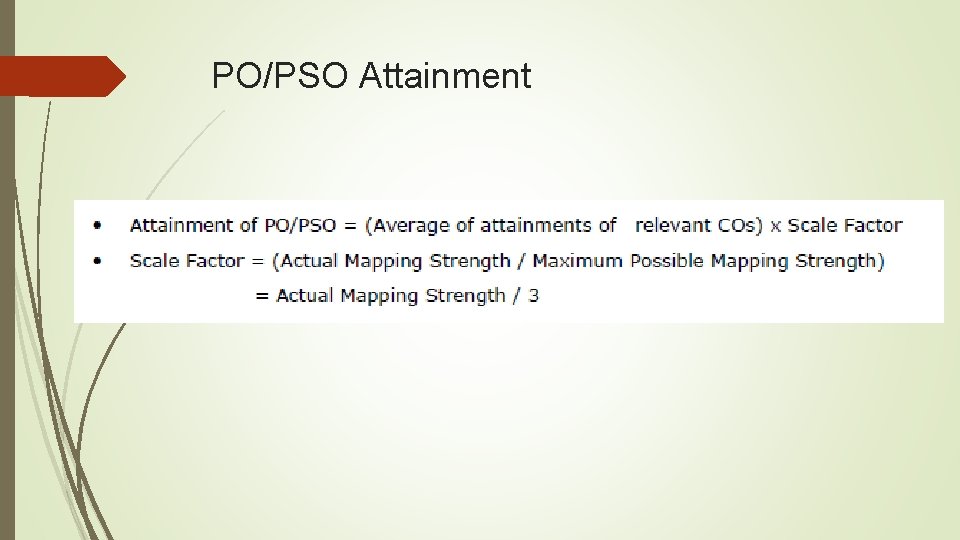
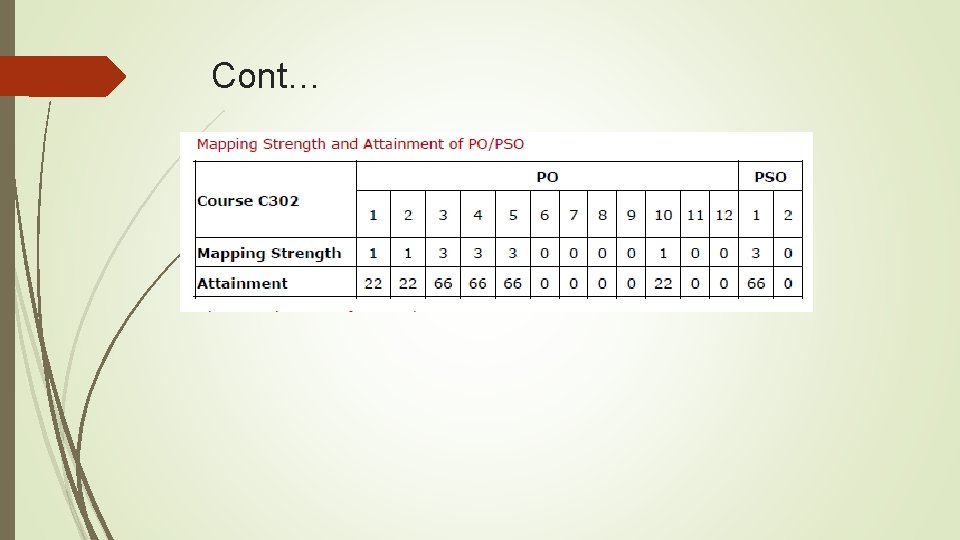
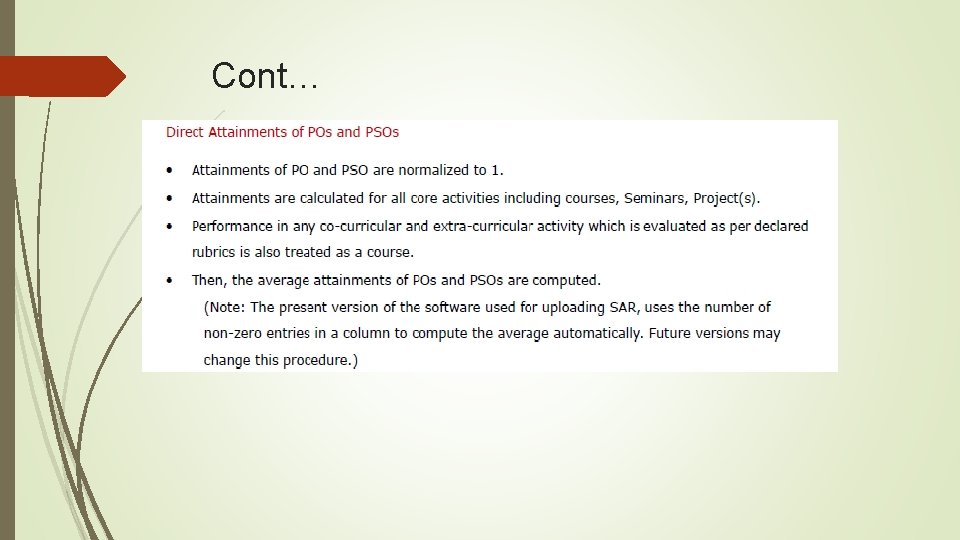
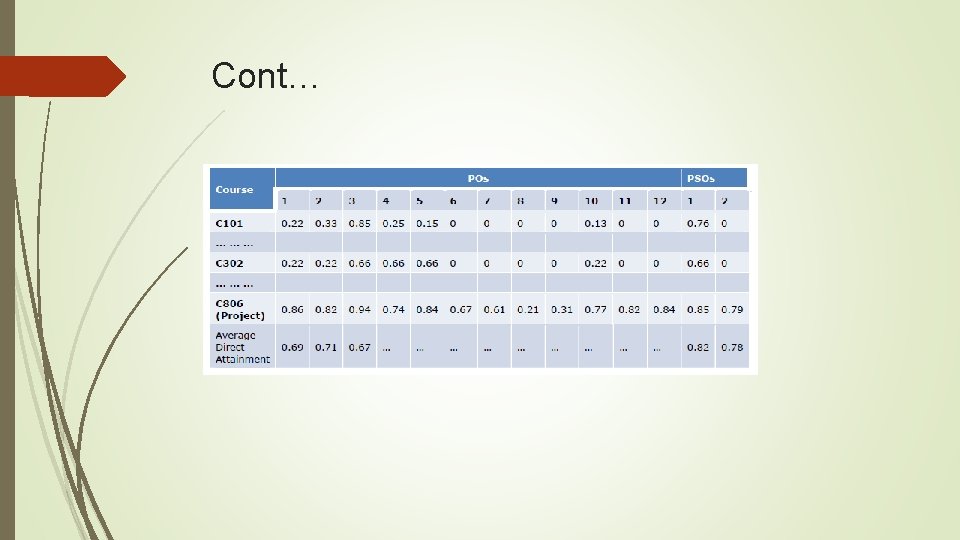
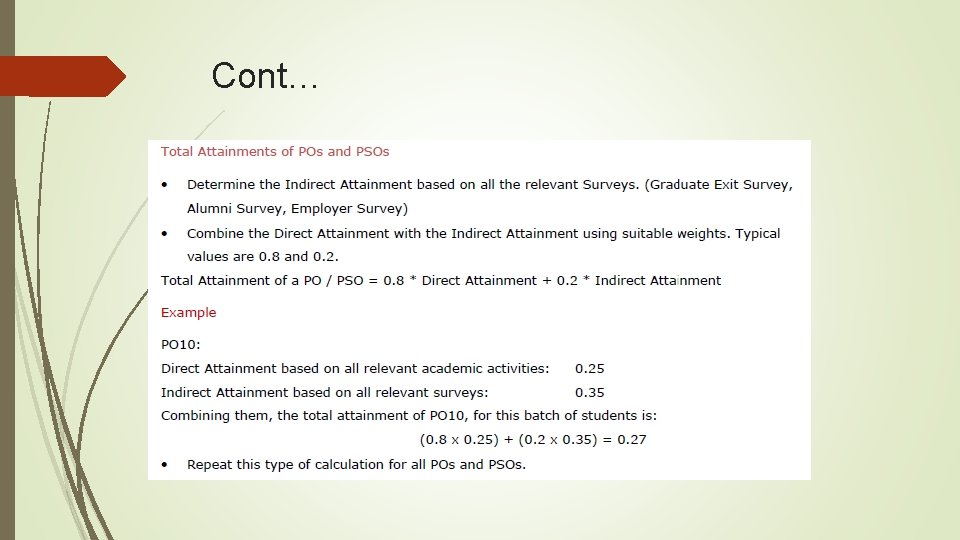
PO/PSO Attainment
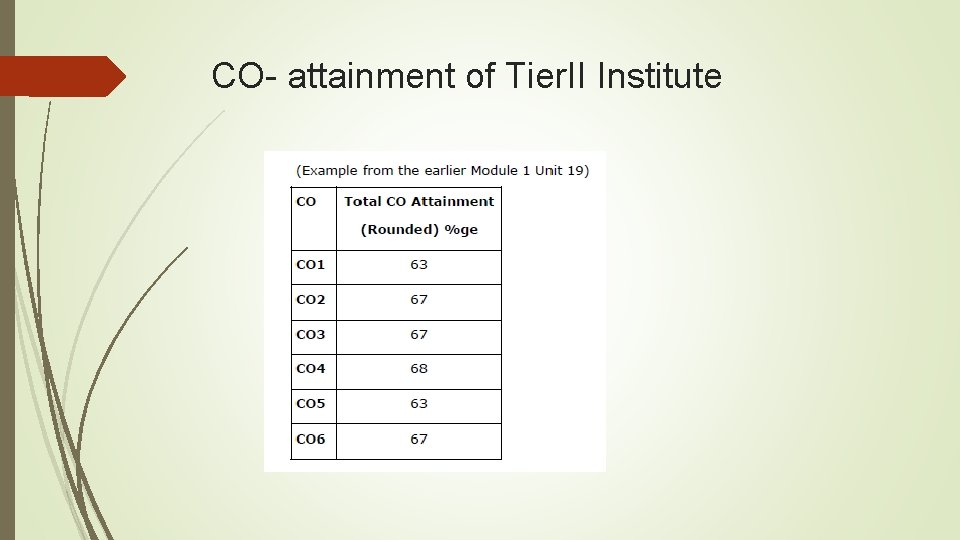
CO- attainment of Tier. II Institute
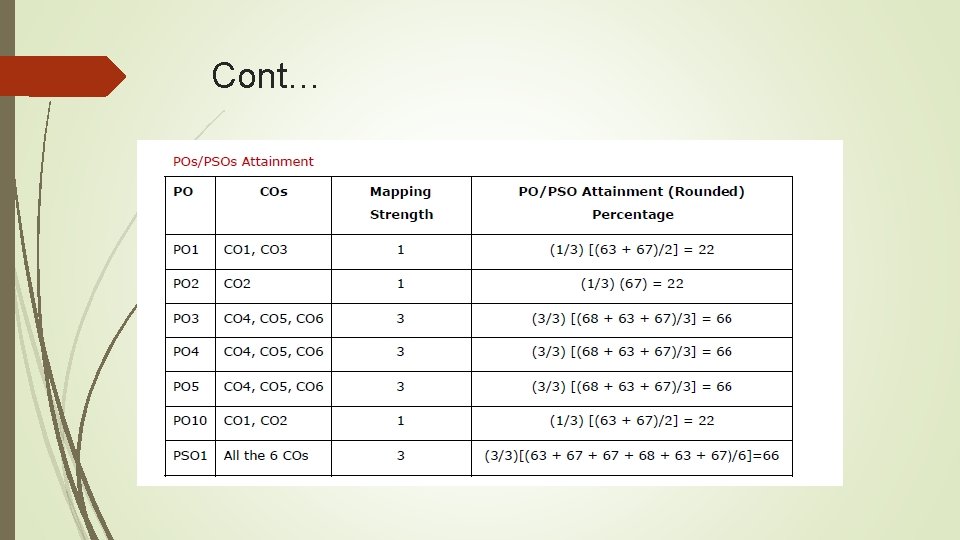
Cont…
Cont…
Cont…
Cont…
Cont…
Cont…
Cont…
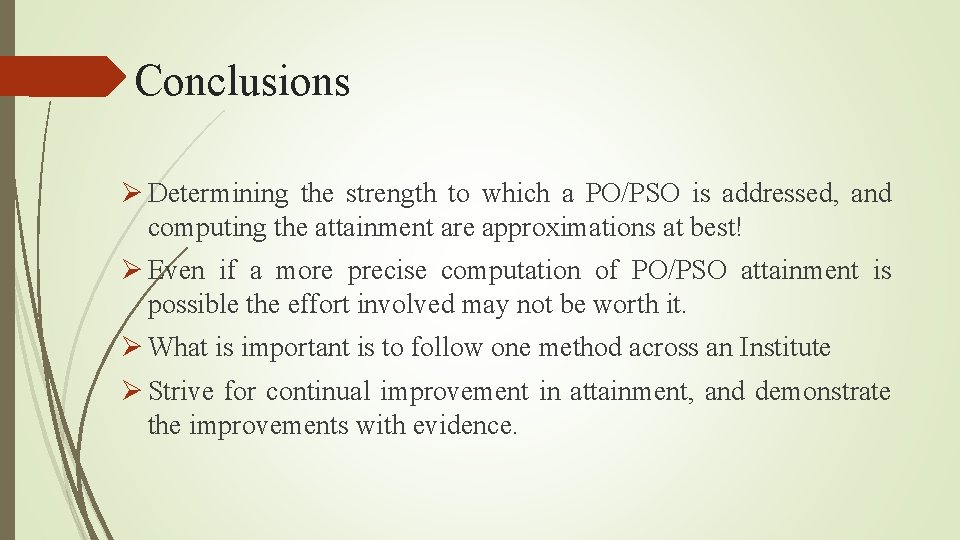
Conclusions Ø Determining the strength to which a PO/PSO is addressed, and computing the attainment are approximations at best! Ø Even if a more precise computation of PO/PSO attainment is possible the effort involved may not be worth it. Ø What is important is to follow one method across an Institute Ø Strive for continual improvement in attainment, and demonstrate the improvements with evidence.
Any Question…. . ?
Acknowledgement All the known or unknown sources used during making the presentation are duly acknowledged without the use of their data/information, the presentation would not have been so informative.
Thank You