
How to Build a Neutrino Oscillations Detector Why
How to Build a Neutrino Oscillations Detector Why MINOS is like it is! Alfons Weber March 2005 A. Weber MINOS Experiment
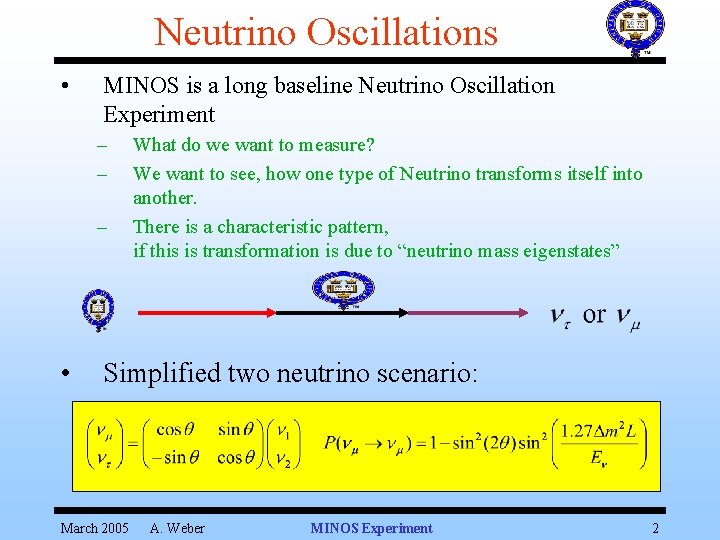
Neutrino Oscillations • MINOS is a long baseline Neutrino Oscillation Experiment – – – • What do we want to measure? We want to see, how one type of Neutrino transforms itself into another. There is a characteristic pattern, if this is transformation is due to “neutrino mass eigenstates” Simplified two neutrino scenario: March 2005 A. Weber MINOS Experiment 2

March 2005 A. Weber MINOS Experiment 3
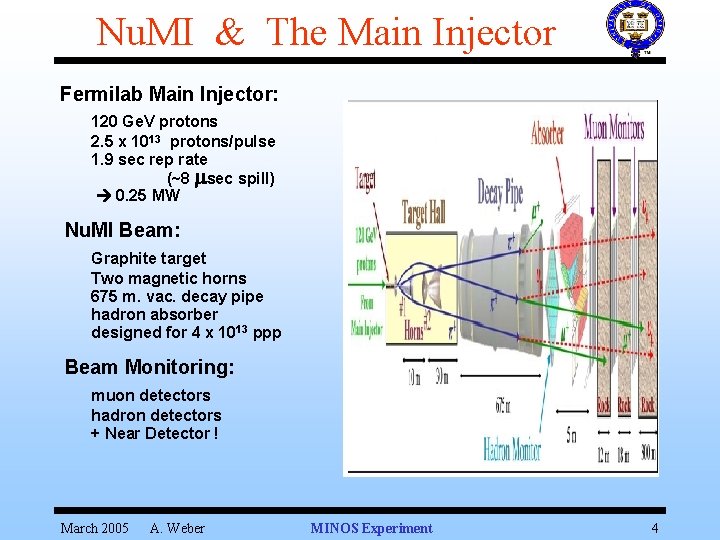
Nu. MI & The Main Injector Fermilab Main Injector: 120 Ge. V protons 2. 5 x 10¹³ protons/pulse 1. 9 sec rep rate (~8 msec spill) 0. 25 MW Nu. MI Beam: Graphite target Two magnetic horns 675 m. vac. decay pipe hadron absorber designed for 4 x 10¹³ ppp Beam Monitoring: muon detectors hadron detectors + Near Detector ! March 2005 A. Weber MINOS Experiment 4
Nu. MI Beam Layout March 2005 A. Weber MINOS Experiment 5
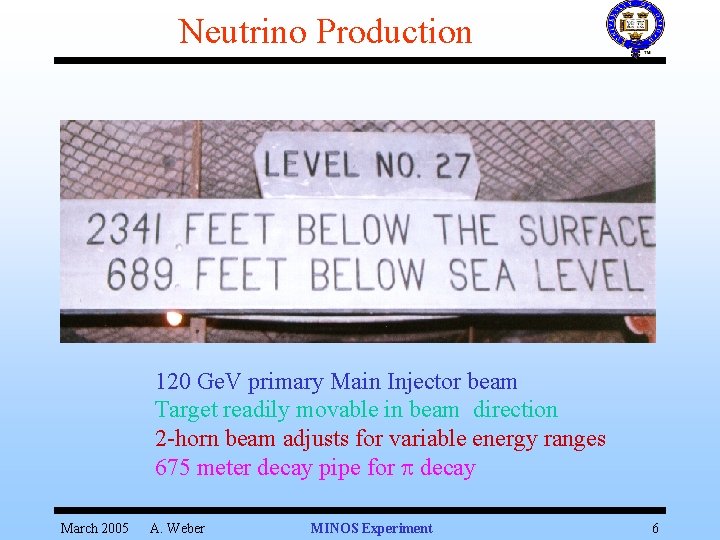
Neutrino Production 120 Ge. V primary Main Injector beam Target readily movable in beam direction 2 -horn beam adjusts for variable energy ranges 675 meter decay pipe for p decay March 2005 A. Weber MINOS Experiment 6
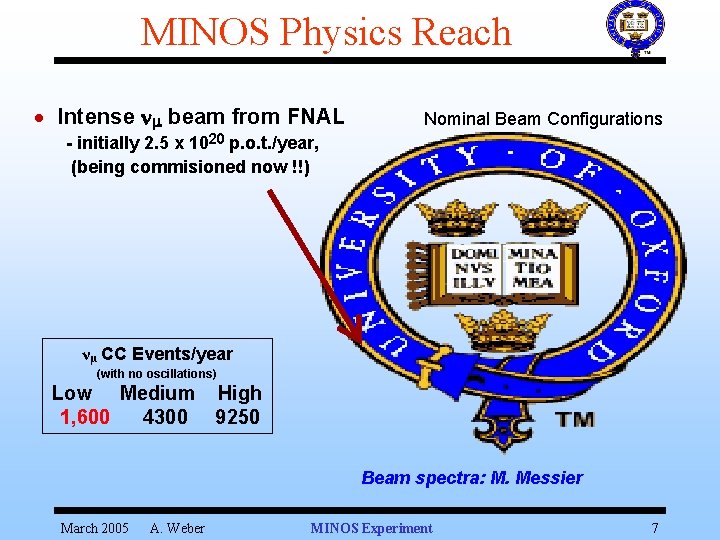
MINOS Physics Reach · Intense nm beam from FNAL Nominal Beam Configurations - initially 2. 5 x 10²⁰ p. o. t. /year, (being commisioned now !!) νµ CC Events/year (with no oscillations) Low Medium 1, 600 4300 High 9250 Beam spectra: M. Messier March 2005 A. Weber MINOS Experiment 7
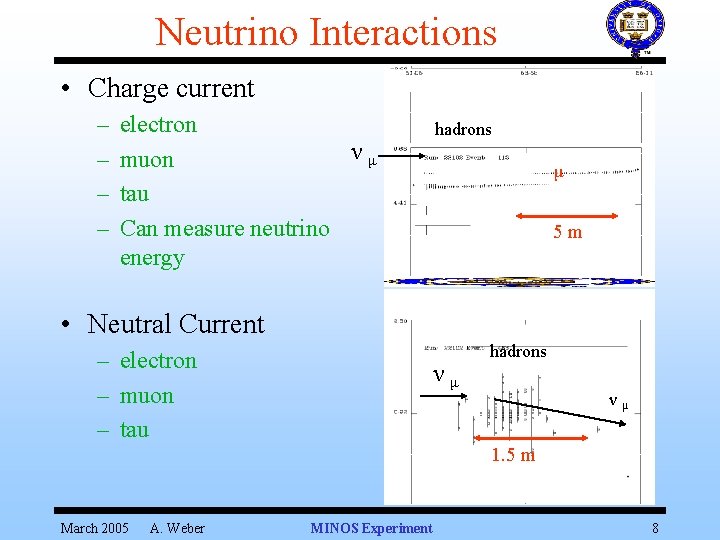
Neutrino Interactions • Charge current – – electron νμ muon tau Can measure neutrino energy hadrons μ 5 m • Neutral Current – electron – muon – tau νμ hadrons νμ 1. 5 m March 2005 A. Weber MINOS Experiment 8
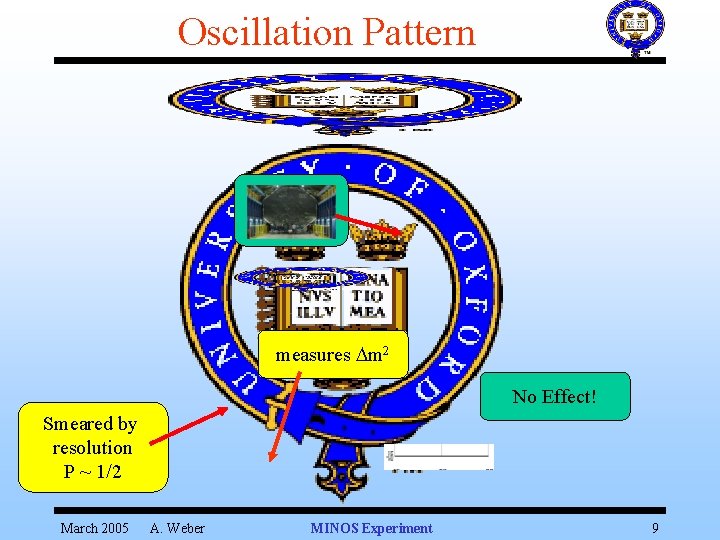
Oscillation Pattern measures m 2 No Effect! Smeared by resolution P ~ 1/2 March 2005 A. Weber MINOS Experiment 9
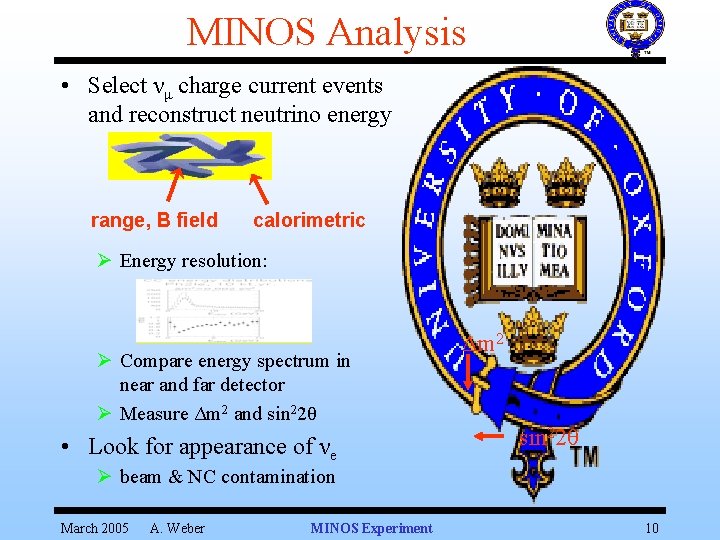
MINOS Analysis • Select νμ charge current events and reconstruct neutrino energy range, B field calorimetric Ø Energy resolution: Ø Compare energy spectrum in near and far detector Ø Measure Δm 2 and sin 22θ • Look for appearance of νe Δm 2 sin 22θ Ø beam & NC contamination March 2005 A. Weber MINOS Experiment 10
Where should the Experiment be? • Δm 2= 0. 002 -0. 003 e. V 2 (from SK) • In oscillation Minimum L/E = 400 - 800 km / Ge. V • Larger distance shorter distance • High energy low energy • Flux ~ 1/L 2 • Cross section ~ E • Event size ~ E March 2005 A. Weber MINOS Experiment 11
The MINOS Experiment • Nu. MI beam travels 735 km to Soudan (MN) • Sagitta: 10 km • 1 km wide at destination March 2005 A. Weber MINOS Experiment 12

March 2005 A. Weber MINOS Experiment 13

Detector • Design requirements – High Mass – High segmentation – Affordable March 2005 A. Weber MINOS Experiment 14
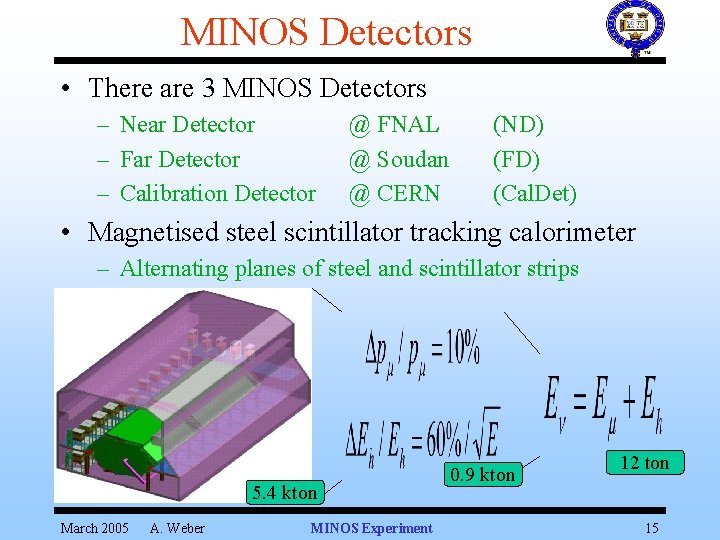
MINOS Detectors • There are 3 MINOS Detectors – Near Detector – Far Detector – Calibration Detector @ FNAL @ Soudan @ CERN (ND) (FD) (Cal. Det) • Magnetised steel scintillator tracking calorimeter – Alternating planes of steel and scintillator strips 5. 4 kton March 2005 A. Weber MINOS Experiment 0. 9 kton 12 ton 15
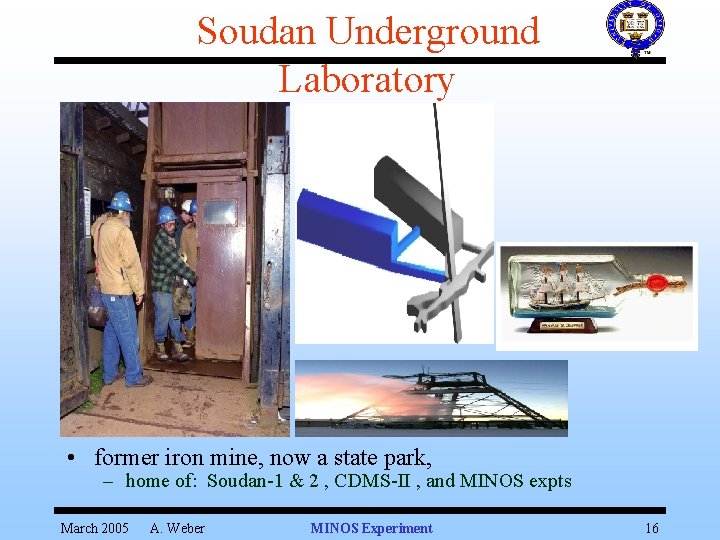
Soudan Underground Laboratory • former iron mine, now a state park, – home of: Soudan-1 & 2 , CDMS-II , and MINOS expts March 2005 A. Weber MINOS Experiment 16
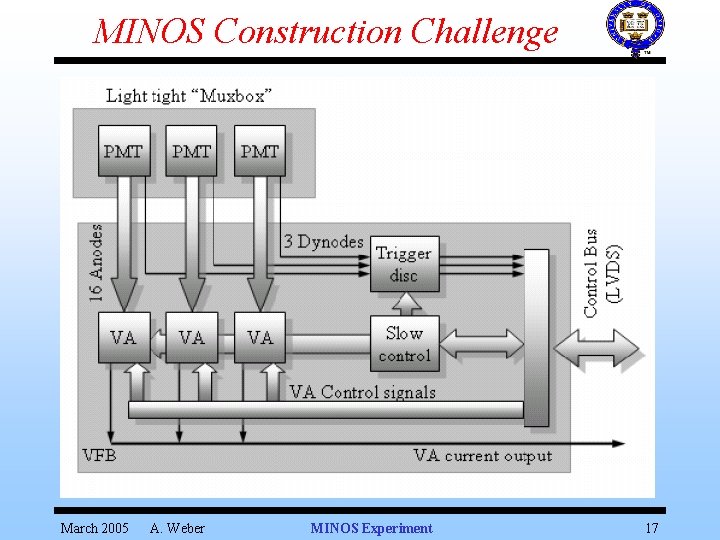
MINOS Construction Challenge March 2005 A. Weber MINOS Experiment 17
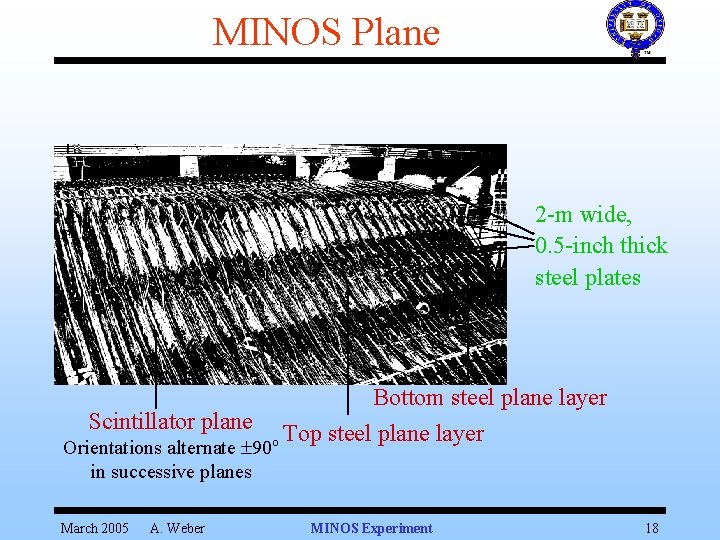
MINOS Plane 2 -m wide, 0. 5 -inch thick steel plates Bottom steel plane layer Scintillator plane Top steel plane layer o Orientations alternate 90 in successive planes March 2005 A. Weber MINOS Experiment 18
Far Detector • In old iron mine • Was already there – Soudan 1 & 2 • Right distance from FNAL March 2005 A. Weber MINOS Experiment 19
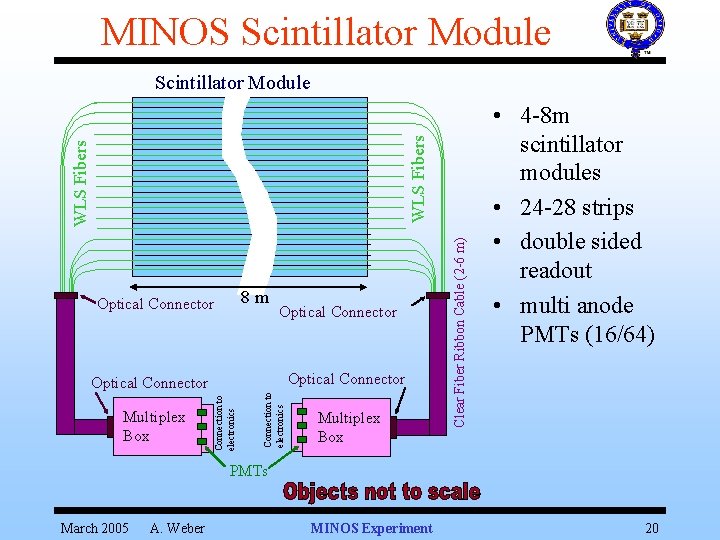
MINOS Scintillator Module 8 m Optical Connector Connection to electronics Optical Connector Multiplex Box Clear Fiber Ribbon Cable (2 -6 m) WLS Fibers Scintillator Module • 4 -8 m scintillator modules • 24 -28 strips • double sided readout • multi anode PMTs (16/64) PMTs March 2005 A. Weber MINOS Experiment 20
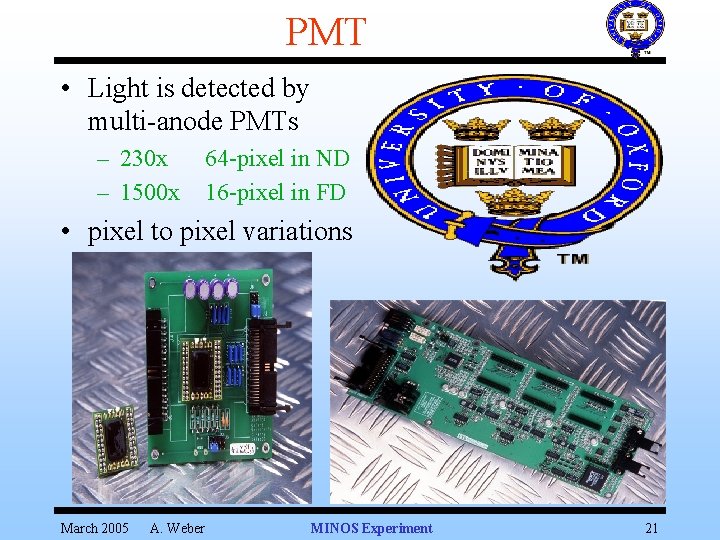
PMT • Light is detected by multi-anode PMTs – 230 x – 1500 x 64 -pixel in ND 16 -pixel in FD • pixel to pixel variations March 2005 A. Weber MINOS Experiment 21
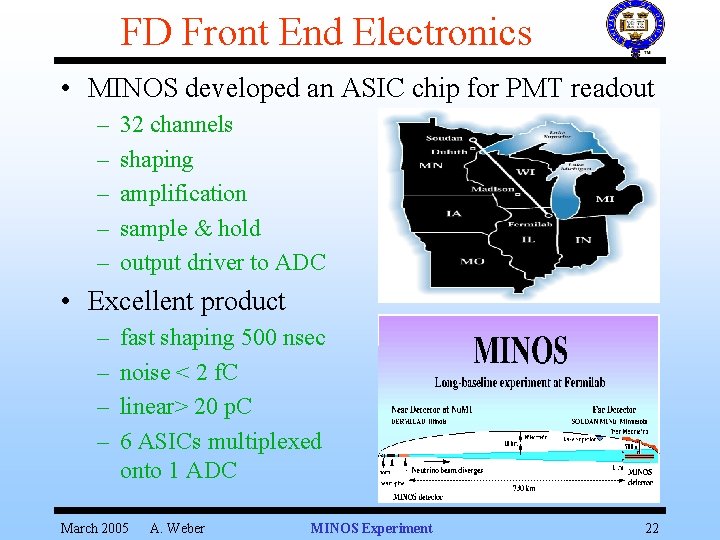
FD Front End Electronics • MINOS developed an ASIC chip for PMT readout – – – 32 channels shaping amplification sample & hold output driver to ADC • Excellent product – – fast shaping 500 nsec noise < 2 f. C linear> 20 p. C 6 ASICs multiplexed onto 1 ADC March 2005 A. Weber MINOS Experiment 22
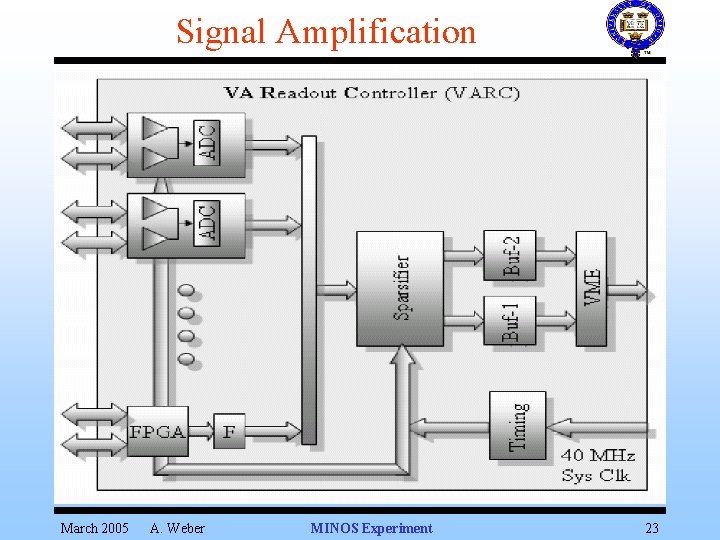
Signal Amplification March 2005 A. Weber MINOS Experiment 23
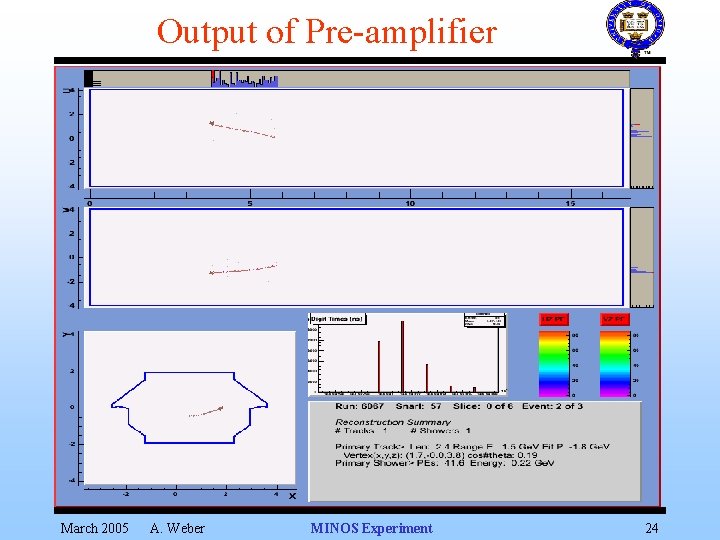
Output of Pre-amplifier March 2005 A. Weber MINOS Experiment 24
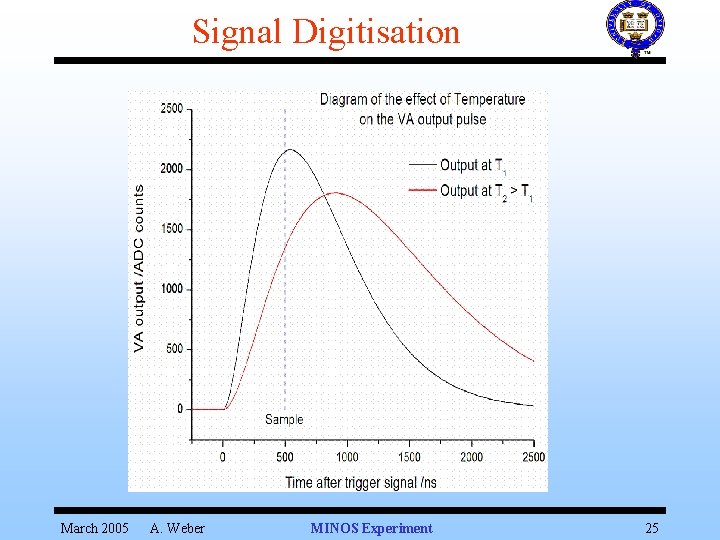
Signal Digitisation March 2005 A. Weber MINOS Experiment 25
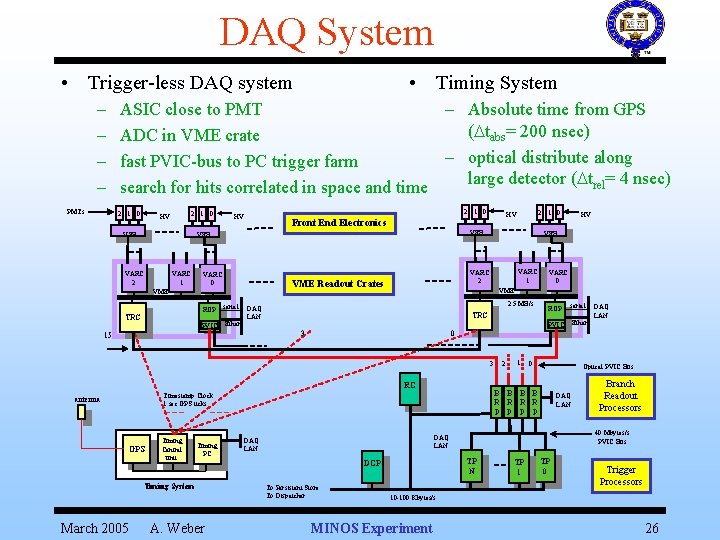
DAQ System • Trigger-less DAQ system – – PMTs • Timing System ASIC close to PMT – Absolute time from GPS ( tabs= 200 nsec) ADC in VME crate – optical distribute along fast PVIC-bus to PC trigger farm large detector ( trel= 4 nsec) search for hits correlated in space and time 2 1 0 HV VFB VARC 2 VARC 1 VARC 0 ROP serial PVIC Ether. VARC 1 2. 5 MB/s TRC RC GPS Timing PC Timing System March 2005 A. Weber serial PVIC Ether. 2 1 0 DAQ LAN Optical PVIC Bus B B R R P P Timestamp Clock 1 sec GPS ticks Timing Central unit ROP 0 3 3 antenna VARC 0 VME DAQ LAN 15 HV VFB VARC 2 VME Readout Crates VME TRC 2 1 0 HV Front End Electronics DAQ LAN 40 Mbytes/s PVIC Bus DAQ LAN TP DCP To Persistent Store To Dispatcher Branch Readout Processors N TP 1 TP 0 Trigger Processors 10 -100 Kbytes/s MINOS Experiment 26
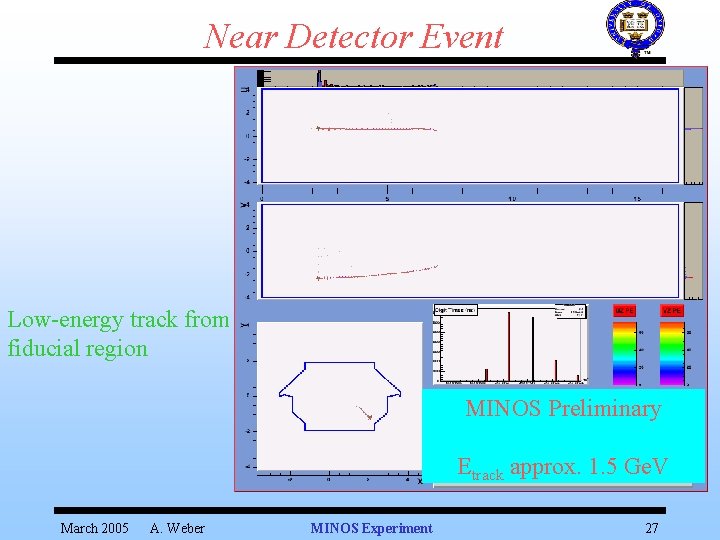
Near Detector Event Low-energy track from fiducial region MINOS Preliminary Etrack approx. 1. 5 Ge. V March 2005 A. Weber MINOS Experiment 27
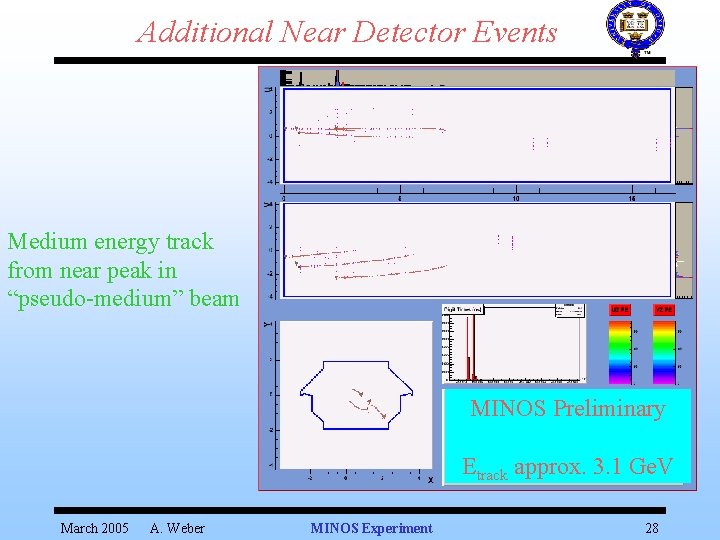
Additional Near Detector Events Medium energy track from near peak in “pseudo-medium” beam MINOS Preliminary Etrack approx. 3. 1 Ge. V March 2005 A. Weber MINOS Experiment 28
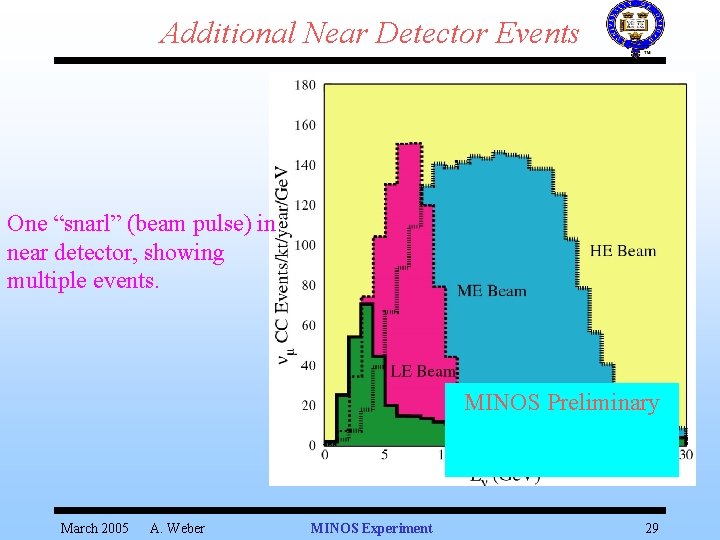
Additional Near Detector Events One “snarl” (beam pulse) in near detector, showing multiple events. MINOS Preliminary March 2005 A. Weber MINOS Experiment 29
- Slides: 29