
How to Bring Crisis Intervention Team Training to
How to Bring Crisis Intervention Team Training to Your Community Using the Collaborative as Cash Presented by: Ericanne Spence- Director Substance Abuse Services & Corrections Mental Health, CMHA-CEI Melissa Misner-Vocational Counselor, CMHA-CEI
OVERVIEW/LEARNING OBJECTIVES Objectives Learn how to organize a collaborative community approach to CIT training Discover how to create sustainability at the community level without Grant funding Explore the importance of the Sequential Intercept Model – specifically Intercept Zero
REGIONAL LAW ENFORCEMENT BUY-IN
THE CONVENER In October, 2015, the regional advocacy group; National Alliance for the Mentally Ill – Lansing (NAMI) brought Major Sam Cochran into Lansing for two days of training/discussion; at which several Law Enforcement Agencies were present, along with many public service agencies, such as the local Community Mental Health Authority. Although many of our partners were familiar with CIT from the State of Michigan’s Jail Diversion division or other avenues, NAMI-Lansing stoked the fires.
REGIONAL LAW ENFORCEMENT BUY-IN Police leadership in our area closely followed the President's 21 st Century Task force on Policing and Police Executive Research Forums, 30 Guiding Principle's; both of which recommend CIT as a "Must have" resource/tool. We accelerated our progress toward that so not to lose ground gained by NAMI's Sam Cochrane visit. A mindset of a carefully crafted letter/email to identified stakeholder leadership, including all area Police Chiefs, inviting them to a forum to discuss Behavioral Health and the prospect of a CIT program was enlisted. Attendance was strong. A CIT orientation presentation was given, Q&A followed, some light discussion and solicitation of "Buy in" was made. Support was unanimous. Steering committee was then formed and progress launched.
REGIONAL LAW ENFORCEMENT BUY-IN There is great pride in our community to make a difference. Behavioral health and co-occurring substance use disorder issues are undeniably critical and saturating problems in our region and beyond. Everyone must take interest as such. This alone could explain the perceived favorable attendance. However, the new initiative and request for community involvement likely had influence as well. Sparrow Systems (local hospital), Lansing School District security personnel and local Ingham County Sheriff’s Office Jail Deputies were among non-law enforcement entities invited to attend as they serve a first line function and contend with their proportion of people in crisis. The training has been valuable for them and plan on sending more employees for training.
BRINGING TOGETHER COMMUNITY PARTNERS
COMMUNITY INVOLVEMENT The large stakeholder forum was like throwing dynamite into the pond, but it’s a good way to see what organizations in your community are interested. Invite all law enforcement, hospital ED representatives, Community Mental health representatives, agencies for the homeless, SUD providers, etc. At this meeting a CIT overview was presented, a list of curriculum subjects was included and a request for interested parties was made From this initial meeting, TRI-COUNTY CIT held one more meeting and then formed a Steering Committee
• The initial Tri-County CIT steering committee included local law enforcement agencies, the local NAMI Affiliate, the local mental health authority, a local court representative, a local homeless shelter and hospital emergency departments. • The committee knew from the get go that there was no grant funding and any initiative would occur through in-kind donation of time. • After a couple of meetings that centered on what was required to get the first training up and going; it became clear that there was a core group of steering committee members that were dedicated and willing to commit the time and effort needed. • The Steering Committee was extremely fortunate to have a MSW intern working with the CMH authority, who was interested in CIT and used the process for both her internship and her research paper for a class. She continued after graduation, being paid per diem by the local CMHA. We would urge any CIT effort to reach out to local universities for interns in either criminal justice or social work to assist in the endeavor.
STEERING COMMITTEE Our Steering Committee did not have a CIT Coordinator. Our intern took meeting minutes, but there were also several others that would do so if she was absent. The Steering Committee just naturally took on a collective CIT Coordinator role, depending on need. Example; if contact was needed for a presenter on Bi-polar disorder, the CMH member would take on that task. The same if it was law enforcement specific. For sustainability, we do feel having a CIT Coordinator is important, but with close community partnership interaction and discussion, a good product can be created without.
UTILIZING THE SEQUENTIAL INTERCEPT MODEL AS A GUIDE

WHAT IS THE SEQUENTIAL INTERCEPT MODEL? Developed by Mark R. Munetz, MD and Patricia A. Griffin, Ph. D, in conjunction with the GAINS Center. Provides a conceptual framework for communities to organize targeted strategies for justice involved individuals with behavioral health disorders. Look at where to you intercept in the justice system – opportunities for linkage to services and prevention. Use to look for gaps in services, assess available resources, and plan for community change SAMSHA GAINS Center often has RFP’s for GAINS to come to your community and assist with Sequential Intercept Mapping. o Clinton, Eaton and Ingham Counties has received this grant and the GAINS Center representatives will be coming to the community August 29 & 30

THE IMPORTANCE OF INTERCEPT ZERO Intercept 0 – What is your community’s Coordinated response to Crisis? Continuum of Care for Crisis? Before you begin to train dispatch and police and begin linkages between police and Emergency departments, Crisis Services, etc. , take a look at what’s available in your community and how do these services work together or against each other? Have a meeting with your crisis continuum agencies first and map out for the police; if A occurs, go to …. . Nothing more frustrating then to train police for Crisis Intervention, only to be told, “we don’t do that” or “you’re in the wrong place” Example of why this was important with the Tri-county CIT
INTERCEPT 1 – LAW ENFORCEMENT 911 – dispatchers trained to identify calls involving persons with behavioral health disorders and refer to trained respondents Police – Train officers to respond to calls where MI/SUD may be an issue Documentation – tool to document interaction (data) Emergency/crisis response – provide police friendly drop off Linkage – ensure positive linkages among community Follow up – wrap around individuals not hospitalized or discharging Evaluation – Monitor/evaluation through stakeholder meetings

DEVELOPMENT OF A WEBSITE/GETTING THE WORD OUT
WWW. TRICOUNTYCIT. COM With a regional effort and not having a CIT coordinator, it was very important to have a method to get information out Researching and building the Website was the intern’s project In hindsight, the website has become indispensable to all involved.
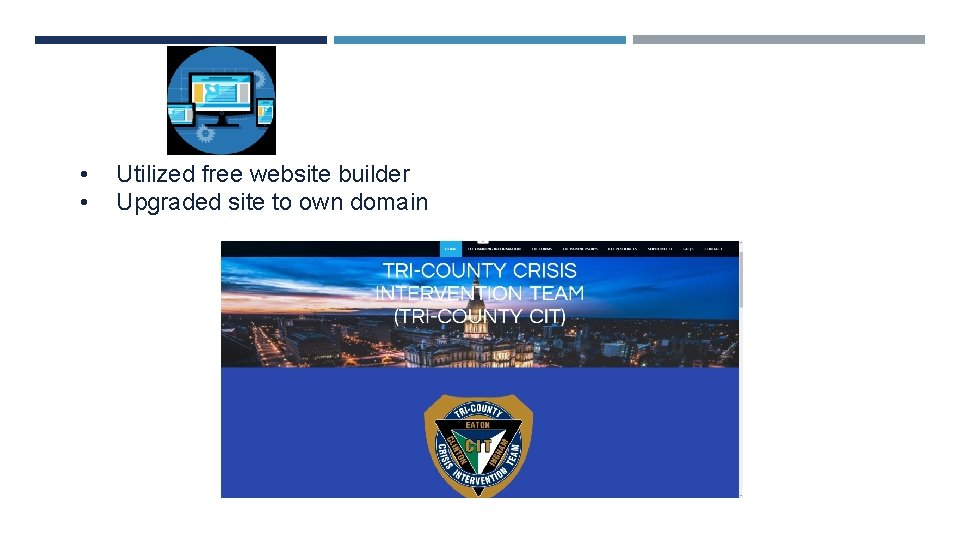
• • Utilized free website builder Upgraded site to own domain
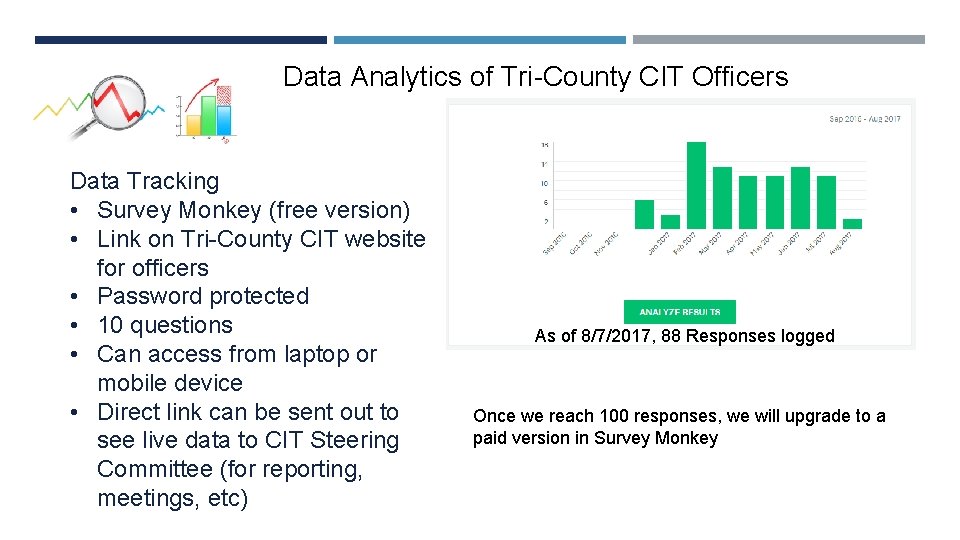
Data Analytics of Tri-County CIT Officers Data Tracking • Survey Monkey (free version) • Link on Tri-County CIT website for officers • Password protected • 10 questions • Can access from laptop or mobile device • Direct link can be sent out to see live data to CIT Steering Committee (for reporting, meetings, etc) As of 8/7/2017, 88 Responses logged Once we reach 100 responses, we will upgrade to a paid version in Survey Monkey
• • • Presentations at CMHA-CEI events Presentations at NAMI-Lansing Events Meetings with Law Enforcement Chiefs in Tri-County Press Releases Presentation at the Michigan Association of Community Mental Health Board Winter Conference 2017 • Lansing Police Department Press Conference • Networking
DONATIONS If you can, find a community partner to act as fiduciary and ask for donations. TRI-COUNTY CIT used NAMI-Lansing and requested donations on the website and in any community forum that the steering committee members were able to attend and discuss the CIT initiative in the community Donations were used to pay for lunch, CIT pins and purchasing a consultant to assist with role play development, including bringing in individuals who have role played in past trainings. Get as much in-kind donations as possible (used binders, copies, etc. ) Currently exploring 501(c) 3 status
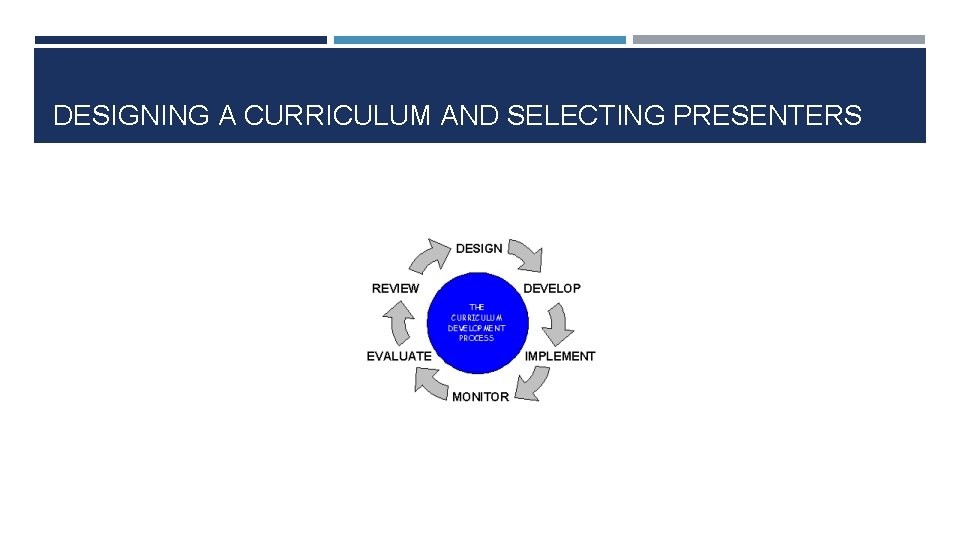
DESIGNING A CURRICULUM AND SELECTING PRESENTERS
COMMUNITY SPECIFIC TRAINING CURRICULUM Don’t re-create the wheel – borrow. TRI-COUNTY CIT borrowed from CIT-Memphis National Curriculum The Steering Committee made decisions on curriculum based on community need. Examples: o CMHA does not have mobile Crisis Services, so therapists don’t meet consumers at the hospital o The region has an active shelter system and law enforcement interaction with the homeless occurs often o Does your community have super utilizers of first responder services and how does that impact Law Enforcement? Currently revising after the first three training sessions to better accommodate time frame, feedback, etc.
THIS IS THE LABOR INTENSIVE ASPECT OF A COLLABORATIVE EFFORT Also what resources are available to assist with the curriculum. Who knows who in the community. Once the steering committee had a “working” curriculum of topics, members begin to identify who in the community could present and gear the presentation to law enforcement. The experts need to be able to present to individuals in a non-academic way. Steering Committee members had to insure that presenters geared the presentation towards cops – with an emphasis on: What does a cop need to know about this subject? What tools do I give to assist the cop when called to a situation with this subject? Often the curriculum schedule would changed based on availability of a presenter. We made sure we had a “second” in case our first choice did not work out.
CURRICULUM DEVELOPMENT CONTINUED…. Each presenter was given an outline of what’s expected of him/her in the presentation. This includes; length of time to present, requirement of a power point, what topics to cover. We set a couple of meeting dates for presenters to meet with Steering Committee – at this meeting discuss CIT, expectations, training week and set a date for when draft Power point presentations are due for review. We learned not to be shy about getting what you want from your presenters. Have your steering committee be in constant contact with your presenters. Tri-County CIT put together binders (donated) with the handouts in them. Feedback from trainees from the 1 st session stated just having them available on the website for printing would be sufficient. The CIT Steering Committee has begun emailing the presentations to participants for the 2 nd and 3 rd sessions. The Presenters have been willing to engage and participate in the trainings free of charge.
ROLE PLAYERS AND SCENARIOS TRI-COUNTY CIT worked with a consultant who was able to bring in role players and scenarios. This saved time (but it was the greatest expense and would not have been possible without donations and Lansing Police Department) The role players were a mix of community volunteers and the consultant’s players It was important to take into consideration the Tri-County region, which includes both urban and rural jurisdictions and different scenarios. If communities wanted to develop this aspect of the training themselves, it’s doable, just requires time and practice. Scenarios need to loop back to the didactics, as well as, de-escalation techniques used by the officers. The role players volunteered their time for the first training and have since come volunteered for ongoing trainings. Role players have also included officers who participated in the first training. The Steering committee has revised the initial scenarios to better fit our three county jurisdiction and day-to- day experiences of local law enforcement.
LOGISTICS Location of training – This was a three county effort and included law enforcement from all three counties. We needed a large space for both the curriculum but also break out space for role playing. Date of training Training registration (email) – The first training was offered free to officers (40). The second and third trainings included a registration fee. We have completed three trainings since November; April and June. Binders/presentation equipment – this was all in-kind donations. Binders were previously used. Lunch/snacks/beverages – Paid for through a donation from NAMI. Didn’t want officers to leave the building.
LOGISTICS CONTINUED CIT Pin – Most models have offices designing the pin as a part of the curriculum. Due to our regional approach, the Steering Committee designed the pin. This was completed early in the process so that we could use the pin as our Logo and Brand ourselves as Tri-County CIT. Satisfaction Surveys after each individual didactic – very important and the steering committee members present during the training made sure officers were reminded. This feedback was important as the committee began the development of the next training. The feedback was used to either assist presenters to sharpen the presentation, find someone else to present a topic or to shorten/lengthen certain topics. We used a numerical rating, as well as a comment section. Data gathering tool for outcomes – the outcomes form is located on the website and is accessible from officer’s cell phones.
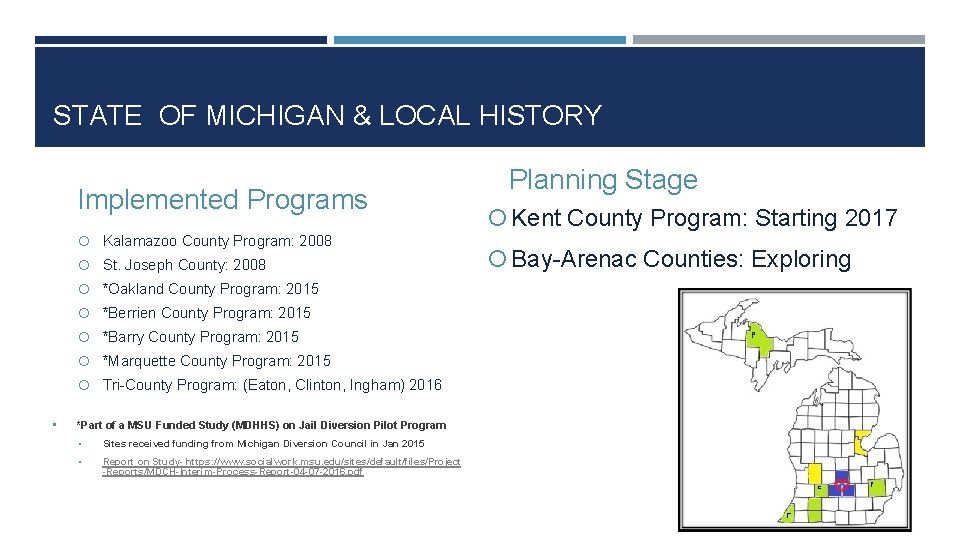
STATE OF MICHIGAN & LOCAL HISTORY Implemented Programs Kalamazoo County Program: 2008 St. Joseph County: 2008 *Oakland County Program: 2015 *Berrien County Program: 2015 *Barry County Program: 2015 *Marquette County Program: 2015 Tri-County Program: (Eaton, Clinton, Ingham) 2016 • *Part of a MSU Funded Study (MDHHS) on Jail Diversion Pilot Program • Sites received funding from Michigan Diversion Council in Jan 2015 • Report on Study- https: //www. socialwork. msu. edu/sites/default/files/Project -Reports/MDCH-Interim-Process-Report-04 -07 -2016. pdf Planning Stage Kent County Program: Starting 2017 Bay-Arenac Counties: Exploring
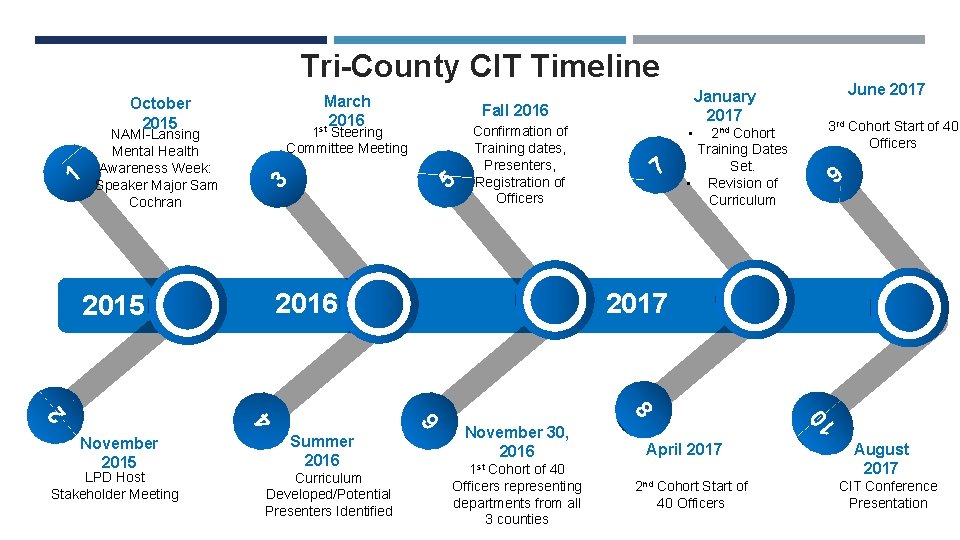
Tri-County CIT Timeline March 2016 st 1 1 Steering Committee Meeting NAMI-Lansing Mental Health Awareness Week: Speaker Major Sam Cochran 5 3 Confirmation of Training dates, Presenters, Registration of Officers • 7 2 nd Cohort Training Dates Set. • Revision of Curriculum 6 4 2 November 2015 LPD Host Stakeholder Meeting Summer 2016 Curriculum Developed/Potential Presenters Identified 3 rd Cohort Start of 40 Officers 9 2017 2016 8 2015 Fall 2016 June 2017 November 30, 2016 1 st Cohort of 40 Officers representing departments from all 3 counties April 2017 2 nd Cohort Start of 40 Officers 10 October 2015 January 2017 August 2017 CIT Conference Presentation
STRENGTHS AND WEAKNESSES OF A GRASSROOTS CIT TRAINING
STRENGTHS We were able to put the curriculum together quickly because there were no grant requirements, including measures No grant reporting Community support/dedication – brought community together and worked on identifying and filling existing gaps The three counties have MOUs in place to share CIT officers when needed. Significant community buy-in – local groups did all the heavy lifting and were all a part of the curriculum.
MORE STRENGTHS NAMI-Lansing’s focus on CIT as crucial to having a healthier community and pushing all partners to succeed. They were also able to act as Fiduciary for donations. If you have a graduate student – the initial community work for CIT is a great project. The background research was completed by Melissa as a graduate student and her peers, who took this on as a project. Without outside assistance, the community can take ownership – it was kind of a, “we’ll show them” that you don’t need big dollars and can utilize your community. Also by not having a Coordinator, it forced all to act together, versus putting the bulk of the work on one person.
WEAKNESSES Who is fiscally responsible (donations) Loss of community people due to retirements, job changes, etc. Lack of Money for assisting LE departments with back fill/OT to have officers attend The inability to see other CIT programs in action No CIT Coordinator per se No dedicated person to work on this (unless you have an intern who happens to have/find a passion for this? ) – highly recommended if possible.
QUESTIONS/COMMENTS
BIBLIOGRAPHY/INFORMATION University of Memphis: CIT Center: http: //www. cit. memphis. edu/bjaa. php Mental Health Crisis Response Institute: http: //www. mentalhealthcrisis. org/lawenforcement. html NAMI- San Antonio: http: //nami-sat. org/crisis-intervention-teams-cit-an-invaluable-community-resource/ Bureau of Justice Assistance- Improving Responses to People with Mental Illnesses Report: https: //www. bja. gov/Publications/Strategies_%20 for_LE_Training. pdf CIT International: http: //www. citinternational. org/index. php Police Officers’ Perceptions of the 40 -Hour Crisis Intervention Team (CIT) Curriculum http: //community. nicic. gov/blogs/mentalhealth/archive/2011/08/04/police-officersperceptions-of-the-40 -hour-crisis-intervention-team-cit-curriculum. aspx Berkeley Police Department - Crisis Intervention Team: A Report with Recommendations http: //www. berkeleyside. com/wp-content/uploads/2014/04/BPD-CIT-Proposal. pdf Self-Help Manual Starting a CIT Program A Step by Step Guide: http: //naminc. org/nn/affiliates/startcitpartner. pdf Crisis Intervention Training (CIT) Suggested Course Materials : https: //www. dshs. wa. gov/sites/default/files/BHSIA/dbh/documents/CITResource. Manual. pdf Crisis Intervention Teams: A Frontline Response to Mental Illness in Corrections [Lesson Plans and Participant's Manual]: http: //nicic. gov/library/024797 NAMI- Lansing: www. nami-lansing. org/ Substance Abuse and Mental Health Services Administration: https: //www. samhsa. gov/gains-center Tri-County CIT Program: www. tricountycit. com Rafael Diaz, Diaz Consulting
PRESENTER INFORMATION Ericanne Spence, Director, CMHA-CEI spence@ceicmh. org Melissa Misner, Vocational Counselor misner@ceicmh. org
- Slides: 36