
How to be an Ally PEERs Seminar Week
How to be an Ally PEERs Seminar Week 10
Agenda • Cultural Representations • Discussion of allyship – Interpersonal allyship – Structural allyship • Final presentations • Course conclusion • Course evaluations
Cultural Representation North Carolina State University’s Center for Universal Design http: //www. ncsu. edu/ncsu/design/cud/index. htm “Universal by Design” course Advanced undergraduate and graduate level course on universal design
Social Justice Ally: Definition “Social justice allies are members of dominant social groups (e. g. , men, whites, heterosexuals) who are working to end the system of oppression that gives them greater privilege and power based upon their social group membership” (Broido, 2000).

Circular Model of Allyship Awareness Education • • • Understanding our own backgrounds Becoming cognizant of those around us Action • Do it! • Speak up! Adapted from Anne Bishop’s 2002 Becoming an Ally and Evans, Assadi, Herriot’s 2005 Encouraging the Development of Disability Allies History Power structures Patterns Development of Skills • • Planning for action Strategies
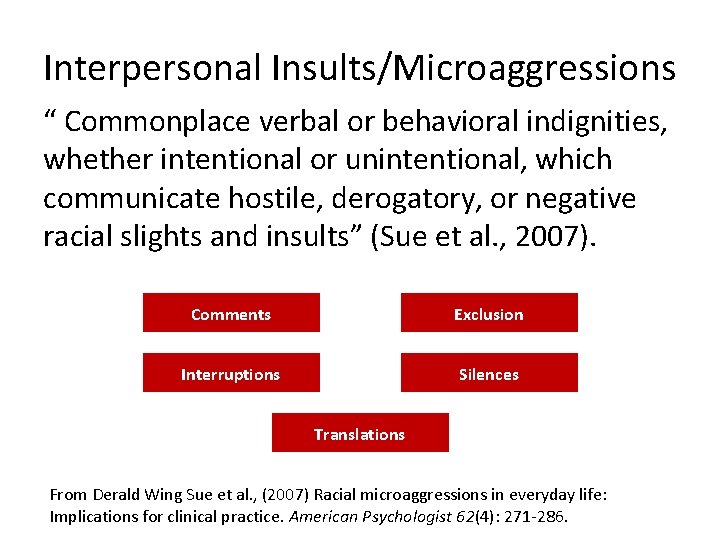
Interpersonal Insults/Microaggressions “ Commonplace verbal or behavioral indignities, whether intentional or unintentional, which communicate hostile, derogatory, or negative racial slights and insults” (Sue et al. , 2007). Comments Exclusion Interruptions Silences Translations From Derald Wing Sue et al. , (2007) Racial microaggressions in everyday life: Implications for clinical practice. American Psychologist 62(4): 271 -286.
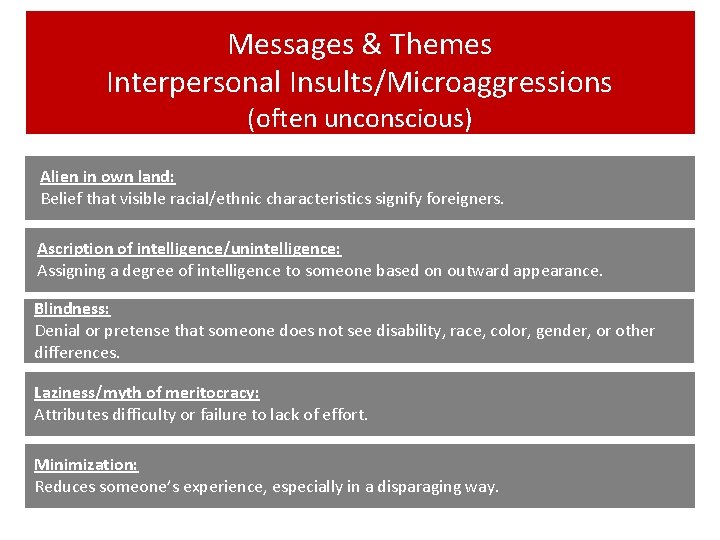
Messages & Themes Interpersonal Insults/Microaggressions (often unconscious) Alien in own land: Belief that visible racial/ethnic characteristics signify foreigners. Ascription of intelligence/unintelligence: Assigning a degree of intelligence to someone based on outward appearance. Blindness: Denial or pretense that someone does not see disability, race, color, gender, or other differences. Laziness/myth of meritocracy: Attributes difficulty or failure to lack of effort. Minimization: Reduces someone’s experience, especially in a disparaging way.
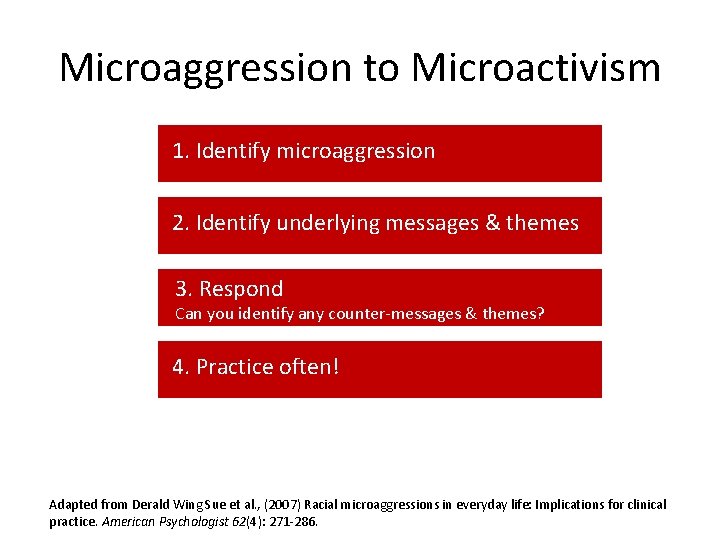
Microaggression to Microactivism 1. Identify microaggression 2. Identify underlying messages & themes 3. Respond Can you identify any counter-messages & themes? 4. Practice often! Adapted from Derald Wing Sue et al. , (2007) Racial microaggressions in everyday life: Implications for clinical practice. American Psychologist 62(4): 271 -286.
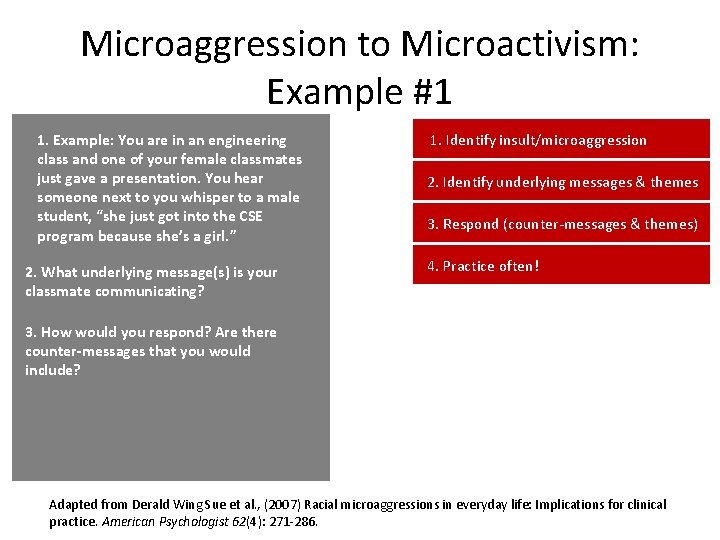
Microaggression to Microactivism: Example #1 1. Example: You are in an engineering class and one of your female classmates just gave a presentation. You hear someone next to you whisper to a male student, “she just got into the CSE program because she’s a girl. ” 2. What underlying message(s) is your classmate communicating? 1. Identify insult/microaggression 2. Identify underlying messages & themes 3. Respond (counter-messages & themes) 4. Practice often! 3. How would you respond? Are there counter-messages that you would include? Adapted from Derald Wing Sue et al. , (2007) Racial microaggressions in everyday life: Implications for clinical practice. American Psychologist 62(4): 271 -286.
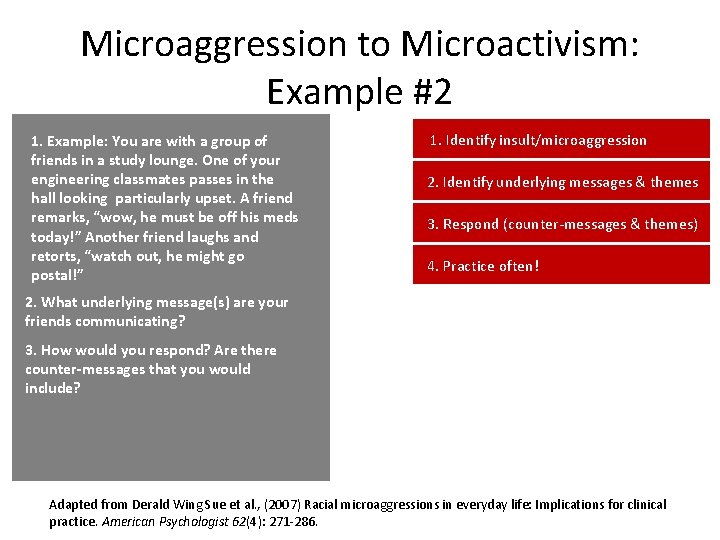
Microaggression to Microactivism: Example #2 1. Example: You are with a group of friends in a study lounge. One of your engineering classmates passes in the hall looking particularly upset. A friend remarks, “wow, he must be off his meds today!” Another friend laughs and retorts, “watch out, he might go postal!” 1. Identify insult/microaggression 2. Identify underlying messages & themes 3. Respond (counter-messages & themes) 4. Practice often! 2. What underlying message(s) are your friends communicating? 3. How would you respond? Are there counter-messages that you would include? Adapted from Derald Wing Sue et al. , (2007) Racial microaggressions in everyday life: Implications for clinical practice. American Psychologist 62(4): 271 -286.
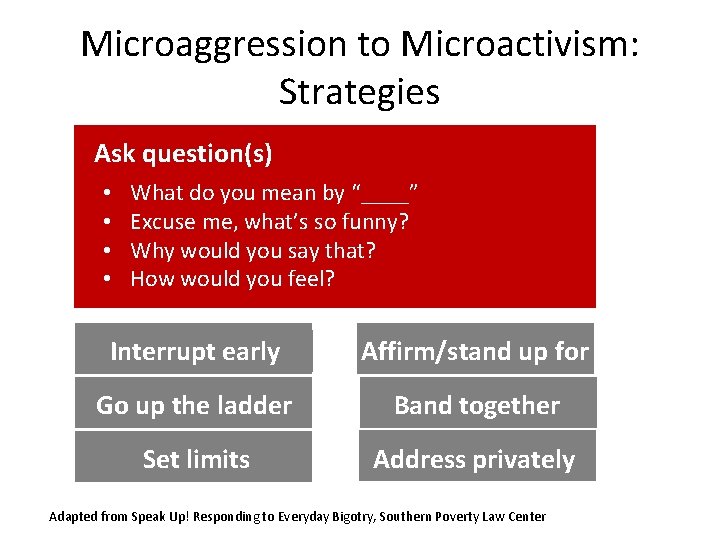
Microaggression to Microactivism: Strategies Ask question(s) • • What do you mean by “____” Excuse me, what’s so funny? Why would you say that? How would you feel? Interrupt early Affirm/stand up for Go up the ladder Band together Set limits Address privately Adapted from Speak Up! Responding to Everyday Bigotry, Southern Poverty Law Center

BREAK
Structural Bias & Allyship What are some examples of structural bias from the readings or from your experiences in engineering?
Allyship in Engineering It is 2030 and you work as a CEO in a Seattle-based engineering company. How can you create a diverse team of engineers? What can you do to ensure your organization is fair and inclusive? What ideas, practices, and/or policies would you implement?
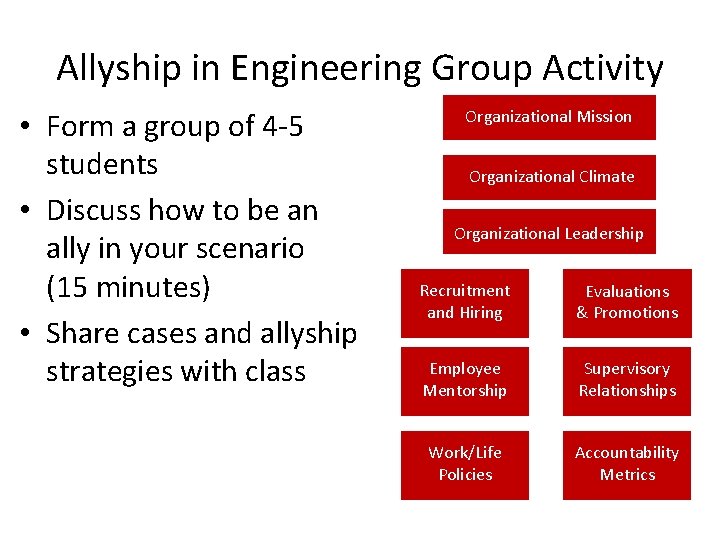
Allyship in Engineering Group Activity • Form a group of 4 -5 students • Discuss how to be an ally in your scenario (15 minutes) • Share cases and allyship strategies with class Organizational Mission Organizational Climate Organizational Leadership Recruitment and Hiring Evaluations & Promotions Employee Mentorship Supervisory Relationships Work/Life Policies Accountability Metrics
Allyship in Engineering: Discussion Accountability What strategies did your team brainstorm?
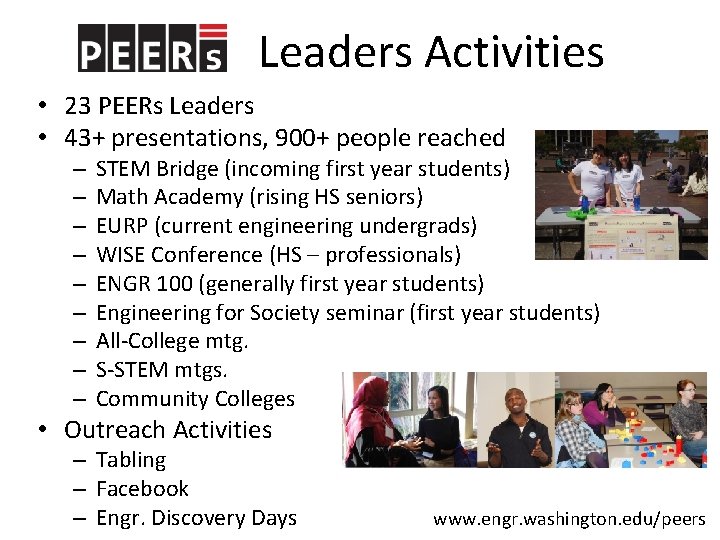
Leaders Activities • 23 PEERs Leaders • 43+ presentations, 900+ people reached – – – – – STEM Bridge (incoming first year students) Math Academy (rising HS seniors) EURP (current engineering undergrads) WISE Conference (HS – professionals) ENGR 100 (generally first year students) Engineering for Society seminar (first year students) All-College mtg. S-STEM mtgs. Community Colleges • Outreach Activities – Tabling – Facebook – Engr. Discovery Days www. engr. washington. edu/peers
Final Projects • Must sign up for a 15 -minute check-in and practice session with one of the instructors: https: //calendly. com/peersengr 401/15 min • Materials due to us Thursday June 11 th at noon via Catalyst Dropbox https: //catalyst. uw. edu/collectit/dropbox/peers /35755
FINAL PROJECTS-QUESTIONS?
REFLECTIONS FROM COURSE INSTRUCTORS
Joyce’s Key Take-aways • New paradigms for bias and meritocracy – – Lots of factors at play Patterns revealed in research studies Your own experiences Individual …. . Structural • Your role: Action versus Inaction • Diversity’s benefits apply to everyone • Multiple dimensions of diversity – incorporate as many as you can in presentations • How will you share what you have learned with others? • How will what you have learned change your actions?
Sapna’s Key Take-aways • Power of peer social connections – Predictor of engagement at work – Matters especially to those who are targeted by stereotypes – Science Magazine’s study on physics grades • Diversity is complicated – What to do when you notice some being treated unfairly? – Don’t be afraid to ask people how they want to be treated
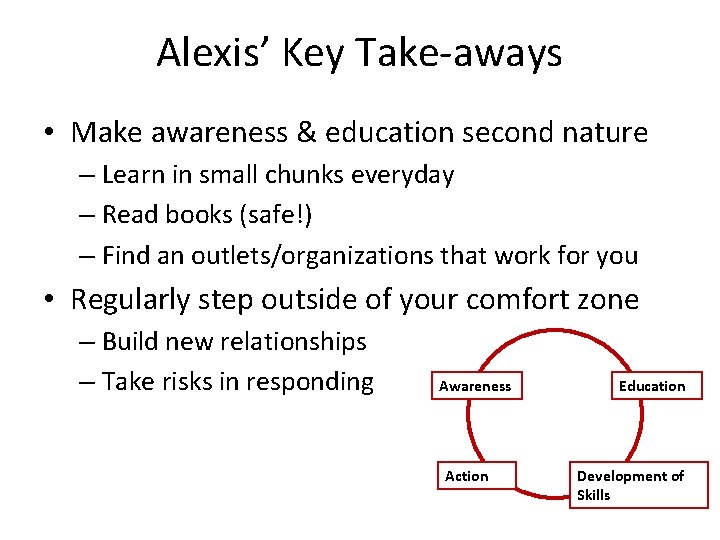
Alexis’ Key Take-aways • Make awareness & education second nature – Learn in small chunks everyday – Read books (safe!) – Find an outlets/organizations that work for you • Regularly step outside of your comfort zone – Build new relationships – Take risks in responding Awareness Action Education Development of Skills

COURSE WRAP-UP
COURSE EVALUATIONS
- Slides: 25