
How to Avoid Plagiarism Paraphrasing and Quoting What
- Slides: 21
How to Avoid Plagiarism Paraphrasing and Quoting
What is Plagiarism? Plagiarism is using or passing off other people’s work without giving credit. WORK includes original ideas, writing, strategies, research, art graphics, computer programs, music, and other creative expression. SOURCES needing to be cited include published works and unpublished works (such as class lectures, handouts, speeches, interviews, etc. ) From Avoiding Plagiarism: Mastering the Art of Scholarship a UTSA Publication of Student Judicial Affairs
Mistakes We Might Make: Misrepresenting someone else’s work as your own. Copying sentences or paragraphs without properly citing the source. Paraphrasing or summarizing without proper acknowledgment. Using specific facts without crediting the source (other than “common knowledge. ”)
What is Common Knowledge? Common When the Civil War was When Texas became part of U. S. Needs citation Opinion about Civil War Disputable fact or not commonly known- i. e. when humans first came to the Americas Even if you had to look up the information, but most people wouldn’t have had to, then it is considered “common knowledge, ” but I still highly encourage you to cite EVERYTHING- even encyclopedias…
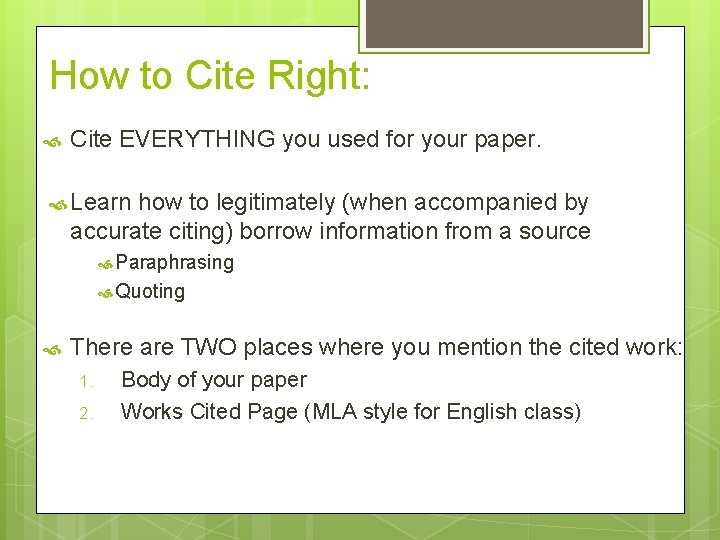
How to Cite Right: Cite EVERYTHING you used for your paper. Learn how to legitimately (when accompanied by accurate citing) borrow information from a source Paraphrasing Quoting There are TWO places where you mention the cited work: 1. 2. Body of your paper Works Cited Page (MLA style for English class)
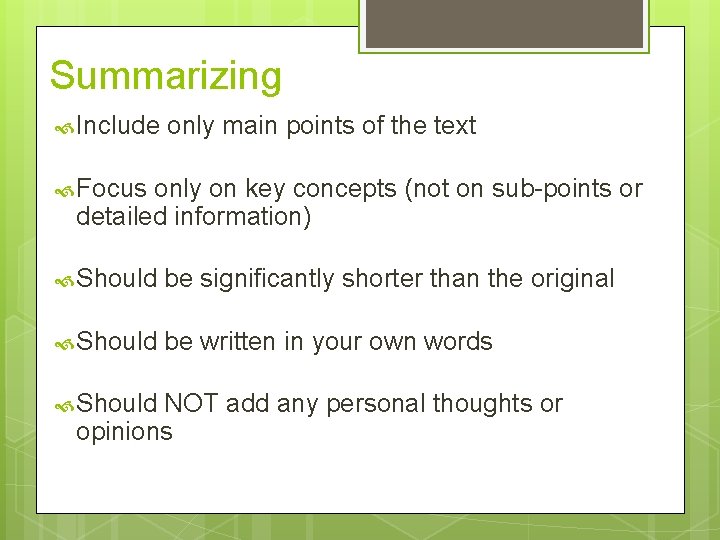
Summarizing Include only main points of the text Focus only on key concepts (not on sub-points or detailed information) Should be significantly shorter than the original Should be written in your own words Should NOT add any personal thoughts or opinions
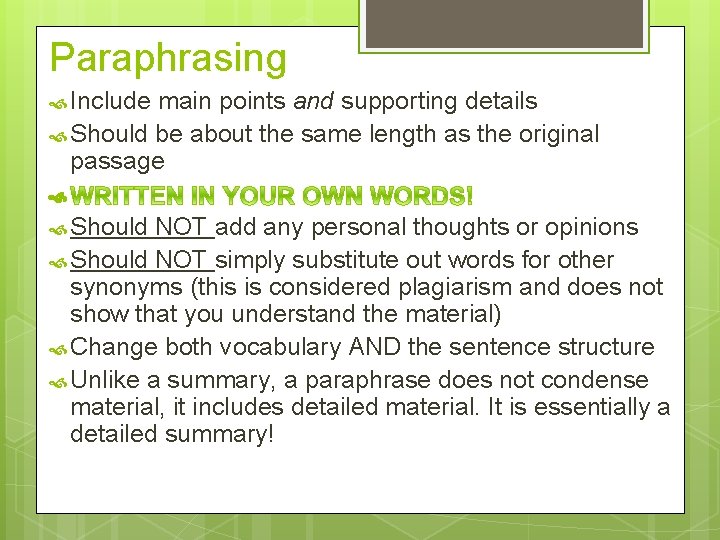
Paraphrasing Include main points and supporting details Should be about the same length as the original passage Should NOT add any personal thoughts or opinions Should NOT simply substitute out words for other synonyms (this is considered plagiarism and does not show that you understand the material) Change both vocabulary AND the sentence structure Unlike a summary, a paraphrase does not condense material, it includes detailed material. It is essentially a detailed summary!
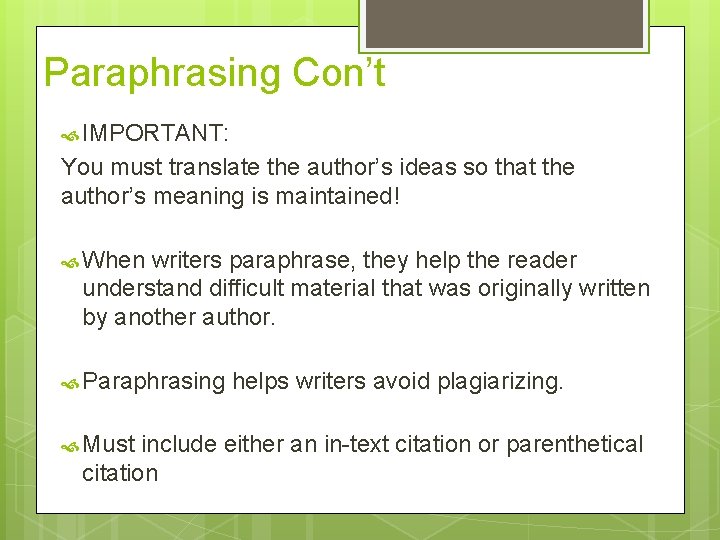
Paraphrasing Con’t IMPORTANT: You must translate the author’s ideas so that the author’s meaning is maintained! When writers paraphrase, they help the reader understand difficult material that was originally written by another author. Paraphrasing Must helps writers avoid plagiarizing. include either an in-text citation or parenthetical citation
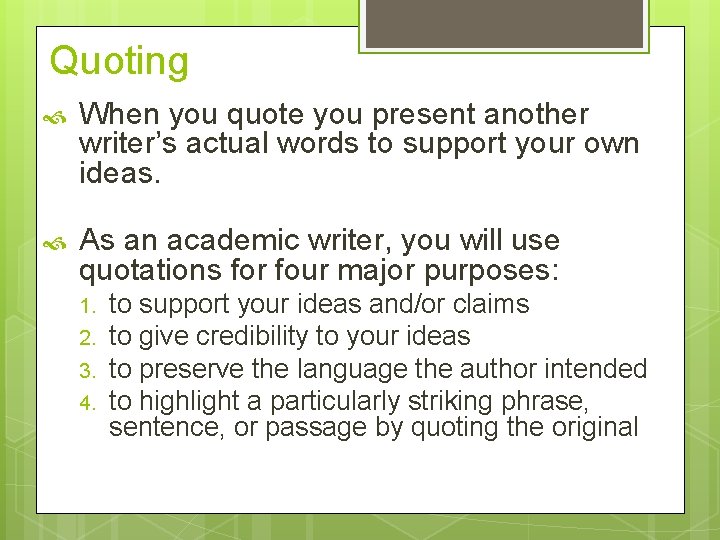
Quoting When you quote you present another writer’s actual words to support your own ideas. As an academic writer, you will use quotations for four major purposes: 1. 2. 3. 4. to support your ideas and/or claims to give credibility to your ideas to preserve the language the author intended to highlight a particularly striking phrase, sentence, or passage by quoting the original
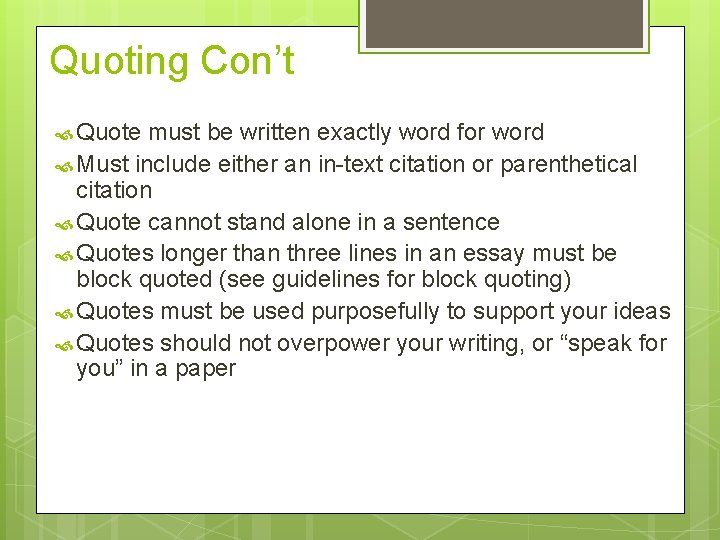
Quoting Con’t Quote must be written exactly word for word Must include either an in-text citation or parenthetical citation Quote cannot stand alone in a sentence Quotes longer than three lines in an essay must be block quoted (see guidelines for block quoting) Quotes must be used purposefully to support your ideas Quotes should not overpower your writing, or “speak for you” in a paper
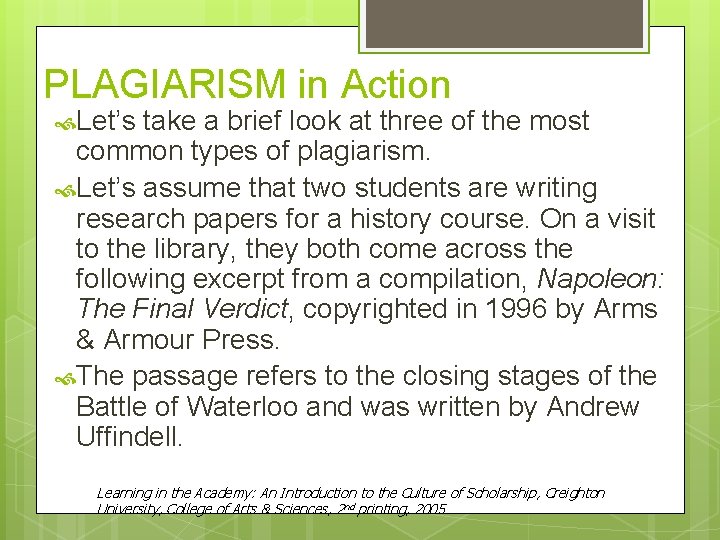
PLAGIARISM in Action Let’s take a brief look at three of the most common types of plagiarism. Let’s assume that two students are writing research papers for a history course. On a visit to the library, they both come across the following excerpt from a compilation, Napoleon: The Final Verdict, copyrighted in 1996 by Arms & Armour Press. The passage refers to the closing stages of the Battle of Waterloo and was written by Andrew Uffindell. Learning in the Academy: An Introduction to the Culture of Scholarship, Creighton University, College of Arts & Sciences, 2 nd printing, 2005
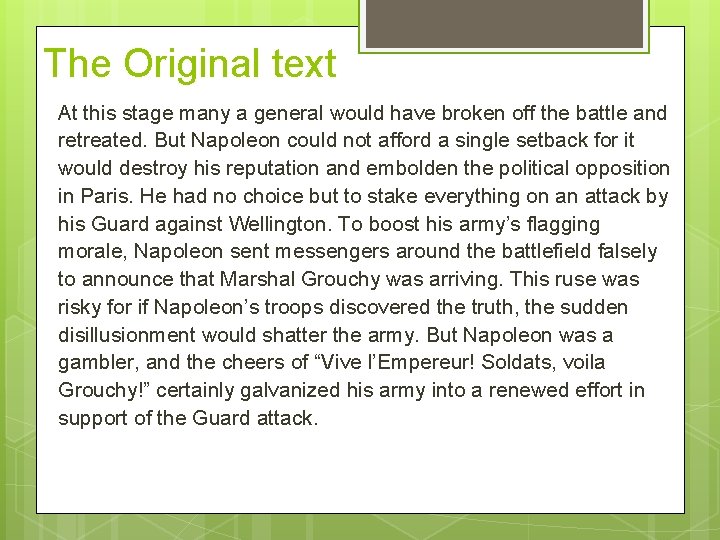
The Original text At this stage many a general would have broken off the battle and retreated. But Napoleon could not afford a single setback for it would destroy his reputation and embolden the political opposition in Paris. He had no choice but to stake everything on an attack by his Guard against Wellington. To boost his army’s flagging morale, Napoleon sent messengers around the battlefield falsely to announce that Marshal Grouchy was arriving. This ruse was risky for if Napoleon’s troops discovered the truth, the sudden disillusionment would shatter the army. But Napoleon was a gambler, and the cheers of “Vive l’Empereur! Soldats, voila Grouchy!” certainly galvanized his army into a renewed effort in support of the Guard attack.
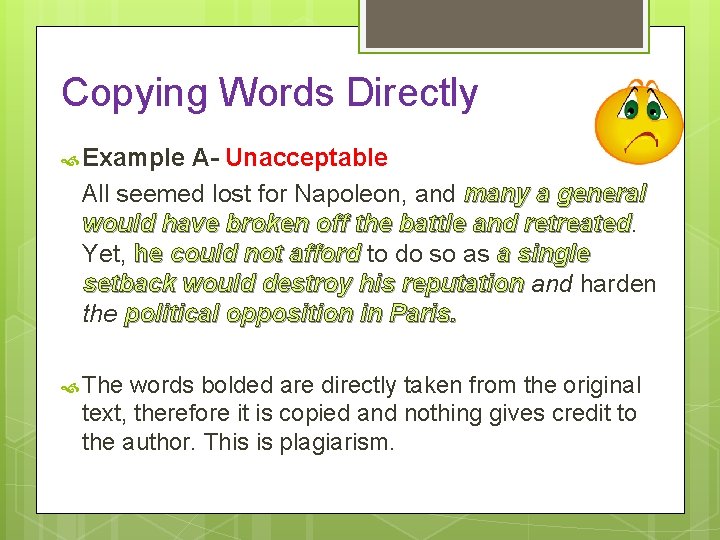
Copying Words Directly Example A- Unacceptable All seemed lost for Napoleon, and many a general would have broken off the battle and retreated Yet, he could not afford to do so as a single setback would destroy his reputation and harden the political opposition in Paris. The words bolded are directly taken from the original text, therefore it is copied and nothing gives credit to the author. This is plagiarism.
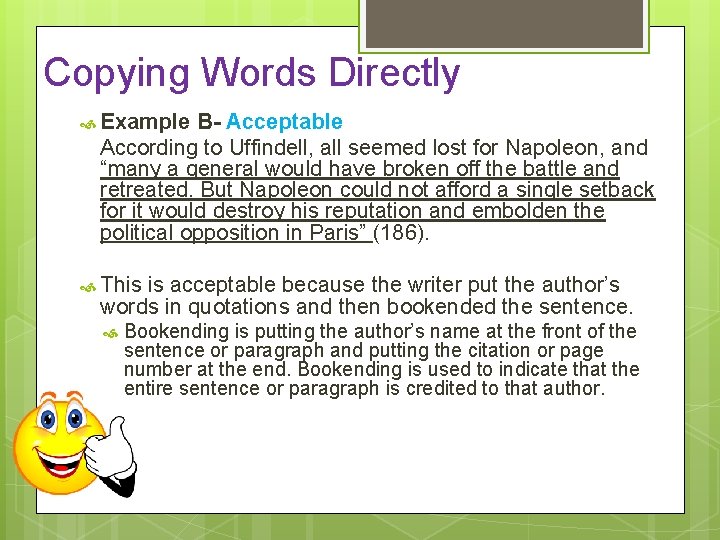
Copying Words Directly Example B- Acceptable According to Uffindell, all seemed lost for Napoleon, and “many a general would have broken off the battle and retreated. But Napoleon could not afford a single setback for it would destroy his reputation and embolden the political opposition in Paris” (186). This is acceptable because the writer put the author’s words in quotations and then bookended the sentence. Bookending is putting the author’s name at the front of the sentence or paragraph and putting the citation or page number at the end. Bookending is used to indicate that the entire sentence or paragraph is credited to that author.
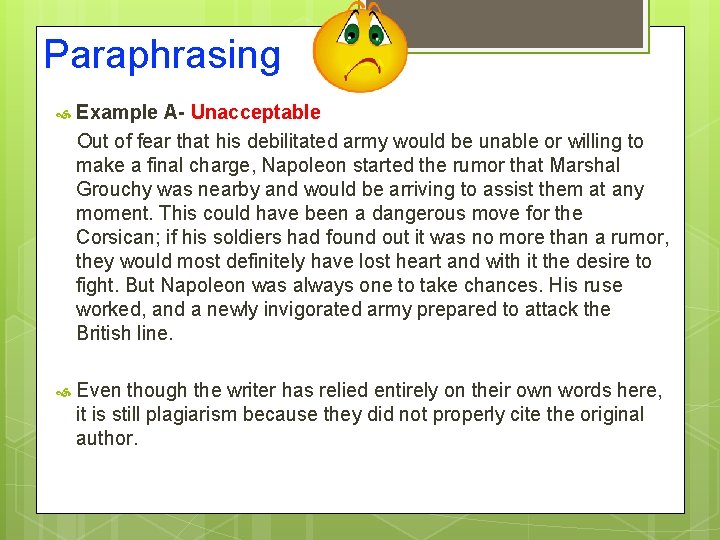
Paraphrasing Example A- Unacceptable Out of fear that his debilitated army would be unable or willing to make a final charge, Napoleon started the rumor that Marshal Grouchy was nearby and would be arriving to assist them at any moment. This could have been a dangerous move for the Corsican; if his soldiers had found out it was no more than a rumor, they would most definitely have lost heart and with it the desire to fight. But Napoleon was always one to take chances. His ruse worked, and a newly invigorated army prepared to attack the British line. Even though the writer has relied entirely on their own words here, it is still plagiarism because they did not properly cite the original author.
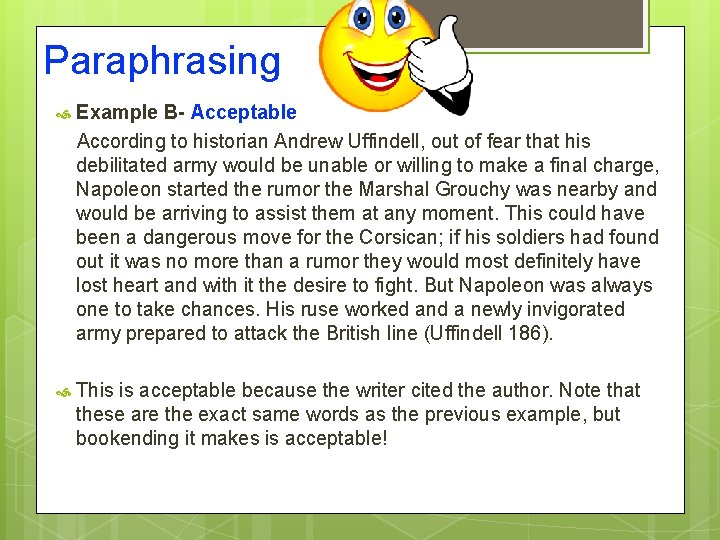
Paraphrasing Example B- Acceptable According to historian Andrew Uffindell, out of fear that his debilitated army would be unable or willing to make a final charge, Napoleon started the rumor the Marshal Grouchy was nearby and would be arriving to assist them at any moment. This could have been a dangerous move for the Corsican; if his soldiers had found out it was no more than a rumor they would most definitely have lost heart and with it the desire to fight. But Napoleon was always one to take chances. His ruse worked and a newly invigorated army prepared to attack the British line (Uffindell 186). This is acceptable because the writer cited the author. Note that these are the exact same words as the previous example, but bookending it makes is acceptable!
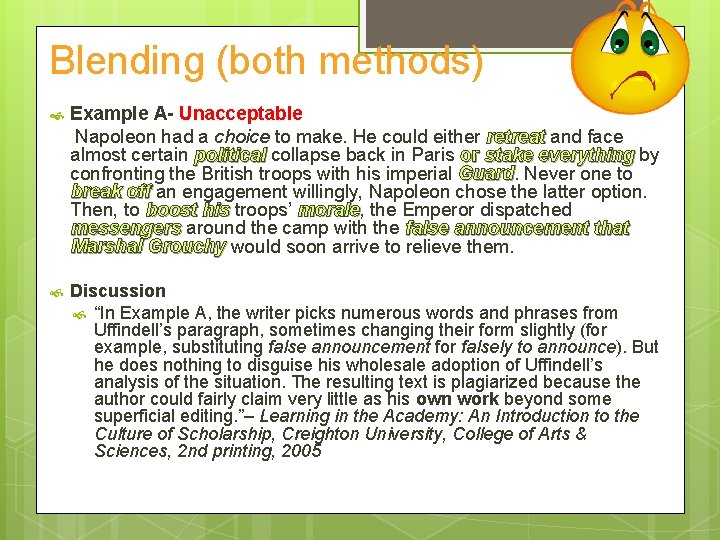
Blending (both methods) Example A- Unacceptable Napoleon had a choice to make. He could either retreat and face almost certain political collapse back in Paris or stake everything by confronting the British troops with his imperial Guard Never one to break off an engagement willingly, Napoleon chose the latter option. Then, to boost his troops’ morale, morale the Emperor dispatched messengers around the camp with the false announcement that Marshal Grouchy would soon arrive to relieve them. Discussion “In Example A, the writer picks numerous words and phrases from Uffindell’s paragraph, sometimes changing their form slightly (for example, substituting false announcement for falsely to announce). But he does nothing to disguise his wholesale adoption of Uffindell’s analysis of the situation. The resulting text is plagiarized because the author could fairly claim very little as his own work beyond some superficial editing. ”– Learning in the Academy: An Introduction to the Culture of Scholarship, Creighton University, College of Arts & Sciences, 2 nd printing, 2005
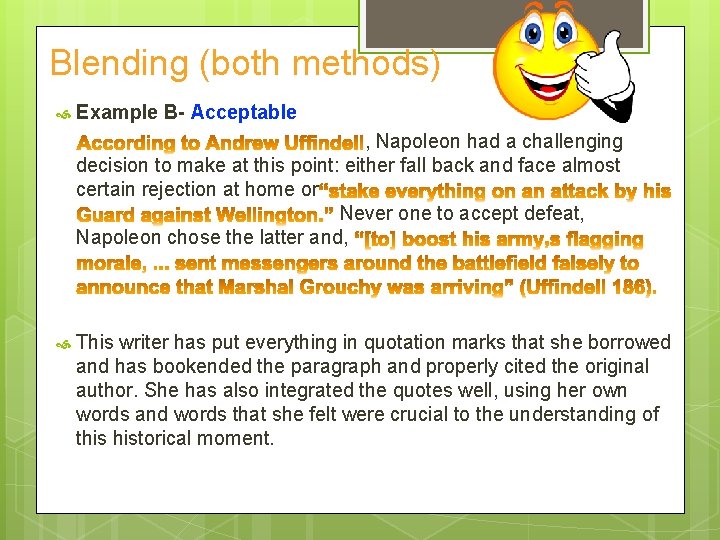
Blending (both methods) Example B- Acceptable , Napoleon had a challenging decision to make at this point: either fall back and face almost certain rejection at home or Never one to accept defeat, Napoleon chose the latter and, This writer has put everything in quotation marks that she borrowed and has bookended the paragraph and properly cited the original author. She has also integrated the quotes well, using her own words and words that she felt were crucial to the understanding of this historical moment.
Resources used for this presentation Purdue Owl: http: //owl. english. purdue. edu/owl/resource/619/1/ Learning in the Academy: AN Introduction to the Culture of Scholarship, Creighton University, College of Arts & Sciences http: //puffin. creighton. edu/ccas/forms/Learningin. Academy. pdf Avoiding Plagiarism: Mastering the Art of Scholarship, a UTSA Publication of Student Judicial Affairs. SFU Library- Subject Research website http: //www. lib. sfu. ca/researchhelp/subjectguides/engl/classes/Essay. Arch. htm
When in doubt… CITE IT!!
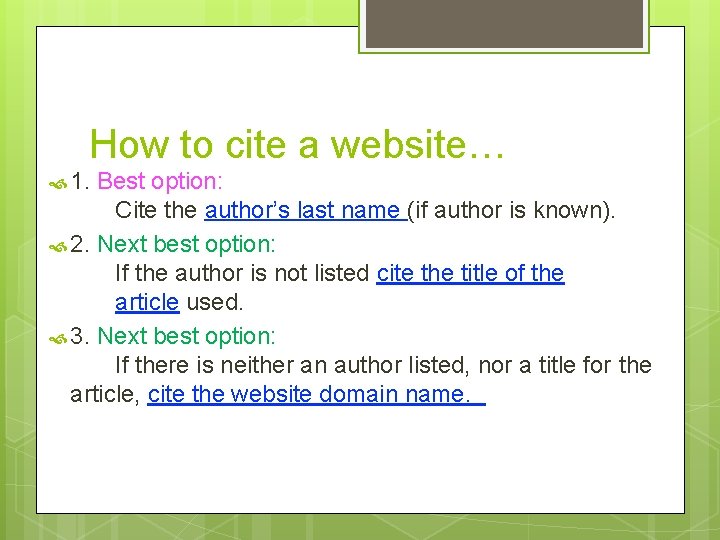
How to cite a website… 1. Best option: Cite the author’s last name (if author is known). 2. Next best option: If the author is not listed cite the title of the article used. 3. Next best option: If there is neither an author listed, nor a title for the article, cite the website domain name.