
How to assess Modes of assessment Mode may
- Slides: 41
How to assess?
Modes of assessment Mode may be seen as an organising principle or a reference point. Examples of modes of assessment (which may overlap): Ø Ø Ø Ø formal ~ informal internal ~ external process ~ product continuous ~ terminal summative ~ formative norm-referenced ~ criterion-referenced idiographic (individual) ~ nomothetic (group)
Desirable vs Practical Ø Although we may wish to assess mental attributes such as cognitive skills or attitudes, all we can actually assess are things we can see – objects or behaviours Ø ‘Objects’ are concrete, often written pieces of work – but may also include paintings, artwork, sculpture, etc. Ø ‘Behaviours’ are ephemeral, actions that we observe or speech that we listen to, or a combination of both
Ø So how do we assess the many different types of objects and behaviours in which we may have an interest? Ø ‘Techniques’ (or methods) are the tools of Assessment – that we use in different contexts for different purposes. Which tools we choose to use will depend on what (and whom? ) we wish to assess
Techniques/Methods of assessment What are the options available for assessment for different purposes and different curriculum areas (subjects or domains) and skills?
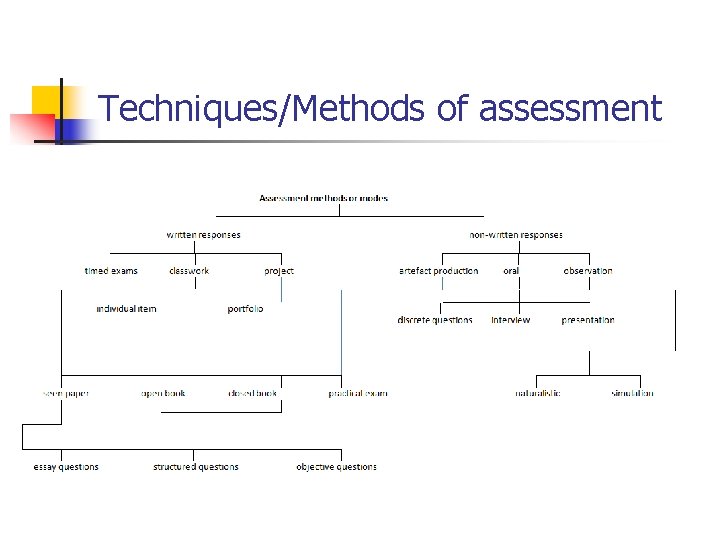
Techniques/Methods of assessment
Activity Ø Look at the typology/list of techniques and decide which of these assessment techniques you use in your own practice. For what purposes do you tend to use each of the techniques you identify? (For example, which do you use for summative or formative purposes? ) Ø Can you identify any techniques that you use to obtain information about your students' achievements that are not included in this typology/ list of techniques?
Expectations? Ø Are there issues about learners’ expectations about assessment? Ø Do they prefer some forms of assessment over others? Ø Do they value some forms of assessment over others?
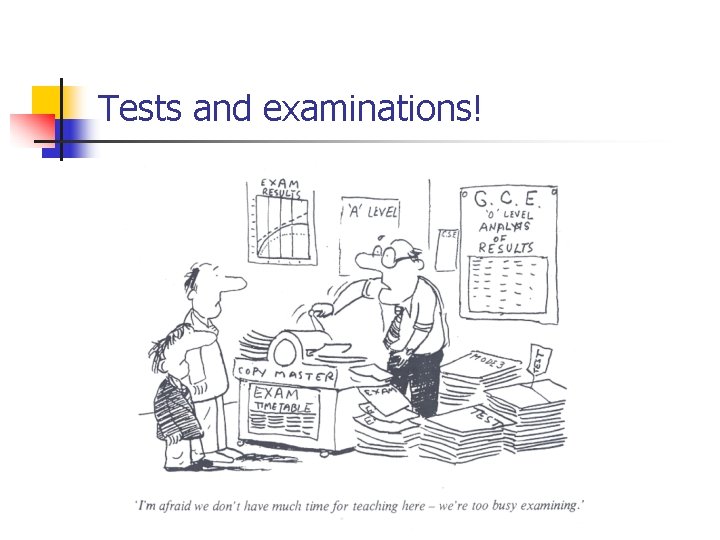
Tests and examinations!
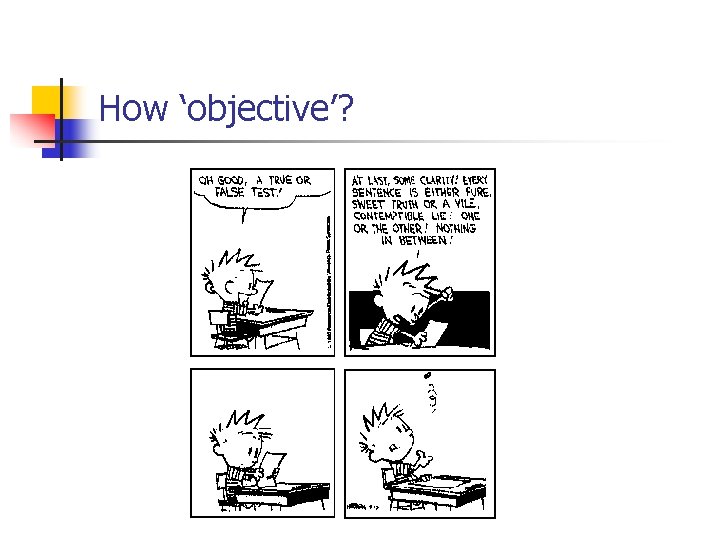
How ‘objective’?
Objective questions Look at the handout, which gives examples of different formats for 'objective' questions. Try answering each of the items given and think about what each one is demanding of you. Now think about these issues: Ø What is 'objective' about these questions? Ø What basic skills do all of these questions demand compared to essay-type questions?
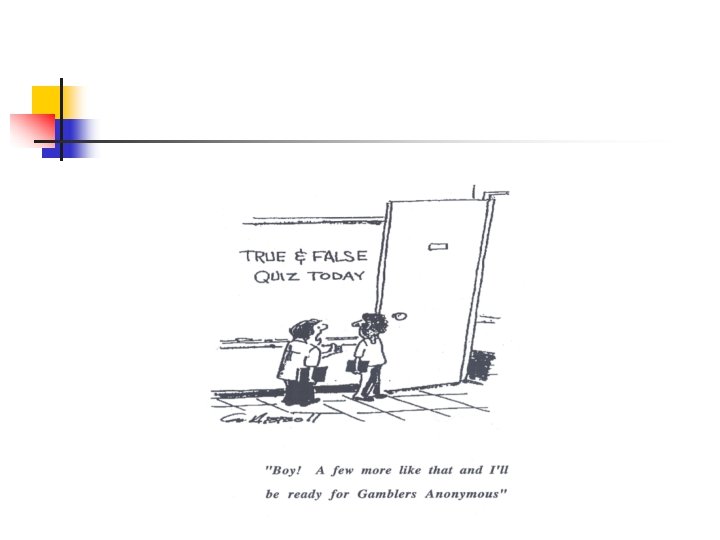
Multiple choice and True/False items Ø In terms of Bloom's taxonomy, what are these items testing? Ø What answering strategy might such items encourage? Ø Can anything be done in marking such items to discourage this strategy or to penalise students for adopting it?
Matching Pairs Ø In Bloomian terms, what are these items testing? Ø What weakness in the first item does the second item deal with?
Multiple completion Ø In terms of Bloom's taxonomy, what is this item testing? Ø Does this form have any advantage over asking the pupils to write the correct answer in the space provided?
Assertion–Reason Ø In terms of Bloom's taxonomy, what is this item testing? What else – perhaps not on Bloom's scheme – does it demand? Ø In what other way could the same cognitive skill be tested? What are the advantages and disadvantages of each form? Ø If either the Assertion or the Reason is False, is the item still testing the same cognitive skill?
Paired statements Ø In terms of Bloom's taxonomy, what cognitive skill(s) are these items testing? Ø How successful do you think the items are in revealing whether the person answering them has actually demonstrated this cognitive skill? Could answers actually reflect a knowledge of empirical facts rather than any reasoning?
Advantages of objective questions Ø Good for testing lower order cognitive skills e. g. recall Ø Large number of items can be answered in short time Ø Knowledge of a wide area of a subject (or domain) can be sampled Ø Large number of items can be marked quickly Ø Marking requires no expertise and could be done by machine Ø No (? ) examiner ‘bias’
Disadvantages of objective questions Ø Provide no evidence of the processes by which an answer has actually been chosen Ø ‘Guessing factor’ Ø Difficult to use for testing higher order skills Ø Are only objective if carefully set (bias can creep in through setting) Ø Construction of good items is difficult and demands expertise (e. g. ambiguity of language, certainty of only one correct response)
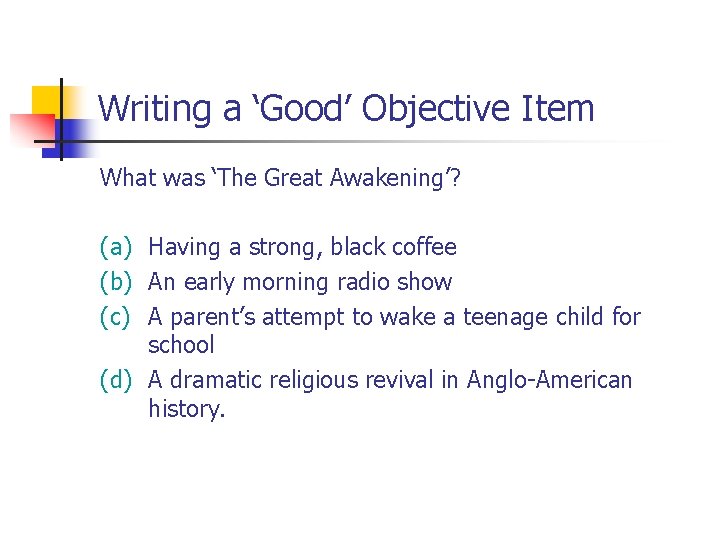
Writing a ‘Good’ Objective Item What was ‘The Great Awakening’? (a) Having a strong, black coffee (b) An early morning radio show (c) A parent’s attempt to wake a teenage child for school (d) A dramatic religious revival in Anglo-American history.
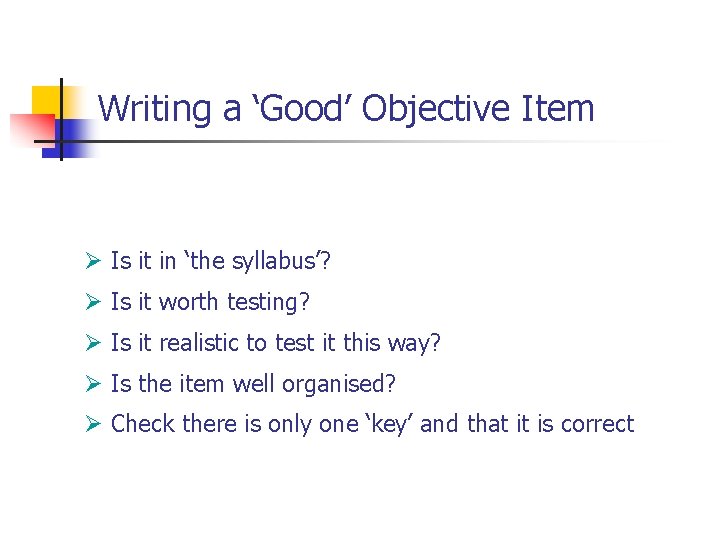
Writing a ‘Good’ Objective Item Ø Is it in ‘the syllabus’? Ø Is it worth testing? Ø Is it realistic to test it this way? Ø Is the item well organised? Ø Check there is only one ‘key’ and that it is correct
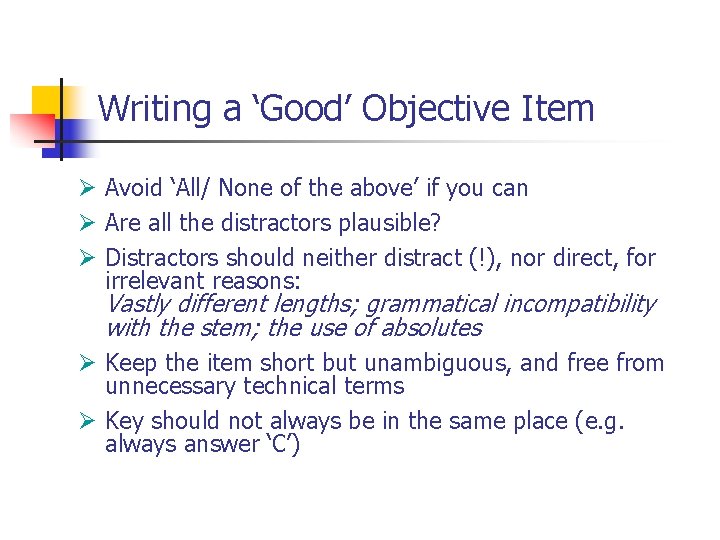
Writing a ‘Good’ Objective Item Ø Avoid ‘All/ None of the above’ if you can Ø Are all the distractors plausible? Ø Distractors should neither distract (!), nor direct, for irrelevant reasons: Vastly different lengths; grammatical incompatibility with the stem; the use of absolutes Ø Keep the item short but unambiguous, and free from unnecessary technical terms Ø Key should not always be in the same place (e. g. always answer ‘C’)
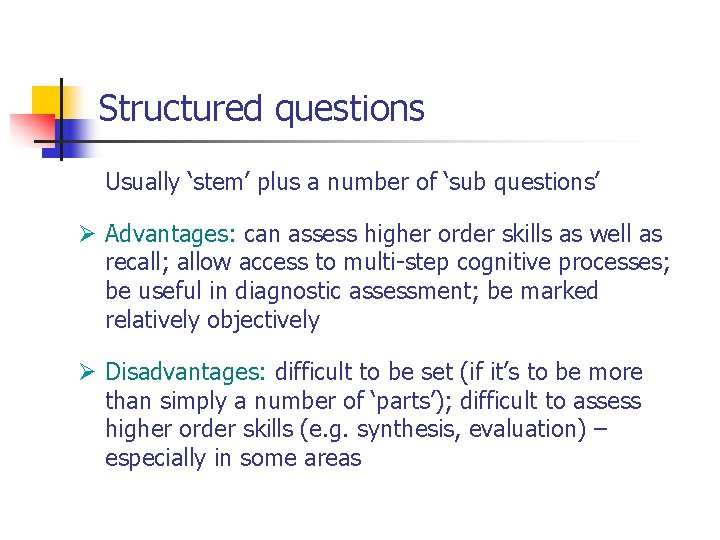
Structured questions Usually ‘stem’ plus a number of ‘sub questions’ Ø Advantages: can assess higher order skills as well as recall; allow access to multi-step cognitive processes; be useful in diagnostic assessment; be marked relatively objectively Ø Disadvantages: difficult to be set (if it’s to be more than simply a number of ‘parts’); difficult to assess higher order skills (e. g. synthesis, evaluation) – especially in some areas
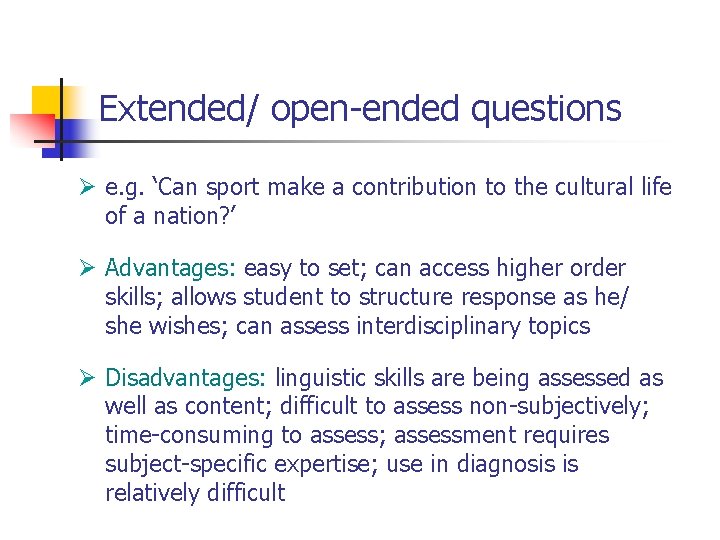
Extended/ open-ended questions Ø e. g. ‘Can sport make a contribution to the cultural life of a nation? ’ Ø Advantages: easy to set; can access higher order skills; allows student to structure response as he/ she wishes; can assess interdisciplinary topics Ø Disadvantages: linguistic skills are being assessed as well as content; difficult to assess non-subjectively; time-consuming to assess; assessment requires subject-specific expertise; use in diagnosis is relatively difficult
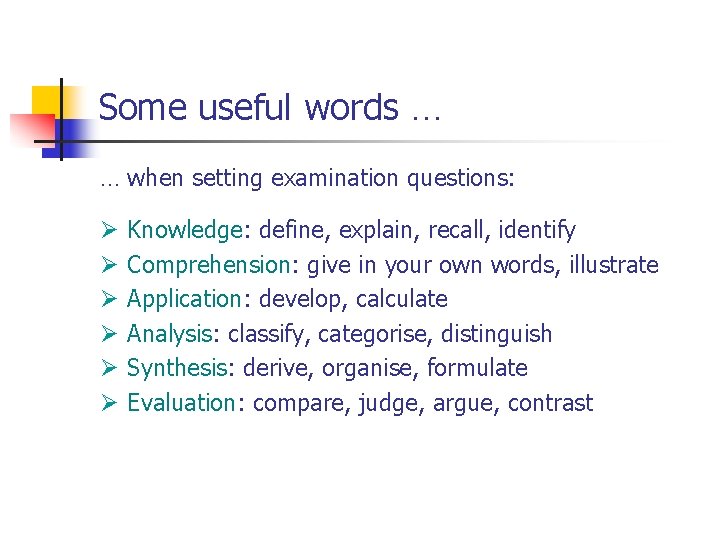
Some useful words … … when setting examination questions: Ø Ø Ø Knowledge: define, explain, recall, identify Comprehension: give in your own words, illustrate Application: develop, calculate Analysis: classify, categorise, distinguish Synthesis: derive, organise, formulate Evaluation: compare, judge, argue, contrast
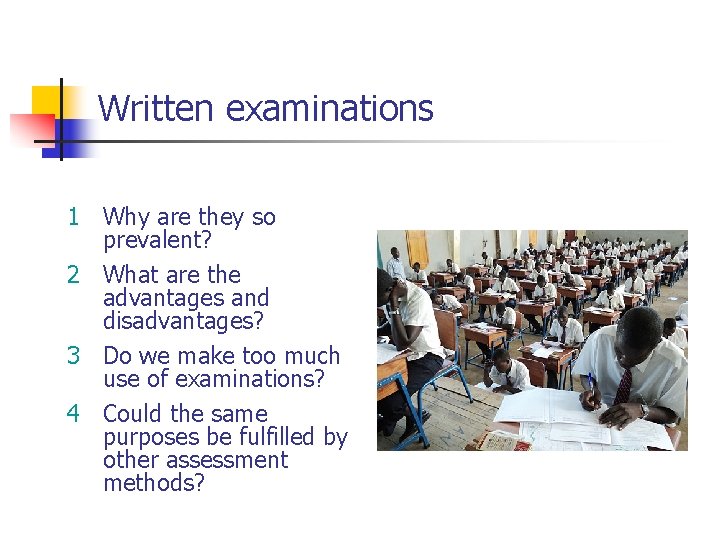
Written examinations 1 Why are they so prevalent? 2 What are the advantages and disadvantages? 3 Do we make too much use of examinations? 4 Could the same purposes be fulfilled by other assessment methods?
‘Open book’ examinations Ø Why might we allow students to have access to books or other materials during an examination? What sort of materials would you consider acceptable – books? lecture notes? the internet? Why? Ø What sort of cognitive (or other) skills should openbook examinations focus on? Ø Why might we want to use a timed-examination format in which students could access any materials they want rather than a 'project' format, outside of the examination room?
‘Open book’ examinations Ø Advantages: can assess higher order skills; more akin to ‘real life’ situation (‘authentic assessment’) then more traditional examinations Ø Disadvantages: students require training in technique; can waste precious time in examination situation
Assessment by Observation Ø When might you use observation as a means of making assessments? Ø When might observation be the most appropriate technique? Ø Most social situations are very complex, with a lot of things happening simultaneously. Why might this be a problem for assessment by observation, and how could you deal with it?
Assessment by Observation One criticism of observational data is that it is often selective, biased, poorly structured and based on half-remembered incidents. As such it is often unreliable. How might this reliability problem be dealt with in practice? Is low reliability always a drawback in situations in which you might rely on observation?
Assessment by Observation Ø Appropriate for making judgements in areas such as pupils' attitudes, social development and work habits Ø Also appropriate for assessing communication skills, skills in games and sport, or ability to contribute effectively to group work Ø It can take place in 'natural' contexts or in specially constructed simulations. It is valuable for judging the regular, habitual activities of a pupil, but is also useful for capturing exceptional behaviour
Three ‘levels’ of observation Conner, discussing the role of observation in primary school assessment in particular, suggests three 'levels' of observation: open/non-specific, focused, and systematic: Ø Open/non-specific observation: taking a general, nonjudgemental overview of a situation, perhaps to get an overall impression of something like 'classroom atmosphere‘
Levels of observation Ø Focused observation: looking at an individual child or interactions in group, with an aspect of their behaviour in mind – such as their degree of collaboration with each other – but without specific categories to guide our attention Ø Systematic observation: highly structured observation of behaviour in terms of previously identified categories, and with observations recorded in some formal way [Based on Conner, C. , 1991. Assessment and Testing in the Primary School. Basingstoke: Falmer Press. Chapter 4]
Levels of observation If we are to use our observations to make important decisions about students, then we must have reliable records on which to base our judgements. Three methods of recording observations are widely used, although there are other formats too: Ø Anecdotal records: written accounts of observed behaviour, which may be short notes or longer passages
Observation as assessment Ø Rating scales: records in which behaviour – or more often, specified aspects of behaviour – is given a score on a scale on which the behaviour corresponding to certain points may be defined (e. g. in assessing a student’s presentational skills) Ø Check lists: a list of actions that we expect to see when a learner is carrying out a certain activity. When each action is observed we tick it on the sheet. In some variations of the check list we may tick each time the action is observed so that we can end up with multiple ticks for any one, or we may wish to write 1, 2, 3, 4 etc. against the various actions to indicate the order in which they were performed.
Oral assessment Ø What is oral assessment normally used for? Ø What are the strengths of this approach? Ø What are the disadvantages? Ø Is there potential for more use?
What about ‘topic work’ assessment Based on a particular theme, encompassing a number of traditional ‘subject areas’ (e. g. ‘water’ or ‘chocolate’ as a theme for 7 year olds, encompassing assessment of science, mathematics, English and technology) Ø Advantages: can allow assessment of crossdisciplinary knowledge/ skills; cognitive, affective and psychomotor skills may all be assessed Ø Disadvantages: assessment may be subjective if criteria are not clearly devised
… and ‘project work’? Involves written as well as ‘practical’ work (e. g. geography fieldwork, science practical work) Ø Advantages: allows assessment of highest order cognitive skills, as well as affective and psychomotor skills; allows assessment of a student’s ability to engage in an extended piece of work Ø Disadvantages: assessment may be subjective if the criteria are not clearly devised
Other methods of assessment? Ø Are there other methods we have not considered? Ø Where does homework fit into this? Ø What about presentations? Ø What’s the role for technology?
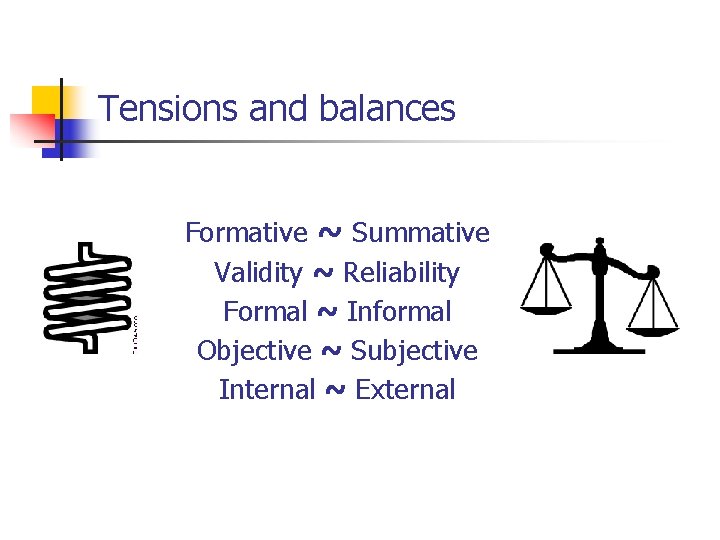
Tensions and balances Formative ~ Summative Validity ~ Reliability Formal ~ Informal Objective ~ Subjective Internal ~ External
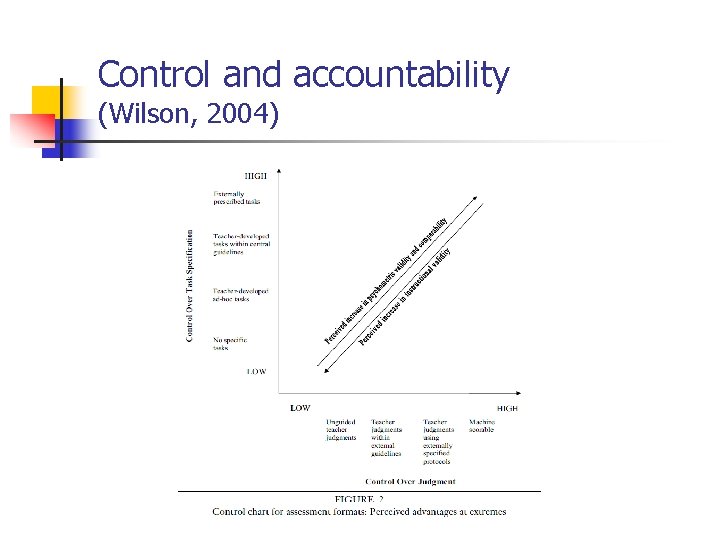
Control and accountability (Wilson, 2004)