
How to AQA GCSE History Paper 2 Section

- Slides: 19
How to…. AQA GCSE History Paper 2 Section A - Health and the People Q 1: How useful is Source A to a historian studying … Q 2: Explain the significance of X in … Q 3: Compare X with Y. In what ways were they similar? Q 4: Has X been the main factor in causing Y? Explain your answer…
Overall summary of what the examiners are looking for: in ALL answers – PEEL paragraphs and evidence of DARKU (Detailed, Accurate, Relevant Knowledge and Understanding), perhaps with links to the ‘bigger picture’. In this paper, examiners also want to see evidence that students have studied 1000 years of history, and perhaps that they can differentiate between Short Term changes and Long Term changes. EXPLAINING CONCEPTS questions: Level 4: Complex explanation of changes (and/or continuity, cause, consequence, significance, similarity, difference). Answer demonstrates a range of accurate and detailed knowledge and understanding that is relevant to the question. (8) HOW USEFUL questions: Analysis of - Content, Provenance & demonstration of Contextual knowledge Target: Analyse sources contemporary to the period, Evaluate sources and make substantiated judgements. (8) WRITE AN ACCOUNT questions: Level 4: Complex analysis of causation/consequence. Answer is presented in a coherent narrative/account. (8) INTERPRETATION questions: Which interpretation do you find more convincing about. . ? How convincing is Interpretation C about …? Level 4: Complex evaluation of the interpretation (source) with sustained judgement based on contextual (factual, from the time) knowledge & understanding. (8) EVALUATION questions (factors): Level 4: Answer demonstrates a complex, sustained line of reasoning which has a sharply-focused coherence and logical structure that is fully substantiated, with well-judged relevance. (16)
How useful to a historian…? Example questions: How useful is source A to a historian studying the understanding of disease? (Source A is an advert for soap from 1910) (8 marks) How useful are sources P and Q for a historian studying the effects of the Black Death on medieval England? (8 marks) Study Sources B and C in the source booklet ( e. g. a diary extract, an American cartoon). How useful are Sources B and C to an historian studying the reasons for the defeat of Germany in 1918. Explain your answer using Sources B and C and your contextual knowledge. (12 marks)
How useful is source X as evidence of… to a historian…? How useful is source Y to a historian studying …? Explain your answer using source X and your own contextual knowledge. Mark scheme - HOW USEFUL is source X to a historian… Requirements of answer: analysis of - Content, Provenance & demonstration of Contextual knowledge All levels require evidence of Accurate and Relevant Knowledge and Understanding (ARKU). PEE paragraphs are expected. Students will draw on their contextual knowledge to question critically the content and provenance of the source (for example, the context of the time in which source was created, place, author’s situation, knowledge, beliefs, circumstances, access to information, purpose and audience). Level 4 Complex evaluation of source with sustained judgement based on content and provenance, in context. 7– 8 Level 3 Developed evaluation of source based on content and/or provenance. 5– 6. Extends Level 2. Students may progress from a simple evaluation of the source with extended reasoning supported by factual knowledge and understanding related to the enquiry point and the broader context of thematic. This may evaluate utility either on the basis of content and/or provenance. Level 2 Simple evaluation of source based on content and/or provenance Students may progress from a basic analysis of the source by reasoning supported with factual knowledge and understanding. Level 1 Basic analysis of source. Answers show some understanding/support for the source. 1 -2
Golden Nugget: always state that the source IS useful! Then assess HOW useful it is for the given question Useful ideas to consider: is the content (what’s in the box) accurate/partly accurate? Does it give information which is typical about the topic? Is it from a trustworthy/reliable source? – explain very carefully. Is it exaggerated, and if so why? – it will still be useful. • First section – what does it show? (the content – what’s in the box) Source X is (very/quite) useful because it shows that…. . (You could then extend this, provided you stick to the source, question and dates given, e. g. ‘However, X does not show other aspects of … such as …. Therefore its usefulness is ( a little/rather/hugely) limited because…’) • Second section – how does the provenance (what’s outside the box) help, or not, the usefulness of the source? (wwww/ TAPP – Time Author Place Purpose) In addition, X was produced by …, in …. which increases / limits usefulness because… • Final section – conclusion – use some words from the question in your summary: Therefore, X is …. useful in learning about. . . because… (accurate? Reliable? Complete/ comprehensive? )
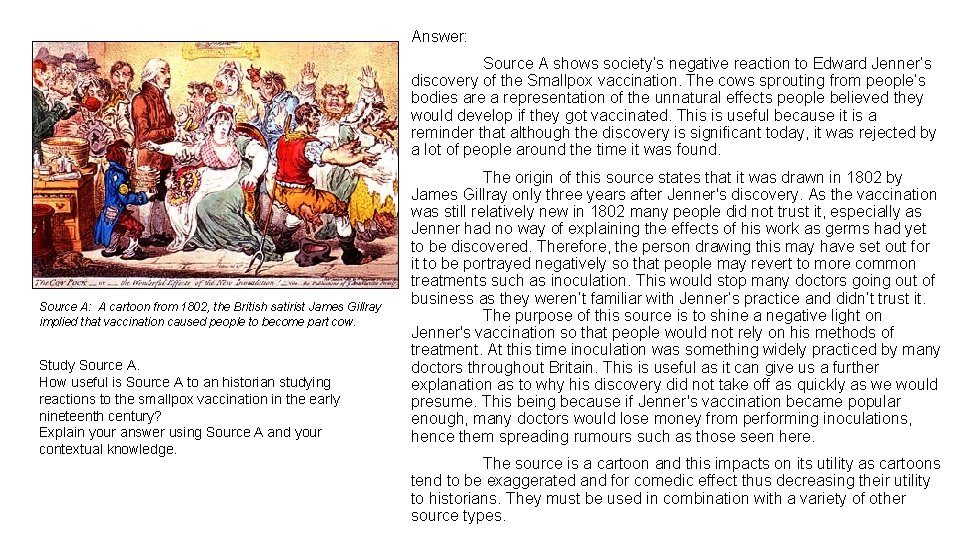
Answer: Source A shows society’s negative reaction to Edward Jenner’s discovery of the Smallpox vaccination. The cows sprouting from people’s bodies are a representation of the unnatural effects people believed they would develop if they got vaccinated. This is useful because it is a reminder that although the discovery is significant today, it was rejected by a lot of people around the time it was found. Source A: A cartoon from 1802, the British satirist James Gillray implied that vaccination caused people to become part cow. Study Source A. How useful is Source A to an historian studying reactions to the smallpox vaccination in the early nineteenth century? Explain your answer using Source A and your contextual knowledge. The origin of this source states that it was drawn in 1802 by James Gillray only three years after Jenner's discovery. As the vaccination was still relatively new in 1802 many people did not trust it, especially as Jenner had no way of explaining the effects of his work as germs had yet to be discovered. Therefore, the person drawing this may have set out for it to be portrayed negatively so that people may revert to more common treatments such as inoculation. This would stop many doctors going out of business as they weren’t familiar with Jenner’s practice and didn’t trust it. The purpose of this source is to shine a negative light on Jenner's vaccination so that people would not rely on his methods of treatment. At this time inoculation was something widely practiced by many doctors throughout Britain. This is useful as it can give us a further explanation as to why his discovery did not take off as quickly as we would presume. This being because if Jenner's vaccination became popular enough, many doctors would lose money from performing inoculations, hence them spreading rumours such as those seen here. The source is a cartoon and this impacts on its utility as cartoons tend to be exaggerated and for comedic effect thus decreasing their utility to historians. They must be used in combination with a variety of other source types.
Explaining concepts e. g significance, change Example questions (8 marks): Explain what was important about voyages abroad during the reign of Elizabeth I Explain the significance of Vesalius’ work for the development of medicine. In what ways did the lives of people in Germany change during the First World War? Compare event A and event B. In what ways were they similar? Explain your answer with reference to both.
Mark scheme - EXPLAINING CONCEPTS (a) Target: Explain and analyse historical events and periods studied using second-order concepts (continuity, change, cause, consequence, significance, similarity and difference) and demonstrate knowledge and understanding of the key features and characteristics of the period studied. All levels require evidence of Accurate and Relevant Knowledge and Understanding (ARKU). PEE paragraphs are expected. Level 4: Complex explanation of changes, demonstrating a range of ARKU. e. g. students may further develop answer by explanation of the complexities of change arising from differences, such as time (short term/long term), group, social and/or economic impact, supported by knowledge and understanding. 7– 8 Level 3: Developed explanation of changes, demonstrating a range of ARKU. e. g. students consider two or more of the identified consequences, supporting them with factual knowledge and understanding. In addition to a Level 2 response, students make additional developed point(s). 5 -6. Level 2: Simple explanation of change. Answer demonstrates specific ARKU. E. g. students may progress from a basic explanation of change by using simple reasoning and supporting it with RKU which might be related, for example, to one of the identified changes. 3– 4 Level 1: Basic explanation of change(s). Answer demonstrates basic RKU. Students identify change(s), which are relevant to the question. 1– 2
Example questions: Explain what was important about …e. g. voyages abroad during the reign of Elizabeth I Explain the significance of…e. g Vesalius’ work for the development of medicine. Key words: important; significant; affected by; similar; different First section: X was (insert appropriate key word from the question) because … Second section: In addition, other reasons for X were… (use this opportunity to show your knowledge and add in several other facts) Third section: X changed (developed / improved. . ) during the (time period) because of other …. . This links to … (the ‘bigger picture’) as … Final section: Therefore, X was very important/significant/different… as it (summarise your arguments, try to include local, national and even international effects, if possible)
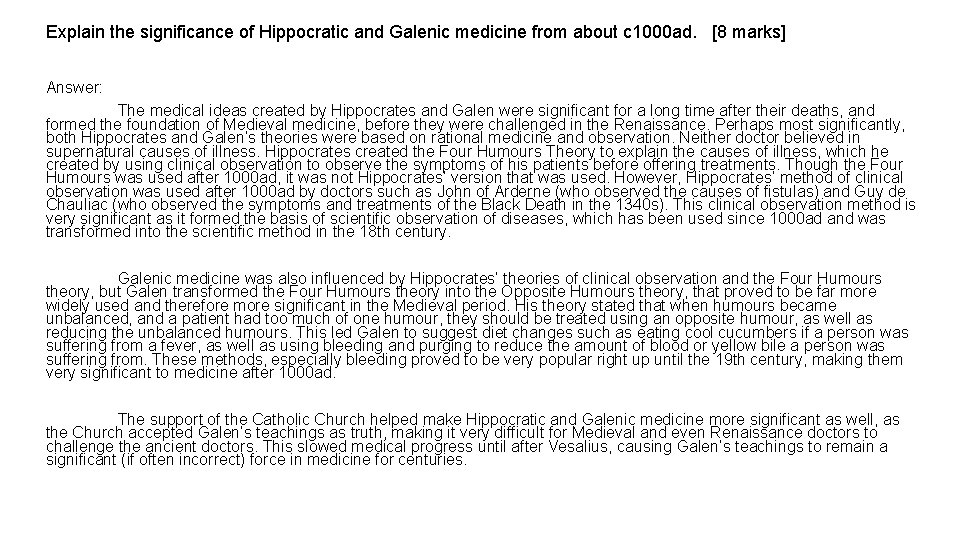
Explain the significance of Hippocratic and Galenic medicine from about c 1000 ad. [8 marks] Answer: The medical ideas created by Hippocrates and Galen were significant for a long time after their deaths, and formed the foundation of Medieval medicine, before they were challenged in the Renaissance. Perhaps most significantly, both Hippocrates and Galen’s theories were based on rational medicine and observation. Neither doctor believed in supernatural causes of illness. Hippocrates created the Four Humours Theory to explain the causes of illness, which he created by using clinical observation to observe the symptoms of his patients before offering treatments. Though the Four Humours was used after 1000 ad, it was not Hippocrates’ version that was used. However, Hippocrates’ method of clinical observation was used after 1000 ad by doctors such as John of Arderne (who observed the causes of fistulas) and Guy de Chauliac (who observed the symptoms and treatments of the Black Death in the 1340 s). This clinical observation method is very significant as it formed the basis of scientific observation of diseases, which has been used since 1000 ad and was transformed into the scientific method in the 18 th century. Galenic medicine was also influenced by Hippocrates’ theories of clinical observation and the Four Humours theory, but Galen transformed the Four Humours theory into the Opposite Humours theory, that proved to be far more widely used and therefore more significant in the Medieval period. His theory stated that when humours became unbalanced, and a patient had too much of one humour, they should be treated using an opposite humour, as well as reducing the unbalanced humours. This led Galen to suggest diet changes such as eating cool cucumbers if a person was suffering from a fever, as well as using bleeding and purging to reduce the amount of blood or yellow bile a person was suffering from. These methods, especially bleeding proved to be very popular right up until the 19 th century, making them very significant to medicine after 1000 ad. The support of the Catholic Church helped make Hippocratic and Galenic medicine more significant as well, as the Church accepted Galen’s teachings as truth, making it very difficult for Medieval and even Renaissance doctors to challenge the ancient doctors. This slowed medical progress until after Vesalius, causing Galen’s teachings to remain a significant (if often incorrect) force in medicine for centuries.
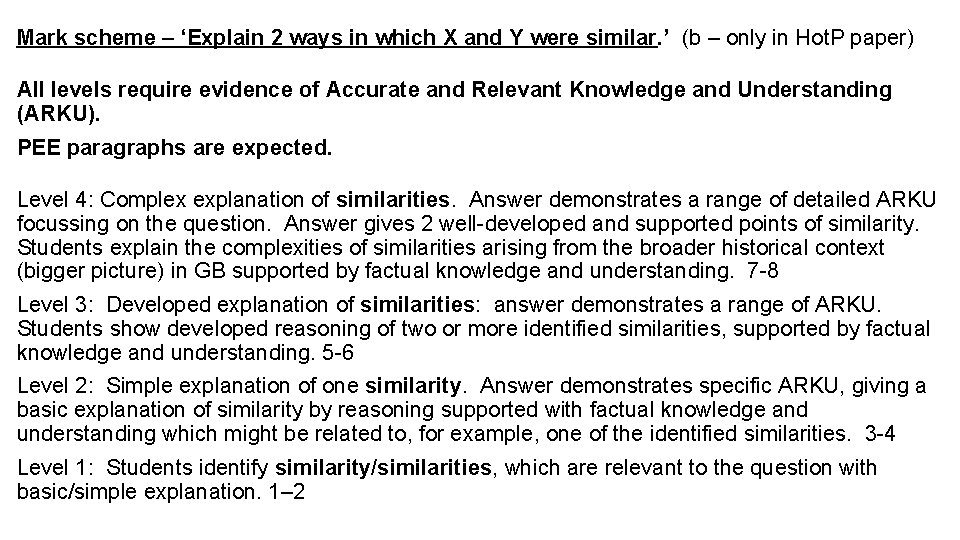
Mark scheme – ‘Explain 2 ways in which X and Y were similar. ’ (b – only in Hot. P paper) All levels require evidence of Accurate and Relevant Knowledge and Understanding (ARKU). PEE paragraphs are expected. Level 4: Complex explanation of similarities. Answer demonstrates a range of detailed ARKU focussing on the question. Answer gives 2 well-developed and supported points of similarity. Students explain the complexities of similarities arising from the broader historical context (bigger picture) in GB supported by factual knowledge and understanding. 7 -8 Level 3: Developed explanation of similarities: answer demonstrates a range of ARKU. Students show developed reasoning of two or more identified similarities, supported by factual knowledge and understanding. 5 -6 Level 2: Simple explanation of one similarity. Answer demonstrates specific ARKU, giving a basic explanation of similarity by reasoning supported with factual knowledge and understanding which might be related to, for example, one of the identified similarities. 3 -4 Level 1: Students identify similarity/similarities, which are relevant to the question with basic/simple explanation. 1– 2
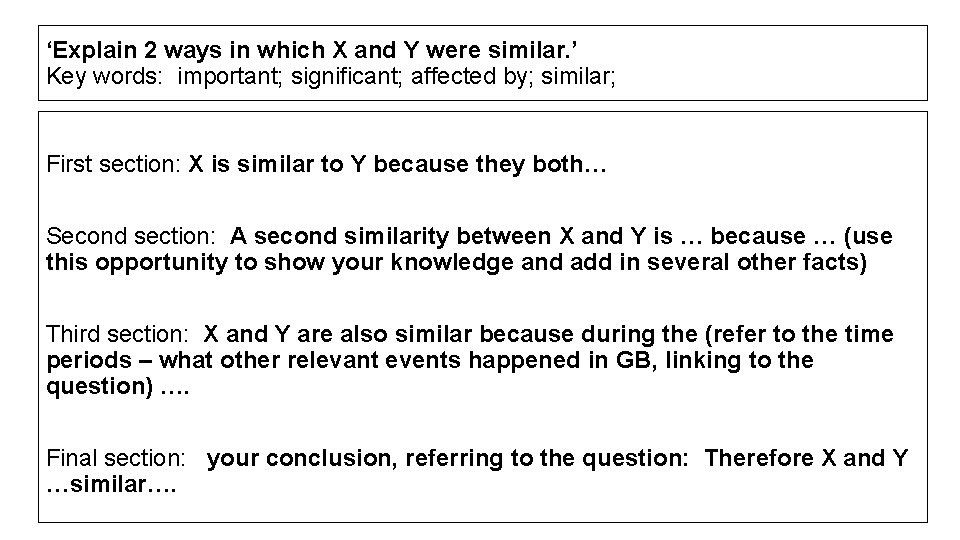
‘Explain 2 ways in which X and Y were similar. ’ Key words: important; significant; affected by; similar; First section: X is similar to Y because they both… Second section: A second similarity between X and Y is … because … (use this opportunity to show your knowledge and add in several other facts) Third section: X and Y are also similar because during the (refer to the time periods – what other relevant events happened in GB, linking to the question) …. Final section: your conclusion, referring to the question: Therefore X and Y …similar….
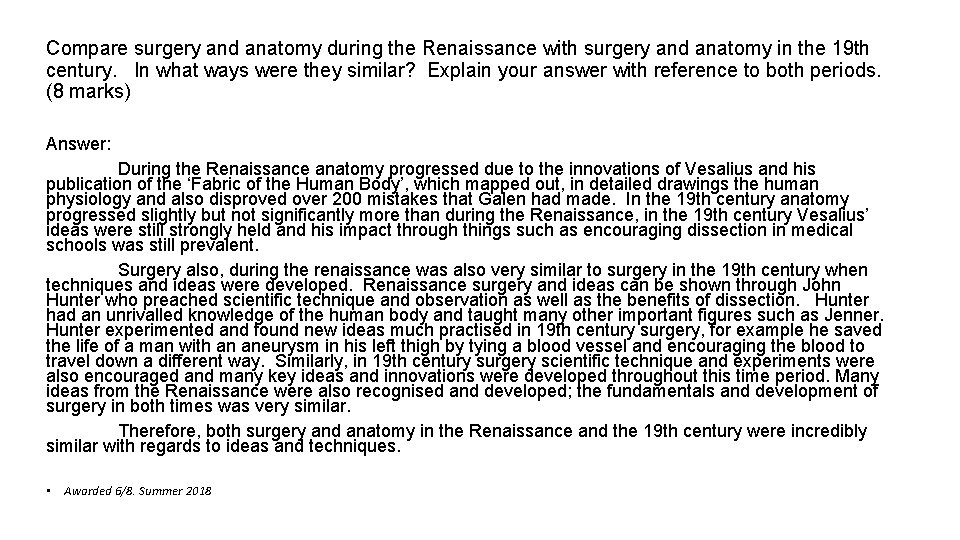
Compare surgery and anatomy during the Renaissance with surgery and anatomy in the 19 th century. In what ways were they similar? Explain your answer with reference to both periods. (8 marks) Answer: During the Renaissance anatomy progressed due to the innovations of Vesalius and his publication of the ‘Fabric of the Human Body’, which mapped out, in detailed drawings the human physiology and also disproved over 200 mistakes that Galen had made. In the 19 th century anatomy progressed slightly but not significantly more than during the Renaissance, in the 19 th century Vesalius’ ideas were still strongly held and his impact through things such as encouraging dissection in medical schools was still prevalent. Surgery also, during the renaissance was also very similar to surgery in the 19 th century when techniques and ideas were developed. Renaissance surgery and ideas can be shown through John Hunter who preached scientific technique and observation as well as the benefits of dissection. Hunter had an unrivalled knowledge of the human body and taught many other important figures such as Jenner. Hunter experimented and found new ideas much practised in 19 th century surgery, for example he saved the life of a man with an aneurysm in his left thigh by tying a blood vessel and encouraging the blood to travel down a different way. Similarly, in 19 th century surgery scientific technique and experiments were also encouraged and many key ideas and innovations were developed throughout this time period. Many ideas from the Renaissance were also recognised and developed; the fundamentals and development of surgery in both times was very similar. Therefore, both surgery and anatomy in the Renaissance and the 19 th century were incredibly similar with regards to ideas and techniques. • Awarded 6/8. Summer 2018
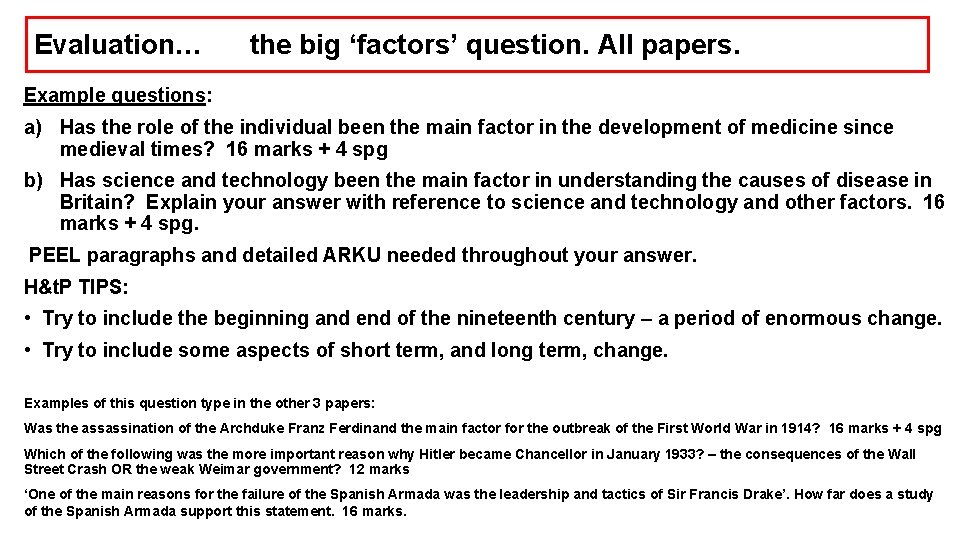
Evaluation… the big ‘factors’ question. All papers. Example questions: a) Has the role of the individual been the main factor in the development of medicine since medieval times? 16 marks + 4 spg b) Has science and technology been the main factor in understanding the causes of disease in Britain? Explain your answer with reference to science and technology and other factors. 16 marks + 4 spg. PEEL paragraphs and detailed ARKU needed throughout your answer. H&t. P TIPS: • Try to include the beginning and end of the nineteenth century – a period of enormous change. • Try to include some aspects of short term, and long term, change. Examples of this question type in the other 3 papers: Was the assassination of the Archduke Franz Ferdinand the main factor for the outbreak of the First World War in 1914? 16 marks + 4 spg Which of the following was the more important reason why Hitler became Chancellor in January 1933? – the consequences of the Wall Street Crash OR the weak Weimar government? 12 marks ‘One of the main reasons for the failure of the Spanish Armada was the leadership and tactics of Sir Francis Drake’. How far does a study of the Spanish Armada support this statement. 16 marks.
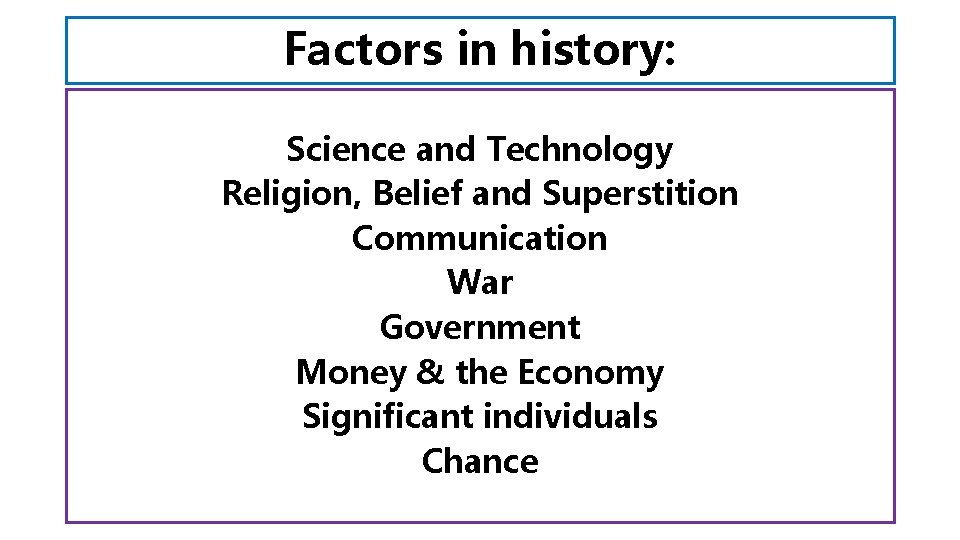
Factors in history: Science and Technology Religion, Belief and Superstition Communication War Government Money & the Economy Significant individuals Chance
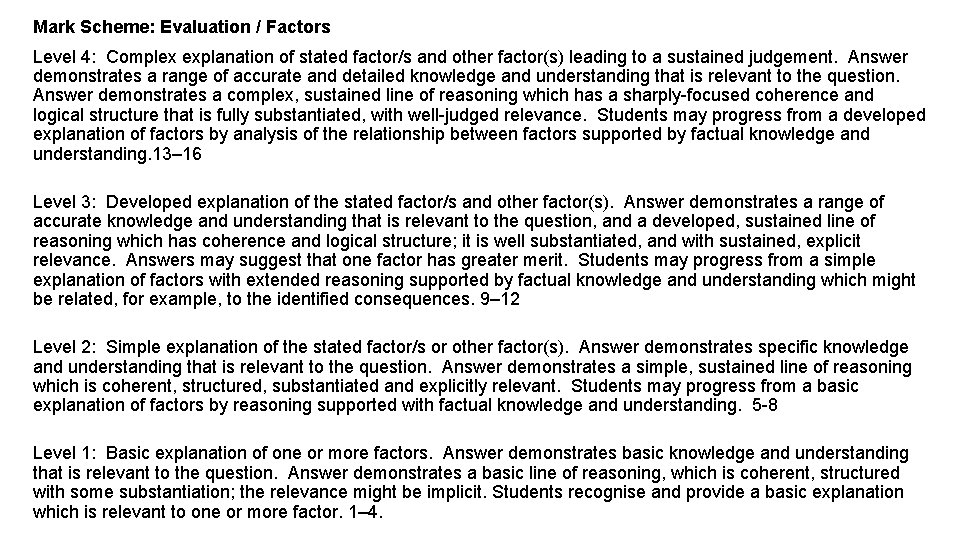
Mark Scheme: Evaluation / Factors Level 4: Complex explanation of stated factor/s and other factor(s) leading to a sustained judgement. Answer demonstrates a range of accurate and detailed knowledge and understanding that is relevant to the question. Answer demonstrates a complex, sustained line of reasoning which has a sharply-focused coherence and logical structure that is fully substantiated, with well-judged relevance. Students may progress from a developed explanation of factors by analysis of the relationship between factors supported by factual knowledge and understanding. 13– 16 Level 3: Developed explanation of the stated factor/s and other factor(s). Answer demonstrates a range of accurate knowledge and understanding that is relevant to the question, and a developed, sustained line of reasoning which has coherence and logical structure; it is well substantiated, and with sustained, explicit relevance. Answers may suggest that one factor has greater merit. Students may progress from a simple explanation of factors with extended reasoning supported by factual knowledge and understanding which might be related, for example, to the identified consequences. 9– 12 Level 2: Simple explanation of the stated factor/s or other factor(s). Answer demonstrates specific knowledge and understanding that is relevant to the question. Answer demonstrates a simple, sustained line of reasoning which is coherent, structured, substantiated and explicitly relevant. Students may progress from a basic explanation of factors by reasoning supported with factual knowledge and understanding. 5 -8 Level 1: Basic explanation of one or more factors. Answer demonstrates basic knowledge and understanding that is relevant to the question. Answer demonstrates a basic line of reasoning, which is coherent, structured with some substantiation; the relevance might be implicit. Students recognise and provide a basic explanation which is relevant to one or more factor. 1– 4.
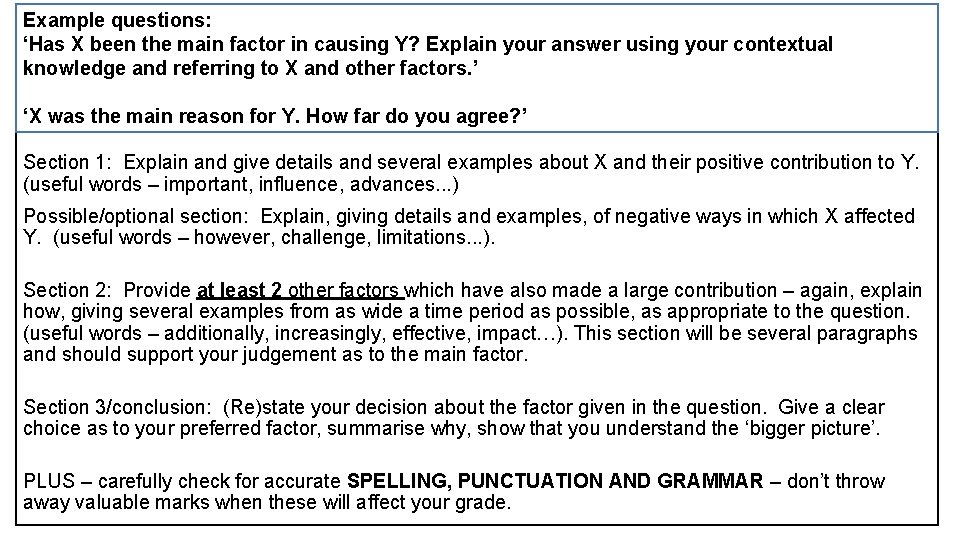
Example questions: ‘Has X been the main factor in causing Y? Explain your answer using your contextual knowledge and referring to X and other factors. ’ ‘X was the main reason for Y. How far do you agree? ’ Section 1: Explain and give details and several examples about X and their positive contribution to Y. (useful words – important, influence, advances. . . ) Possible/optional section: Explain, giving details and examples, of negative ways in which X affected Y. (useful words – however, challenge, limitations. . . ). Section 2: Provide at least 2 other factors which have also made a large contribution – again, explain how, giving several examples from as wide a time period as possible, as appropriate to the question. (useful words – additionally, increasingly, effective, impact…). This section will be several paragraphs and should support your judgement as to the main factor. Section 3/conclusion: (Re)state your decision about the factor given in the question. Give a clear choice as to your preferred factor, summarise why, show that you understand the ‘bigger picture’. PLUS – carefully check for accurate SPELLING, PUNCTUATION AND GRAMMAR – don’t throw away valuable marks when these will affect your grade.
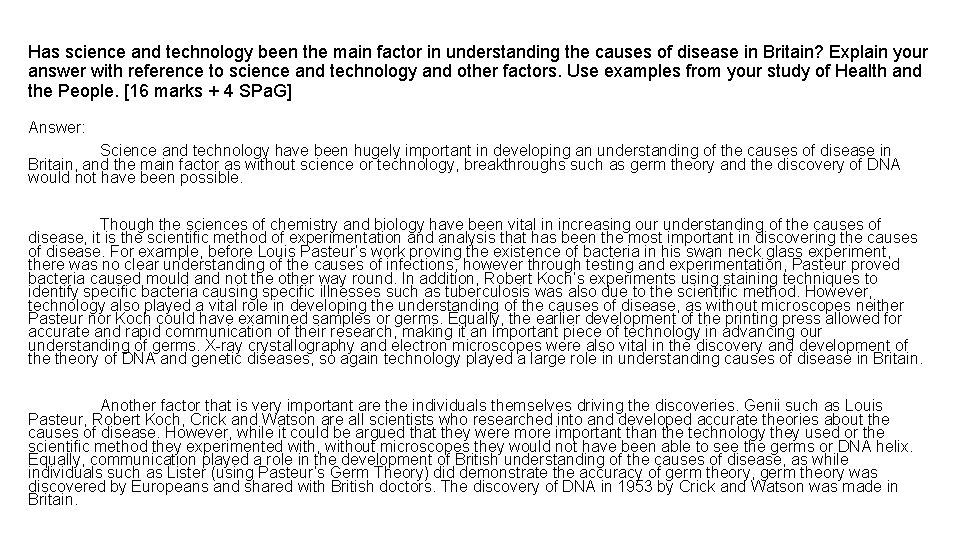
Has science and technology been the main factor in understanding the causes of disease in Britain? Explain your answer with reference to science and technology and other factors. Use examples from your study of Health and the People. [16 marks + 4 SPa. G] Answer: Science and technology have been hugely important in developing an understanding of the causes of disease in Britain, and the main factor as without science or technology, breakthroughs such as germ theory and the discovery of DNA would not have been possible. Though the sciences of chemistry and biology have been vital in increasing our understanding of the causes of disease, it is the scientific method of experimentation and analysis that has been the most important in discovering the causes of disease. For example, before Louis Pasteur’s work proving the existence of bacteria in his swan neck glass experiment, there was no clear understanding of the causes of infections, however through testing and experimentation, Pasteur proved bacteria caused mould and not the other way round. In addition, Robert Koch’s experiments using staining techniques to identify specific bacteria causing specific illnesses such as tuberculosis was also due to the scientific method. However, technology also played a vital role in developing the understanding of the causes of disease, as without microscopes neither Pasteur nor Koch could have examined samples or germs. Equally, the earlier development of the printing press allowed for accurate and rapid communication of their research, making it an important piece of technology in advancing our understanding of germs. X-ray crystallography and electron microscopes were also vital in the discovery and development of theory of DNA and genetic diseases, so again technology played a large role in understanding causes of disease in Britain. Another factor that is very important are the individuals themselves driving the discoveries. Genii such as Louis Pasteur, Robert Koch, Crick and Watson are all scientists who researched into and developed accurate theories about the causes of disease. However, while it could be argued that they were more important than the technology they used or the scientific method they experimented with, without microscopes they would not have been able to see the germs or DNA helix. Equally, communication played a role in the development of British understanding of the causes of disease, as while individuals such as Lister (using Pasteur’s Germ Theory) did demonstrate the accuracy of germ theory, germ theory was discovered by Europeans and shared with British doctors. The discovery of DNA in 1953 by Crick and Watson was made in Britain.
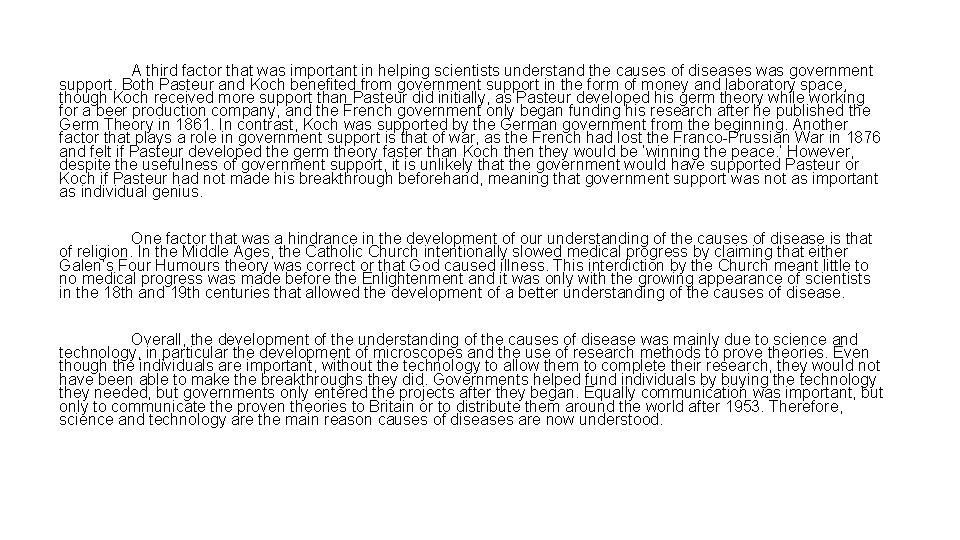
A third factor that was important in helping scientists understand the causes of diseases was government support. Both Pasteur and Koch benefited from government support in the form of money and laboratory space, though Koch received more support than Pasteur did initially, as Pasteur developed his germ theory while working for a beer production company, and the French government only began funding his research after he published the Germ Theory in 1861. In contrast, Koch was supported by the German government from the beginning. Another factor that plays a role in government support is that of war, as the French had lost the Franco-Prussian War in 1876 and felt if Pasteur developed the germ theory faster than Koch then they would be ‘winning the peace. ’ However, despite the usefulness of government support, it is unlikely that the government would have supported Pasteur or Koch if Pasteur had not made his breakthrough beforehand, meaning that government support was not as important as individual genius. One factor that was a hindrance in the development of our understanding of the causes of disease is that of religion. In the Middle Ages, the Catholic Church intentionally slowed medical progress by claiming that either Galen’s Four Humours theory was correct or that God caused illness. This interdiction by the Church meant little to no medical progress was made before the Enlightenment and it was only with the growing appearance of scientists in the 18 th and 19 th centuries that allowed the development of a better understanding of the causes of disease. Overall, the development of the understanding of the causes of disease was mainly due to science and technology, in particular the development of microscopes and the use of research methods to prove theories. Even though the individuals are important, without the technology to allow them to complete their research, they would not have been able to make the breakthroughs they did. Governments helped fund individuals by buying the technology they needed, but governments only entered the projects after they began. Equally communication was important, but only to communicate the proven theories to Britain or to distribute them around the world after 1953. Therefore, science and technology are the main reason causes of diseases are now understood.