
How to AQA GCSE History Paper 1 Section

- Slides: 23
How to… AQA GCSE History Paper 1 Section A Germany 1890 -1945 Qu 1: How do two interpretations differ? Qu 2: Why do two interpretations differ? Qu 3: Which of the two interpretations is most convincing? Qu 4: Describe e. g. two problems about… Qu 5: Explaining concepts e. g. in what ways were the lives of women affected by Nazi policies in the 1930 s? Qu 6: Evaluate two main factors e. g. which of the following was the most important reason why X…
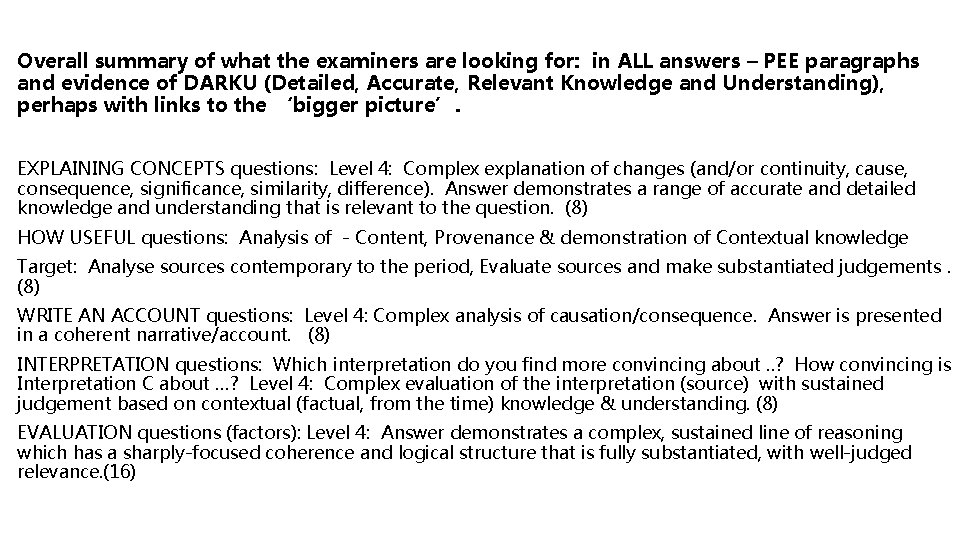
Overall summary of what the examiners are looking for: in ALL answers – PEE paragraphs and evidence of DARKU (Detailed, Accurate, Relevant Knowledge and Understanding), perhaps with links to the ‘bigger picture’. EXPLAINING CONCEPTS questions: Level 4: Complex explanation of changes (and/or continuity, cause, consequence, significance, similarity, difference). Answer demonstrates a range of accurate and detailed knowledge and understanding that is relevant to the question. (8) HOW USEFUL questions: Analysis of - Content, Provenance & demonstration of Contextual knowledge Target: Analyse sources contemporary to the period, Evaluate sources and make substantiated judgements. (8) WRITE AN ACCOUNT questions: Level 4: Complex analysis of causation/consequence. Answer is presented in a coherent narrative/account. (8) INTERPRETATION questions: Which interpretation do you find more convincing about. . ? How convincing is Interpretation C about …? Level 4: Complex evaluation of the interpretation (source) with sustained judgement based on contextual (factual, from the time) knowledge & understanding. (8) EVALUATION questions (factors): Level 4: Answer demonstrates a complex, sustained line of reasoning which has a sharply-focused coherence and logical structure that is fully substantiated, with well-judged relevance. (16)
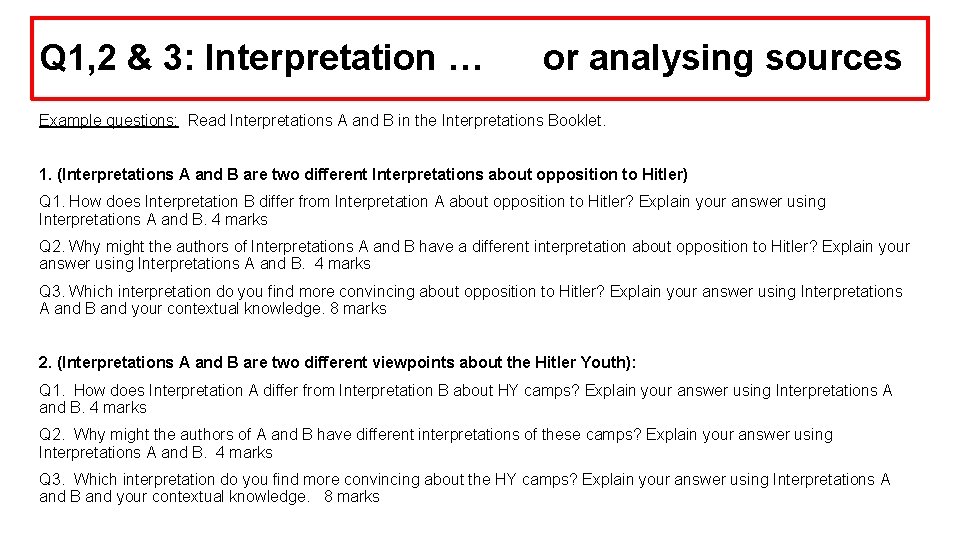
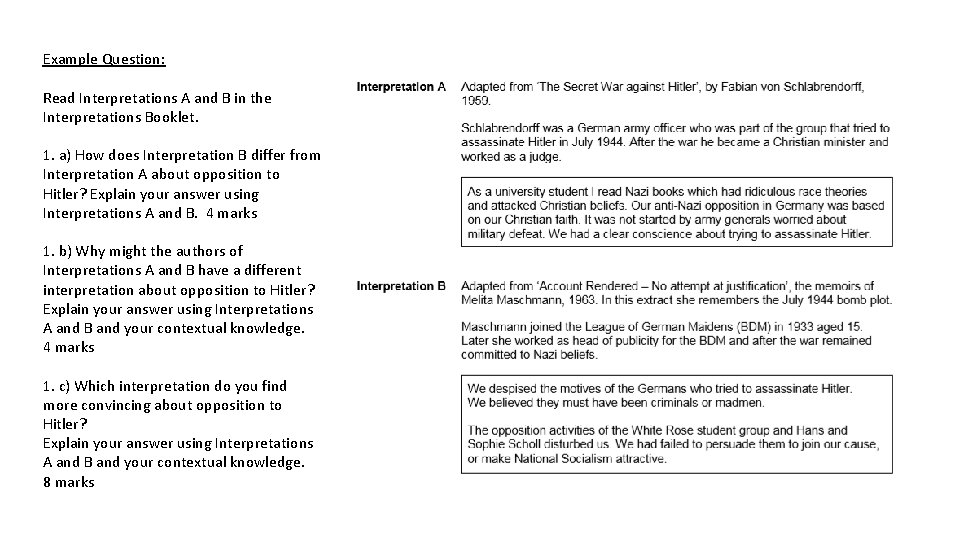
Q 1, 2 & 3: Interpretation … or analysing sources Example questions: Read Interpretations A and B in the Interpretations Booklet. 1. (Interpretations A and B are two different Interpretations about opposition to Hitler) Q 1. How does Interpretation B differ from Interpretation A about opposition to Hitler? Explain your answer using Interpretations A and B. 4 marks Q 2. Why might the authors of Interpretations A and B have a different interpretation about opposition to Hitler? Explain your answer using Interpretations A and B. 4 marks Q 3. Which interpretation do you find more convincing about opposition to Hitler? Explain your answer using Interpretations A and B and your contextual knowledge. 8 marks 2. (Interpretations A and B are two different viewpoints about the Hitler Youth): Q 1. How does Interpretation A differ from Interpretation B about HY camps? Explain your answer using Interpretations A and B. 4 marks Q 2. Why might the authors of A and B have different interpretations of these camps? Explain your answer using Interpretations A and B. 4 marks Q 3. Which interpretation do you find more convincing about the HY camps? Explain your answer using Interpretations A and B and your contextual knowledge. 8 marks
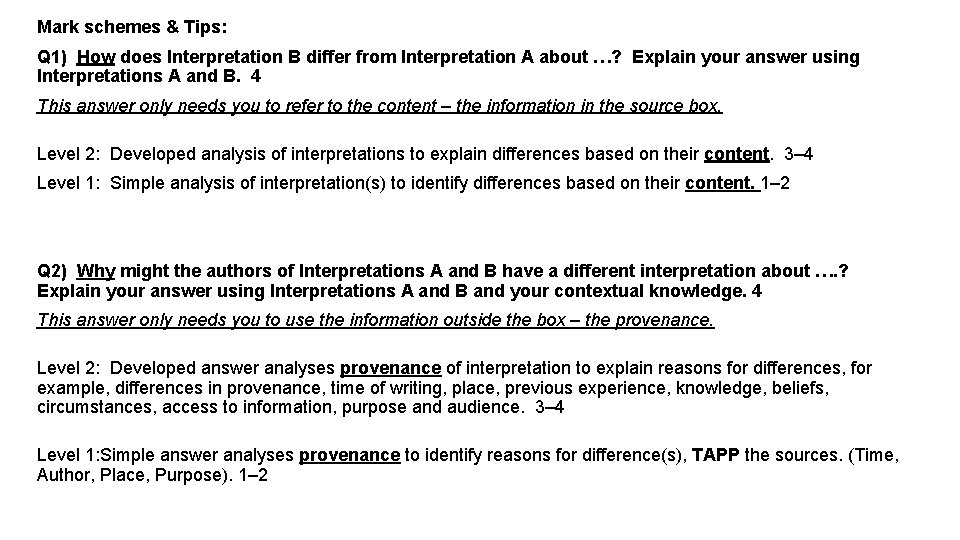
Mark schemes & Tips: Q 1) How does Interpretation B differ from Interpretation A about …? Explain your answer using Interpretations A and B. 4 This answer only needs you to refer to the content – the information in the source box. Level 2: Developed analysis of interpretations to explain differences based on their content. 3– 4 Level 1: Simple analysis of interpretation(s) to identify differences based on their content. 1– 2 Q 2) Why might the authors of Interpretations A and B have a different interpretation about …. ? Explain your answer using Interpretations A and B and your contextual knowledge. 4 This answer only needs you to use the information outside the box – the provenance. Level 2: Developed answer analyses provenance of interpretation to explain reasons for differences, for example, differences in provenance, time of writing, place, previous experience, knowledge, beliefs, circumstances, access to information, purpose and audience. 3– 4 Level 1: Simple answer analyses provenance to identify reasons for difference(s), TAPP the sources. (Time, Author, Place, Purpose). 1– 2
Example Question: Read Interpretations A and B in the Interpretations Booklet. 1. a) How does Interpretation B differ from Interpretation A about opposition to Hitler? Explain your answer using Interpretations A and B. 4 marks 1. b) Why might the authors of Interpretations A and B have a different interpretation about opposition to Hitler? Explain your answer using Interpretations A and B and your contextual knowledge. 4 marks 1. c) Which interpretation do you find more convincing about opposition to Hitler? Explain your answer using Interpretations A and B and your contextual knowledge. 8 marks
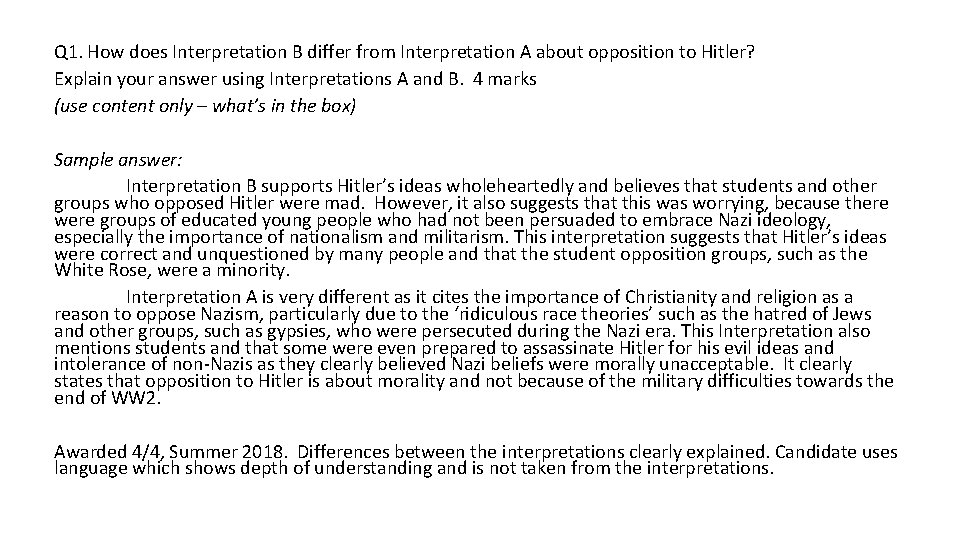
Q 1. How does Interpretation B differ from Interpretation A about opposition to Hitler? Explain your answer using Interpretations A and B. 4 marks (use content only – what’s in the box) Sample answer: Interpretation B supports Hitler’s ideas wholeheartedly and believes that students and other groups who opposed Hitler were mad. However, it also suggests that this was worrying, because there were groups of educated young people who had not been persuaded to embrace Nazi ideology, especially the importance of nationalism and militarism. This interpretation suggests that Hitler’s ideas were correct and unquestioned by many people and that the student opposition groups, such as the White Rose, were a minority. Interpretation A is very different as it cites the importance of Christianity and religion as a reason to oppose Nazism, particularly due to the ‘ridiculous race theories’ such as the hatred of Jews and other groups, such as gypsies, who were persecuted during the Nazi era. This Interpretation also mentions students and that some were even prepared to assassinate Hitler for his evil ideas and intolerance of non-Nazis as they clearly believed Nazi beliefs were morally unacceptable. It clearly states that opposition to Hitler is about morality and not because of the military difficulties towards the end of WW 2. Awarded 4/4, Summer 2018. Differences between the interpretations clearly explained. Candidate uses language which shows depth of understanding and is not taken from the interpretations.
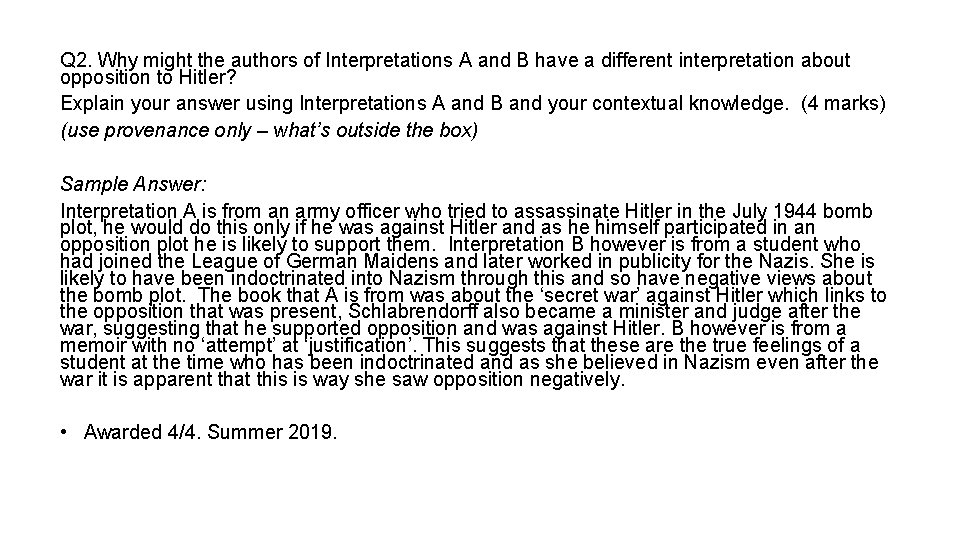
Q 2. Why might the authors of Interpretations A and B have a different interpretation about opposition to Hitler? Explain your answer using Interpretations A and B and your contextual knowledge. (4 marks) (use provenance only – what’s outside the box) Sample Answer: Interpretation A is from an army officer who tried to assassinate Hitler in the July 1944 bomb plot, he would do this only if he was against Hitler and as he himself participated in an opposition plot he is likely to support them. Interpretation B however is from a student who had joined the League of German Maidens and later worked in publicity for the Nazis. She is likely to have been indoctrinated into Nazism through this and so have negative views about the bomb plot. The book that A is from was about the ‘secret war’ against Hitler which links to the opposition that was present, Schlabrendorff also became a minister and judge after the war, suggesting that he supported opposition and was against Hitler. B however is from a memoir with no ‘attempt’ at ‘justification’. This suggests that these are the true feelings of a student at the time who has been indoctrinated and as she believed in Nazism even after the war it is apparent that this is way she saw opposition negatively. • Awarded 4/4. Summer 2019.
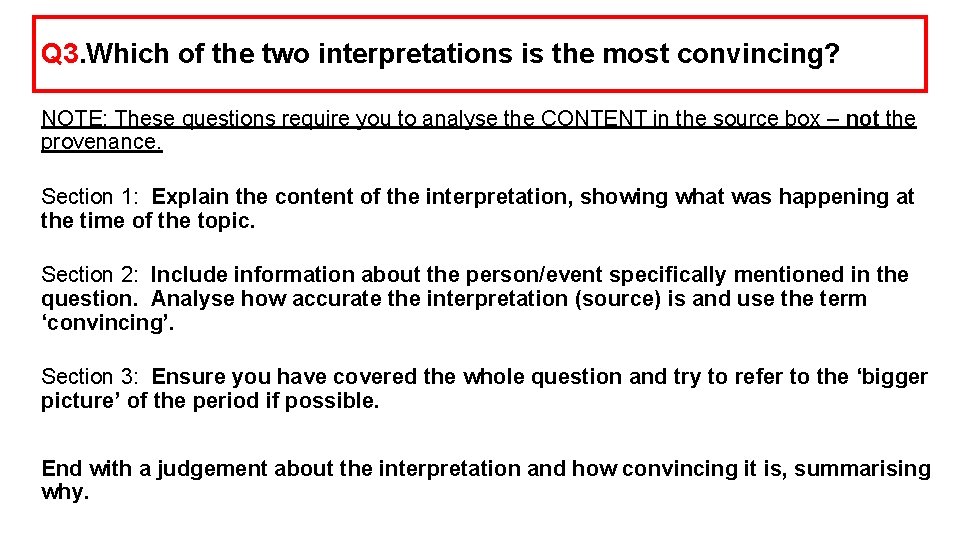
Q 3. Which of the two interpretations is the most convincing? NOTE: These questions require you to analyse the CONTENT in the source box – not the provenance. Section 1: Explain the content of the interpretation, showing what was happening at the time of the topic. Section 2: Include information about the person/event specifically mentioned in the question. Analyse how accurate the interpretation (source) is and use the term ‘convincing’. Section 3: Ensure you have covered the whole question and try to refer to the ‘bigger picture’ of the period if possible. End with a judgement about the interpretation and how convincing it is, summarising why.
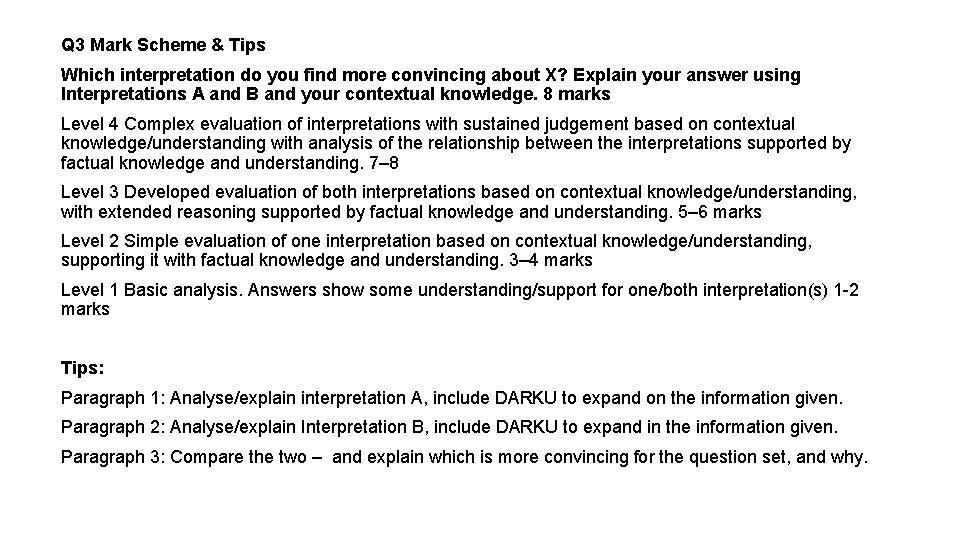
Q 3 Mark Scheme & Tips Which interpretation do you find more convincing about X? Explain your answer using Interpretations A and B and your contextual knowledge. 8 marks Level 4 Complex evaluation of interpretations with sustained judgement based on contextual knowledge/understanding with analysis of the relationship between the interpretations supported by factual knowledge and understanding. 7– 8 Level 3 Developed evaluation of both interpretations based on contextual knowledge/understanding, with extended reasoning supported by factual knowledge and understanding. 5– 6 marks Level 2 Simple evaluation of one interpretation based on contextual knowledge/understanding, supporting it with factual knowledge and understanding. 3– 4 marks Level 1 Basic analysis. Answers show some understanding/support for one/both interpretation(s) 1 -2 marks Tips: Paragraph 1: Analyse/explain interpretation A, include DARKU to expand on the information given. Paragraph 2: Analyse/explain Interpretation B, include DARKU to expand in the information given. Paragraph 3: Compare the two – and explain which is more convincing for the question set, and why.
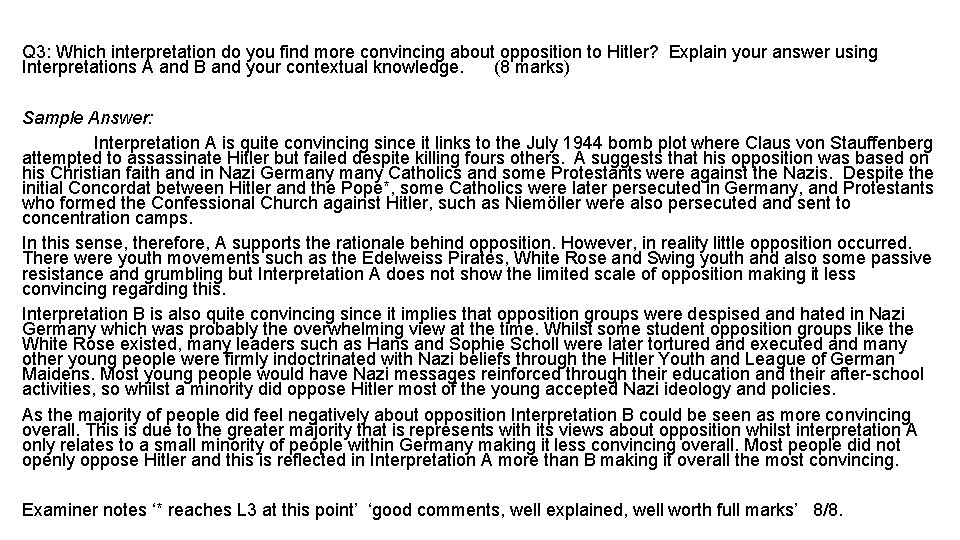
Q 3: Which interpretation do you find more convincing about opposition to Hitler? Explain your answer using Interpretations A and B and your contextual knowledge. (8 marks) Sample Answer: Interpretation A is quite convincing since it links to the July 1944 bomb plot where Claus von Stauffenberg attempted to assassinate Hitler but failed despite killing fours others. A suggests that his opposition was based on his Christian faith and in Nazi Germany Catholics and some Protestants were against the Nazis. Despite the initial Concordat between Hitler and the Pope*, some Catholics were later persecuted in Germany, and Protestants who formed the Confessional Church against Hitler, such as Niemöller were also persecuted and sent to concentration camps. In this sense, therefore, A supports the rationale behind opposition. However, in reality little opposition occurred. There were youth movements such as the Edelweiss Pirates, White Rose and Swing youth and also some passive resistance and grumbling but Interpretation A does not show the limited scale of opposition making it less convincing regarding this. Interpretation B is also quite convincing since it implies that opposition groups were despised and hated in Nazi Germany which was probably the overwhelming view at the time. Whilst some student opposition groups like the White Rose existed, many leaders such as Hans and Sophie Scholl were later tortured and executed and many other young people were firmly indoctrinated with Nazi beliefs through the Hitler Youth and League of German Maidens. Most young people would have Nazi messages reinforced through their education and their after-school activities, so whilst a minority did oppose Hitler most of the young accepted Nazi ideology and policies. As the majority of people did feel negatively about opposition Interpretation B could be seen as more convincing overall. This is due to the greater majority that is represents with its views about opposition whilst interpretation A only relates to a small minority of people within Germany making it less convincing overall. Most people did not openly oppose Hitler and this is reflected in Interpretation A more than B making it overall the most convincing. Examiner notes ‘* reaches L 3 at this point’ ‘good comments, well explained, well worth full marks’ 8/8.
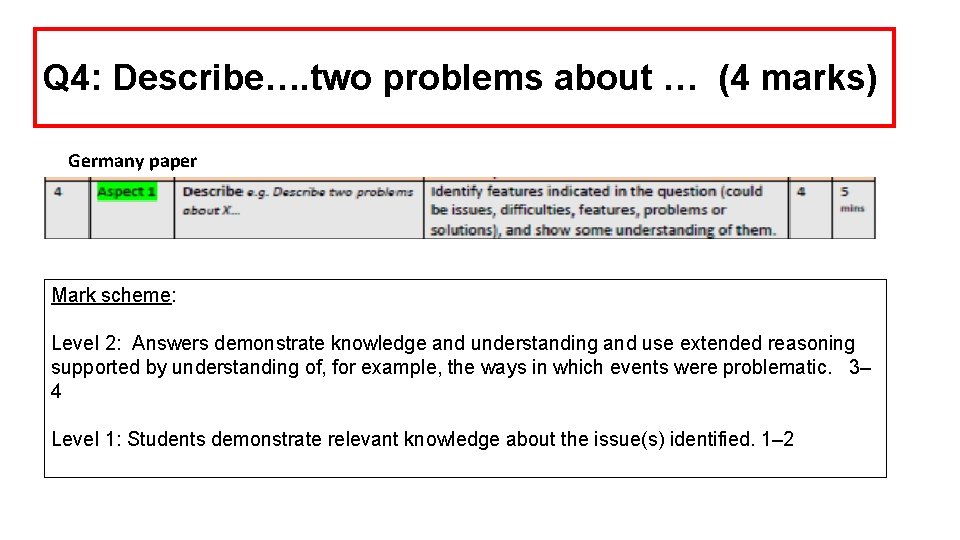
Q 4: Describe…. two problems about … (4 marks) Germany paper Mark scheme: Level 2: Answers demonstrate knowledge and understanding and use extended reasoning supported by understanding of, for example, the ways in which events were problematic. 3– 4 Level 1: Students demonstrate relevant knowledge about the issue(s) identified. 1– 2
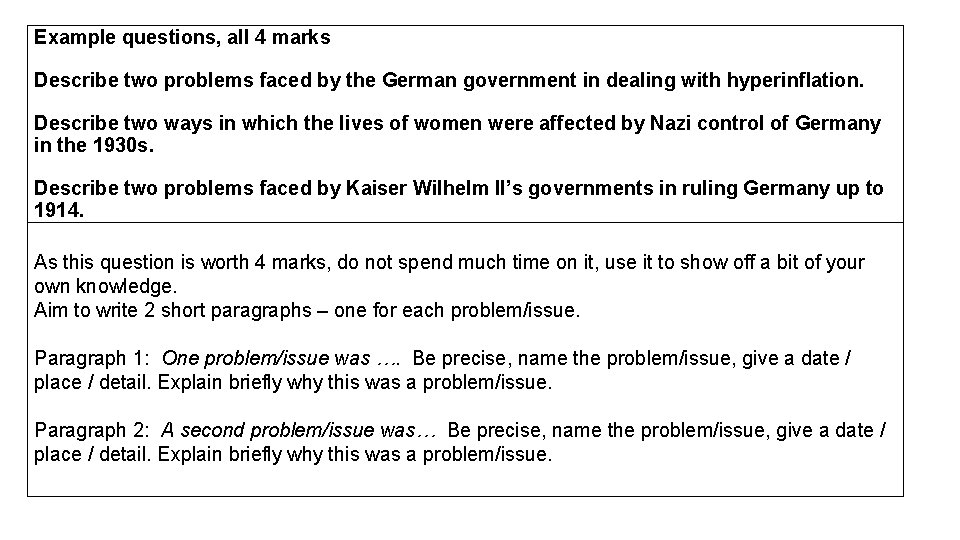
Example questions, all 4 marks Describe two problems faced by the German government in dealing with hyperinflation. Describe two ways in which the lives of women were affected by Nazi control of Germany in the 1930 s. Describe two problems faced by Kaiser Wilhelm II’s governments in ruling Germany up to 1914. As this question is worth 4 marks, do not spend much time on it, use it to show off a bit of your own knowledge. Aim to write 2 short paragraphs – one for each problem/issue. Paragraph 1: One problem/issue was …. Be precise, name the problem/issue, give a date / place / detail. Explain briefly why this was a problem/issue. Paragraph 2: A second problem/issue was… Be precise, name the problem/issue, give a date / place / detail. Explain briefly why this was a problem/issue.
Q 4. Describe two problems facing Jews living in Germany during the years 1933 -1939. (4 marks) Sample answer: One problem was the Nuremburg Laws where Jews had their German citizenship removed and could no longer marry Aryan people. Some could leave but would not be allowed back which created isolation. Another problem facing Jews was their removal from education. This meant that they could no longer get an education and government jobs and positions. This removed a source of income and created poverty amongst Jewish communities as well as further isolation from others. • Awarded 4/4. 2018. Short, concise, DARKU and explained.
Q 5: Explaining concepts e. g significance, change Example questions (8 marks): In what ways did the lives of people in Germany change during the First World War? In what ways were the lives of women in Germany affected by Nazi social policies? In what ways were the lives of children affected by Nazi policies between 1933 and 1945? Explain what was important about voyages abroad during the reign of Elizabeth I Explain the significance of Vesalius’ work for the development of medicine. Compare event A and event B. In what ways were they similar? Explain your answer with reference to both.
Mark scheme - EXPLAINING CONCEPTS (a) Target: Explain and analyse historical events and periods studied using second-order concepts (continuity, change, cause, consequence, significance, similarity and difference) and demonstrate knowledge and understanding of the key features and characteristics of the period studied. All levels require evidence of Accurate and Relevant Knowledge and Understanding (ARKU). PEE paragraphs are expected. Level 4: Complex explanation of changes, demonstrating a range of ARKU. e. g. students may further develop answer by explanation of the complexities of change arising from differences, such as time (short term/long term), group, social and/or economic impact, supported by knowledge and understanding. 7– 8 Level 3: Developed explanation of changes, demonstrating a range of ARKU. e. g. students consider two or more of the identified consequences, supporting them with factual knowledge and understanding. In addition to a Level 2 response, students make additional developed point(s). 5 -6. Level 2: Simple explanation of change. Answer demonstrates specific ARKU. E. g. students may progress from a basic explanation of change by using simple reasoning and supporting it with RKU which might be related, for example, to one of the identified changes. 3– 4 Level 1: Basic explanation of change(s). Answer demonstrates basic RKU. Students identify change(s), which are relevant to the question. 1– 2
Example questions: In what ways did the lives of people in Germany change during the First World War? In what ways were the lives of women in Germany affected by Nazi social policies? Key words: important; significant; affected by; similar; different First section: X was (insert appropriate key word from the question) because … Second section: In addition, other reasons for X were… (use this opportunity to show your knowledge and add in several other facts) Third section: X changed (developed / improved. . ) during the (time period) because of other …. . This links to … (the ‘bigger picture’) as … Final section: Therefore, X was very important/significant/different… as it (summarise your arguments, try to include local, national and even international effects, if possible)
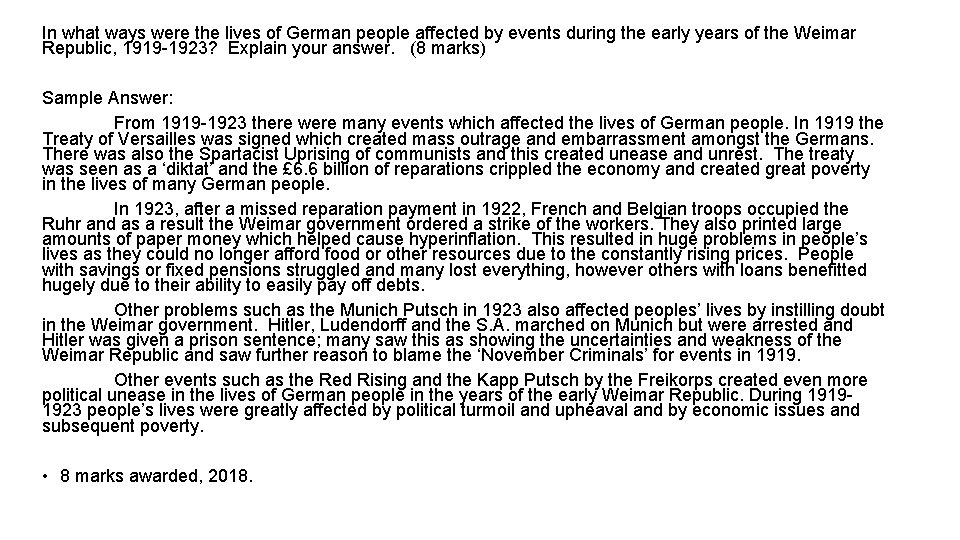
In what ways were the lives of German people affected by events during the early years of the Weimar Republic, 1919 -1923? Explain your answer. (8 marks) Sample Answer: From 1919 -1923 there were many events which affected the lives of German people. In 1919 the Treaty of Versailles was signed which created mass outrage and embarrassment amongst the Germans. There was also the Spartacist Uprising of communists and this created unease and unrest. The treaty was seen as a ‘diktat’ and the £ 6. 6 billion of reparations crippled the economy and created great poverty in the lives of many German people. In 1923, after a missed reparation payment in 1922, French and Belgian troops occupied the Ruhr and as a result the Weimar government ordered a strike of the workers. They also printed large amounts of paper money which helped cause hyperinflation. This resulted in huge problems in people’s lives as they could no longer afford food or other resources due to the constantly rising prices. People with savings or fixed pensions struggled and many lost everything, however others with loans benefitted hugely due to their ability to easily pay off debts. Other problems such as the Munich Putsch in 1923 also affected peoples’ lives by instilling doubt in the Weimar government. Hitler, Ludendorff and the S. A. marched on Munich but were arrested and Hitler was given a prison sentence; many saw this as showing the uncertainties and weakness of the Weimar Republic and saw further reason to blame the ‘November Criminals’ for events in 1919. Other events such as the Red Rising and the Kapp Putsch by the Freikorps created even more political unease in the lives of German people in the years of the early Weimar Republic. During 19191923 people’s lives were greatly affected by political turmoil and upheaval and by economic issues and subsequent poverty. • 8 marks awarded, 2018.
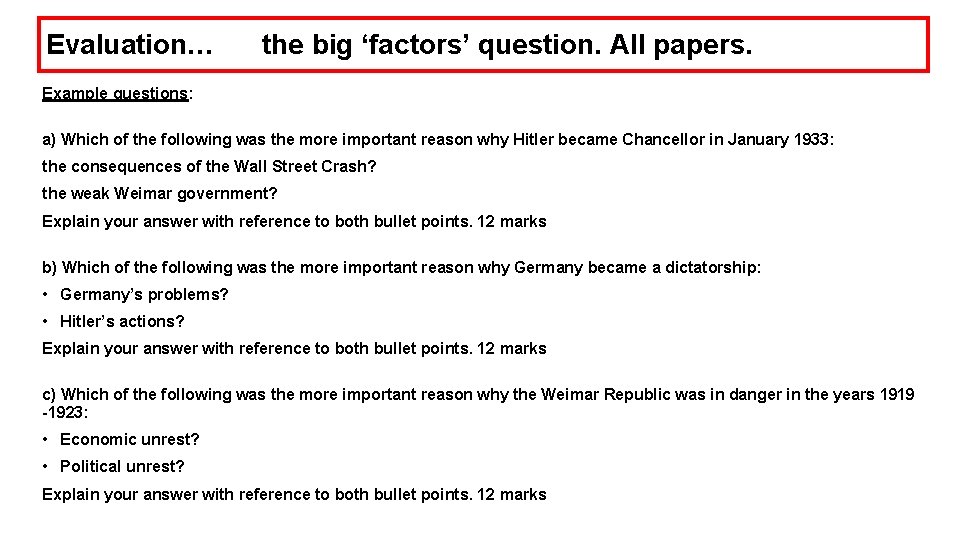
Evaluation… the big ‘factors’ question. All papers. Example questions: a) Which of the following was the more important reason why Hitler became Chancellor in January 1933: the consequences of the Wall Street Crash? the weak Weimar government? Explain your answer with reference to both bullet points. 12 marks b) Which of the following was the more important reason why Germany became a dictatorship: • Germany’s problems? • Hitler’s actions? Explain your answer with reference to both bullet points. 12 marks c) Which of the following was the more important reason why the Weimar Republic was in danger in the years 1919 -1923: • Economic unrest? • Political unrest? Explain your answer with reference to both bullet points. 12 marks
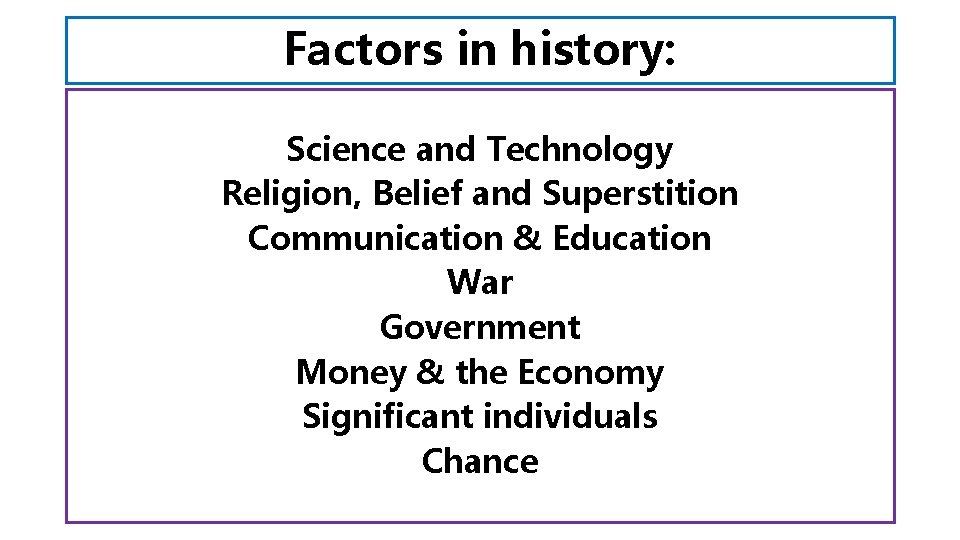
Factors in history: Science and Technology Religion, Belief and Superstition Communication & Education War Government Money & the Economy Significant individuals Chance
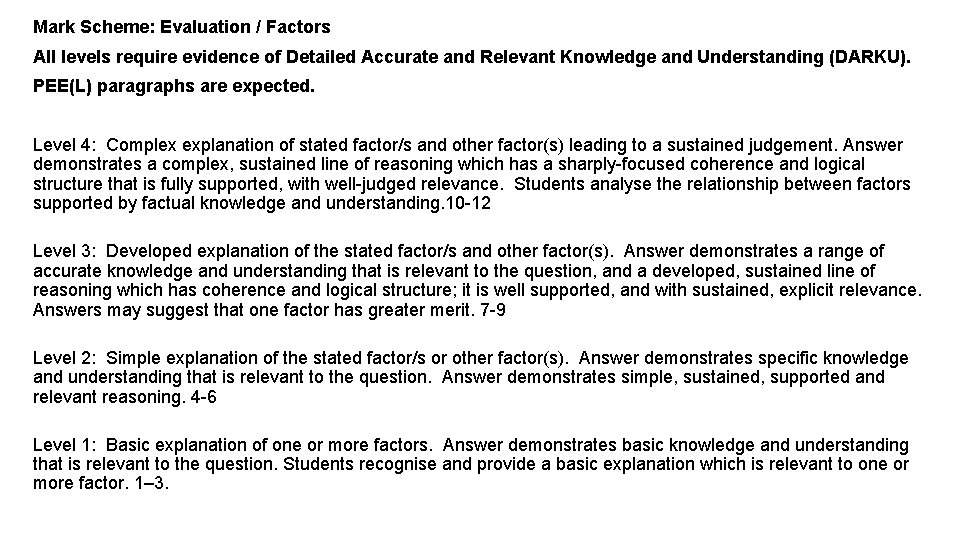
Mark Scheme: Evaluation / Factors All levels require evidence of Detailed Accurate and Relevant Knowledge and Understanding (DARKU). PEE(L) paragraphs are expected. Level 4: Complex explanation of stated factor/s and other factor(s) leading to a sustained judgement. Answer demonstrates a complex, sustained line of reasoning which has a sharply-focused coherence and logical structure that is fully supported, with well-judged relevance. Students analyse the relationship between factors supported by factual knowledge and understanding. 10 -12 Level 3: Developed explanation of the stated factor/s and other factor(s). Answer demonstrates a range of accurate knowledge and understanding that is relevant to the question, and a developed, sustained line of reasoning which has coherence and logical structure; it is well supported, and with sustained, explicit relevance. Answers may suggest that one factor has greater merit. 7 -9 Level 2: Simple explanation of the stated factor/s or other factor(s). Answer demonstrates specific knowledge and understanding that is relevant to the question. Answer demonstrates simple, sustained, supported and relevant reasoning. 4 -6 Level 1: Basic explanation of one or more factors. Answer demonstrates basic knowledge and understanding that is relevant to the question. Students recognise and provide a basic explanation which is relevant to one or more factor. 1– 3.
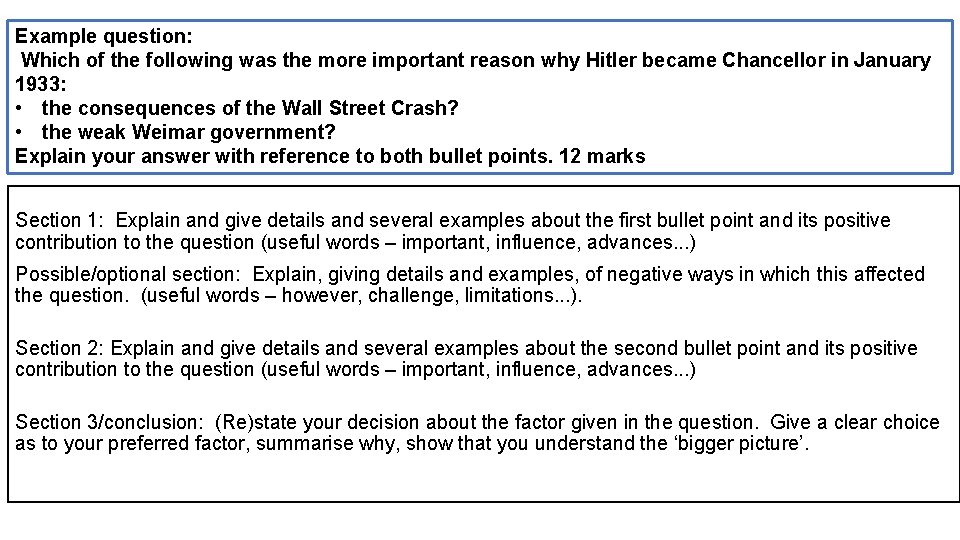
Example question: Which of the following was the more important reason why Hitler became Chancellor in January 1933: • the consequences of the Wall Street Crash? • the weak Weimar government? Explain your answer with reference to both bullet points. 12 marks Section 1: Explain and give details and several examples about the first bullet point and its positive contribution to the question (useful words – important, influence, advances. . . ) Possible/optional section: Explain, giving details and examples, of negative ways in which this affected the question. (useful words – however, challenge, limitations. . . ). Section 2: Explain and give details and several examples about the second bullet point and its positive contribution to the question (useful words – important, influence, advances. . . ) Section 3/conclusion: (Re)state your decision about the factor given in the question. Give a clear choice as to your preferred factor, summarise why, show that you understand the ‘bigger picture’.
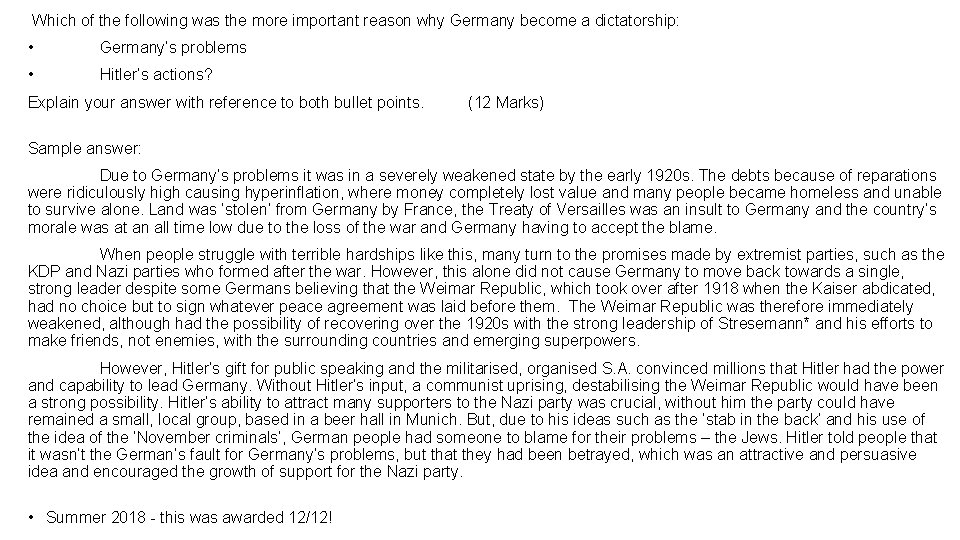
Which of the following was the more important reason why Germany become a dictatorship: • Germany’s problems • Hitler’s actions? Explain your answer with reference to both bullet points. (12 Marks) Sample answer: Due to Germany’s problems it was in a severely weakened state by the early 1920 s. The debts because of reparations were ridiculously high causing hyperinflation, where money completely lost value and many people became homeless and unable to survive alone. Land was ‘stolen’ from Germany by France, the Treaty of Versailles was an insult to Germany and the country’s morale was at an all time low due to the loss of the war and Germany having to accept the blame. When people struggle with terrible hardships like this, many turn to the promises made by extremist parties, such as the KDP and Nazi parties who formed after the war. However, this alone did not cause Germany to move back towards a single, strong leader despite some Germans believing that the Weimar Republic, which took over after 1918 when the Kaiser abdicated, had no choice but to sign whatever peace agreement was laid before them. The Weimar Republic was therefore immediately weakened, although had the possibility of recovering over the 1920 s with the strong leadership of Stresemann* and his efforts to make friends, not enemies, with the surrounding countries and emerging superpowers. However, Hitler’s gift for public speaking and the militarised, organised S. A. convinced millions that Hitler had the power and capability to lead Germany. Without Hitler’s input, a communist uprising, destabilising the Weimar Republic would have been a strong possibility. Hitler’s ability to attract many supporters to the Nazi party was crucial, without him the party could have remained a small, local group, based in a beer hall in Munich. But, due to his ideas such as the ‘stab in the back’ and his use of the idea of the ‘November criminals’, German people had someone to blame for their problems – the Jews. Hitler told people that it wasn’t the German’s fault for Germany’s problems, but that they had been betrayed, which was an attractive and persuasive idea and encouraged the growth of support for the Nazi party. • Summer 2018 - this was awarded 12/12!