
How to Approach MultipleChoice Questions Intro We can

- Slides: 23
How to Approach Multiple-Choice Questions
Intro…. . We can do this • The multiple choice part of the test will consist of two to five questions, which are tied to primary sources, secondary sources, or historical issues. The directions will be pretty simple:
Directions: • Each of the questions or incomplete statements below is followed by four suggested answers or completions. Select the one that is best in each case and then fill in the corresponding space on the answer sheet. • **There will be 55 Multiple Choice Questions and you will be given 55 minutes to work.
Types of Sources: • Primary sources- Original materials that provide a firsthand account or perspective. These could include: famous works, legislation, or speeches • Secondary sources- Not firsthand accounts. Examples: historical perspectives of an event, historical criticisms, artwork or cartoons, or retrospective analysis. • Historical issues- Charts or graphs that show key historical relationships
Types of Questions and examples: • • 1. Straight forward (no tricks here ) 2. “Not/Except” Questions 3. Political Cartoon/ Maps / Illustration 4. Charts or Graphs
The Straight Forward “Can we forge against these enemies a grand global alliance, North and South, East and West, that can assure a more fruitful life for all mankind? Will you join in that historical effort? In the long history of the world, only a few generations have been granted the role of defending freedom in its hour of maximum danger. I do not shrink from this responsibility- I welcome it. I do not believe that any of us would exchange places with any other people or any other generation. And so, my fellow Americans: ask not what your country can do for you- ask what you can do for your country. My fellow citizens of the world: ask not what America will do for you, but what together we can do for the freedom of man. ” John F. Kennedy, Inaugural Address, 1961
Question: • The excerpt provided discusses global turbulence and the desire for freedom of man kind in reference to which of the following events: – A) Civil Rights Movement – B) Women’s Suffrage Movement – C) The Cold War – D) The Great Depression
And the answer is…. . • C. Helpful hints: Process of Elimination! Identify ALL the INCORRECT answers (easier to identify) and eliminate them from your test. Scratch them off. *If you are looking for the correct answer you will waste all your time trying to justify why an answer could be right.
Not/ Except Question • The New Deal included programs for achieving all of the following goals EXCEPT A. Developing an interstate highway system B. Stabilizing agricultural prices C. Insuring bank deposits D. Eliminating industrial overproduction E. Providing employment for the unemployed
And the answer is…. . • A Helpful Hints: A simple way to handle these questions is to treat them like a true/ false questions. Go through your answer choices and label them true or false Your false answer will be your CORRECT (TRUE) answer
Political Cartoons or Maps Helpful Hints: Do not read too much into them! Read the Question first, and then go to the illustration, map or political cartoon. This way you know what you are EXACTLY looking for
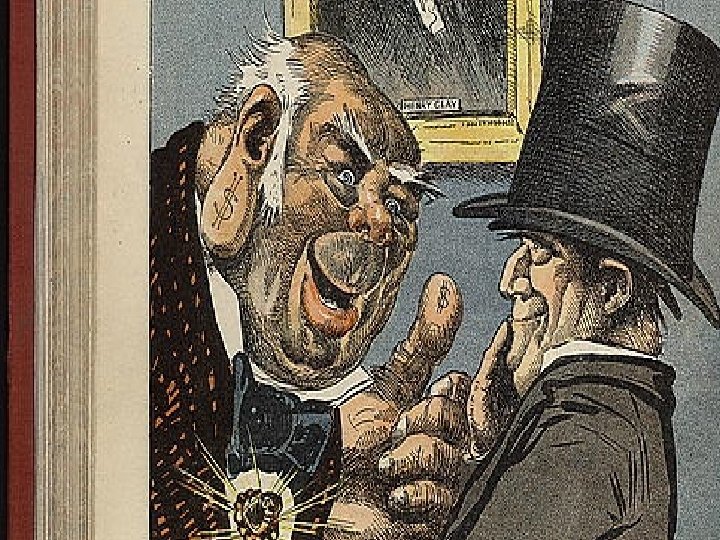
Question: • The Political cartoon above implies that: – A) Mc. Kinley was the first president to favor big business interests openly – B) By the 1890’s, Henry Clay’s political approach had lost favor with the electorate – C) Mc. Kinley’s presidential campaign was masterminded by Marcus Hanna – D) Marcus Hanna single-handedly controlled all three branches of the federal government
And the Answer is: • C-----WHY? ? ? ?
Charts or Graphs • Usually pretty straightforward • Can be time consuming so you may choose to do those last • Realize one or more options could be Valid, but only one will be supported by the information in the chart or graph
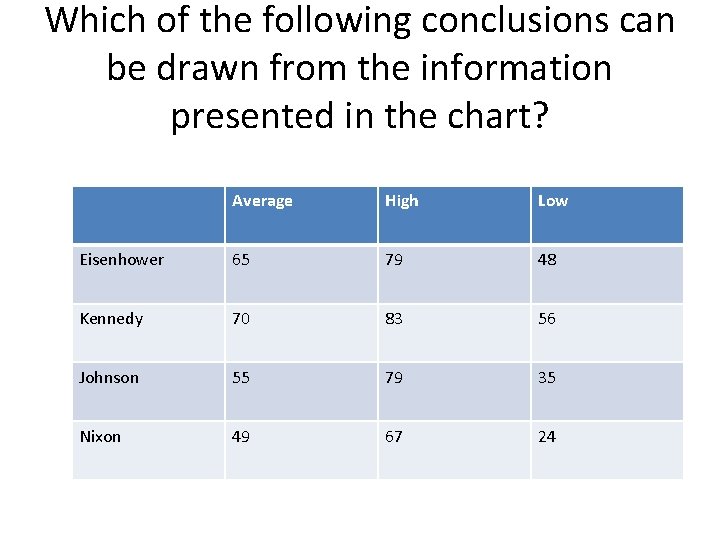
Which of the following conclusions can be drawn from the information presented in the chart? Average High Low Eisenhower 65 79 48 Kennedy 70 83 56 Johnson 55 79 35 Nixon 49 67 24
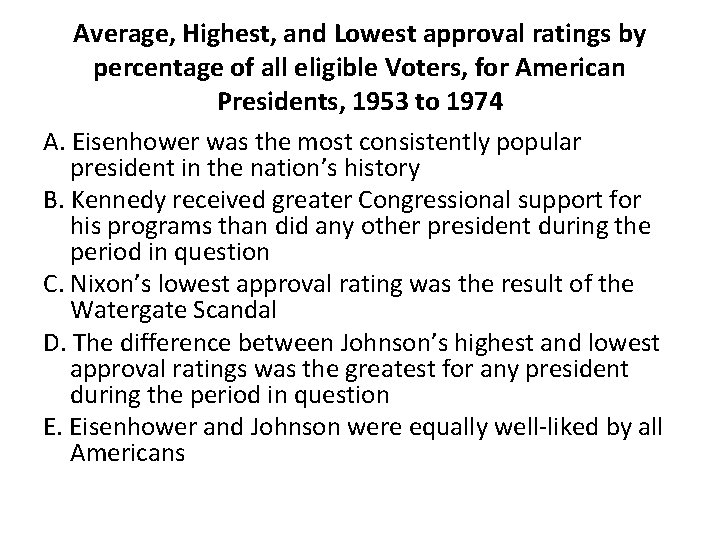
Average, Highest, and Lowest approval ratings by percentage of all eligible Voters, for American Presidents, 1953 to 1974 A. Eisenhower was the most consistently popular president in the nation’s history B. Kennedy received greater Congressional support for his programs than did any other president during the period in question C. Nixon’s lowest approval rating was the result of the Watergate Scandal D. The difference between Johnson’s highest and lowest approval ratings was the greatest for any president during the period in question E. Eisenhower and Johnson were equally well-liked by all Americans
No Military History or Straight Memorization -When asking about war, questions will focus on political, diplomatic, or social implications of battle instead of specific detail. ***Significance of the battle of Saratoga? ? • Straight memorization will help you on essays, but MC Questions are looking at the larger historical context.
The Big Picture • One of the most important characteristics of the AP US History multiple-choice section if that the questions and answers are designed to illustrate BASIC PRINCIPLES of American History. • They are looking to find out whether you mastered the important generalizations that can be drawn from history. • Always keep the BIG PICTURE in mind as you take this exam. As you approach questions, use the sources provided to help you focus on the key specific event or concept being tested, you should be able to answer the question by remembering the general social and political trends od the era and using the information that may be ascertained from the source.
Process of Elimination (POE) • Use POE to whittle down the answer choices to one on all but the easiest questions. • Look for the WRONG ANSWERS and cross them off! Forget about them…. • If you go in looking for the right answers you will find yourself justifying why something could be right…… DON’T TRY TO FIX IT!!
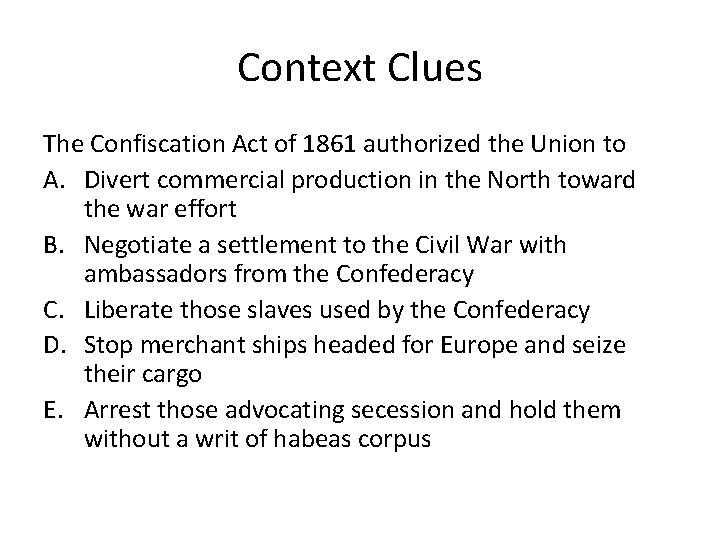
Context Clues The Confiscation Act of 1861 authorized the Union to A. Divert commercial production in the North toward the war effort B. Negotiate a settlement to the Civil War with ambassadors from the Confederacy C. Liberate those slaves used by the Confederacy D. Stop merchant ships headed for Europe and seize their cargo E. Arrest those advocating secession and hold them without a writ of habeas corpus
And the answer is…. . • C Helpful Hints: You may not remember the specific details of the topic but look for key words such as Confiscation. Think about the meaning and then look for the wrong answers. By identifying a key term you can use process of elimination
Summary: • Don’t over extend yourself, but fill in all bubbles • Familiarize yourself with all types of questions • Look for “ Big picture” questions. *Great history review in Princeton book. Know your common History Trends • Use Process of Elimination on all but the easiest questions. Scratch out all those eliminated, guess and MOVE ON! • Use Common Sense and LOOK for Context Clues