
How to Approach a Child with Delayed Walking





- Slides: 13
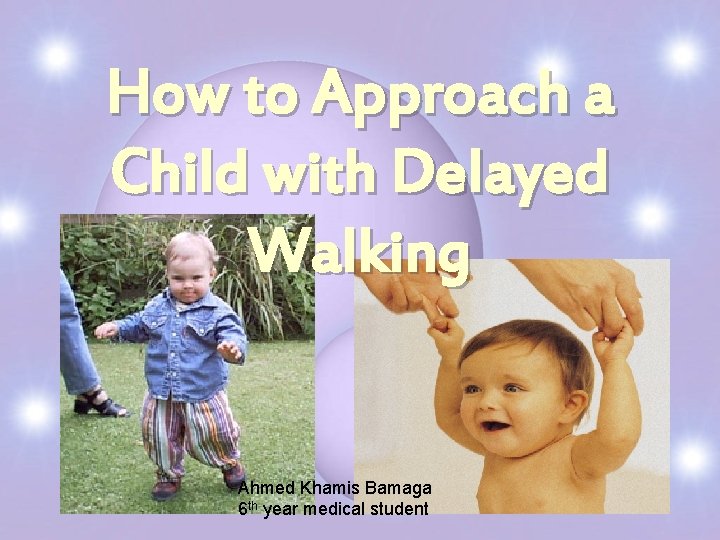
How to Approach a Child with Delayed Walking Ahmed Khamis Bamaga 6 th year medical student
Normal ranges: • Sit unsupported at 18 to 30 weeks of age. • Pull self up to stand at 6 to 10 months. • walk by holding on to furniture at 7 to 13 months. • walk alone at 11 to 18 months.
History • Was the child a full term normal delivery? • Were there any problems in pregnancy? • Did the child feed well from the outset? • Was there deep jaundice? • Has the child had any serious illnesses?
History • Are there any significant inherited conditions in the family? • Has the mother been trying to get the baby to walk ? • Are there any other aspects of development that have been a cause for concern?
Examination • Does the baby look well cared for? • Does the child look normal? • Does the child seem alert and attentive? • What is the resting posture? • How is muscle tone?
Examination • Try to get the child to walk. • Test the plantar (Babinski) response. • Check that the crease of the buttocks looks normal.
D & D First, The child reached all other milestones normally and seems on the way of achieving this one. Review in one month and if the child can walk that is fine. If not, refer. Maturational lag
D & D • Second, Walking seems to be the only significant delay. Referral to a community paediatrician may be in order for more detailed assessment. Motor disorder
D & D • Third, This seems to be part of global developmental delay. Refer to a community or general paediatrician. The cause of delay may be brain damage or unknown. global developmental delay
D & D • Fourth, This would appear to be part of a previously undiagnosed syndrome. Refer to a paediatrician for full diagnosis or exclusion.
Causes • Nutritional – Protein calorie malnutrition – Rickets • Infectious – Poliomyelitis • Chromosomal – Down’s syndrome – Werding Hoffman’s disease – Duchenne muscular dystrophy • Neurological diseases – Guillian Barre Syndrome – Cerebral palsy • Endocrine – Cretinism • Familial delayed walking
Causes • Environment: Lack of practice. • Special Senses: Interference with perception of the environment. • Brain: Immaturity, variant of normal, lack initiative, control movements.
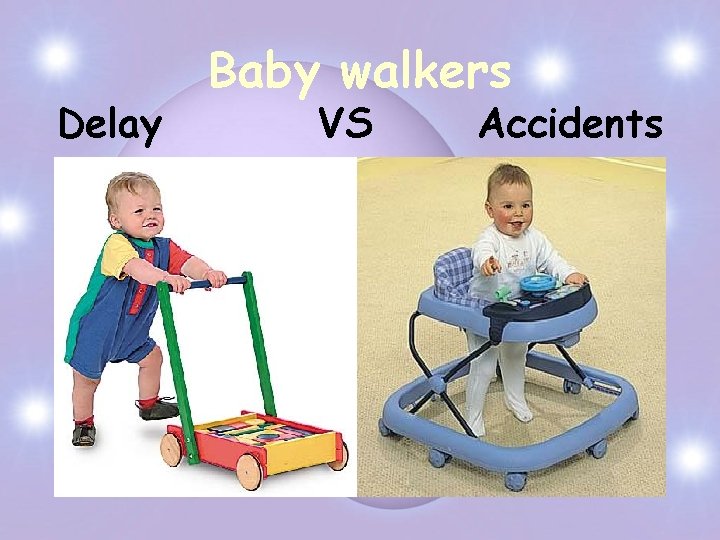
Delay Baby walkers VS Accidents