
How To Answer AP Questions Target Skill Context
- Slides: 10
How To Answer AP Questions Target Skill: Context and Periodization
Why are these questions so hard? l The answer is not in the stimuli l It is asking you to think at the highest level l Analytical l Synthesis *These are the highest forms of thinking the brain can do
Let’s talk about CONTEXT l What is it? l l How is it used? l l Historical thinking involves the ability to connect historical developments to specific circumstances in time and place, and to broader regional, national or global processes. (CB, 2016) CB uses it to evaluate or explain patterns, cause and effect, phenomena, process of how events connect to each other Why does CB like it so much? Well it separates a 5 from a 3…. l Again it makes the brain tackle the most difficult thinking skills it can hold l
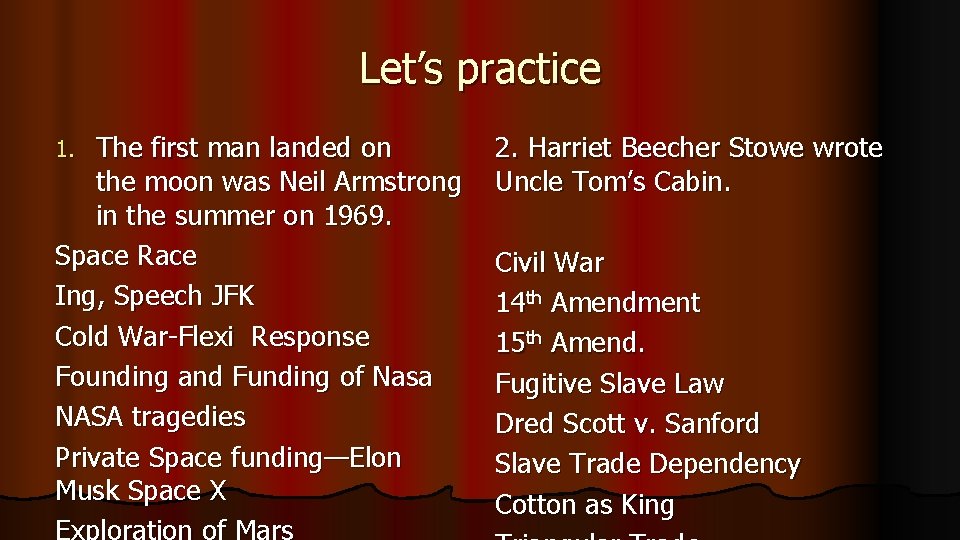
Let’s practice The first man landed on the moon was Neil Armstrong in the summer on 1969. Space Race Ing, Speech JFK Cold War-Flexi Response Founding and Funding of Nasa NASA tragedies Private Space funding—Elon Musk Space X 1. 2. Harriet Beecher Stowe wrote Uncle Tom’s Cabin. Civil War 14 th Amendment 15 th Amend. Fugitive Slave Law Dred Scott v. Sanford Slave Trade Dependency Cotton as King
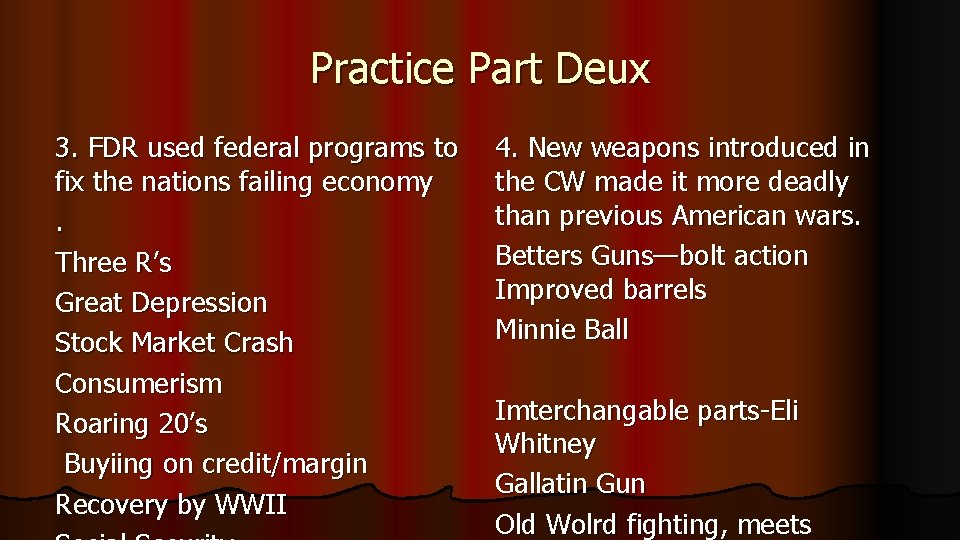
Practice Part Deux 3. FDR used federal programs to fix the nations failing economy. Three R’s Great Depression Stock Market Crash Consumerism Roaring 20’s Buyiing on credit/margin Recovery by WWII 4. New weapons introduced in the CW made it more deadly than previous American wars. Betters Guns—bolt action Improved barrels Minnie Ball Imterchangable parts-Eli Whitney Gallatin Gun Old Wolrd fighting, meets
And now for some Periodization l What is it? Explain ways that historical events and processes can be organized within blocks of time. l Analyze and evaluate competing and contrasting models of US history. l l How is it used? l l It is obvious that the new curriculum targets thinking skill due to our 9 set historical periods. Knowing when and why a period ended or began is essential. Knowing how other periods connect to each other is also imperative Why does CB like it so much? l Again it reaches into your most sophisticated layers of those amazing brains of yours.
Periodization Practice 1. Women have definitively over time fought or championed for societal issues. 2. U. S foreign policy kept the country out of global war from the 1810’s to the 1890’s.
Periodization oh my! 3. The policies pushed by FDR have a legacy in U. S society today. 4. The U. S. has determined to shield democracy from other world powers.
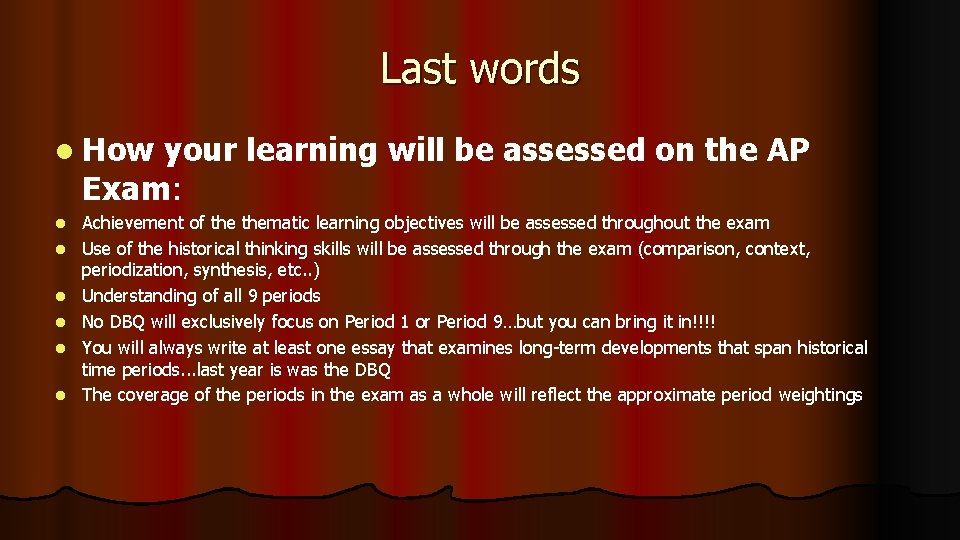
Last words l How your learning will be assessed on the AP Exam: l l l Achievement of thematic learning objectives will be assessed throughout the exam Use of the historical thinking skills will be assessed through the exam (comparison, context, periodization, synthesis, etc. . ) Understanding of all 9 periods No DBQ will exclusively focus on Period 1 or Period 9…but you can bring it in!!!! You will always write at least one essay that examines long-term developments that span historical time periods. . . last year is was the DBQ The coverage of the periods in the exam as a whole will reflect the approximate period weightings
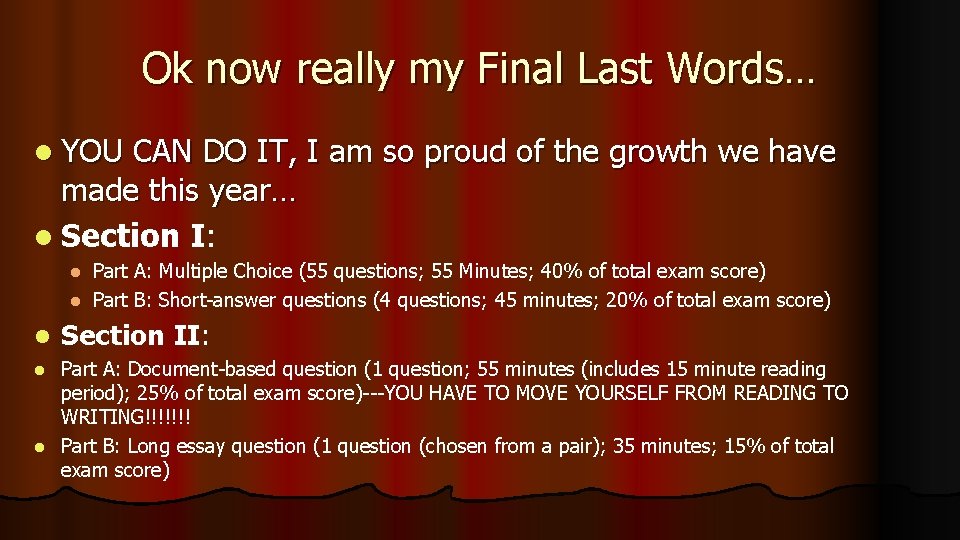
Ok now really my Final Last Words… l YOU CAN DO IT, I am so proud of the growth we have made this year… l Section I: Part A: Multiple Choice (55 questions; 55 Minutes; 40% of total exam score) l Part B: Short-answer questions (4 questions; 45 minutes; 20% of total exam score) l l Section II: Part A: Document-based question (1 question; 55 minutes (includes 15 minute reading period); 25% of total exam score)---YOU HAVE TO MOVE YOURSELF FROM READING TO WRITING!!!!!!! l Part B: Long essay question (1 question (chosen from a pair); 35 minutes; 15% of total exam score) l