
How to Analyze Political Cartoons Five Methods Understanding
- Slides: 36
How to Analyze Political Cartoons Five Methods: Understanding Persuasive Techniques Looking at the Picture Looking at the Text Identifying the Issue Analyzing the Message
• Political cartoons use imagery and text to comment on a contemporary social issue. • They may contain a caricature (the exaggerated imitation of a person) of a well-known person or an allusion to a contemporary event or trend. • By examining the pictorial elements of the cartoon, along with the textual elements, you can start to understand the message of the cartoon. • This will lead you to understanding the cartoonist’s goal in persuading the reader to think a certain way about a current issue.
Method Understanding Persuasive Techniques
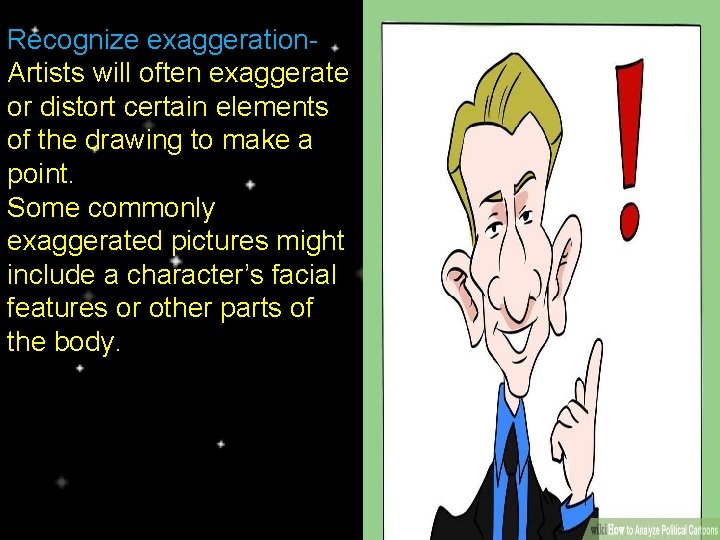
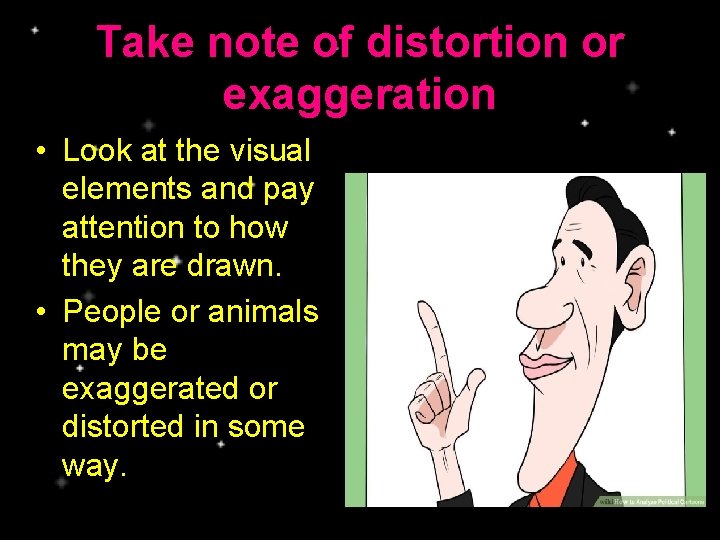
Recognize exaggeration. Artists will often exaggerate or distort certain elements of the drawing to make a point. Some commonly exaggerated pictures might include a character’s facial features or other parts of the body.
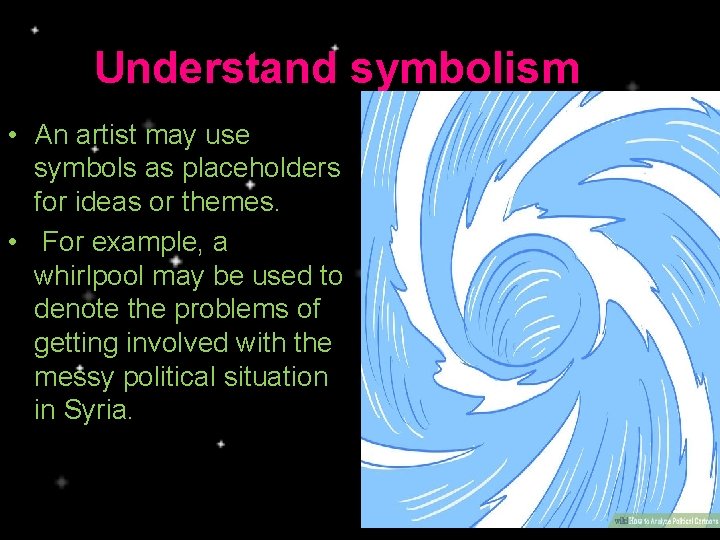
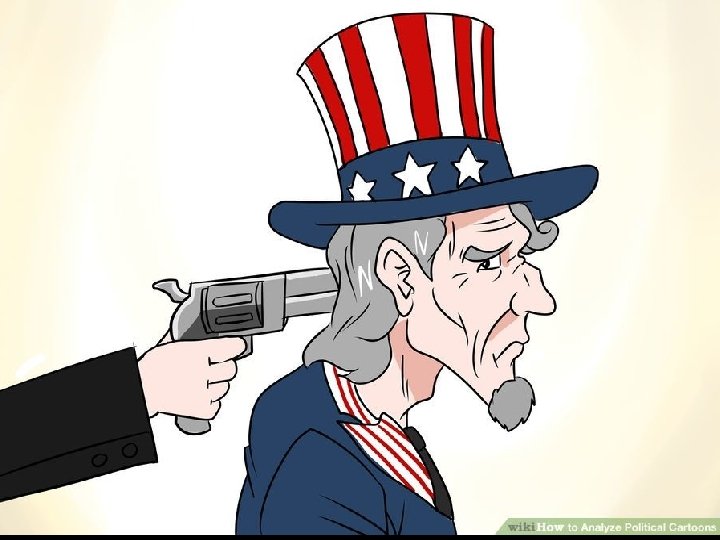
Understand symbolism • An artist may use symbols as placeholders for ideas or themes. • For example, a whirlpool may be used to denote the problems of getting involved with the messy political situation in Syria.
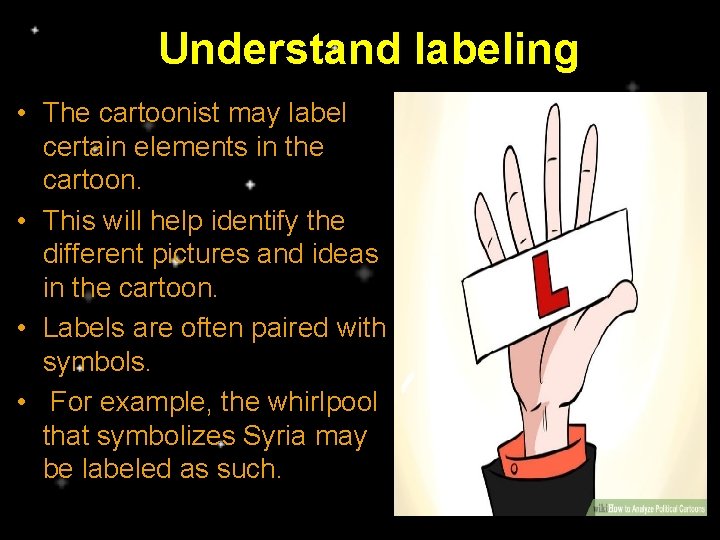
Understand labeling • The cartoonist may label certain elements in the cartoon. • This will help identify the different pictures and ideas in the cartoon. • Labels are often paired with symbols. • For example, the whirlpool that symbolizes Syria may be labeled as such.
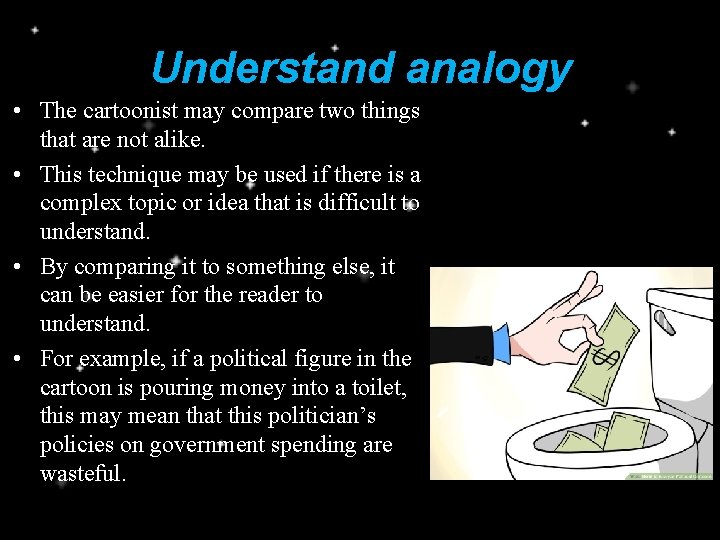
Understand analogy • The cartoonist may compare two things that are not alike. • This technique may be used if there is a complex topic or idea that is difficult to understand. • By comparing it to something else, it can be easier for the reader to understand. • For example, if a political figure in the cartoon is pouring money into a toilet, this may mean that this politician’s policies on government spending are wasteful.
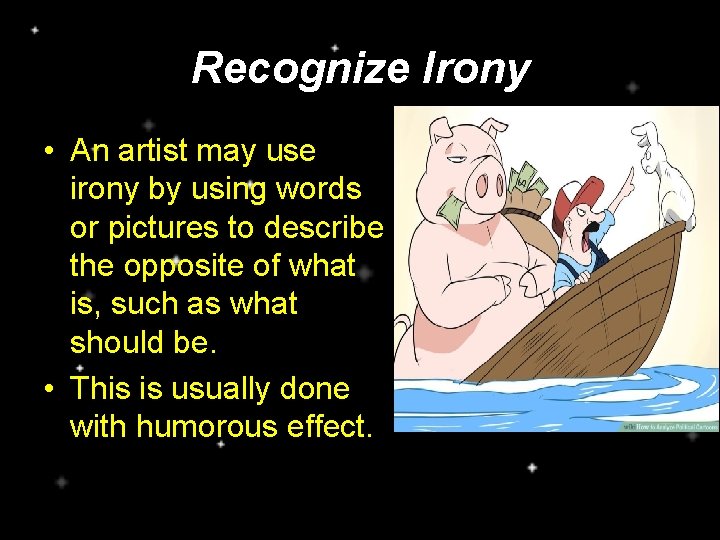
Recognize Irony • An artist may use irony by using words or pictures to describe the opposite of what is, such as what should be. • This is usually done with humorous effect.
Method Number 2 Looking at the Picture
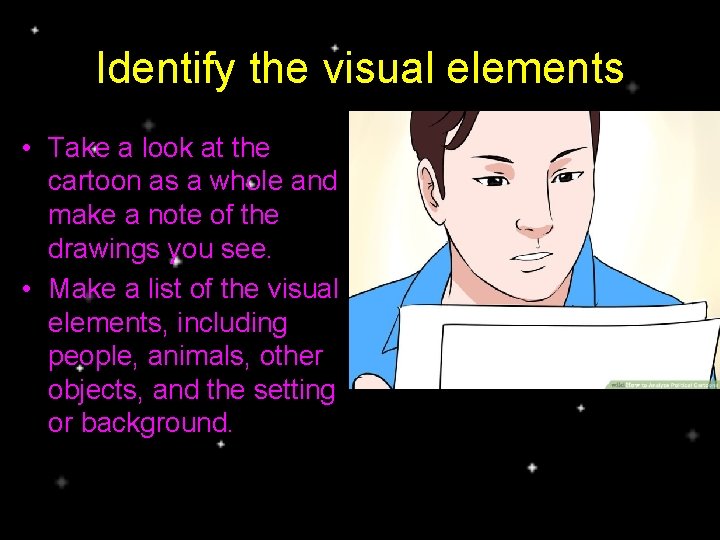
Identify the visual elements • Take a look at the cartoon as a whole and make a note of the drawings you see. • Make a list of the visual elements, including people, animals, other objects, and the setting or background.
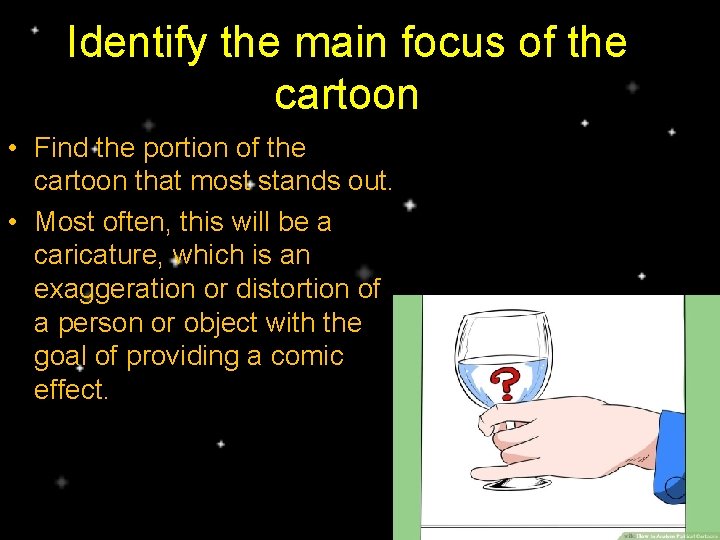
Identify the main focus of the cartoon • Find the portion of the cartoon that most stands out. • Most often, this will be a caricature, which is an exaggeration or distortion of a person or object with the goal of providing a comic effect.
Look for widely recognized symbols • • • Some metaphors are commonly used by political cartoonists. Examples. Uncle Sam or an eagle for the United States John Bull, Britannia or a lion for the United Kingdom A beaver for Canada A bear for Russia A dragon for China A sun for Japan A kangaroo for Australia A donkey for the Democratic Party in the U. S. An elephant for the Republican Party in the U. S.
Take note of distortion or exaggeration • Look at the visual elements and pay attention to how they are drawn. • People or animals may be exaggerated or distorted in some way.
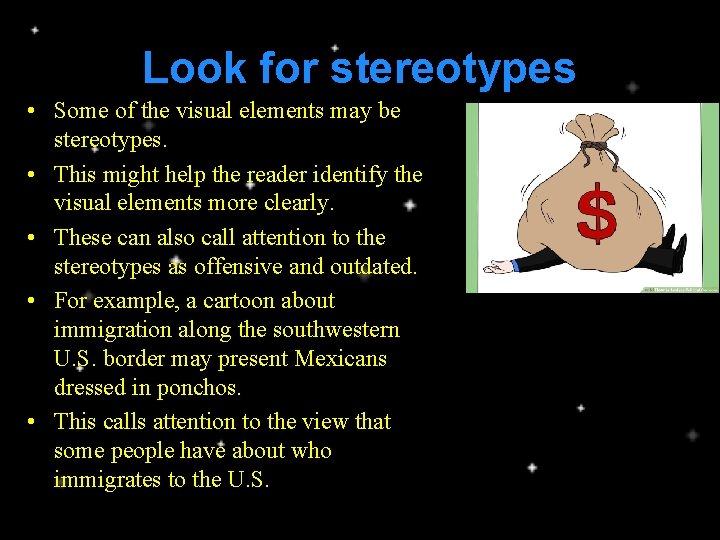
Look for stereotypes • Some of the visual elements may be stereotypes. • This might help the reader identify the visual elements more clearly. • These can also call attention to the stereotypes as offensive and outdated. • For example, a cartoon about immigration along the southwestern U. S. border may present Mexicans dressed in ponchos. • This calls attention to the view that some people have about who immigrates to the U. S.
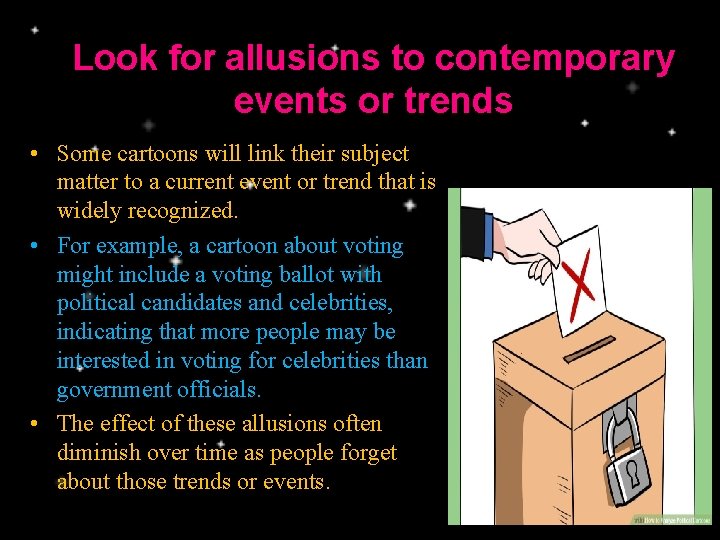
Look for allusions to contemporary events or trends • Some cartoons will link their subject matter to a current event or trend that is widely recognized. • For example, a cartoon about voting might include a voting ballot with political candidates and celebrities, indicating that more people may be interested in voting for celebrities than government officials. • The effect of these allusions often diminish over time as people forget about those trends or events.
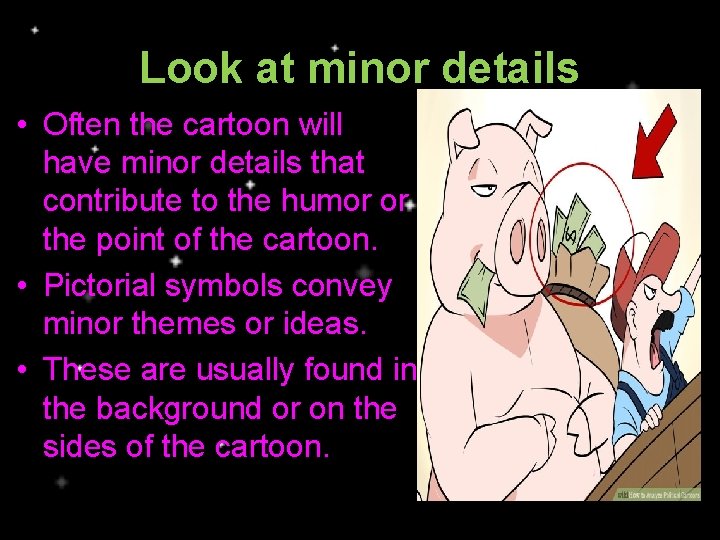
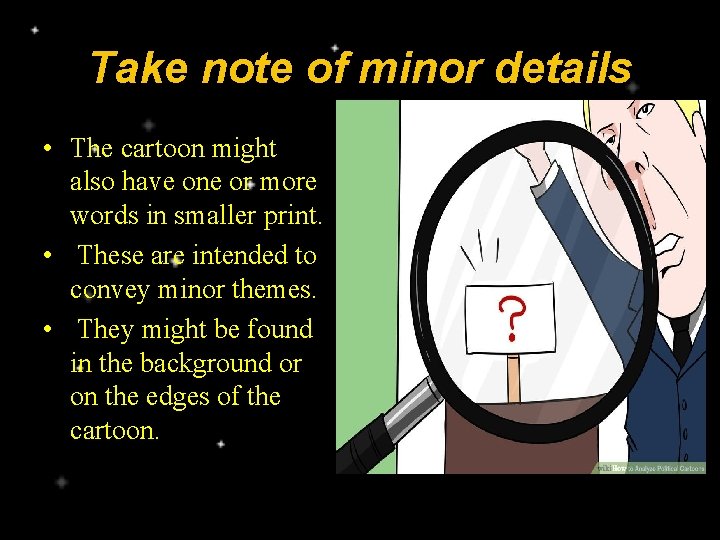
Look at minor details • Often the cartoon will have minor details that contribute to the humor or the point of the cartoon. • Pictorial symbols convey minor themes or ideas. • These are usually found in the background or on the sides of the cartoon.
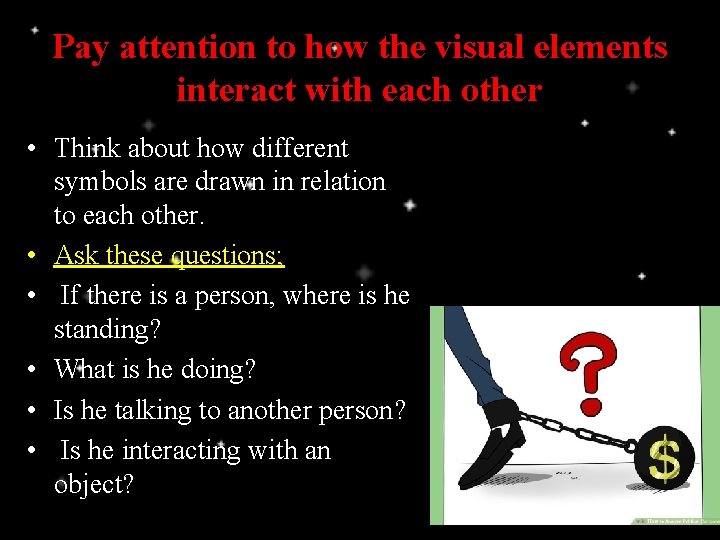
Pay attention to how the visual elements interact with each other • Think about how different symbols are drawn in relation to each other. • Ask these questions; • If there is a person, where is he standing? • What is he doing? • Is he talking to another person? • Is he interacting with an object?
Method 3 Looking at the Text
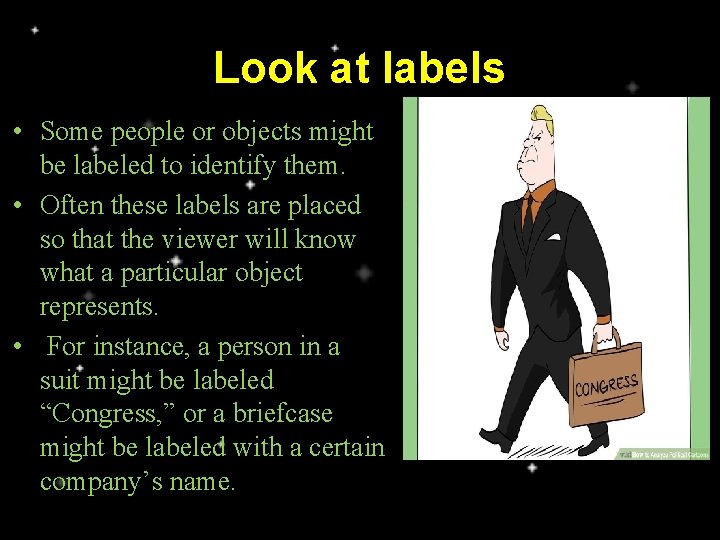
Look at labels • Some people or objects might be labeled to identify them. • Often these labels are placed so that the viewer will know what a particular object represents. • For instance, a person in a suit might be labeled “Congress, ” or a briefcase might be labeled with a certain company’s name.
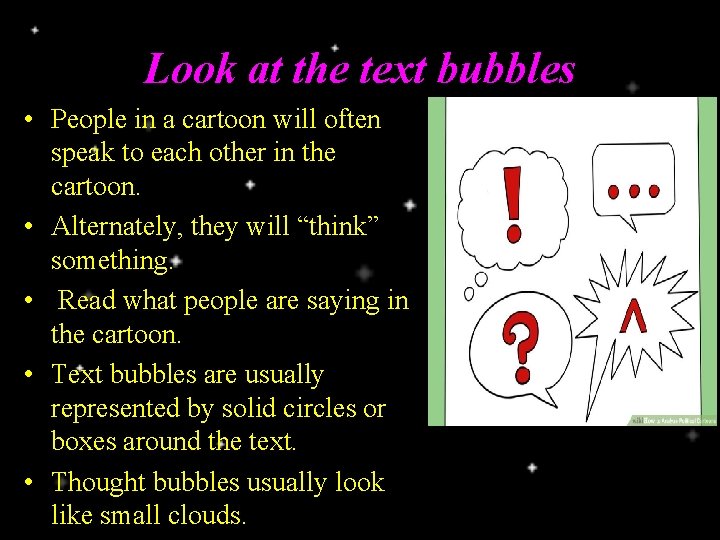
Look at the text bubbles • People in a cartoon will often speak to each other in the cartoon. • Alternately, they will “think” something. • Read what people are saying in the cartoon. • Text bubbles are usually represented by solid circles or boxes around the text. • Thought bubbles usually look like small clouds.
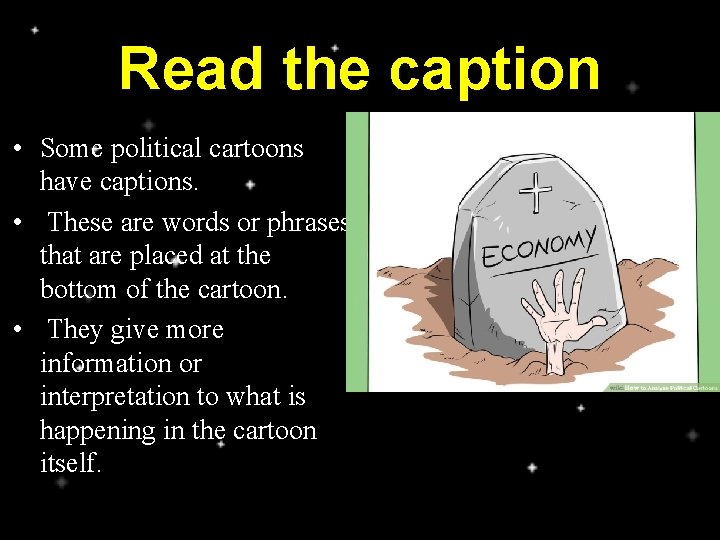
Read the caption • Some political cartoons have captions. • These are words or phrases that are placed at the bottom of the cartoon. • They give more information or interpretation to what is happening in the cartoon itself.
Take note of minor details • The cartoon might also have one or more words in smaller print. • These are intended to convey minor themes. • They might be found in the background or on the edges of the cartoon.
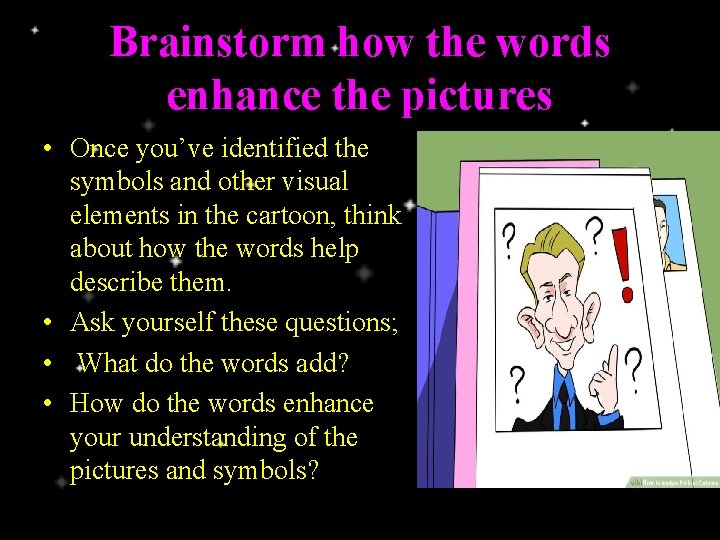
Brainstorm how the words enhance the pictures • Once you’ve identified the symbols and other visual elements in the cartoon, think about how the words help describe them. • Ask yourself these questions; • What do the words add? • How do the words enhance your understanding of the pictures and symbols?
Method 4 Identifying the Issue
Identify the issue that the cartoon is referencing • Political cartoons typically comment on a certain event or issue. • If you’re not sure about the issue, check recent news stories to identify the story.
Identify the people involved in the issue • To give you more reference points, find out the names and roles of the people involved with the issue or event.
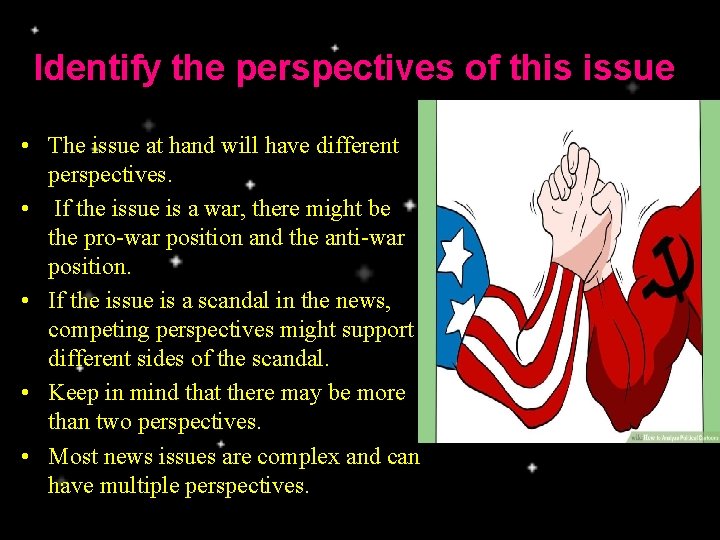
Identify the perspectives of this issue • The issue at hand will have different perspectives. • If the issue is a war, there might be the pro-war position and the anti-war position. • If the issue is a scandal in the news, competing perspectives might support different sides of the scandal. • Keep in mind that there may be more than two perspectives. • Most news issues are complex and can have multiple perspectives.
Do additional research on the issue • Find out the background of the issue, how it came about, who is impacted, and so on. • If the political cartoon is historical, find out what some of the main news stories and common beliefs were at the time. • This will help deepen your understanding of the cartoon.
Determine the audience • A political cartoon is created with consideration to the experiences and assumptions of the intended audience. • What section of the population is the publication geared towards? • What country and locality do they live in? • What are their political leanings? • For example, a political cartoon in a publication distributed in a strictly conservative tone will convey its message in a different way than it would if the audience was a particularly liberal group.
Method 5 Analyzing the Message
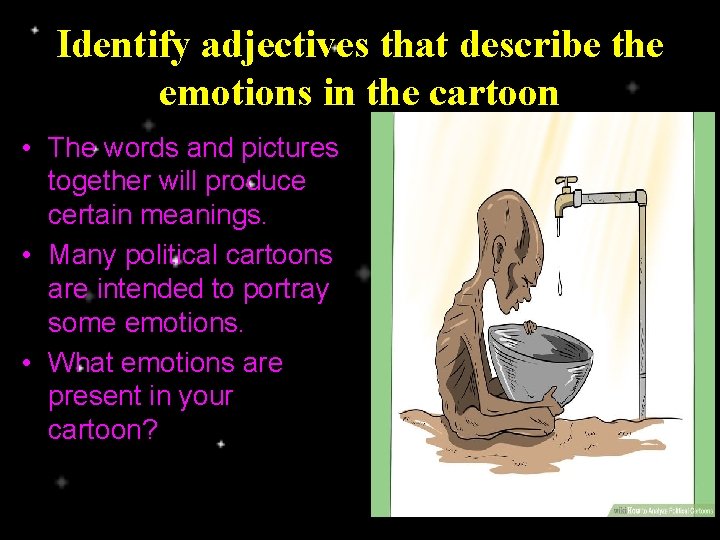
Identify adjectives that describe the emotions in the cartoon • The words and pictures together will produce certain meanings. • Many political cartoons are intended to portray some emotions. • What emotions are present in your cartoon?
Determine the artist’s perspective • The artist will have a particular viewpoint about the issue in the cartoon. • Once you’ve pinpointed the issue and the possible perspectives on this issue, you can figure out what the artist is arguing for. • Try to boil it down to one sentence. • What is the artist trying to say with this cartoon?
Think about how readers might respond to the cartoon • The audience for the cartoon may agree completely with the message of the cartoon. • Or, the audience might be shocked by the content. • What is controversial about the cartoon?
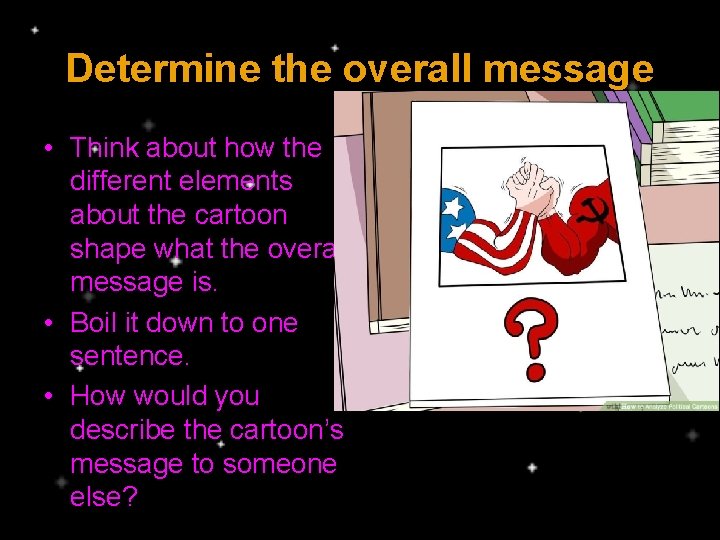
Determine the overall message • Think about how the different elements about the cartoon shape what the overall message is. • Boil it down to one sentence. • How would you describe the cartoon’s message to someone else?
Evaluate the effectiveness of the cartoon • Once you’ve put together all the elements, determine if you think the cartoon is effective. • Does it make a sound argument? • Does it use appropriate and meaningful symbols and words to convey a viewpoint? • Do the people and objects in the cartoon adequately represent the issue?