
HOW TO ANALYZE A POEM VISUAL ELEMENTS LYRICAL

- Slides: 18
HOW TO ANALYZE A POEM
VISUAL ELEMENTS LYRICAL DEVICES LITERAL MEANING HISTORICA L CONTEXT FIGURATIV E MEANING IMAGERY THEME ELEMENTS TO ANALYZE As you analyze, ask: 1. Why did the poet make use of this device? 2. How does it contribute to the poem’s meaning?
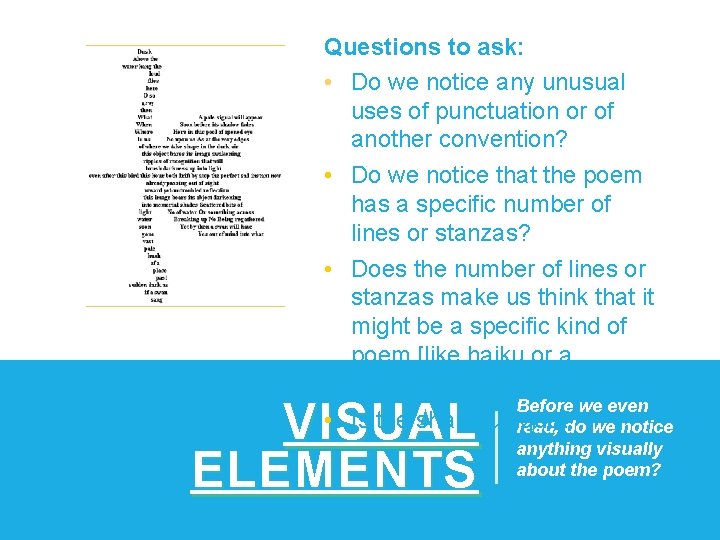
Questions to ask: • Do we notice any unusual uses of punctuation or of another convention? • Do we notice that the poem has a specific number of lines or stanzas? • Does the number of lines or stanzas make us think that it might be a specific kind of poem [like haiku or a sonnet? ] Before we even • Is the shape unique? read, do we notice VISUAL ELEMENTS anything visually about the poem?
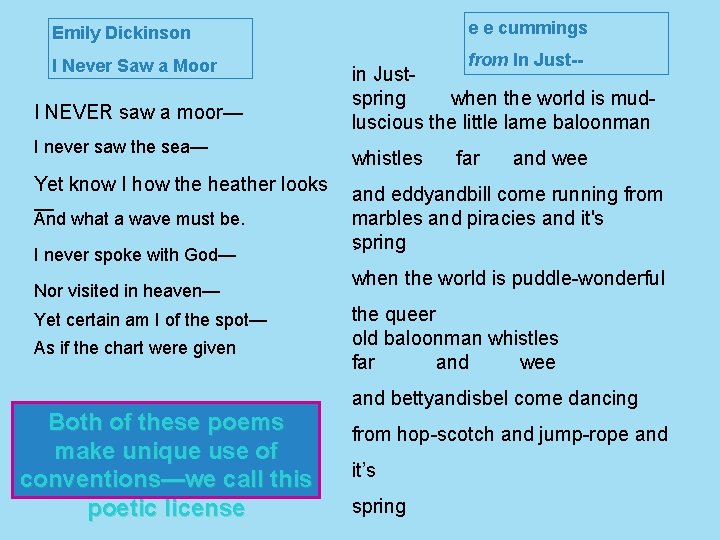
Emily Dickinson e e cummings I Never Saw a Moor from In Just-- I NEVER saw a moor— I never saw the sea— Yet know I how the heather looks — And what a wave must be. I never spoke with God— Nor visited in heaven— Yet certain am I of the spot— As if the chart were given Both of these poems make unique use of conventions—we call this poetic license in Justspring when the world is mudluscious the little lame baloonman whistles far and wee and eddyandbill come running from marbles and piracies and it's spring 5 when the world is puddle-wonderful the queer old baloonman whistles far and wee and bettyandisbel come dancing from hop-scotch and jump-rope and it’s spring
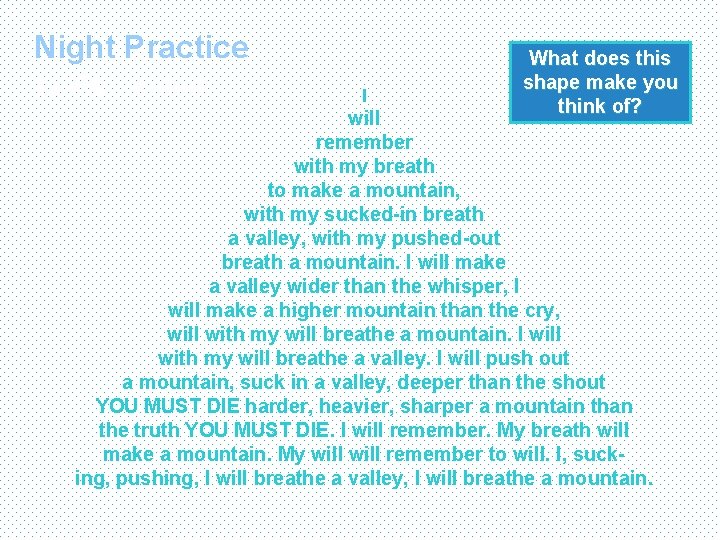
Night Practice By May Swenson I What does this shape make you think of? will remember with my breath to make a mountain, with my sucked-in breath a valley, with my pushed-out breath a mountain. I will make a valley wider than the whisper, I will make a higher mountain than the cry, will with my will breathe a mountain. I will with my will breathe a valley. I will push out a mountain, suck in a valley, deeper than the shout YOU MUST DIE harder, heavier, sharper a mountain than the truth YOU MUST DIE. I will remember. My breath will make a mountain. My will remember to will. I, sucking, pushing, I will breathe a valley, I will breathe a mountain.
Lyrical devices are elements that a writer uses to give his/her poem a pleasing sound Think about the songs you like or childhood stories, many of them had fun rhymes or repetitive sounds Poetry is meant to be read out loud; therefore, it should sound pleasing to the ear LYRICAL DEVICES
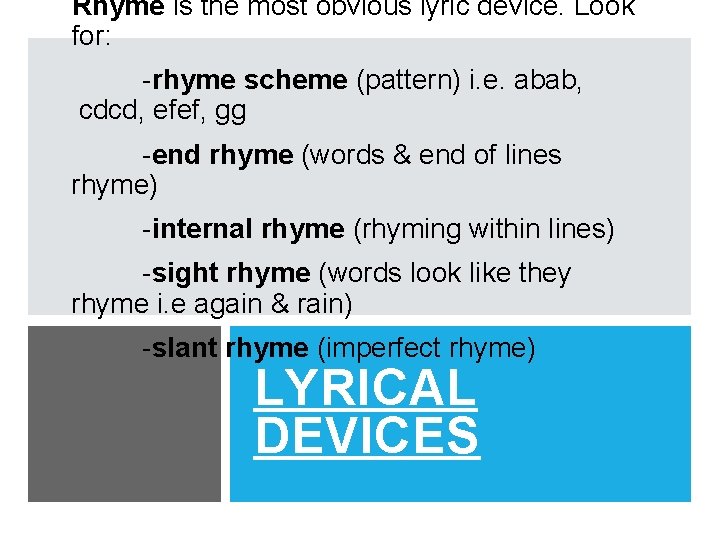
Rhyme is the most obvious lyric device. Look for: -rhyme scheme (pattern) i. e. abab, cdcd, efef, gg -end rhyme (words & end of lines rhyme) -internal rhyme (rhyming within lines) -sight rhyme (words look like they rhyme i. e again & rain) -slant rhyme (imperfect rhyme) LYRICAL DEVICES
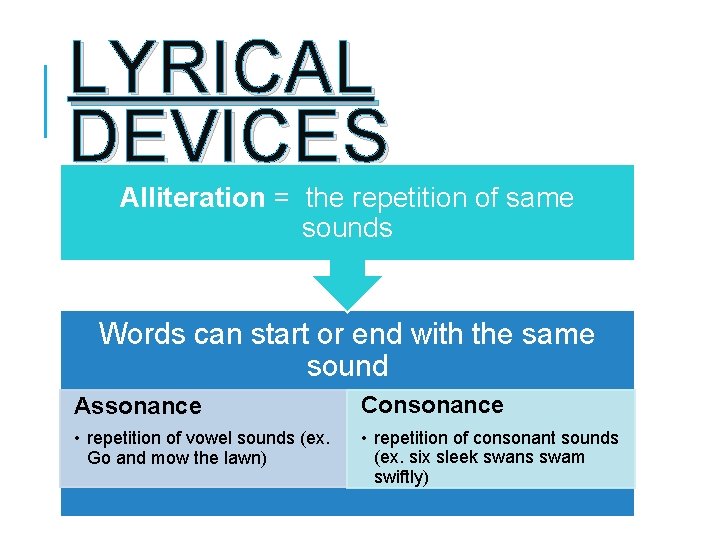
LYRICAL DEVICES Alliteration = the repetition of same sounds Words can start or end with the same sound Assonance Consonance • repetition of vowel sounds (ex. Go and mow the lawn) • repetition of consonant sounds (ex. six sleek swans swam swiftly)
LITERAL MEANING: • The literal meaning is the first layer—What is happening in the poem? What is the poem about? • To understand the literal meaning a reader needs to paraphrase [summarize in his/her own words] • Long poems must be paraphrased line by line or stanza by stanza in order to be understood POEMS HAVE LAYERS Poems have many layers of
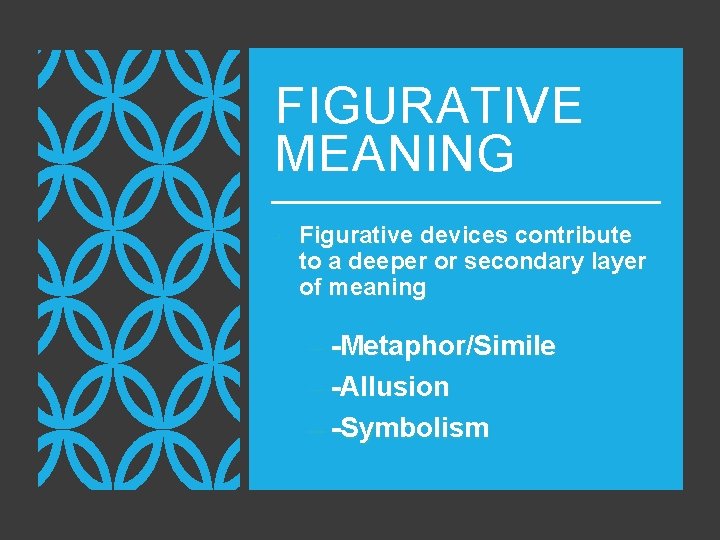
FIGURATIVE MEANING • Figurative devices contribute to a deeper or secondary layer of meaning – -Metaphor/Simile – -Allusion – -Symbolism
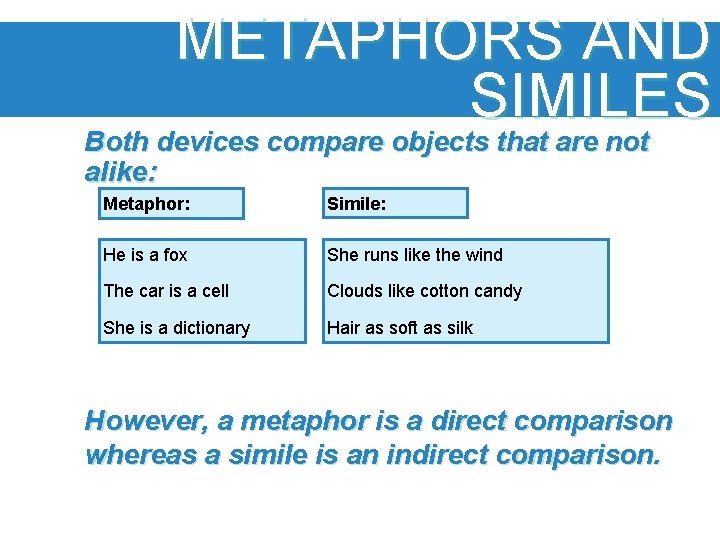
METAPHORS AND SIMILES Both devices compare objects that are not alike: Metaphor: Simile: He is a fox She runs like the wind The car is a cell Clouds like cotton candy She is a dictionary Hair as soft as silk However, a metaphor is a direct comparison whereas a simile is an indirect comparison.
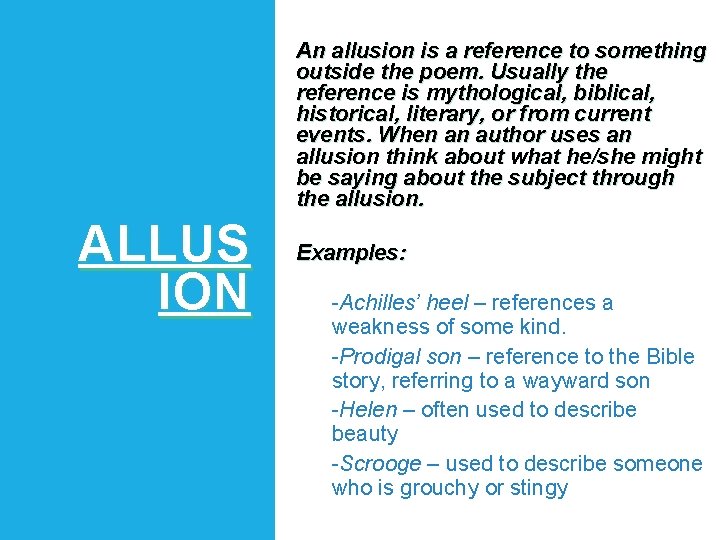
An allusion is a reference to something outside the poem. Usually the reference is mythological, biblical, historical, literary, or from current events. When an author uses an allusion think about what he/she might be saying about the subject through the allusion. ALLUS ION Examples: -Achilles’ heel – references a weakness of some kind. -Prodigal son – reference to the Bible story, referring to a wayward son -Helen – often used to describe beauty -Scrooge – used to describe someone who is grouchy or stingy
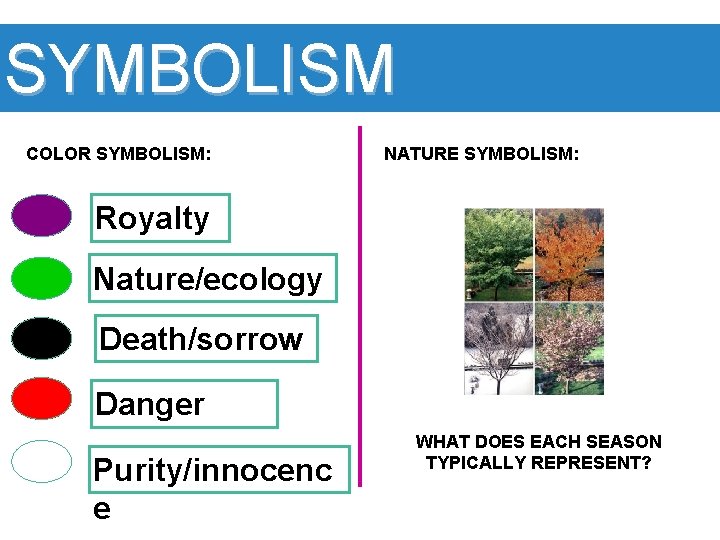
SYMBOLISM COLOR SYMBOLISM: NATURE SYMBOLISM: Royalty Nature/ecology Death/sorrow Danger Purity/innocenc e WHAT DOES EACH SEASON TYPICALLY REPRESENT?
Poets use imagery to help us create pictures in our mind and to appeal to our senses. Remember to ask: • Why did the poet make use of this device? • How does it contribute to the poems meaning? IMAGERY
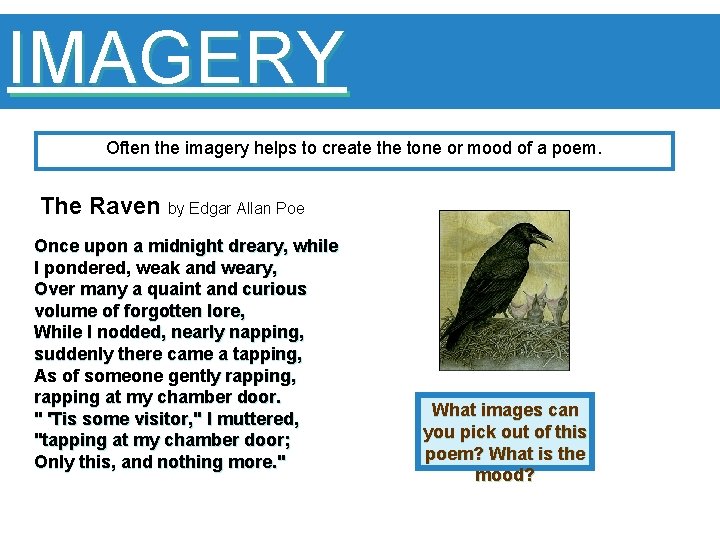
IMAGERY Often the imagery helps to create the tone or mood of a poem. The Raven by Edgar Allan Poe Once upon a midnight dreary, while I pondered, weak and weary, Over many a quaint and curious volume of forgotten lore, While I nodded, nearly napping, suddenly there came a tapping, As of someone gently rapping, rapping at my chamber door. " 'Tis some visitor, " I muttered, "tapping at my chamber door; Only this, and nothing more. " What images can you pick out of this poem? What is the mood?
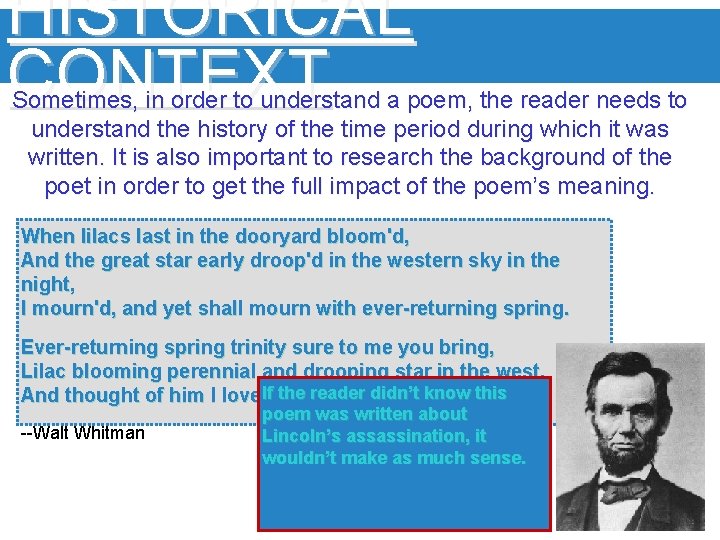
HISTORICAL CONTEXT Sometimes, in order to understand a poem, the reader needs to understand the history of the time period during which it was written. It is also important to research the background of the poet in order to get the full impact of the poem’s meaning. When lilacs last in the dooryard bloom'd, And the great star early droop'd in the western sky in the night, I mourn'd, and yet shall mourn with ever-returning spring. Ever-returning spring trinity sure to me you bring, Lilac blooming perennial and drooping star in the west, And thought of him I love. If the reader didn’t know this --Walt Whitman poem was written about Lincoln’s assassination, it wouldn’t make as much sense.
SO, WHAT’S THE POINT? • We analyze a poem to find the meaning. • We look at all the parts to determine the whole. • We pick it apart to see what the poet has hidden for us.
Here’s a trick: Theme = The me(ssage) -What lesson, truth or message is the poet trying to impart to us? Usually it can be stated in one sentence. Remember, the THEME is not the subject. -If you can point back to the poem and show where you got theme, you cannot be wrong. However, some interpretations can be more right based on correct interpretation of symbolism, allusion or other parts of the poem. WE ARE TRYING TO FIGURE OUT THEME