
How to Acquire 2 Billion Records of Data

How to Acquire 2 Billion Records of Data and Make It Accessible for Data Scientists By Anthony Fitzroy
Who am I? • • Office for National Statistics – Data Engineering • Liaise with data suppliers to discuss technical specification of data for delivery, to ensure system compatibility and plan processing requirements. • Develop web harvesting solutions for numerous customers, examples include price monitoring tool for the Prices division and hotel address scraping for the Address Index team. • MData. Gov student at Oxford Brookes University. Provide data standardisation and warehousing services to the office. Process and deliver administrative, survey, census and web harvested data for use across the business.
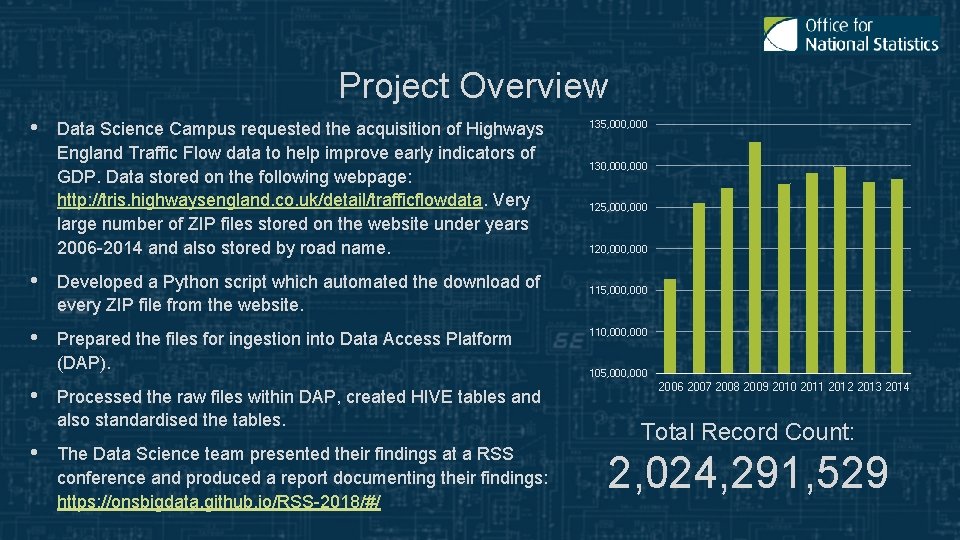
Project Overview • Data Science Campus requested the acquisition of Highways England Traffic Flow data to help improve early indicators of GDP. Data stored on the following webpage: http: //tris. highwaysengland. co. uk/detail/trafficflowdata. Very large number of ZIP files stored on the website under years 2006 -2014 and also stored by road name. • Developed a Python script which automated the download of every ZIP file from the website. • Prepared the files for ingestion into Data Access Platform (DAP). • • Processed the raw files within DAP, created HIVE tables and also standardised the tables. The Data Science team presented their findings at a RSS conference and produced a report documenting their findings: https: //onsbigdata. github. io/RSS-2018/#/ 135, 000 130, 000 125, 000 120, 000 115, 000 110, 000 105, 000 2006 2007 2008 2009 2010 2011 2012 2013 2014 Total Record Count: 2, 024, 291, 529

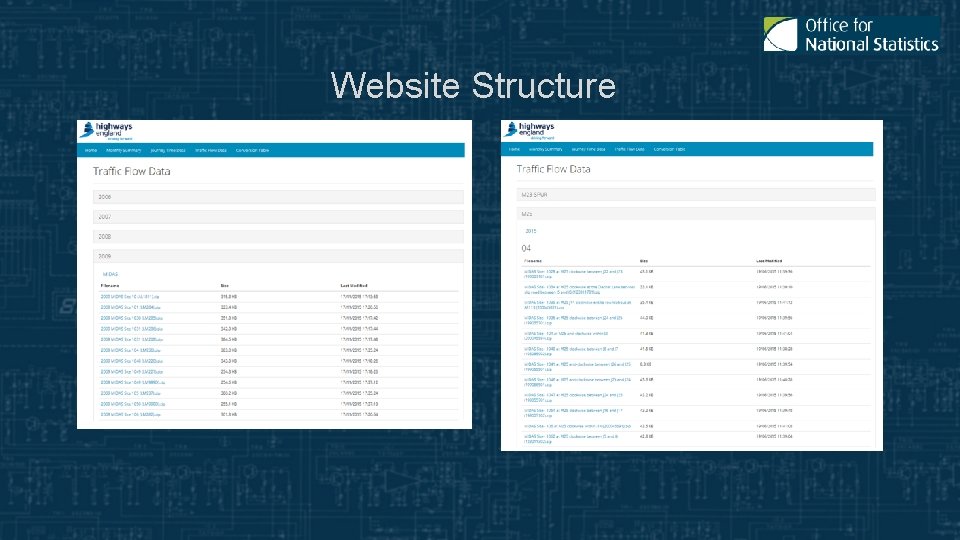
Website Structure
![Website Structure XPath = ‘//*[@id="M 25+2015"]/table[1]/tbody/tr[1]/td[1]/a’](http://slidetodoc.com/presentation_image_h2/738ca52c672522b3bcea4941b6c1f9f0/image-6.jpg "Website Structure XPath = ‘//*[@id=\"M 25+2015\"]/table[1]/tbody/tr[1]/td[1]/a’")
Website Structure XPath = ‘//*[@id="M 25+2015"]/table[1]/tbody/tr[1]/td[1]/a’
![Website Structure XPath = ‘//*[@id="M 25+2015"]/table[2]/tbody/tr[3]/td[1]/a’](http://slidetodoc.com/presentation_image_h2/738ca52c672522b3bcea4941b6c1f9f0/image-7.jpg "Website Structure XPath = ‘//*[@id=\"M 25+2015\"]/table[2]/tbody/tr[3]/td[1]/a’")
Website Structure XPath = ‘//*[@id="M 25+2015"]/table[2]/tbody/tr[3]/td[1]/a’
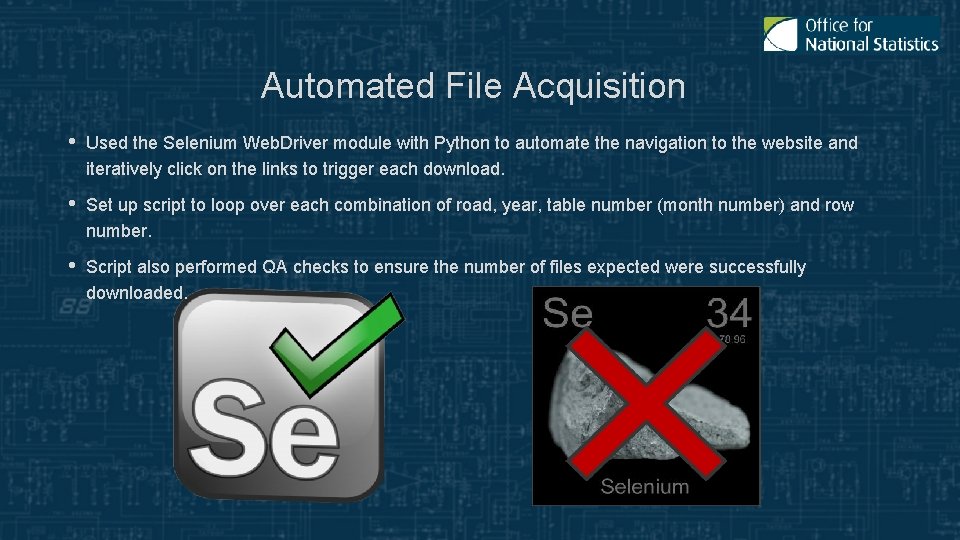
Automated File Acquisition • Used the Selenium Web. Driver module with Python to automate the navigation to the website and iteratively click on the links to trigger each download. • Set up script to loop over each combination of road, year, table number (month number) and row number. • Script also performed QA checks to ensure the number of files expected were successfully downloaded.
Preparation for Ingestion into DAP • With the files being ingested onto a distributed computing platform (Hadoop cluster), needed to collapse thousands of files into larger chunks of data prior to ingestion. • A Python script was used to iteratively decompress each separate CSV file. Files were then recompressed into five archive files, each containing up to 200 k files.
Data Processing in DAP • To continue to avoid working with numerous small files in the Hadoop cluster, the data was processed following ingestion using a ‘utility’ node, running the Red Hat Enterprise distribution of Linux. • Using Bash command line and Python, archive files were extracted, header records were converted into derived variables, and files were finally appended together based on traffic monitoring system. • Appended files were transferred back onto the Hadoop cluster for final processing steps.
Data Processing in DAP • With the preprocessed data stored back on the Hadoop cluster, the big data tools such as Spark and Hive were used for the final stages of processing. • Raw CSV files were read using the Py. Spark module to apply a schema of data-types and standardising column names. • Data was finally written out as Hive tables into a target database accessible by the researchers in the DSC.
How was the data used? • The Data Science Campus lead research on the use of traffic flow data as a faster economic indicator. Particular interest in looking to use the data to estimate freight activity around ports, to provide better understanding around trade. • A lot of ambition for future work, and there will be further publications of the work starting from next month. • Check out the publication: https: //datasciencecampus. ons. gov. uk/projects/faster-indicators-of-ukeconomic-activity-road-traffic-data-for-england/

- Slides: 13