
How to account for aspectual derivation in Russian
- Slides: 28
“How to account for aspectual derivation in Russian” Laura A. Janda UNC-Chapel Hill janda@unc. edu, www. unc. edu/~lajanda Laura A. Janda SLS 2006
In a nutshell… • Q: So, how DO we account for aspectual derivation in Russian? • A: Look at the verbs of motion! – Verbs of motion are prototypical for the Russian aspectual system – Understanding of events is metaphorically motivated by verbs of motion Laura A. Janda SLS 2006 2
Overview: • Metaphors based on properties of motion are crucial to understanding Russian aspectual derivation. • These metaphors motivate the derivation of four different types of perfective verbs. • There is a single implicational hierarchy that predicts all and only the aspectual clusters that exist in Russian. – This result is based on an empirical study of a multiply stratified sample of 283 verb clusters (including over 2000 verbs). Laura A. Janda SLS 2006 3
The two metaphors: • Travel vs. Motion, metaphorically interpreted as Completability vs. Non. Completability • Granular vs. Fluid, metaphorically interpreted as Singularizable vs. Non. Singularizable Laura A. Janda SLS 2006 4
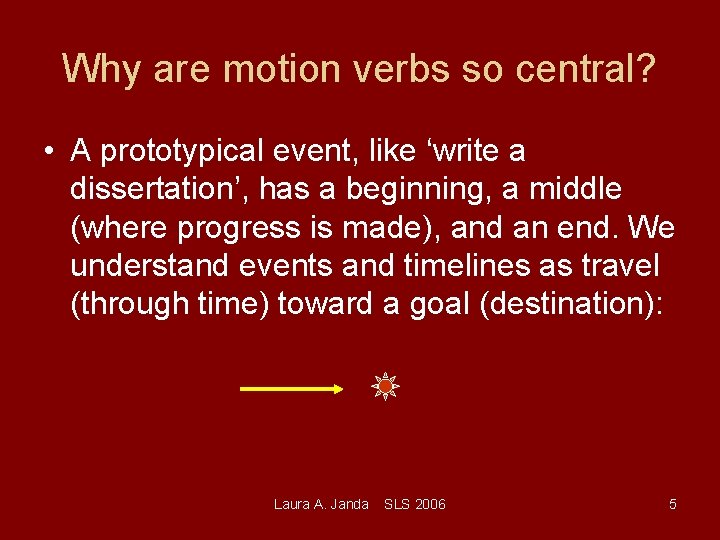
Why are motion verbs so central? • A prototypical event, like ‘write a dissertation’, has a beginning, a middle (where progress is made), and an end. We understand events and timelines as travel (through time) toward a goal (destination): Laura A. Janda SLS 2006 5
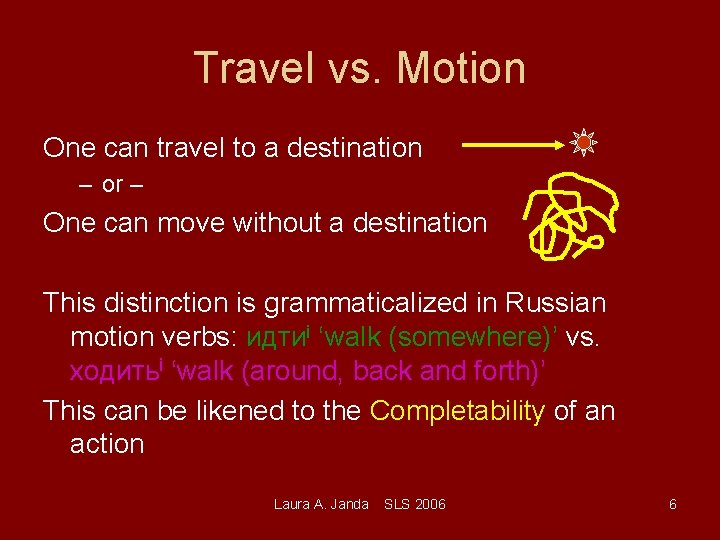
Travel vs. Motion One can travel to a destination – or – One can move without a destination This distinction is grammaticalized in Russian motion verbs: идтиi ‘walk (somewhere)’ vs. ходитьi ‘walk (around, back and forth)’ This can be likened to the Completability of an action Laura A. Janda SLS 2006 6
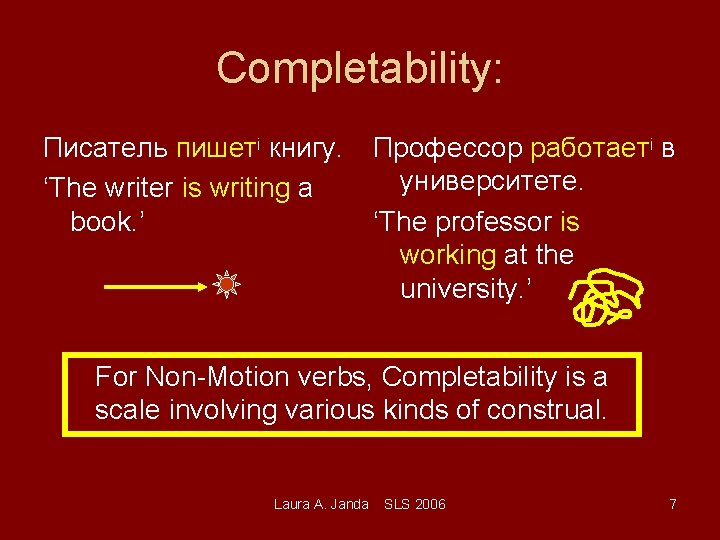
Completability: Писатель пишетi книгу. ‘The writer is writing a book. ’ Профессор работаетi в университете. ‘The professor is working at the university. ’ For Non-Motion verbs, Completability is a scale involving various kinds of construal. Laura A. Janda SLS 2006 7
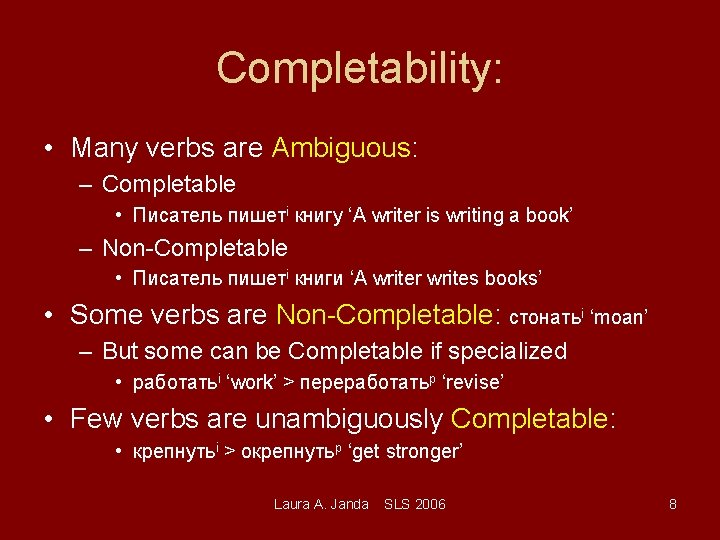
Completability: • Many verbs are Ambiguous: – Completable • Писатель пишетi книгу ‘A writer is writing a book’ – Non-Completable • Писатель пишетi книги ‘A writer writes books’ • Some verbs are Non-Completable: стонатьi ‘moan’ – But some can be Completable if specialized • работатьi ‘work’ > переработатьp ‘revise’ • Few verbs are unambiguously Completable: • крепнутьi > окрепнутьp ‘get stronger’ Laura A. Janda SLS 2006 8
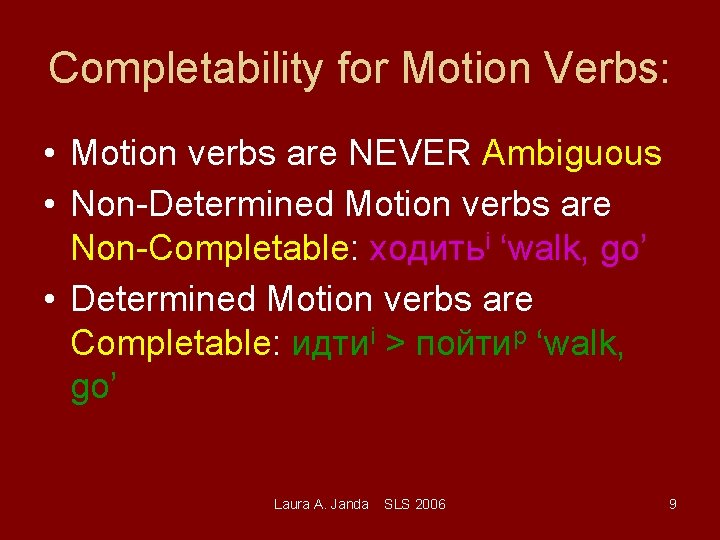
Completability for Motion Verbs: • Motion verbs are NEVER Ambiguous • Non-Determined Motion verbs are Non-Completable: ходитьi ‘walk, go’ • Determined Motion verbs are Completable: идтиi > пойтиp ‘walk, go’ Laura A. Janda SLS 2006 9
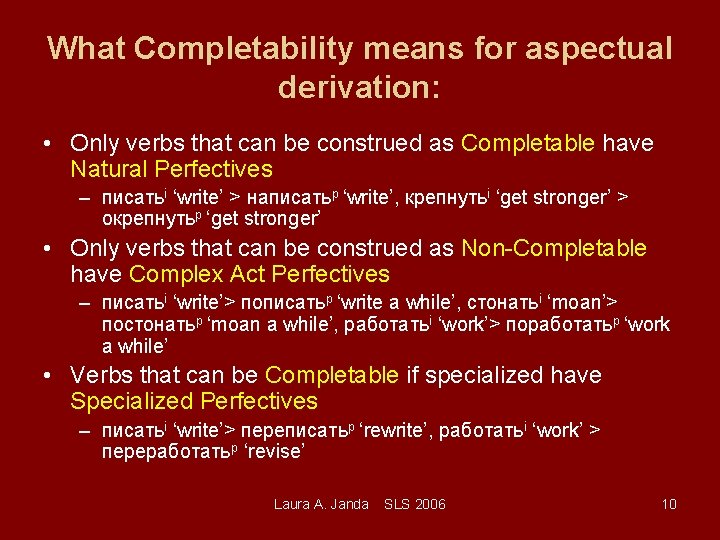
What Completability means for aspectual derivation: • Only verbs that can be construed as Completable have Natural Perfectives – писатьi ‘write’ > написатьp ‘write’, крепнутьi ‘get stronger’ > окрепнутьp ‘get stronger’ • Only verbs that can be construed as Non-Completable have Complex Act Perfectives – писатьi ‘write’> пописатьp ‘write a while’, стонатьi ‘moan’> постонатьp ‘moan a while’, работатьi ‘work’> поработатьp ‘work a while’ • Verbs that can be Completable if specialized have Specialized Perfectives – писатьi ‘write’> переписатьp ‘rewrite’, работатьi ‘work’ > переработатьp ‘revise’ Laura A. Janda SLS 2006 10
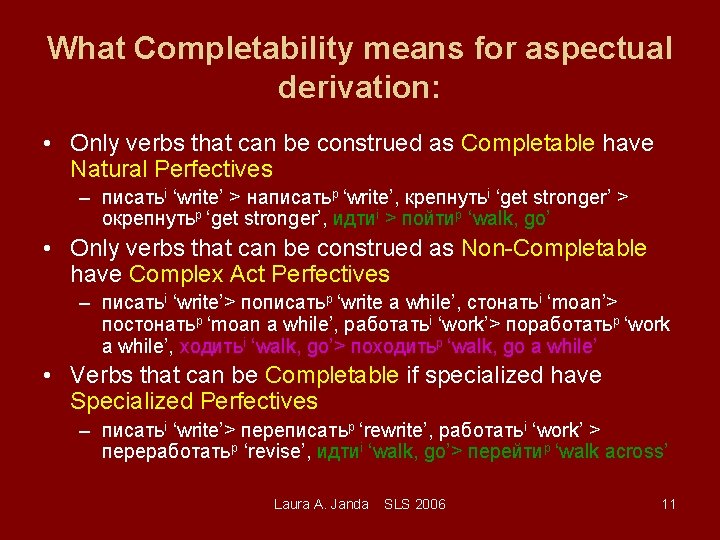
What Completability means for aspectual derivation: • Only verbs that can be construed as Completable have Natural Perfectives – писатьi ‘write’ > написатьp ‘write’, крепнутьi ‘get stronger’ > окрепнутьp ‘get stronger’, идтиi > пойтиp ‘walk, go’ • Only verbs that can be construed as Non-Completable have Complex Act Perfectives – писатьi ‘write’> пописатьp ‘write a while’, стонатьi ‘moan’> постонатьp ‘moan a while’, работатьi ‘work’> поработатьp ‘work a while’, ходитьi ‘walk, go’> походитьp ‘walk, go a while’ • Verbs that can be Completable if specialized have Specialized Perfectives – писатьi ‘write’> переписатьp ‘rewrite’, работатьi ‘work’ > переработатьp ‘revise’, идтиi ‘walk, go’> перейтиp ‘walk across’ Laura A. Janda SLS 2006 11
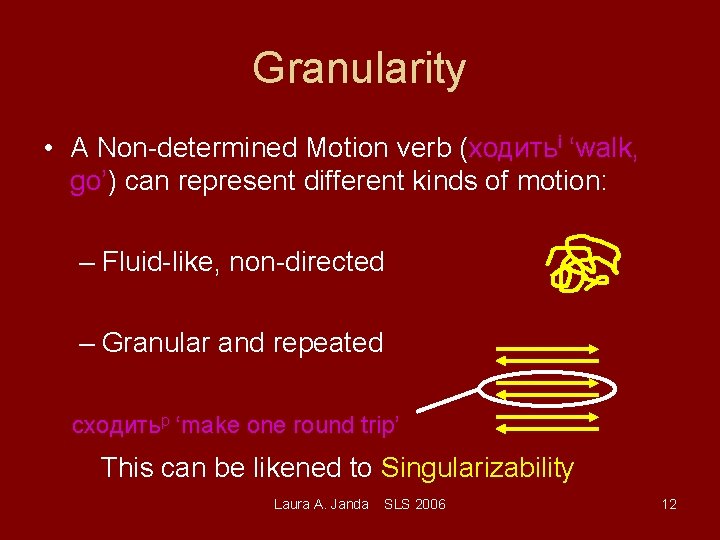
Granularity • A Non-determined Motion verb (ходитьi ‘walk, go’) can represent different kinds of motion: – Fluid-like, non-directed – Granular and repeated сходитьp ‘make one round trip’ This can be likened to Singularizability Laura A. Janda SLS 2006 12
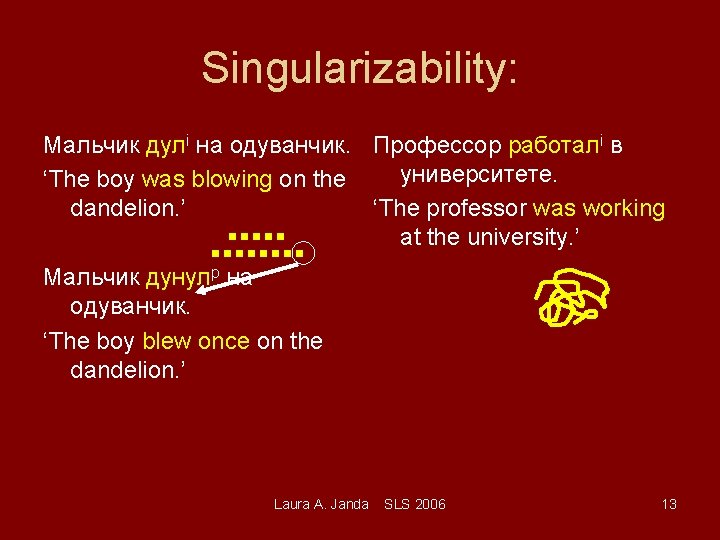
Singularizability: Мальчик дулi на одуванчик. Профессор работалi в университете. ‘The boy was blowing on the ‘The professor was working dandelion. ’ at the university. ’ Мальчик дунулp на одуванчик. ‘The boy blew once on the dandelion. ’ Laura A. Janda SLS 2006 13
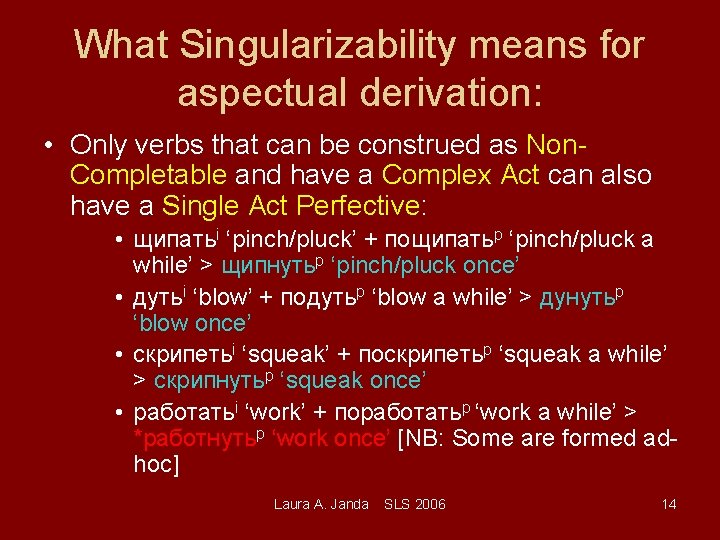
What Singularizability means for aspectual derivation: • Only verbs that can be construed as Non. Completable and have a Complex Act can also have a Single Act Perfective: • щипатьi ‘pinch/pluck’ + пощипатьp ‘pinch/pluck a while’ > щипнутьp ‘pinch/pluck once’ • дутьi ‘blow’ + подутьp ‘blow a while’ > дунутьp ‘blow once’ • скрипетьi ‘squeak’ + поскрипетьp ‘squeak a while’ > скрипнутьp ‘squeak once’ • работатьi ‘work’ + поработатьp ‘work a while’ > *работнутьp ‘work once’ [NB: Some are formed adhoc] Laura A. Janda SLS 2006 14
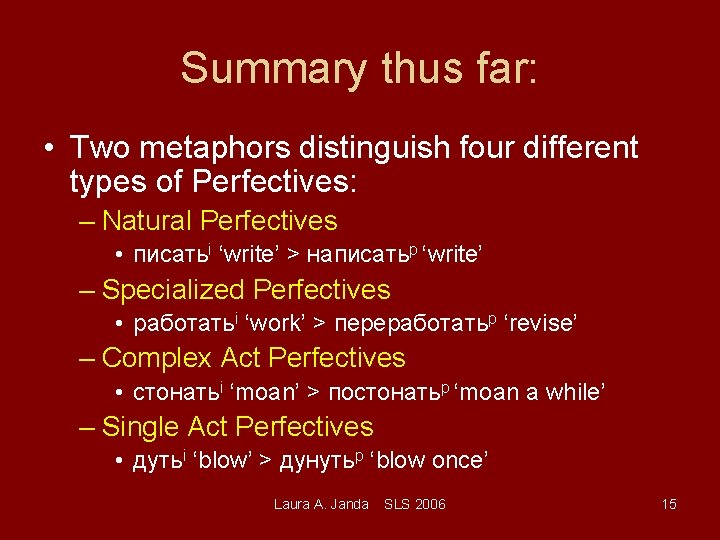
Summary thus far: • Two metaphors distinguish four different types of Perfectives: – Natural Perfectives • писатьi ‘write’ > написатьp ‘write’ – Specialized Perfectives • работатьi ‘work’ > переработатьp ‘revise’ – Complex Act Perfectives • стонатьi ‘moan’ > постонатьp ‘moan a while’ – Single Act Perfectives • дутьi ‘blow’ > дунутьp ‘blow once’ Laura A. Janda SLS 2006 15
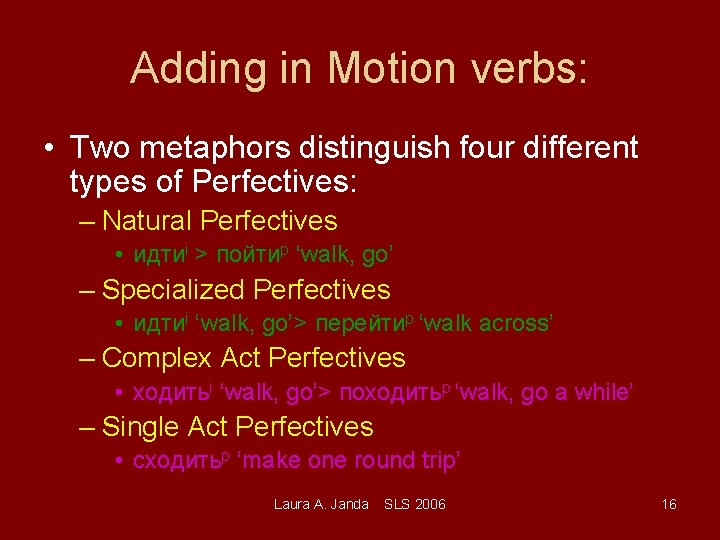
Adding in Motion verbs: • Two metaphors distinguish four different types of Perfectives: – Natural Perfectives • идтиi > пойтиp ‘walk, go’ – Specialized Perfectives • идтиi ‘walk, go’> перейтиp ‘walk across’ – Complex Act Perfectives • ходитьi ‘walk, go’> походитьp ‘walk, go a while’ – Single Act Perfectives • сходитьp ‘make one round trip’ Laura A. Janda SLS 2006 16
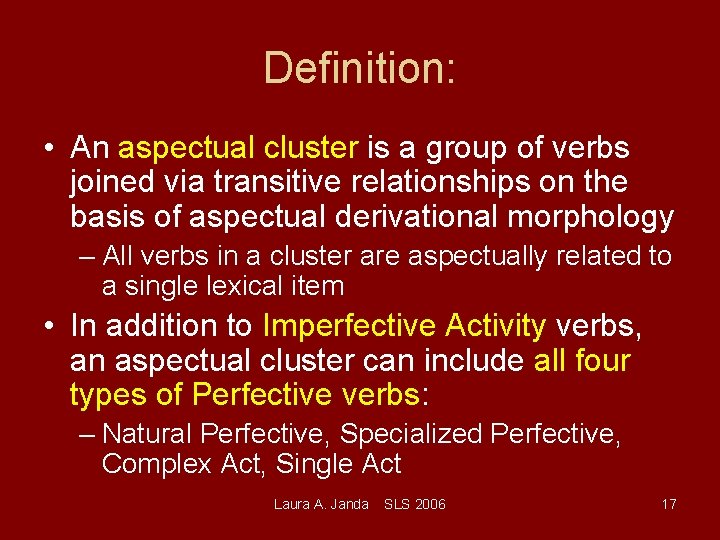
Definition: • An aspectual cluster is a group of verbs joined via transitive relationships on the basis of aspectual derivational morphology – All verbs in a cluster are aspectually related to a single lexical item • In addition to Imperfective Activity verbs, an aspectual cluster can include all four types of Perfective verbs: – Natural Perfective, Specialized Perfective, Complex Act, Single Act Laura A. Janda SLS 2006 17
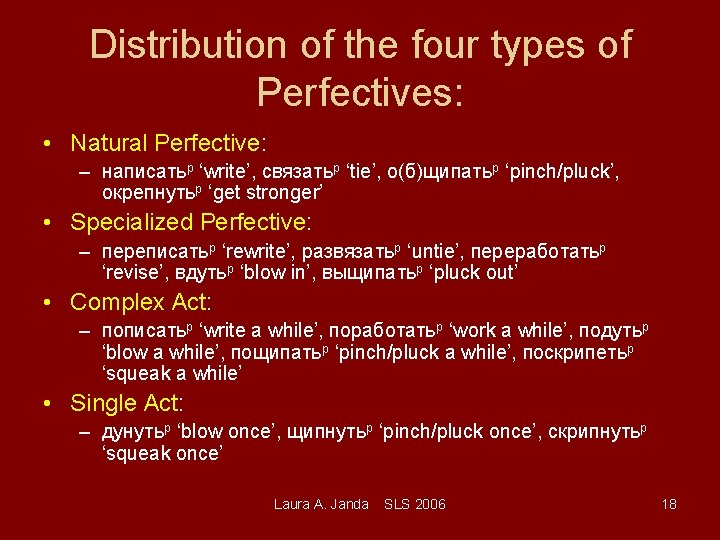
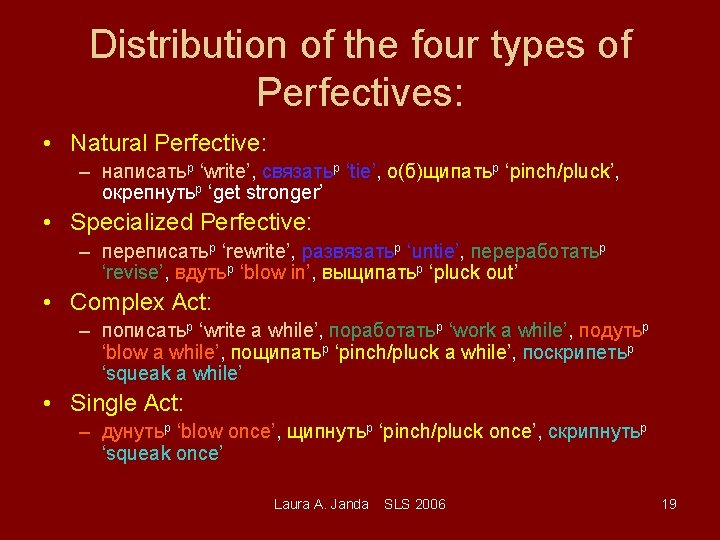
Distribution of the four types of Perfectives: • Natural Perfective: – написатьp ‘write’, связатьp ‘tie’, о(б)щипатьp ‘pinch/pluck’, окрепнутьp ‘get stronger’ • Specialized Perfective: – переписатьp ‘rewrite’, развязатьp ‘untie’, переработатьp ‘revise’, вдутьp ‘blow in’, выщипатьp ‘pluck out’ • Complex Act: – пописатьp ‘write a while’, поработатьp ‘work a while’, подутьp ‘blow a while’, пощипатьp ‘pinch/pluck a while’, поскрипетьp ‘squeak a while’ • Single Act: – дунутьp ‘blow once’, щипнутьp ‘pinch/pluck once’, скрипнутьp ‘squeak once’ Laura A. Janda SLS 2006 18
Distribution of the four types of Perfectives: • Natural Perfective: – написатьp ‘write’, связатьp ‘tie’, о(б)щипатьp ‘pinch/pluck’, окрепнутьp ‘get stronger’ • Specialized Perfective: – переписатьp ‘rewrite’, развязатьp ‘untie’, переработатьp ‘revise’, вдутьp ‘blow in’, выщипатьp ‘pluck out’ • Complex Act: – пописатьp ‘write a while’, поработатьp ‘work a while’, подутьp ‘blow a while’, пощипатьp ‘pinch/pluck a while’, поскрипетьp ‘squeak a while’ • Single Act: – дунутьp ‘blow once’, щипнутьp ‘pinch/pluck once’, скрипнутьp ‘squeak once’ Laura A. Janda SLS 2006 19
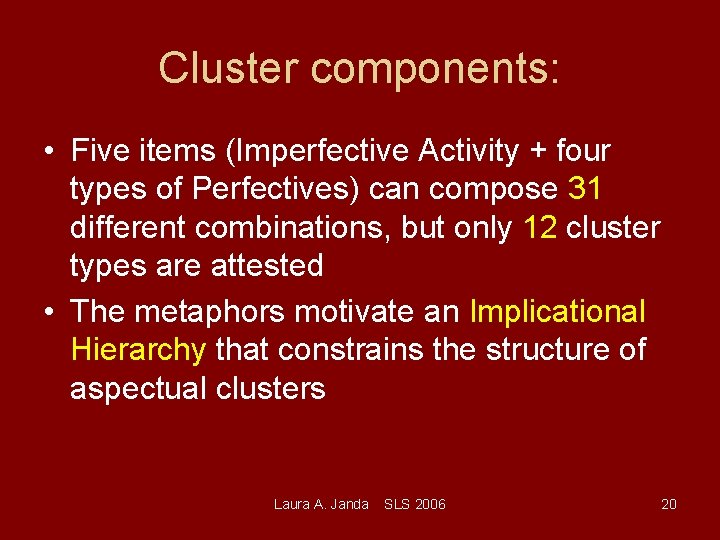
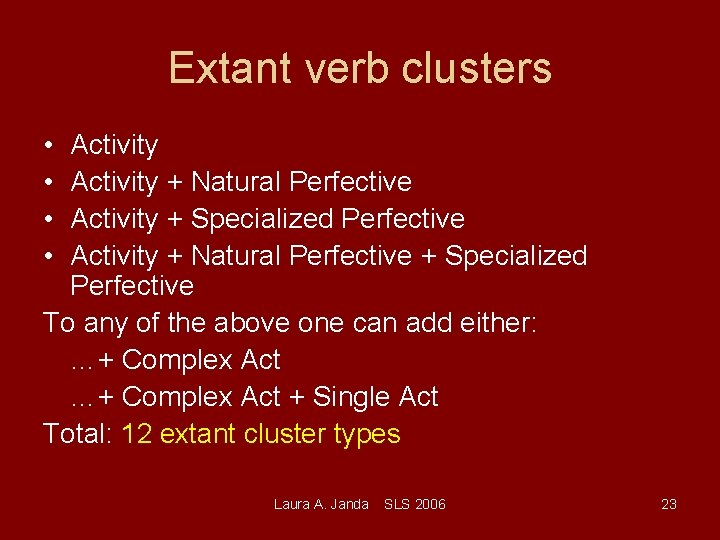
Cluster components: • Five items (Imperfective Activity + four types of Perfectives) can compose 31 different combinations, but only 12 cluster types are attested • The metaphors motivate an Implicational Hierarchy that constrains the structure of aspectual clusters Laura A. Janda SLS 2006 20
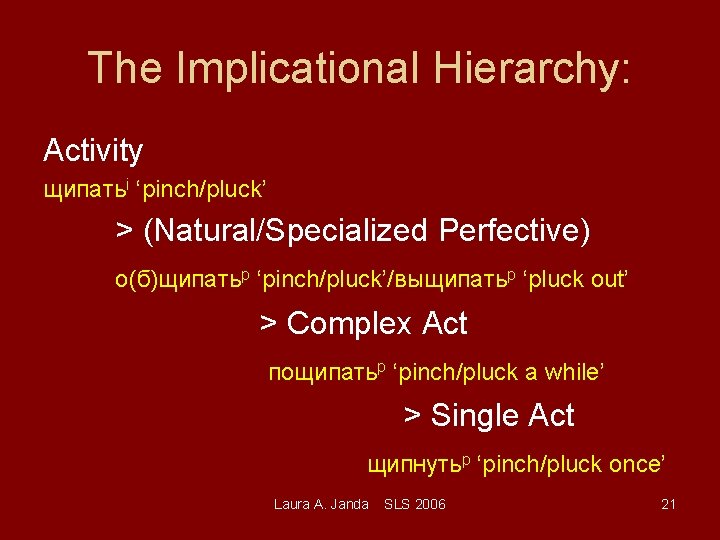
The Implicational Hierarchy: Activity щипатьi ‘pinch/pluck’ > (Natural/Specialized Perfective) о(б)щипатьp ‘pinch/pluck’/выщипатьp ‘pluck out’ > Complex Act пощипатьp ‘pinch/pluck a while’ > Single Act щипнутьp ‘pinch/pluck once’ Laura A. Janda SLS 2006 21
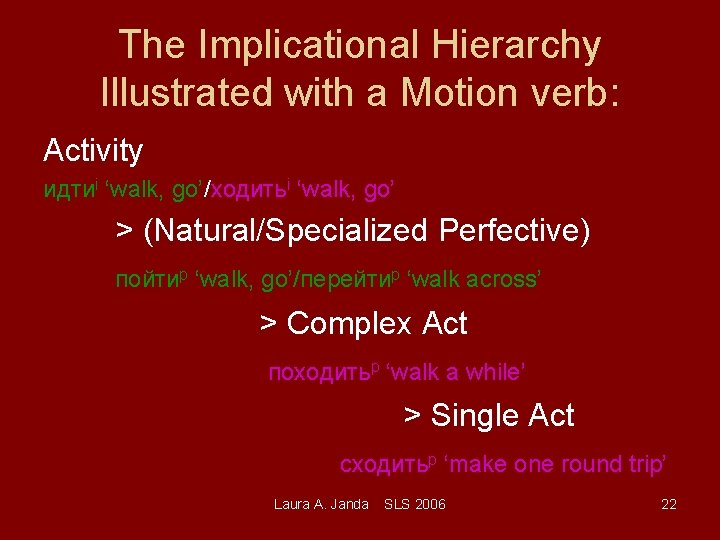
The Implicational Hierarchy Illustrated with a Motion verb: Activity идтиi ‘walk, go’/ходитьi ‘walk, go’ > (Natural/Specialized Perfective) пойтиp ‘walk, go’/перейтиp ‘walk across’ > Complex Act походитьp ‘walk a while’ > Single Act сходитьp ‘make one round trip’ Laura A. Janda SLS 2006 22
Extant verb clusters • • Activity + Natural Perfective Activity + Specialized Perfective Activity + Natural Perfective + Specialized Perfective To any of the above one can add either: …+ Complex Act + Single Act Total: 12 extant cluster types Laura A. Janda SLS 2006 23
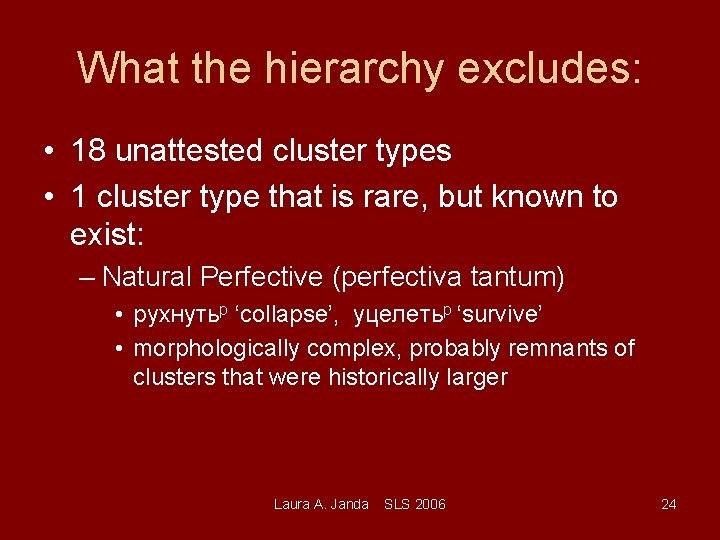
What the hierarchy excludes: • 18 unattested cluster types • 1 cluster type that is rare, but known to exist: – Natural Perfective (perfectiva tantum) • рухнутьp ‘collapse’, уцелетьp ‘survive’ • morphologically complex, probably remnants of clusters that were historically larger Laura A. Janda SLS 2006 24
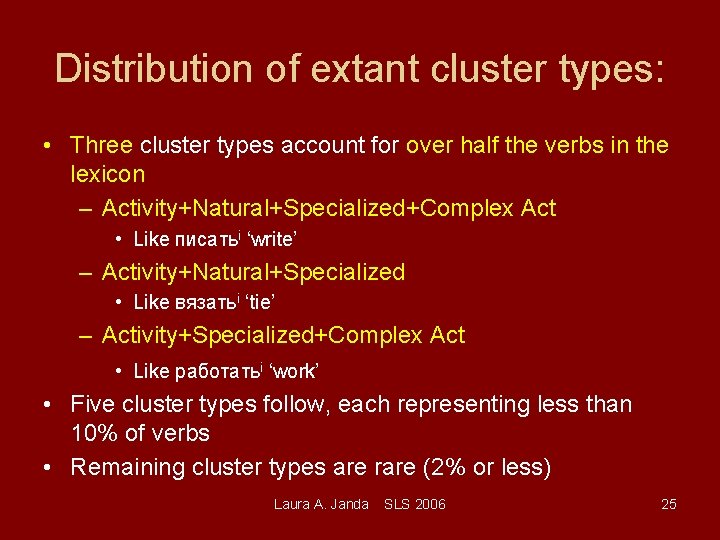
Distribution of extant cluster types: • Three cluster types account for over half the verbs in the lexicon – Activity+Natural+Specialized+Complex Act • Like писатьi ‘write’ – Activity+Natural+Specialized • Like вязатьi ‘tie’ – Activity+Specialized+Complex Act • Like работатьi ‘work’ • Five cluster types follow, each representing less than 10% of verbs • Remaining cluster types are rare (2% or less) Laura A. Janda SLS 2006 25
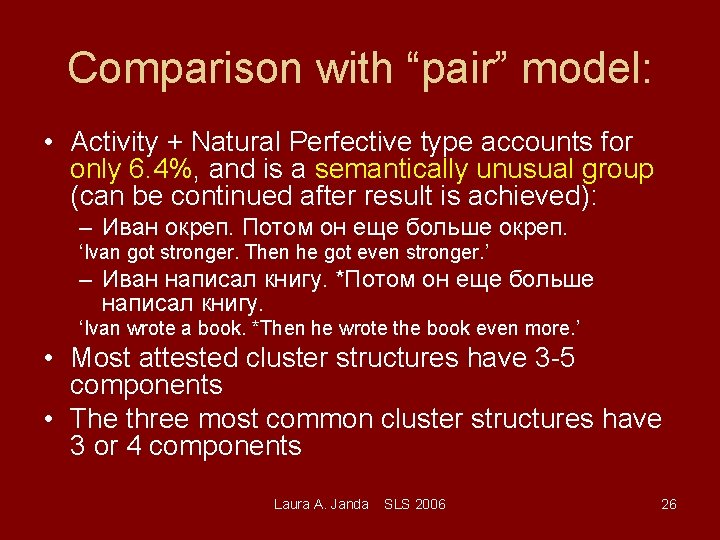
Comparison with “pair” model: • Activity + Natural Perfective type accounts for only 6. 4%, and is a semantically unusual group (can be continued after result is achieved): – Иван окреп. Потом он еще больше окреп. ‘Ivan got stronger. Then he got even stronger. ’ – Иван написал книгу. *Потом он еще больше написал книгу. ‘Ivan wrote a book. *Then he wrote the book even more. ’ • Most attested cluster structures have 3 -5 components • The three most common cluster structures have 3 or 4 components Laura A. Janda SLS 2006 26
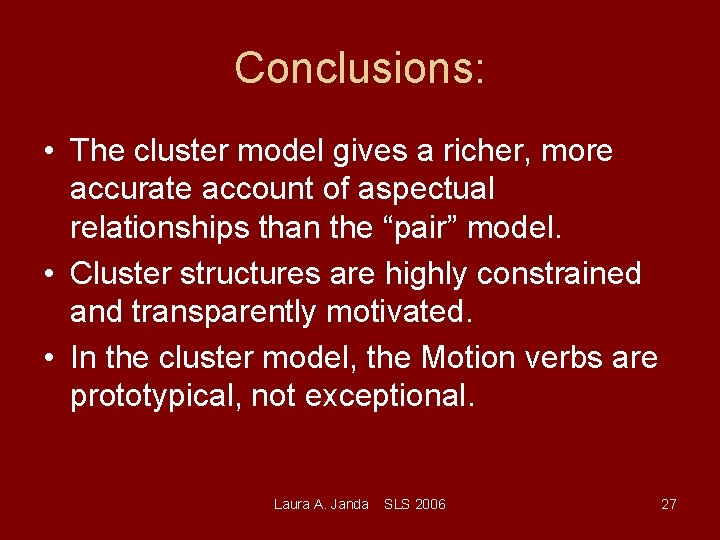
Conclusions: • The cluster model gives a richer, more accurate account of aspectual relationships than the “pair” model. • Cluster structures are highly constrained and transparently motivated. • In the cluster model, the Motion verbs are prototypical, not exceptional. Laura A. Janda SLS 2006 27
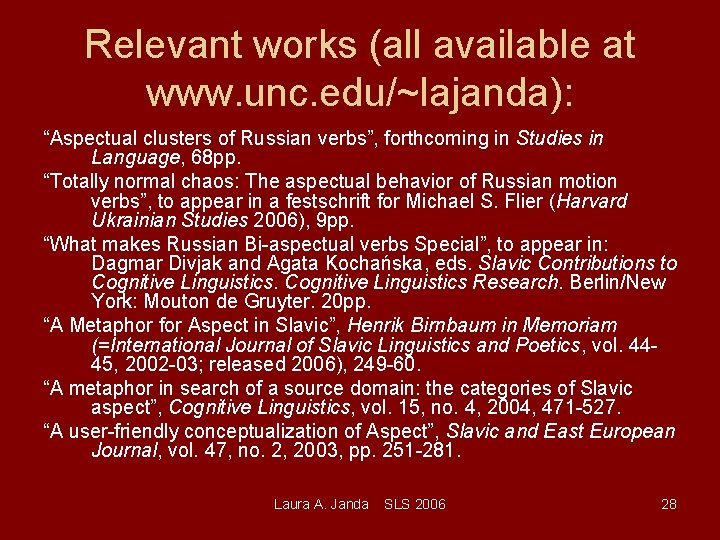
Relevant works (all available at www. unc. edu/~lajanda): “Aspectual clusters of Russian verbs”, forthcoming in Studies in Language, 68 pp. “Totally normal chaos: The aspectual behavior of Russian motion verbs”, to appear in a festschrift for Michael S. Flier (Harvard Ukrainian Studies 2006), 9 pp. “What makes Russian Bi-aspectual verbs Special”, to appear in: Dagmar Divjak and Agata Kochańska, eds. Slavic Contributions to Cognitive Linguistics Research. Berlin/New York: Mouton de Gruyter. 20 pp. “A Metaphor for Aspect in Slavic”, Henrik Birnbaum in Memoriam (=International Journal of Slavic Linguistics and Poetics, vol. 4445, 2002 -03; released 2006), 249 -60. “A metaphor in search of a source domain: the categories of Slavic aspect”, Cognitive Linguistics, vol. 15, no. 4, 2004, 471 -527. “A user-friendly conceptualization of Aspect”, Slavic and East European Journal, vol. 47, no. 2, 2003, pp. 251 -281. Laura A. Janda SLS 2006 28