
How the Way the Construct of Disability is
How the Way the Construct of Disability is Measured Affects the Estimates Obtained in Selected National Surveys Frances M. Chevarley David W. Keer 2016 QDET 2 Session CS 35 November 12, 11: 00 AM to 12: 25 PM The views expressed in this presentation are those of the authors and no official endorsement by the Department of Health and Human Services or the Agency for Healthcare Research and Quality is intended or should be inferred.
How to measure disability? • Two approaches Disability Measure, AHRQ’s National Quality/Disparity Reports — 2007+ NQDR reports ► Disability Questions, Census Bureau’s 2008 American Community Survey— 2008+ ACS ► • Separate but overlapping workgroups for each • Different goals Increase disability data in NQDR using similar groups ► Better disability measure for ACS ►
AHRQ’s National Quality/Disparity Reports Disability Measure • Background of the National Healthcare Quality and Disparities Reports (NQDR) ► Priority populations including persons with Special Health Care Needs • NQDR disability working group (NQDR DWG) • Measurement of disability • Implemented with the 2007 NQDR reports
Interagency Disability Working Group of the NQDR IWG • AHRQ convenes group with help from: ► • Representatives from over 16 agencies ► • Interagency Subcommittee of Disability Statistics Including HHS, VA, Census, Social Security Administration, NCD, and Department of Education Goal to recommend similar measurements of individuals with disabilities for NQDR Applicable across multiple data sources o MEPS, NHIS, MCBS ► Can be described to lay persons in a half page ► Allows comparisons by race, ethnicity, and income ► Broad and inclusive-sensitive to sample size limitations ►
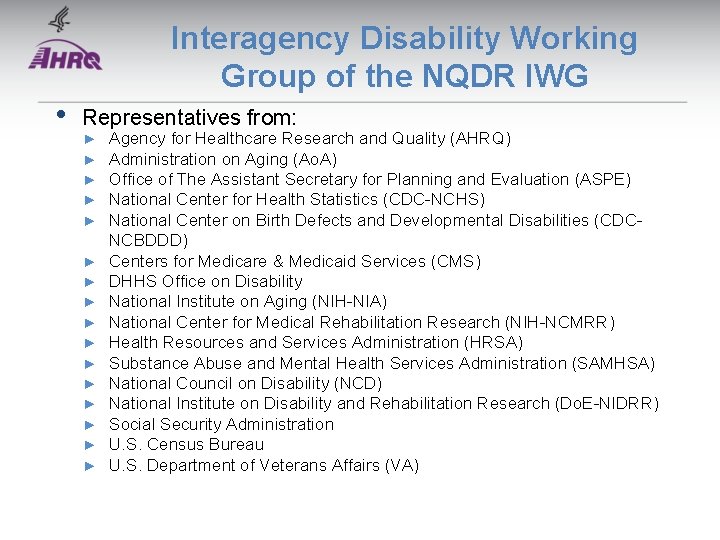
Interagency Disability Working Group of the NQDR IWG • Representatives from: ► ► ► ► Agency for Healthcare Research and Quality (AHRQ) Administration on Aging (Ao. A) Office of The Assistant Secretary for Planning and Evaluation (ASPE) National Center for Health Statistics (CDC-NCHS) National Center on Birth Defects and Developmental Disabilities (CDCNCBDDD) Centers for Medicare & Medicaid Services (CMS) DHHS Office on Disability National Institute on Aging (NIH-NIA) National Center for Medical Rehabilitation Research (NIH-NCMRR) Health Resources and Services Administration (HRSA) Substance Abuse and Mental Health Services Administration (SAMHSA) National Council on Disability (NCD) National Institute on Disability and Rehabilitation Research (Do. E-NIDRR) Social Security Administration U. S. Census Bureau U. S. Department of Veterans Affairs (VA)
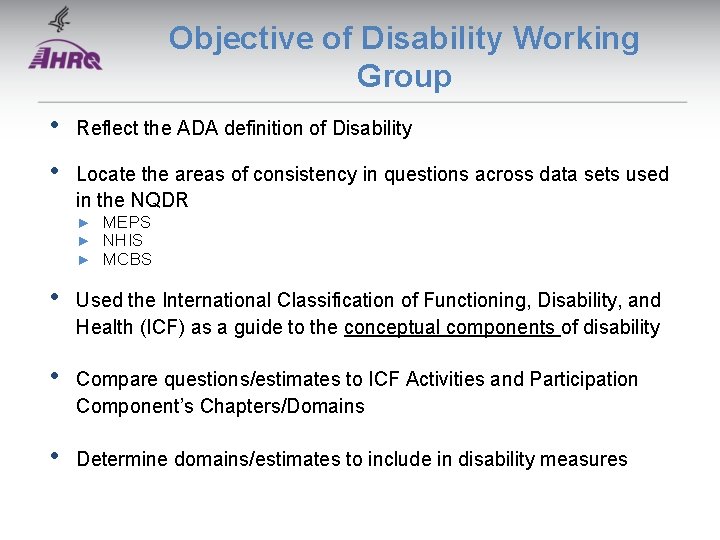
Objective of Disability Working Group • Reflect the ADA definition of Disability • Locate the areas of consistency in questions across data sets used in the NQDR ► ► ► MEPS NHIS MCBS • Used the International Classification of Functioning, Disability, and Health (ICF) as a guide to the conceptual components of disability • Compare questions/estimates to ICF Activities and Participation Component’s Chapters/Domains • Determine domains/estimates to include in disability measures
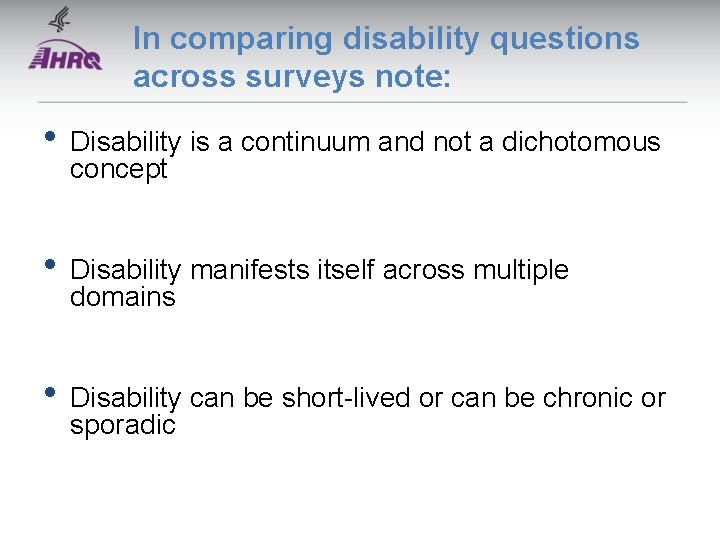
In comparing disability questions across surveys note: • Disability is a continuum and not a dichotomous concept • Disability manifests itself across multiple domains • Disability can be short-lived or can be chronic or sporadic

In comparing disability questions across surveys note (Cont. ): • Surveys have different purposes ► capture different # of disability questions ► capture different domains and at different points on the severity continuum • Survey tools to measure disability are not as precise as measurement tools for physical sciences
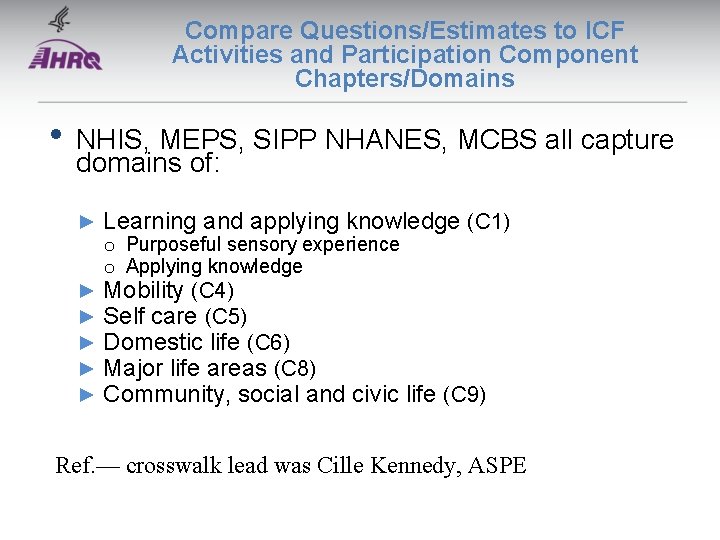
Compare Questions/Estimates to ICF Activities and Participation Component Chapters/Domains • NHIS, MEPS, SIPP NHANES, MCBS all capture domains of: ► Learning and applying knowledge (C 1) ► ► ► Mobility (C 4) Self care (C 5) Domestic life (C 6) Major life areas (C 8) Community, social and civic life (C 9) o Purposeful sensory experience o Applying knowledge Ref. — crosswalk lead was Cille Kennedy, ASPE
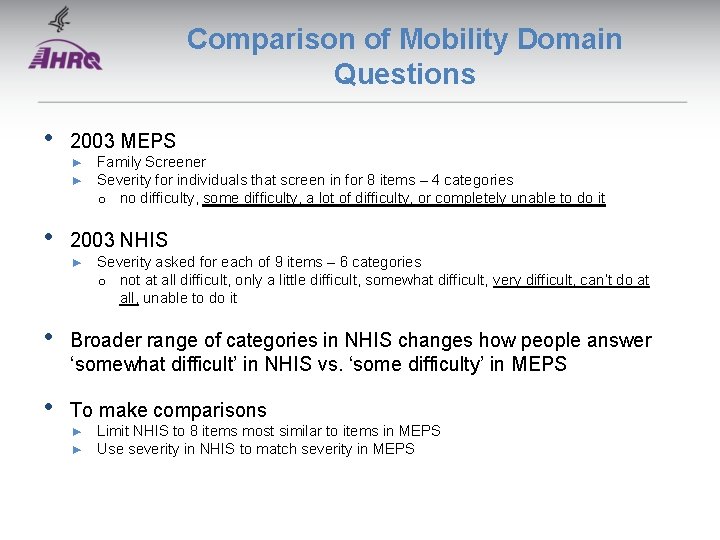
Comparison of Mobility Domain Questions • 2003 MEPS ► ► • Family Screener Severity for individuals that screen in for 8 items – 4 categories o no difficulty, some difficulty, a lot of difficulty, or completely unable to do it 2003 NHIS ► Severity asked for each of 9 items – 6 categories o not at all difficult, only a little difficult, somewhat difficult, very difficult, can’t do at all, unable to do it • Broader range of categories in NHIS changes how people answer ‘somewhat difficult’ in NHIS vs. ‘some difficulty’ in MEPS • To make comparisons ► ► Limit NHIS to 8 items most similar to items in MEPS Use severity in NHIS to match severity in MEPS
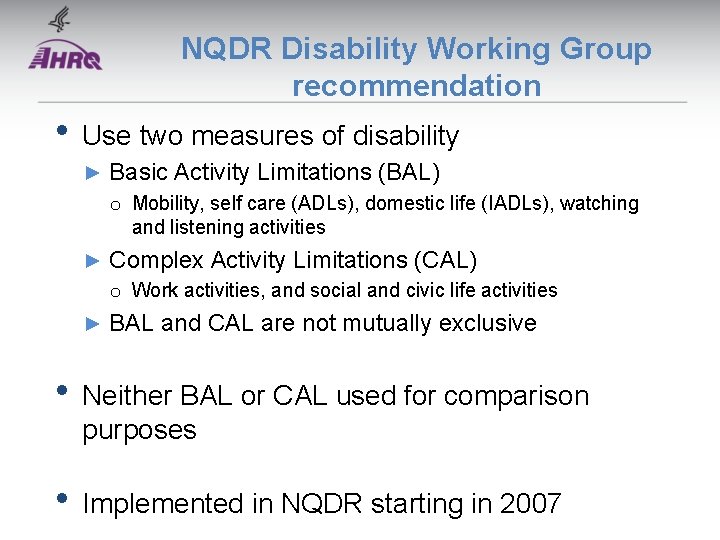
NQDR Disability Working Group recommendation • Use two measures of disability ► Basic Activity Limitations (BAL) o Mobility, self care (ADLs), domestic life (IADLs), watching and listening activities ► Complex Activity Limitations (CAL) o Work activities, and social and civic life activities ► BAL and CAL are not mutually exclusive • Neither BAL or CAL used for comparison purposes • Implemented in NQDR starting in 2007
Census Bureau’s 2008 American Community Survey Disability Measure • Background--2000 Census and 2003 -2007 ACS Disability Questions • ACS Subcommittee on Disability Measurement • Measurement of disability • Implemented with the 2008 ACS Ref. — Brault, 2009; Altman, 2006; Brault, Stern, and Raglin, 2007
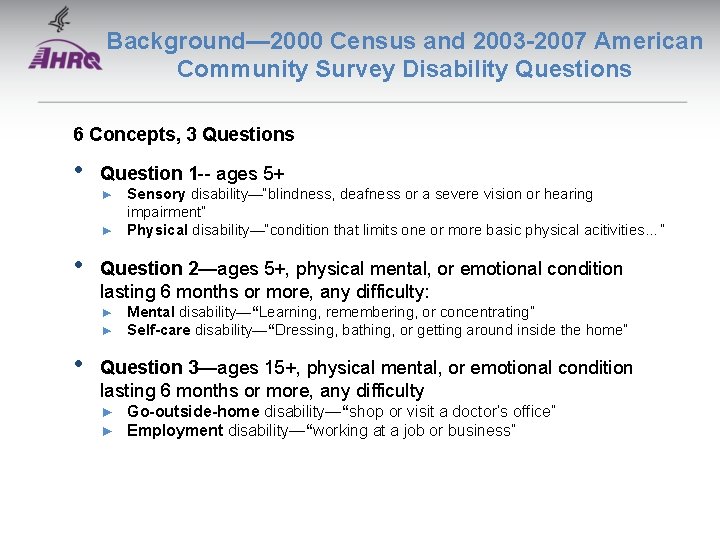
Background— 2000 Census and 2003 -2007 American Community Survey Disability Questions 6 Concepts, 3 Questions • Question 1 -- ages 5+ Sensory disability—“blindness, deafness or a severe vision or hearing impairment” ► Physical disability—“condition that limits one or more basic physical acitivities…” ► • Question 2—ages 5+, physical mental, or emotional condition lasting 6 months or more, any difficulty: ► ► • Mental disability—“Learning, remembering, or concentrating” Self-care disability—“Dressing, bathing, or getting around inside the home” Question 3—ages 15+, physical mental, or emotional condition lasting 6 months or more, any difficulty ► ► Go-outside-home disability—“shop or visit a doctor’s office” Employment disability—“working at a job or business”

ACS Subcommittee on Disability Measurement • Convened by the OMB Interagency Committee for the ACS in 2002 ► NCHS to take the lead, all agencies invited • Representatives from NCHS, U. S. Census Bureau, AHRQ, ASPE, Ao. A, BLS, EDNIDRR, FCC, NSF, NCD, NIMH, OMB, SSA, VA, HUD, IHS • Objective: To assess the adequacy of the current ACS (former 2000 Census) disability questions

ACS Measurement of Disability • Constraints on number of questions & legislature mandates • Disability involves social factors—both internal and external -- Difficult to measure in surveys • Focused on population likely to experience restrictions in participation due to physical, social and other environmental barriers—Easier to measure in surveys • Goal to identify broad representation of population at risk of restrictions in participation at the person level Less influenced by social and structural contexts which can vary across groups ► Want to identify younger as well as older people ►

ACS Measurement of Disability • Came up with initial questions • Cognitively tested initial questions • Revised questions ► Part of the 2006 ACS Content Test • Revised questions performed equal or better than 2003 -2007 ACS disability questions ► ► nonresponse rates Measures of item by item and overall disability recode reliability
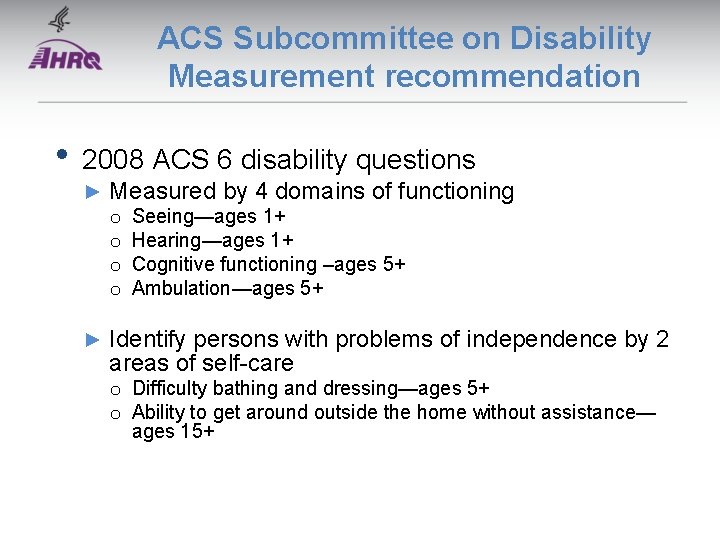
ACS Subcommittee on Disability Measurement recommendation • 2008 ACS 6 disability questions ► Measured by 4 domains of functioning o o ► Seeing—ages 1+ Hearing—ages 1+ Cognitive functioning –ages 5+ Ambulation—ages 5+ Identify persons with problems of independence by 2 areas of self-care o Difficulty bathing and dressing—ages 5+ o Ability to get around outside the home without assistance— ages 15+
Compare 2014 MEPS and NHIS estimates using these two approaches • NQDR disability measure ► • 2014 MEPS and 2014 NHIS estimates for ages 18+ 2008 ACS disability questions ► 2014 MEPS and 2014 NHIS estimates for ages 18+
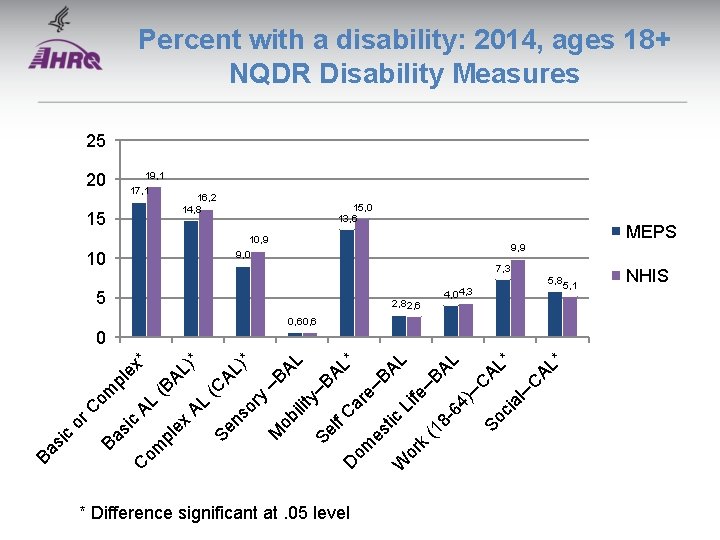
Percent with a disability: 2014, ages 18+ NQDR Disability Measures 25 19, 1 20 17, 1 16, 2 14, 8 15 15, 0 13, 6 MEPS 10, 9 9, 0 10 9, 9 7, 3 5, 8 5 2, 8 2, 6 4, 0 4, 3 5, 1 0, 6 (C Se AL ns )* or y --B M ob AL ilit y. Se -B AL lf C D * ar om ees -B t AL i c W L or ife k --B (1 8 AL 64 )-C So AL ci * al --C AL * )* pl ex AL (B AL AL C om si c Ba Ba si c or C om pl ex * 0 * Difference significant at. 05 level NHIS
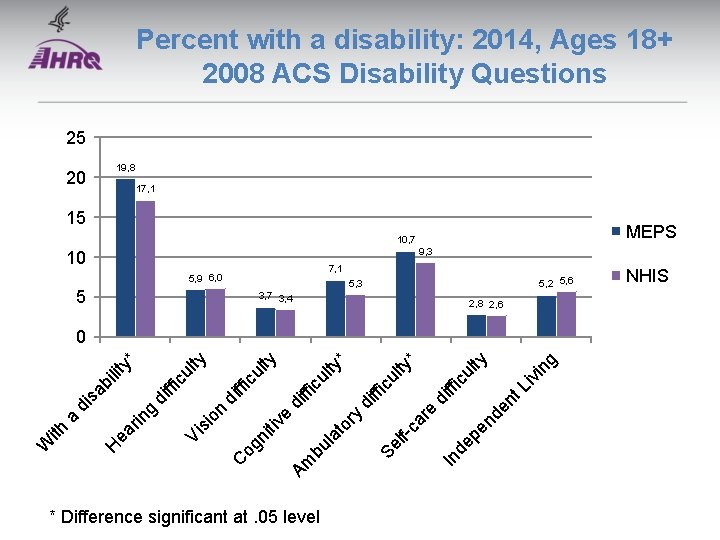
Percent with a disability: 2014, Ages 18+ 2008 ACS Disability Questions 25 19, 8 20 17, 1 15 MEPS 10, 7 9, 3 10 7, 1 5, 9 6, 0 5, 2 5, 6 5, 3 5 3, 7 3, 4 2, 8 2, 6 * Difference significant at. 05 level In g t. L de p en de n di e ar f-c iv in ul ty ffi c ic di ff Se l Am bu la to ry ve di ffi cu lty ul ty * * cu lty ni ti C og Vi si o n di ffi g H ea rin W ith a di s ab i lit y * cu lty 0 NHIS
How did we do with our two approaches for disability measures (Cont. )? • Goal of both approaches to produce outcomes for similar groups of disabled persons across surveys • In general MEPS and NHIS produce similar estimates for both approaches, though there are statistically significant differences along some domains • Which approach is better?
Strengths and limitations of two disability measures • NQDR disability measures • 2008 ACS disability questions • Neither approach has a severity level within the domains they consider • Will there be a standard set of questions for more detailed disability information? ► ► Limited to ages 18+ Within a domain had to choose severity that was most similar in the surveys (not necessarily the one we would want to choose) Estimates for broad range of ages Used in a number of surveys so outcomes for disabled can be compared across many more surveys
Thank you! Questions? MEPS Website: http: //MEPS. AHRQ. gov/ Contact: Frances M. Chevarley David W. Keer Email: fran. chevarley@ahrq. hhs. gov dwkone@verizon. net
- Slides: 23