
How the Space Data Center Is Improving Safety
- Slides: 27
How the Space Data Center Is Improving Safety of Space Operations Dr. T. S. Kelso
Overview • Motivation • Background • Proposed Solution • Validation • SOCRATES-GEO & LEO • Future Enhancements • Summary & Conclusions 11 th AMOS Technical Conference, 2010 September 14 -17 Slide 2
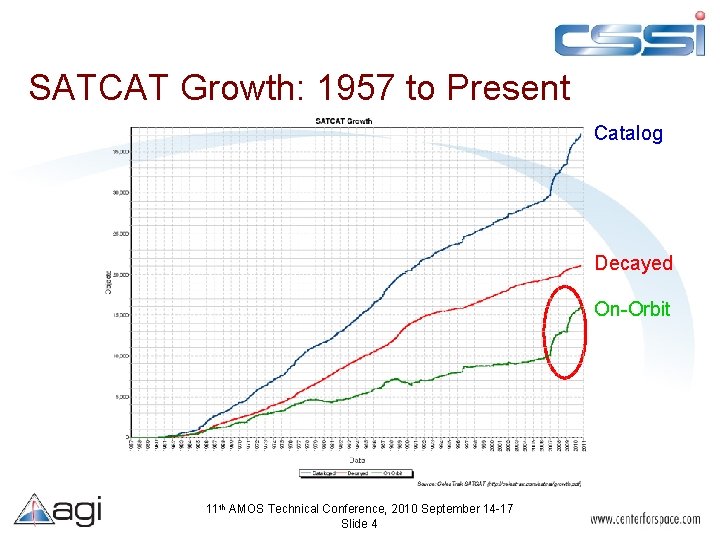
Motivation • 59 percent increase in size of known on-orbit population since 2007 Jan 1 – 2007 Jan 1: – 2010 Sep 5: 10, 136 16, 068 • 80 percent of growth due to two events – Chinese ASAT test (2007 Jan 11) • 3, 037 pieces cataloged to date (only 93 decayed) – Iridium 33/Cosmos 2251 collision (2009 Feb 10) • 1, 875 pieces cataloged to date (only 89 decayed) • Does not include another 6, 000+ ‘analyst’ objects 11 th AMOS Technical Conference, 2010 September 14 -17 Slide 3
SATCAT Growth: 1957 to Present Catalog Decayed On-Orbit 11 th AMOS Technical Conference, 2010 September 14 -17 Slide 4
Motivation • ~997 operational satellites in Earth orbit – 89 added in 2008 – 98 added in 2009 • More satellites = more conjunctions • Implications of a collision are significant – Potential loss of satellites & associated revenues – Increase in debris, putting all satellites at risk 11 th AMOS Technical Conference, 2010 September 14 -17 Slide 5
Background • Conjunction analysis needs full-catalog orbital data • Current SSA limited to non-cooperative tracking – US SSN uses combination of radar & optical resources • Maneuvering satellites most difficult to track – Maneuvers typically not known to SSN ahead of time – Delays in detection can result in poor accuracy or even ‘lost’ satellites – Requires more SSA resources to maintain orbits 11 th AMOS Technical Conference, 2010 September 14 -17 Slide 6
Background • SOCRATES started as proof-of-concept in 2004 – Show it isn’t hard to screen all payloads, using: • COTS software & hardware • Standard orbital data products – Produce timely reports • Screens 3, 054 payloads vs. 14, 600 objects over 7 -day window in 77 minutes on a 3 GHz Core 2 Duo with 4 GB RAM – Raise awareness of the magnitude of the problem • As of 2010 Sep 5, 16, 817 occasions where something comes within 5 km of one of 3, 054 payloads over a 7 -day period – Point out limitations of existing orbital data sources 11 th AMOS Technical Conference, 2010 September 14 -17 Slide 7
Proposed Solution • Satellite operators already maintain orbits – Active ranging, GPS can be very accurate • Develop Data Center to collect operator data – Use operator data to improve conjunction analysis – Provide analysis/data to all contributors • Requires validation of accuracy assumption 11 th AMOS Technical Conference, 2010 September 14 -17 Slide 8
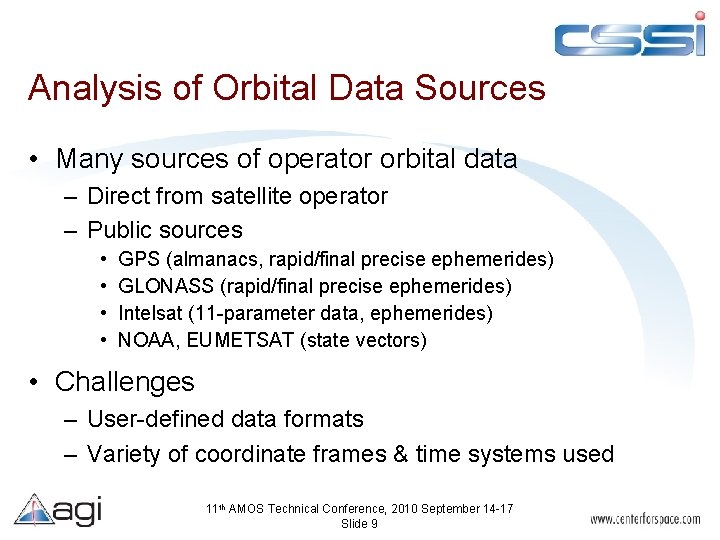
Analysis of Orbital Data Sources • Many sources of operator orbital data – Direct from satellite operator – Public sources • • GPS (almanacs, rapid/final precise ephemerides) GLONASS (rapid/final precise ephemerides) Intelsat (11 -parameter data, ephemerides) NOAA, EUMETSAT (state vectors) • Challenges – User-defined data formats – Variety of coordinate frames & time systems used 11 th AMOS Technical Conference, 2010 September 14 -17 Slide 9
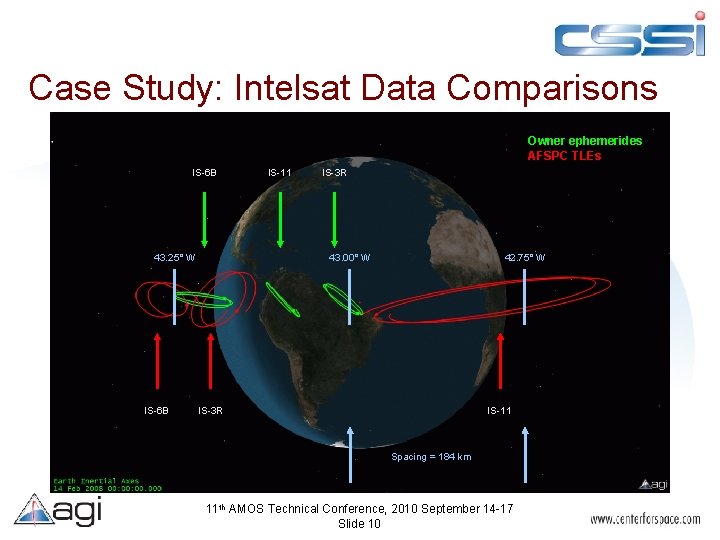
Case Study: Intelsat Data Comparisons Owner ephemerides AFSPC TLEs IS-6 B IS-3 R 43. 00° W 43. 25° W IS-6 B IS-11 42. 75° W IS-3 R IS-11 Spacing = 184 km 11 th AMOS Technical Conference, 2010 September 14 -17 Slide 10
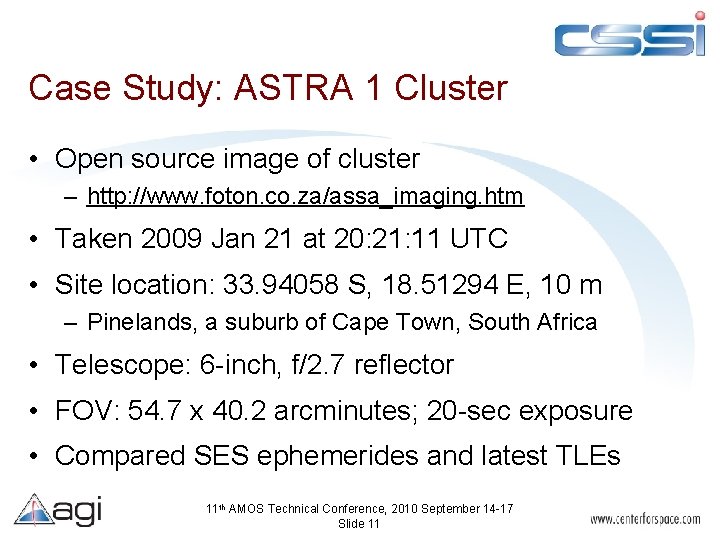
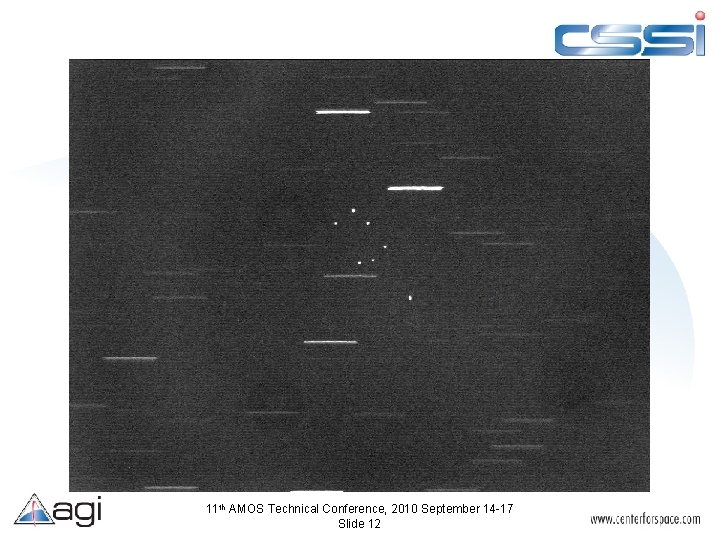
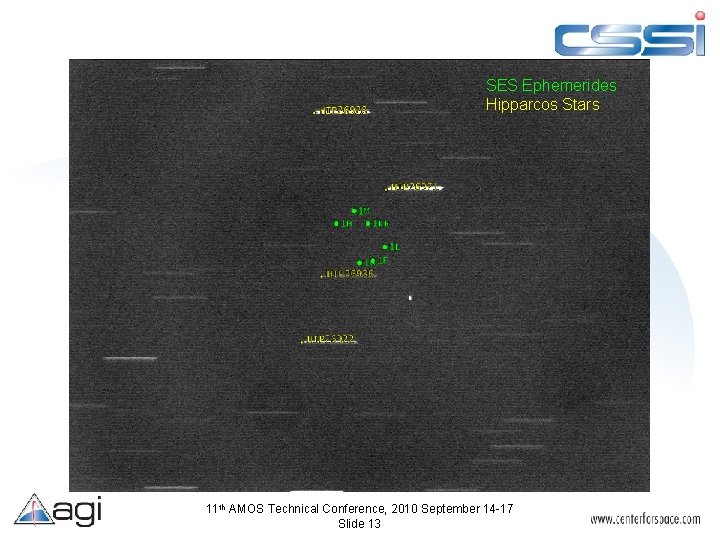
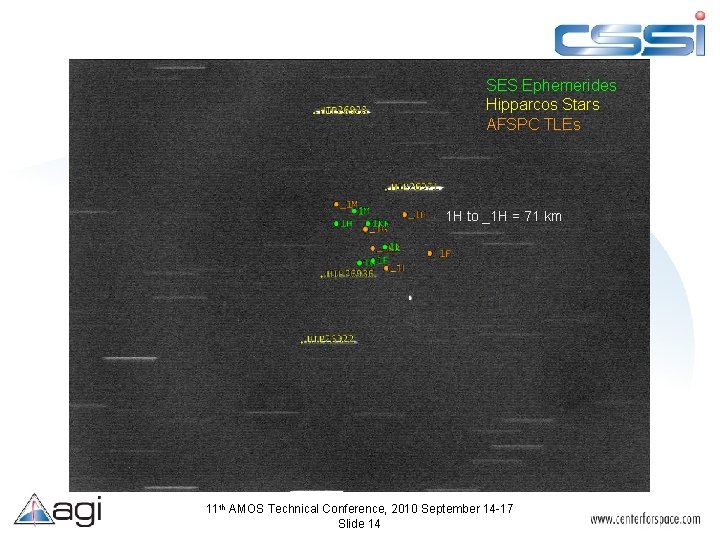
Case Study: ASTRA 1 Cluster • Open source image of cluster – http: //www. foton. co. za/assa_imaging. htm • Taken 2009 Jan 21 at 20: 21: 11 UTC • Site location: 33. 94058 S, 18. 51294 E, 10 m – Pinelands, a suburb of Cape Town, South Africa • Telescope: 6 -inch, f/2. 7 reflector • FOV: 54. 7 x 40. 2 arcminutes; 20 -sec exposure • Compared SES ephemerides and latest TLEs 11 th AMOS Technical Conference, 2010 September 14 -17 Slide 11
11 th AMOS Technical Conference, 2010 September 14 -17 Slide 12
SES Ephemerides Hipparcos Stars 11 th AMOS Technical Conference, 2010 September 14 -17 Slide 13
SES Ephemerides Hipparcos Stars AFSPC TLEs 1 H to _1 H = 71 km 11 th AMOS Technical Conference, 2010 September 14 -17 Slide 14
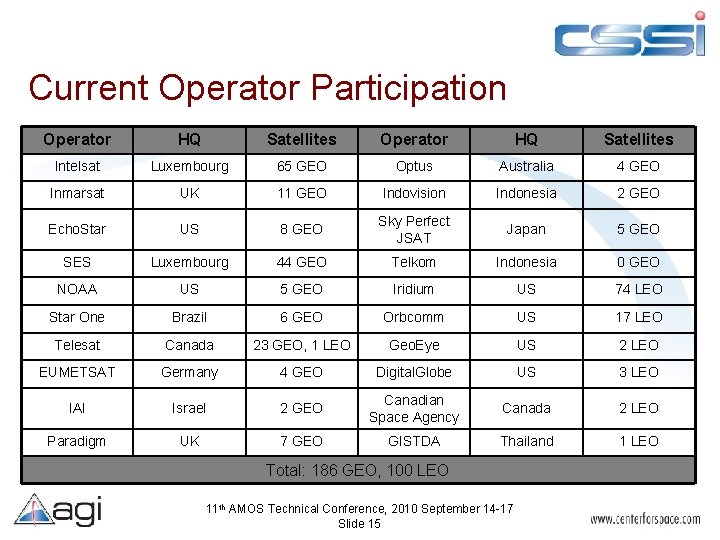
Current Operator Participation Operator HQ Satellites Intelsat Luxembourg 65 GEO Optus Australia 4 GEO Inmarsat UK 11 GEO Indovision Indonesia 2 GEO Echo. Star US 8 GEO Sky Perfect JSAT Japan 5 GEO SES Luxembourg 44 GEO Telkom Indonesia 0 GEO NOAA US 5 GEO Iridium US 74 LEO Star One Brazil 6 GEO Orbcomm US 17 LEO Telesat Canada 23 GEO, 1 LEO Geo. Eye US 2 LEO EUMETSAT Germany 4 GEO Digital. Globe US 3 LEO IAI Israel 2 GEO Canadian Space Agency Canada 2 LEO Paradigm UK 7 GEO GISTDA Thailand 1 LEO Total: 186 GEO, 100 LEO 11 th AMOS Technical Conference, 2010 September 14 -17 Slide 15
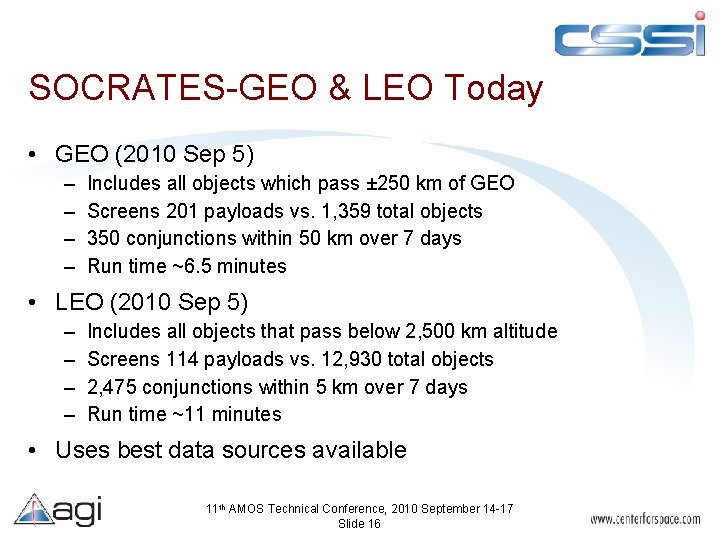
SOCRATES-GEO & LEO Today • GEO (2010 Sep 5) – – Includes all objects which pass ± 250 km of GEO Screens 201 payloads vs. 1, 359 total objects 350 conjunctions within 50 km over 7 days Run time ~6. 5 minutes • LEO (2010 Sep 5) – – Includes all objects that pass below 2, 500 km altitude Screens 114 payloads vs. 12, 930 total objects 2, 475 conjunctions within 5 km over 7 days Run time ~11 minutes • Uses best data sources available 11 th AMOS Technical Conference, 2010 September 14 -17 Slide 16
SOCRATES-GEO & LEO Today • Runs generate standard reports – Provides links to standard (OEM, JSp. OC) orbital data • Allows user-defined notification criteria – Metrics: Min range, max probability – Individual thresholds • Automatically sends notification via e-mail • Web access to latest data via secure system 11 th AMOS Technical Conference, 2010 September 14 -17 Slide 17
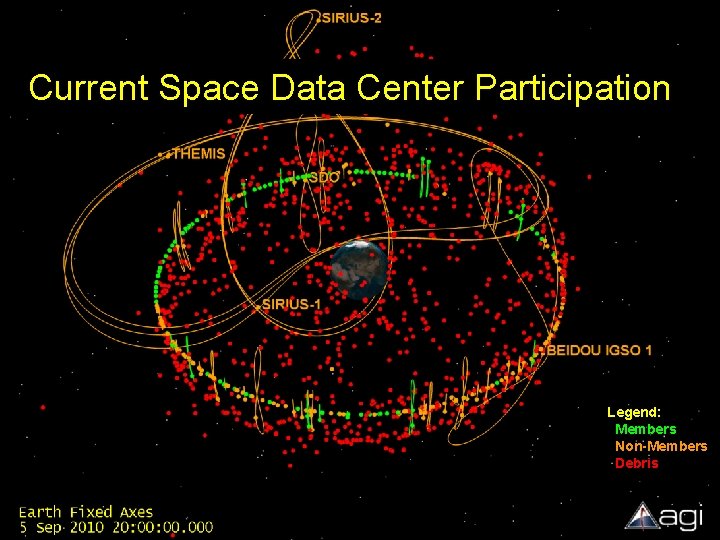
Space Data Center • Space Data Association established in 2009 – Dedicated to safe and responsible satellite operations • Prevention of collisions in space • Improving satellite communications – Establishing Space Data Center • Automated space situational awareness system – Reduce risk of on-orbit collisions – Mitigate radio frequency interference • Selected AGI to develop and operate (2010 Apr 12) – Initial Operational Capability: 2010 Jul 27 – Fully Operational Capability: 2011 Q 1 11 th AMOS Technical Conference, 2010 September 14 -17 Slide 18
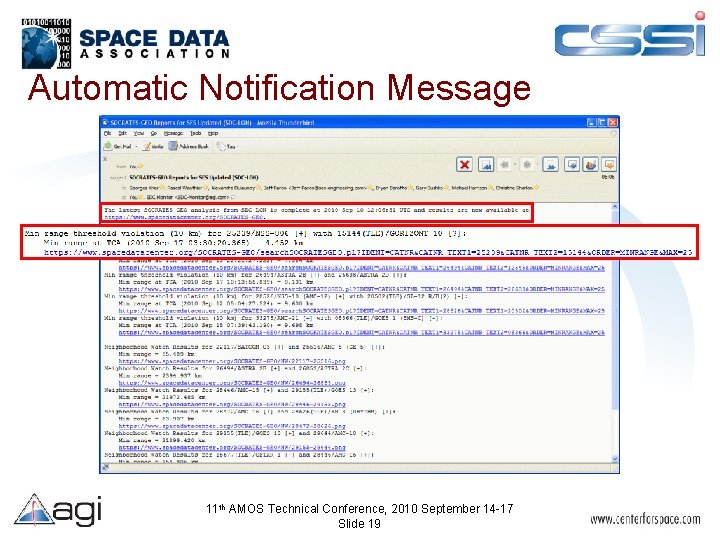
Automatic Notification Message 11 th AMOS Technical Conference, 2010 September 14 -17 Slide 19
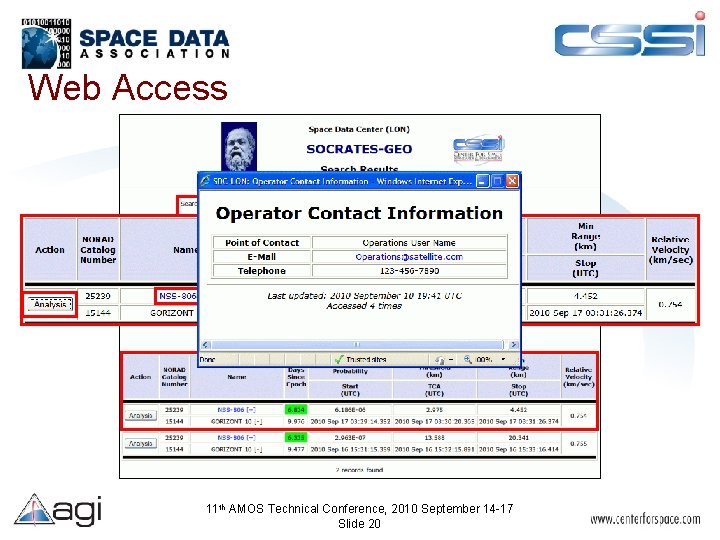
Web Access 11 th AMOS Technical Conference, 2010 September 14 -17 Slide 20
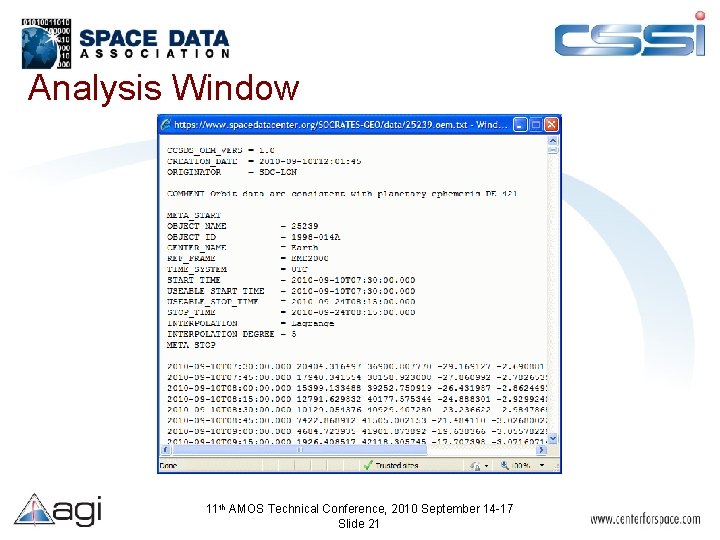
Analysis Window 11 th AMOS Technical Conference, 2010 September 14 -17 Slide 21
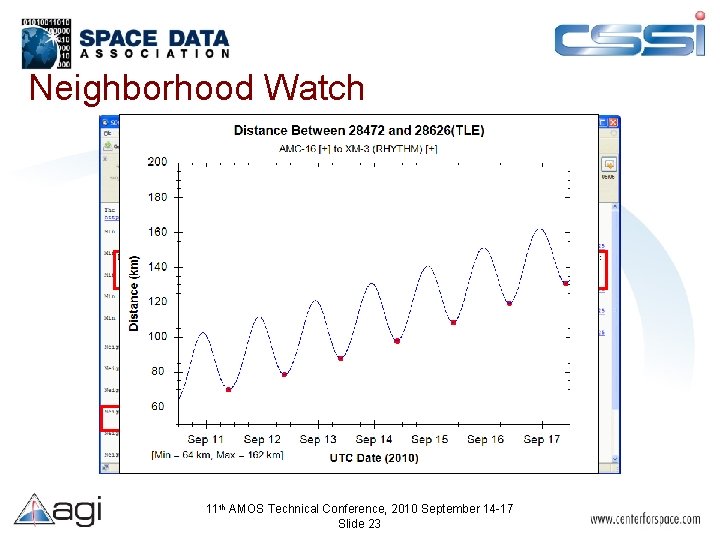
Neighborhood Watch 11 th AMOS Technical Conference, 2010 September 14 -17 Slide 23
Future Enhancements (FOC) • Process new data as received – User defines notification interval – Parallel analysis tool for maneuver planning • Improved data status page – Data type, age, and quality – Direct contact information for operational satellites • Enhanced graphs, reports, visualization – Customizable tool kits • Collection of RFI data for mitigation 11 th AMOS Technical Conference, 2010 September 14 -17 Slide 24
Current Space Data Center Participation Legend: Members Non-Members Debris
Summary & Conclusions • Bottom line: – Technical solution is easy • Biggest obstacle: – Data sharing policies • Other issues: – Organization – Resources & Funding • Together we can work today to mitigate risk 11 th AMOS Technical Conference, 2010 September 14 -17 Slide 26
Questions?