
How the Internet Is Controlled Policy implications and
- Slides: 22
How the Internet Is Controlled Policy implications and the technical basis of the networked society
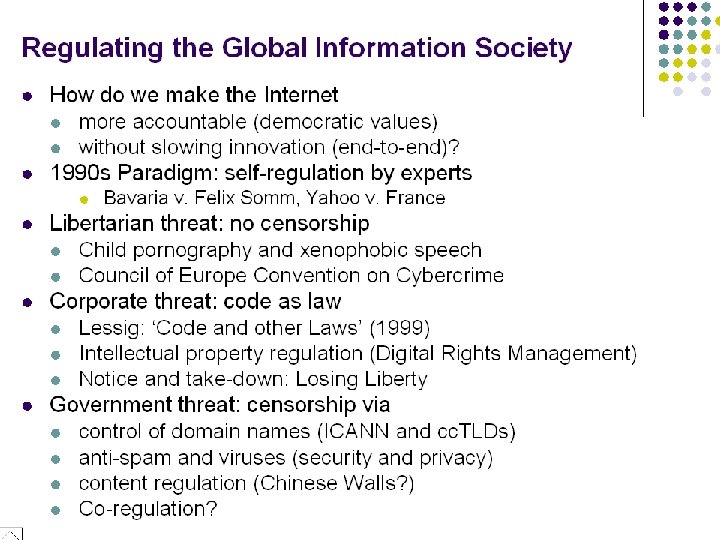
Structure of the Lecture Some introductory thoughts n Regulating the Global Information Society n ‘Medium law’ – the new Internet regulation n ‘Realpolitik’: US Control of the Internet n The United Nations and the Internet n Developing some principles for regulation n
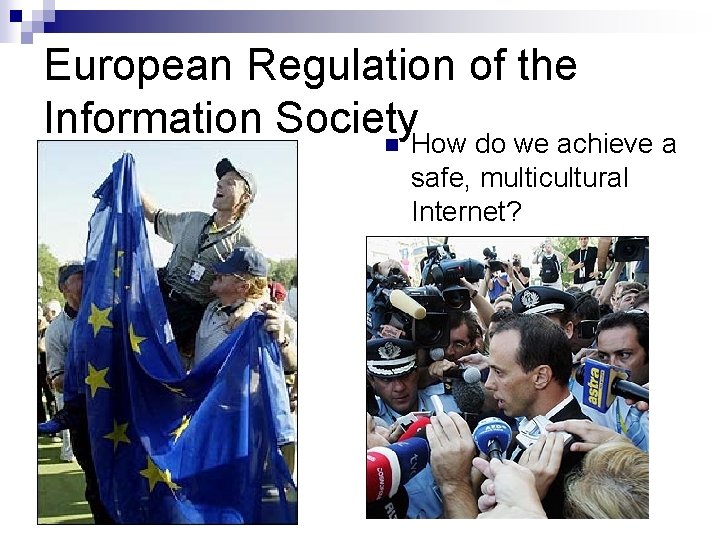
European Regulation of the Information Society n How do we achieve a safe, multicultural Internet?
BUT there is a serious problem Terrorism and incitement to racial and religious hatred are rife online Many Internet users have poor media literacy Should we tolerate such views on the Internet when we do not in the street?
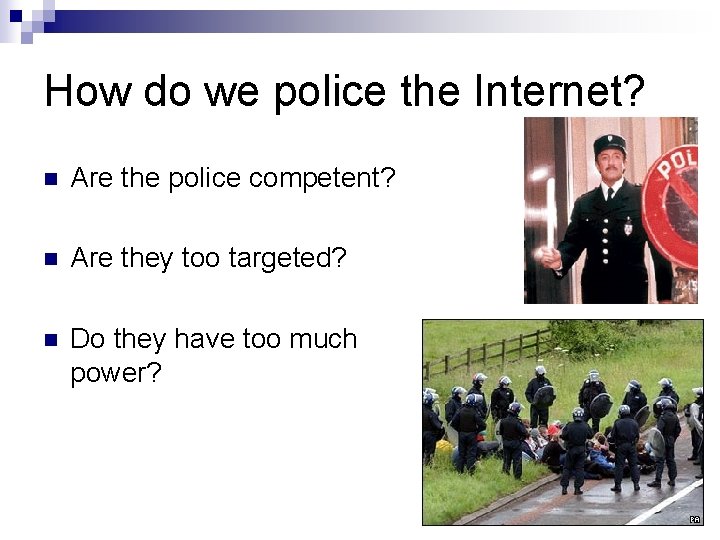
How do we police the Internet? n Are the police competent? n Are they too targeted? n Do they have too much power?
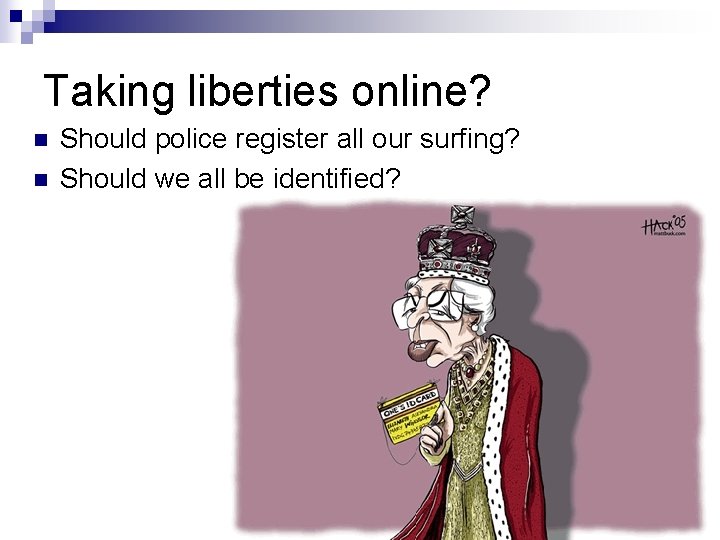
Taking liberties online? n n Should police register all our surfing? Should we all be identified?
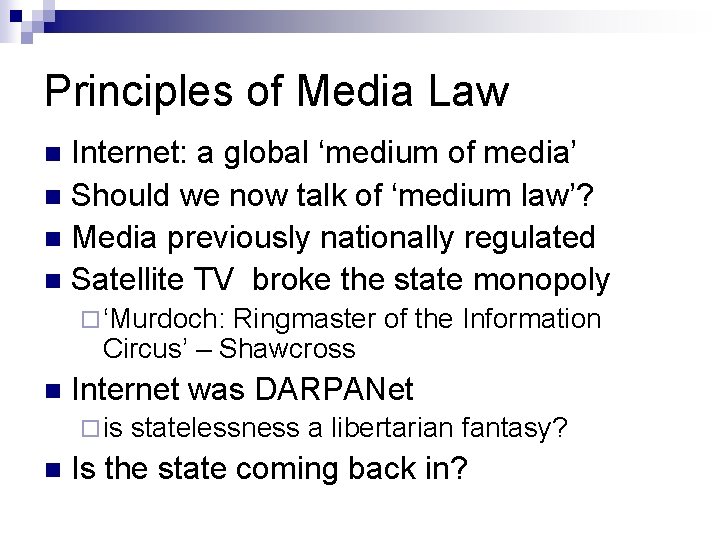
Principles of Media Law Internet: a global ‘medium of media’ n Should we now talk of ‘medium law’? n Media previously nationally regulated n Satellite TV broke the state monopoly n ¨ ‘Murdoch: Ringmaster of the Information Circus’ – Shawcross n Internet was DARPANet ¨ is n statelessness a libertarian fantasy? Is the state coming back in?
Media Co-Regulation Freedom of expression is a constitutional principle n BUT the different media n ¨ Video, n Are evolving onto one MEDIUM ¨ The n radio, printed press, film, gaming ‘Medium of Media’ Internet ¨ digital, ubiquitous, always-on
Legal Fiction n n If it’s illegal offline, it’s illegal on-line OR “we can all be multinationals, routinely living in multiple jurisdictions” Which is right?
Current Policy Created Late 1990 s n ISP liability ¨ n Telecoms regulation ¨ ¨ n Directive EC/2000/31 formulated 1998 -9 Trustmarks and SSL – Trust. E and others Privacy regulation ¨ ¨ n 1996 Telecoms Act as implemented by FCC and courts; 1997 ‘Convergence’ Green paper led to 2002 E-comms Package E-commerce regulation ¨ ¨ n DMCA 1998; EC Copyright Directives Directive EC/95/46 ‘Safe Harbor’ (sic) agreement 2000 and 2002 E-Privacy Directive Content self-regulation ¨ Hotlines (IWF 1996) and Codes of Conduct (Safer Internet Action Plan 1997)
Taking Self-Regulation Seriously? n Implementation of Directives patchy ¨ Widespread n Implementation of self-regulation scratchy ¨ Widespread n n reporting of abuses e. g. privacy view of ‘Potemkin’ bodies with no substance behind the glossy websites Wide consumer adoption of broadband ¨ Digital Divide remains; mobile and wireless prospects ¨ Ubiquitous connectivity for digitally enabled ¨ Content creation and sharing n Creative Commons, Peer-to-peer, ‘rip mix burn’, mashing
Zoe Baird/Stefaan Verhulst (2002 November) Governing the Internet: Engaging Government, Business, and Nonprofits, Foreign Affairs ‘‘The rapid growth of the Internet has led to a worldwide crisis of governance. “In the early years of Internet development, the prevailing view was that government should stay out of Internet governance; market forces and selfregulation would suffice to create order and enforce standards of behavior. “But this view has proven inadequate as the Internet has become mainstream. ’’
Multistakeholderisation n Industry/government paradigm of 1990 s Supplemented by academic/geek experts ¨ ‘Rough consensus and running code’ cliché ¨ n 2000 s NGOs join policy-making ¨ n Civil society illegitimate and unaccountable Claimed to be dynamic – but outside UN agencies? Note ‘progress’ at IGF and WIPO, as well as UNESCO ¨ Is it Mc. Bride mark II? ¨ n Is this a new paradigm or an activist phase? What’s new about it? ¨ Bits of Freedom/EDRI ¨ Electronic Frontier Foundation ¨ Chaos Computer Club ¨
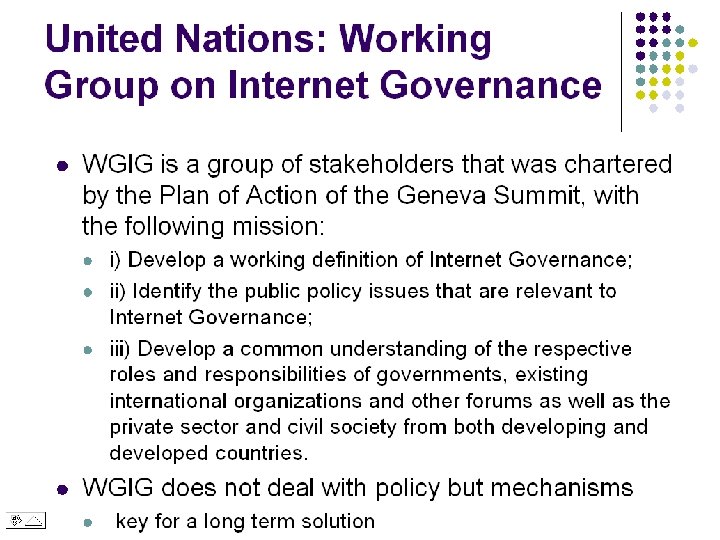
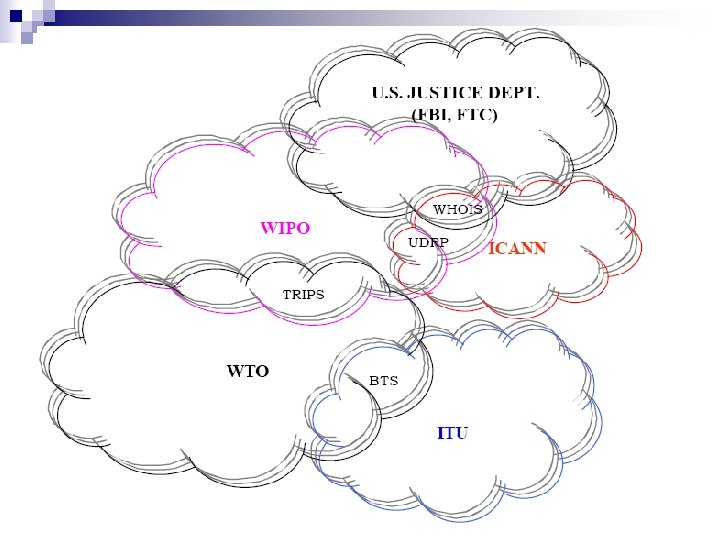
IGOs – Intergovernmental Organisations ITU – telephony n UNESCO – culture n WIPO – intellectual property n WTO – trade n UNDP – development n BUT n NGOs and civil society– n ¨ W 3 C, IETF, IAB, ISOC, ICANN
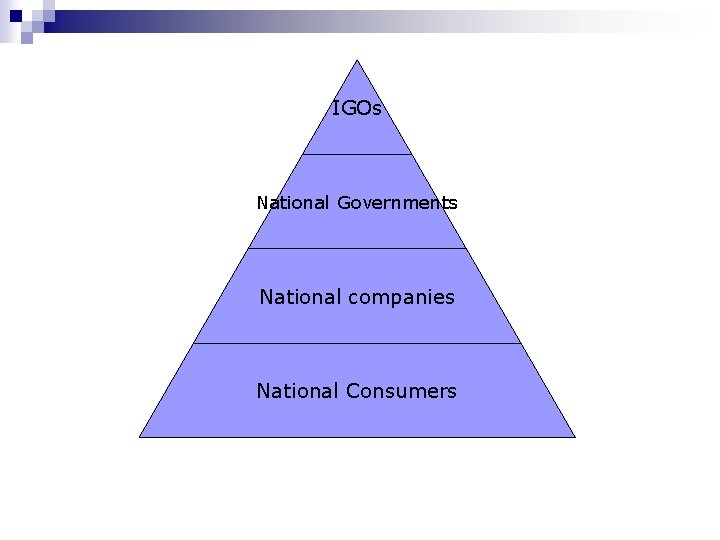
IGOs National Governments National companies National Consumers
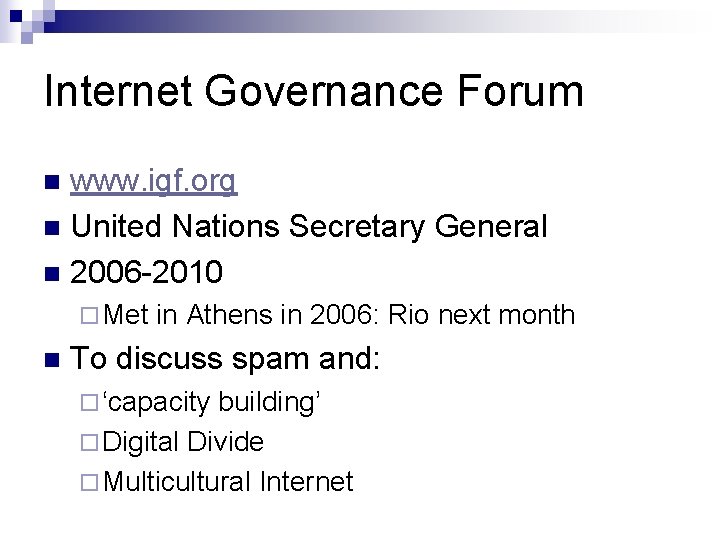
Internet Governance Forum www. igf. org n United Nations Secretary General n 2006 -2010 n ¨ Met n in Athens in 2006: Rio next month To discuss spam and: ¨ ‘capacity building’ ¨ Digital Divide ¨ Multicultural Internet
Does Web 2. 0 need Regulation 2. 0? Two alternative futures (and the present) 1. Do nothing – rely on 1990 s settlement 2. Co-regulation – enforced self-regulation 3. User-generated regulation 1. 2. 3. 4. 5. Abuse buttons for stalking/inappropriate Rating by users – by self and others New forms of netiquette Dynamic feedback to site owners BUT does it need legislative pressure/surveillance?