
How the Balance Scorecard Approach Compares to Policy
How the Balance Scorecard Approach Compares to Policy ® Governance Presented by: David Mustine IPGA 2007 Annual Conference Alexandria, VA June 23, 2007 Policy Governance is the registered service mark of John Carver.
The Balanced Scorecard Robert S. Kaplan & David P. Norton This presentation will: 1. Provide general understanding of Balanced Scorecard 2. Compare Balanced Scorecard to Policy Governance® 3. Demonstrate why Policy Governance is superior to Balanced Scorecard in the field of governance 2
The Balanced Scorecard Robert S. Kaplan & David P. Norton • Developed early 1990’s • Initial purpose – improve performance measurement • Discovered effective in strengthening strategy implementation • Now propose to use it in governing 3
The Balanced Scorecard Robert S. Kaplan & David P. Norton 4 barriers to effective strategy implementation: 1. Vision and strategy are not actionable 2. Strategies are not linked to departmental, team, and individual goals 3. Strategies are not linked to long and shortterm resource allocation 4. Feedback is tactical, not strategic 4
The Balanced Scorecard 3 Key Elements • Measurement system • Strategic management • Communication tool 5
The Balanced Scorecard Four Perspectives • • Financial Internal processes Learning & development Customer 6
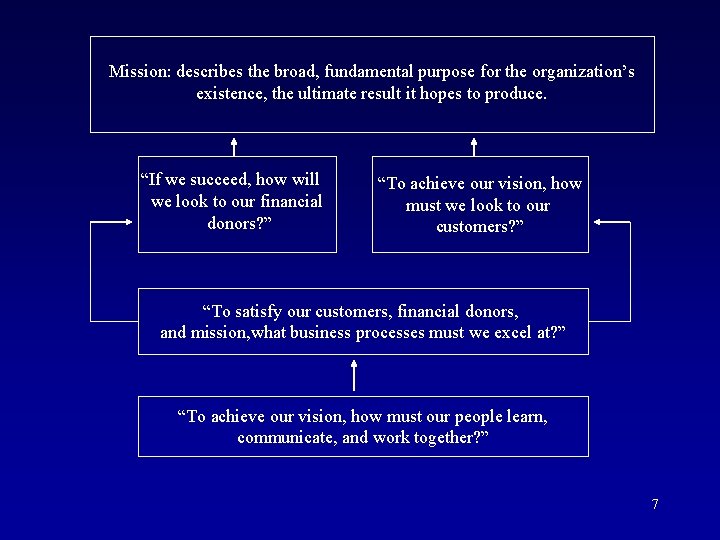
Mission: describes the broad, fundamental purpose for the organization’s existence, the ultimate result it hopes to produce. “If we succeed, how will we look to our financial donors? ” “To achieve our vision, how must we look to our customers? ” “To satisfy our customers, financial donors, and mission, what business processes must we excel at? ” “To achieve our vision, how must our people learn, communicate, and work together? ” 7
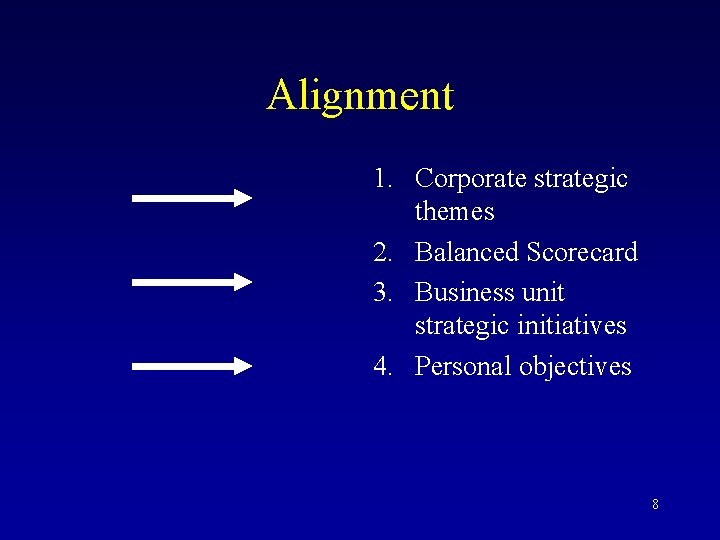
Alignment 1. Corporate strategic themes 2. Balanced Scorecard 3. Business unit strategic initiatives 4. Personal objectives 8
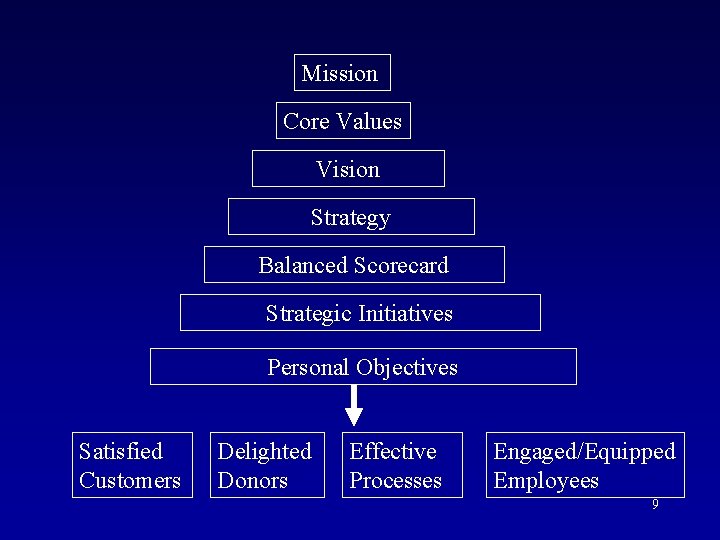
Mission Core Values Vision Strategy Balanced Scorecard Strategic Initiatives Personal Objectives Satisfied Customers Delighted Donors Effective Processes Engaged/Equipped Employees 9
5 Major Responsibilities of a Board (Kaplan & Norton) 1. Ensuring integrity and compliance 2. Approving and monitoring enterprise strategy 3. Approving major financial decisions 4. Selecting and evaluating executives 5. Counseling and supporting the CEO 10
Integrity and Compliance (Kaplan & Norton) • Ensure reporting and disclosure reflect underlying organization performance • Monitor risks and risk management processes • Make certain there adequate internal controls • Assure operating ethically • Verify that laws and regulations not violated 11
Approving and Monitoring Enterprise Strategy (Kaplan & Norton) • • Ensure plans result in creation of LT value Approve or reject major mgm’t decisions Must understand approve corp. strategy Continuously monitor strategy execution and results 12
Approving Major Financial Decisions (Kaplan & Norton) • Ensure financial resources are used efficiently and effectively to achieve strategic objectives • Approve annual operating and capital budgets • Authorize major capital expenditures, new financings and major mergers/acquisitions/divestitures 13
Selecting and Evaluating Executives (Kaplan & Norton) • Hires, evaluates performance and determines CEO compensation • Approves hiring of other senior executives • Assure succession plan on entire executive team 14
Counseling and supporting the CEO (Kaplan & Norton) • Individual board members use specific knowledge to provide CEO and executive team guidance 15
Governance Scorecards (Kaplan & Norton) • Enterprise: – Contains strategic objectives, performance measurements, targets and initiatives – Plays central role in governing: provides financial and non-financial information essential to performance oversight • Executive: – Provides objective assessment of executive performance 16
Governance Scorecards (Kaplan & Norton) • Board: – Enterprise financial perspective – Stakeholder perspective – Internal board processes – Learning and Development (knowledge, information and culture) 17
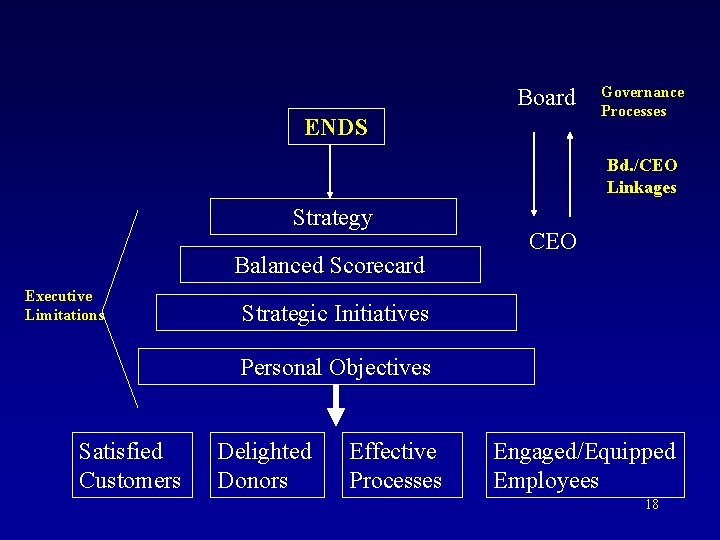
Board ENDS Governance Processes Bd. /CEO Linkages Strategy Balanced Scorecard Executive Limitations CEO Strategic Initiatives Personal Objectives Satisfied Customers Delighted Donors Effective Processes Engaged/Equipped Employees 18
3 Major Responsibilities of a Board in Policy Governance 1. Connect with and understand ownership expectations 2. Develop and express board expectations in written policies 3. Assure owner expectations are met through rigorous monitoring 19
Integrity and Compliance in Policy Governance • Integrity accomplished through policies • Compliance is confirmed through monitoring 20
Approving and Monitoring Enterprise Strategy in Policy Governance • Board establishes ownership expectations through ENDS • Enterprise strategy is a management tool 21
Approving Major Financial Decisions in Policy Governance • Board may reserve some major financial decisions for itself (e. g. merger) • Operating and capital budgets are management tools • Carefully designed financial executive limitations policies coupled with monitoring effect strong method of control 22
Selecting and Evaluating Executives in Policy Governance • Board hires and evaluates only the CEO – Clarity of accountability – Clarity of board vs CEO roles • Achievement of ENDS and avoidance of violating Executive Limitations comprise CEO evaluation 23
Counseling and Supporting the CEO in Policy Governance • Board never advises • Individual board members urged to advise only if asked and then make sure it is not confused with board decisions 24
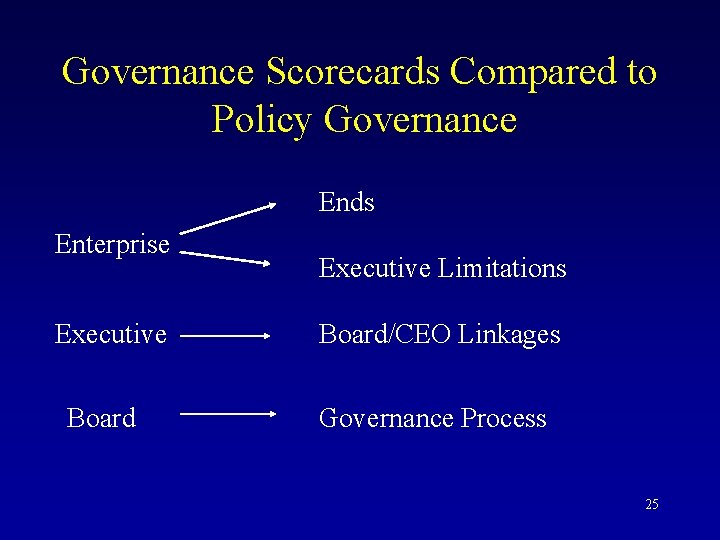
Governance Scorecards Compared to Policy Governance Ends Enterprise Executive Board Executive Limitations Board/CEO Linkages Governance Process 25
Discussion • In what ways do you see Policy Governance providing a balanced perspective to the board? • Could Balanced Scorecard data be used in monitoring reports? • Policy Governance starts with owners’ perspective – with which perspective does Balanced Scorecard start? 26
Works Consulted Carver, John. Boards That Make a Difference. San Francisco: Jossey-Bass, 2006, 3 rd ed. Robert S. Kaplan and David P. Norton, The Strategy-Focused Organization. Boston: Harvard Business School Press, 2001. Robert S. Kaplan and David Norton, The Balanced Scorecard. Boston: Harvard Business School Press, 1996. Robert S. Kaplan and David P. Norton, “Aligning the Board of Directors, The Balanced Scorecard Report. ” Balanced Scorecard Report, March-April 2006. Niven, Paul R. Balanced Scorecard: Step-by-step for Government and Nonprofit Agencies. Hoboken, NJ: John Wiley & sons, Inc. , 2003. The authoritative website for the Policy Governance® model can be found at www. carvergovernance. com. 27
- Slides: 27