
How SNOMED CT can help in the ICD10
- Slides: 36
How SNOMED CT can help in the ICD-10 -CM transition Kin Wah Fung, MD, FRCSEd, MS, MA National Library of Medicine National Institutes of Health © 2010
SNOMED CT • Systematized Nomenclature of Medicine - Clinical Terms • The most comprehensive, multilingual clinical healthcare terminology in the world • Created by the merging of SNOMED RT (Reference Terminology) with CTV 3 (Clinical Terms version 3) in 2002 2 © 2010
An international standard • Owned by IHTSDO (International Health Terminology Standards Development Organisation) • 18 member countries so far, including – US, UK, Canada, The Netherlands, Spain, Denmark, Australia, New Zealand • SNOMED CT can be used by • Anyone with an Affiliate License (free for all member countries) • 40 low income countries (defined by the World Bank) • Qualifying research/humanitarian/charitable projects 3 © 2010
Terminology for the EHR • As a clinical terminology, SNOMED CT is inherently more suitable than other terminologies/classifications for clinical documentation in the EHR (electronic health record) • This is not to say that ‘SNOMED CT is superior to ICD’, since they are designed for different purposes and each should each be used for the purpose for which it was designed 4 © 2010
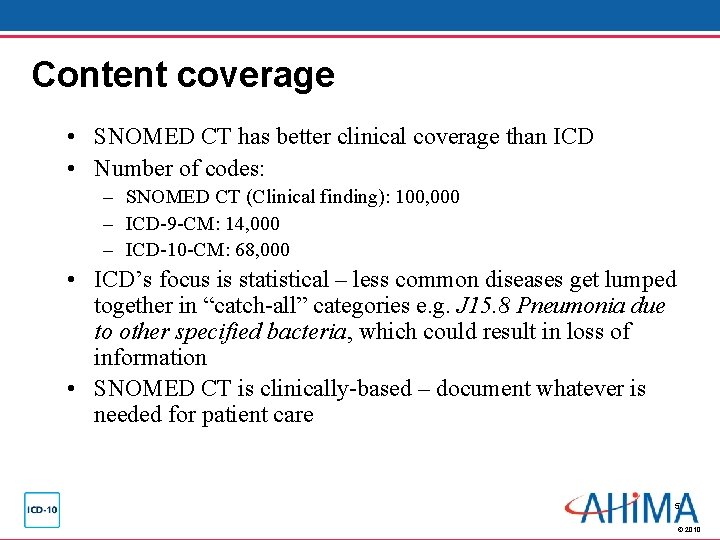
Content coverage • SNOMED CT has better clinical coverage than ICD • Number of codes: – SNOMED CT (Clinical finding): 100, 000 – ICD-9 -CM: 14, 000 – ICD-10 -CM: 68, 000 • ICD’s focus is statistical – less common diseases get lumped together in “catch-all” categories e. g. J 15. 8 Pneumonia due to other specified bacteria, which could result in loss of information • SNOMED CT is clinically-based – document whatever is needed for patient care 5 © 2010
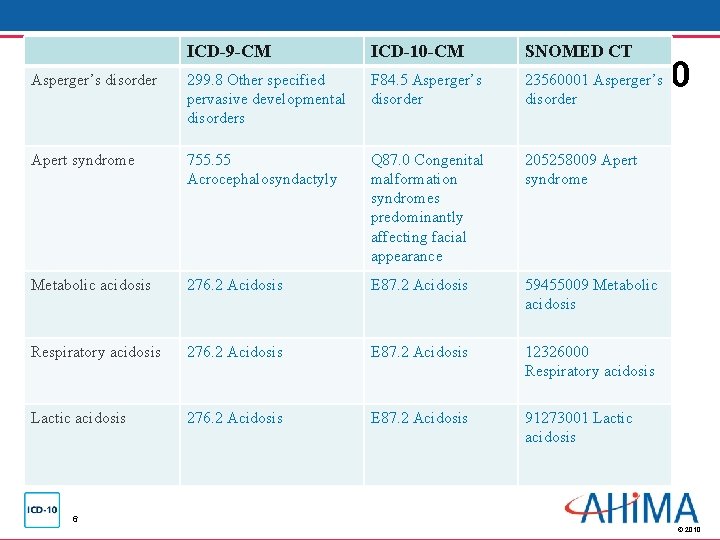
ICD-9 -CM ICD-10 -CM SNOMED CT Apert syndrome 755. 55 Acrocephalosyndactyly Q 87. 0 Congenital malformation syndromes predominantly affecting facial appearance 205258009 Apert syndrome Metabolic acidosis 276. 2 Acidosis E 87. 2 Acidosis 59455009 Metabolic acidosis Respiratory acidosis 276. 2 Acidosis E 87. 2 Acidosis 12326000 Respiratory acidosis Lactic acidosis 276. 2 Acidosis E 87. 2 Acidosis 91273001 Lactic acidosis 299. 8 Other specified F 84. 5 Asperger’s 23560001 Asperger’s Differences Between ICD-9 -CM, ICD-10 pervasive developmental disorders -CM and SNOMED CT Asperger’s disorder 6 © 2010
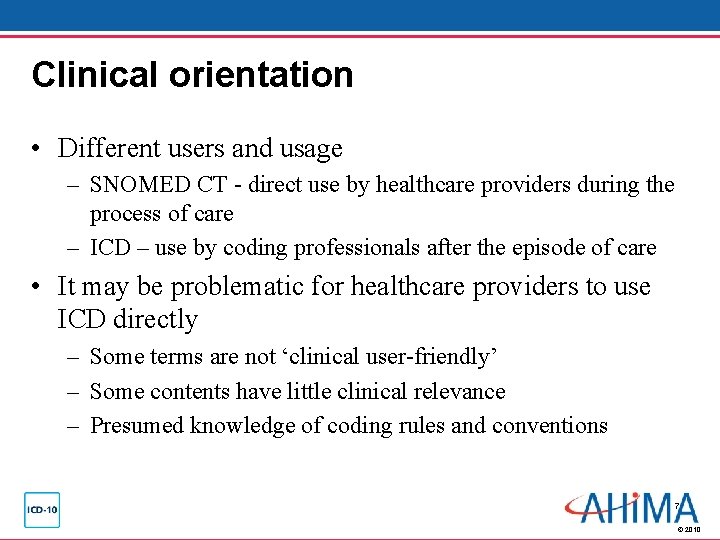
Clinical orientation • Different users and usage – SNOMED CT - direct use by healthcare providers during the process of care – ICD – use by coding professionals after the episode of care • It may be problematic for healthcare providers to use ICD directly – Some terms are not ‘clinical user-friendly’ – Some contents have little clinical relevance – Presumed knowledge of coding rules and conventions 7 © 2010
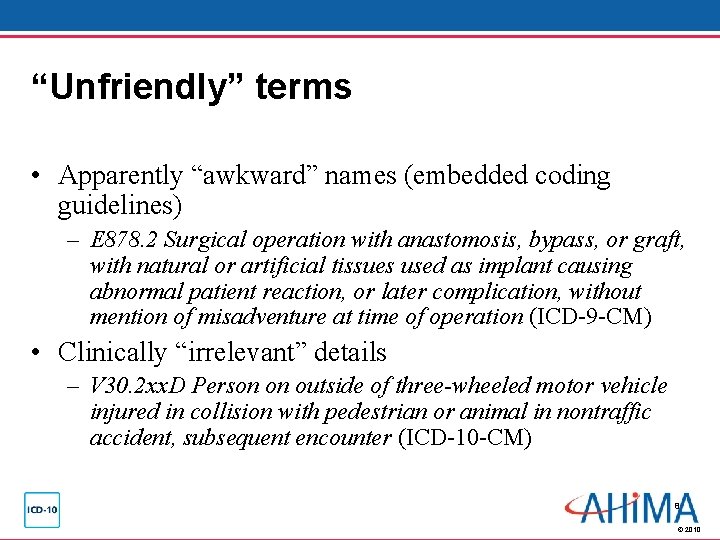
“Unfriendly” terms • Apparently “awkward” names (embedded coding guidelines) – E 878. 2 Surgical operation with anastomosis, bypass, or graft, with natural or artificial tissues used as implant causing abnormal patient reaction, or later complication, without mention of misadventure at time of operation (ICD-9 -CM) • Clinically “irrelevant” details – V 30. 2 xx. D Person on outside of three-wheeled motor vehicle injured in collision with pedestrian or animal in nontraffic accident, subsequent encounter (ICD-10 -CM) 8 © 2010
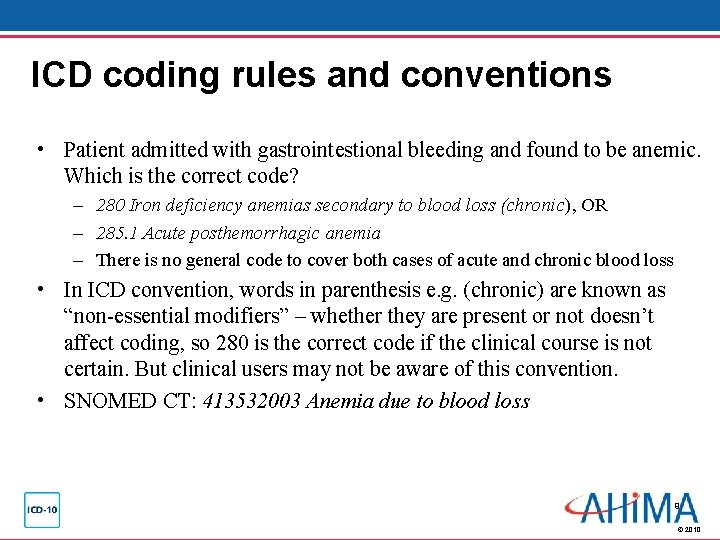
ICD coding rules and conventions • Patient admitted with gastrointestional bleeding and found to be anemic. Which is the correct code? – 280 Iron deficiency anemias secondary to blood loss (chronic), OR – 285. 1 Acute posthemorrhagic anemia – There is no general code to cover both cases of acute and chronic blood loss • In ICD convention, words in parenthesis e. g. (chronic) are known as “non-essential modifiers” – whether they are present or not doesn’t affect coding, so 280 is the correct code if the clinical course is not certain. But clinical users may not be aware of this convention. • SNOMED CT: 413532003 Anemia due to blood loss 9 © 2010
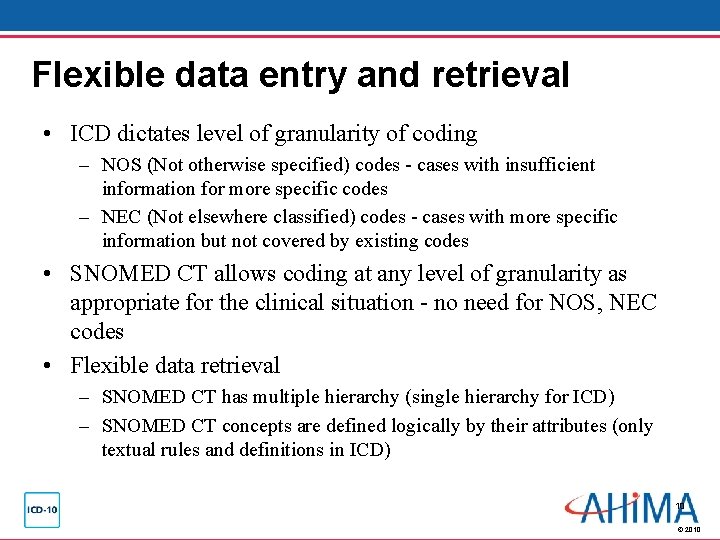
Flexible data entry and retrieval • ICD dictates level of granularity of coding – NOS (Not otherwise specified) codes - cases with insufficient information for more specific codes – NEC (Not elsewhere classified) codes - cases with more specific information but not covered by existing codes • SNOMED CT allows coding at any level of granularity as appropriate for the clinical situation - no need for NOS, NEC codes • Flexible data retrieval – SNOMED CT has multiple hierarchy (single hierarchy for ICD) – SNOMED CT concepts are defined logically by their attributes (only textual rules and definitions in ICD) 10 © 2010
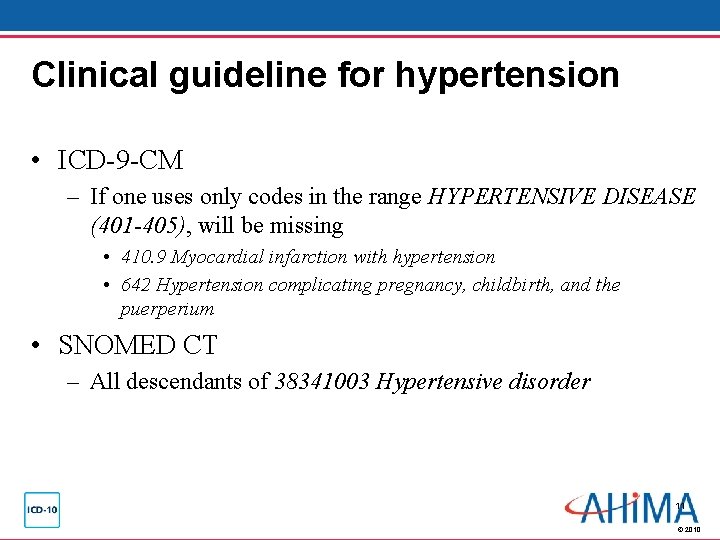
Clinical guideline for hypertension • ICD-9 -CM – If one uses only codes in the range HYPERTENSIVE DISEASE (401 -405), will be missing • 410. 9 Myocardial infarction with hypertension • 642 Hypertension complicating pregnancy, childbirth, and the puerperium • SNOMED CT – All descendants of 38341003 Hypertensive disorder 11 © 2010
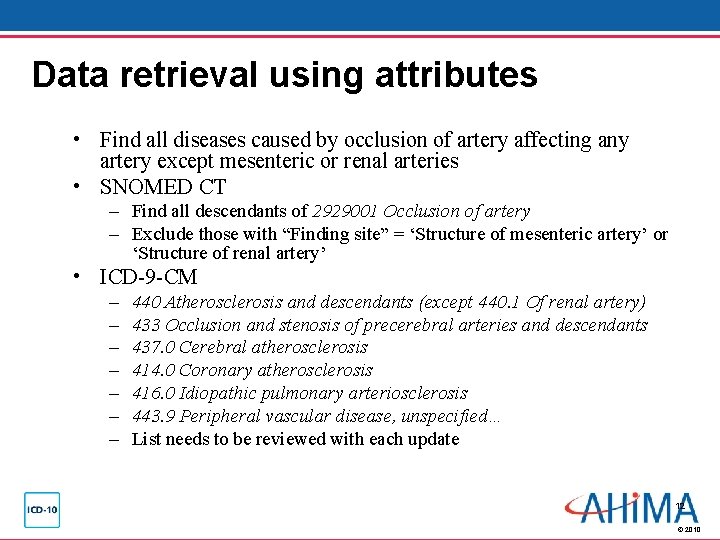
Data retrieval using attributes • Find all diseases caused by occlusion of artery affecting any artery except mesenteric or renal arteries • SNOMED CT – Find all descendants of 2929001 Occlusion of artery – Exclude those with “Finding site” = ‘Structure of mesenteric artery’ or ‘Structure of renal artery’ • ICD-9 -CM – – – – 440 Atherosclerosis and descendants (except 440. 1 Of renal artery) 433 Occlusion and stenosis of precerebral arteries and descendants 437. 0 Cerebral atherosclerosis 414. 0 Coronary atherosclerosis 416. 0 Idiopathic pulmonary arteriosclerosis 443. 9 Peripheral vascular disease, unspecified… List needs to be reviewed with each update 12 © 2010
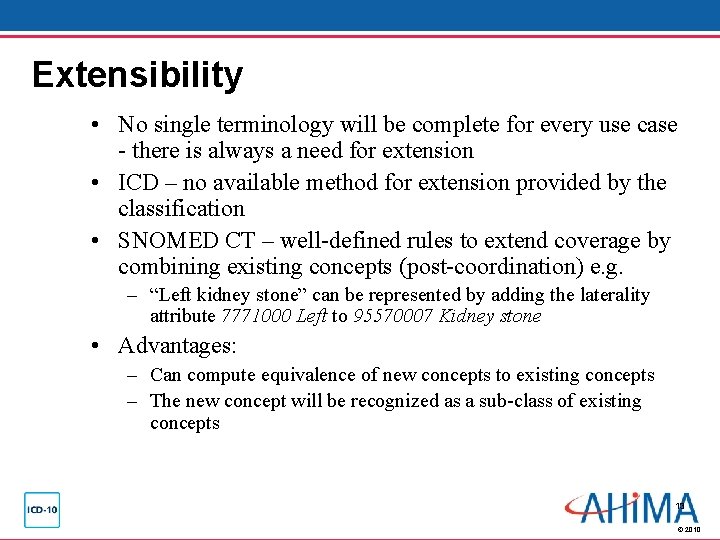
Extensibility • No single terminology will be complete for every use case - there is always a need for extension • ICD – no available method for extension provided by the classification • SNOMED CT – well-defined rules to extend coverage by combining existing concepts (post-coordination) e. g. – “Left kidney stone” can be represented by adding the laterality attribute 7771000 Left to 95570007 Kidney stone • Advantages: – Can compute equivalence of new concepts to existing concepts – The new concept will be recognized as a sub-class of existing concepts 13 © 2010
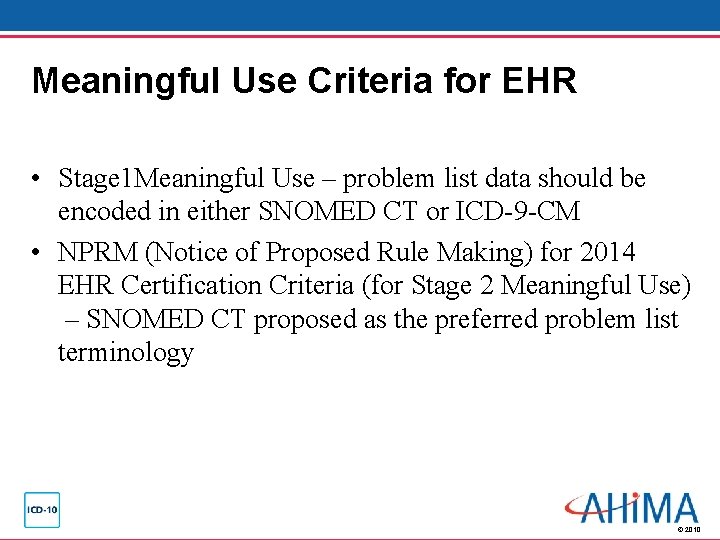
Meaningful Use Criteria for EHR • Stage 1 Meaningful Use – problem list data should be encoded in either SNOMED CT or ICD-9 -CM • NPRM (Notice of Proposed Rule Making) for 2014 EHR Certification Criteria (for Stage 2 Meaningful Use) – SNOMED CT proposed as the preferred problem list terminology © 2010
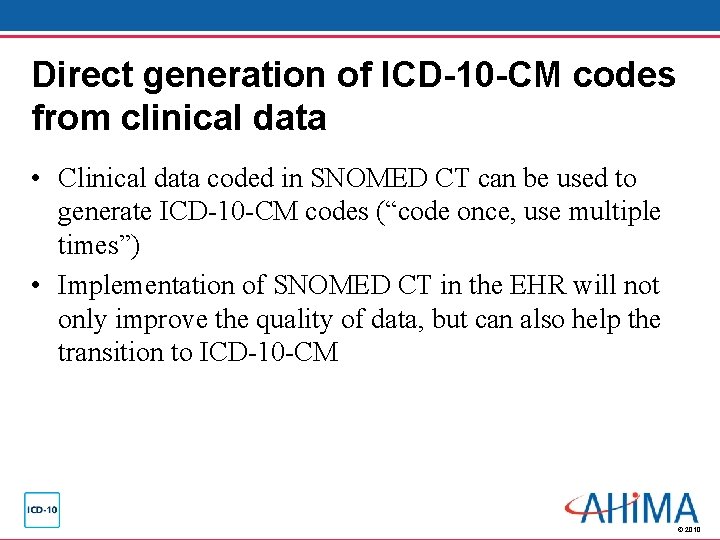
Direct generation of ICD-10 -CM codes from clinical data • Clinical data coded in SNOMED CT can be used to generate ICD-10 -CM codes (“code once, use multiple times”) • Implementation of SNOMED CT in the EHR will not only improve the quality of data, but can also help the transition to ICD-10 -CM © 2010
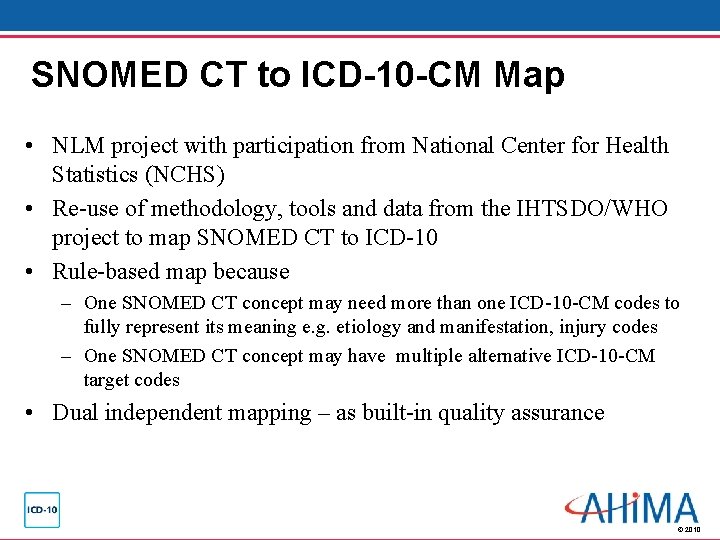
SNOMED CT to ICD-10 -CM Map • NLM project with participation from National Center for Health Statistics (NCHS) • Re-use of methodology, tools and data from the IHTSDO/WHO project to map SNOMED CT to ICD-10 • Rule-based map because – One SNOMED CT concept may need more than one ICD-10 -CM codes to fully represent its meaning e. g. etiology and manifestation, injury codes – One SNOMED CT concept may have multiple alternative ICD-10 -CM target codes • Dual independent mapping – as built-in quality assurance © 2010
Scope of the map • Only mapping those SNOMED CT concepts suitable for the problem list: clinical findings, events and situation • Commonly occurring concepts are mapped first – CORE Problem List Subset – Donated content from Kaiser Permanente’s Convergent Medical Terminology (CMT) • Preview publication released in February - covers 7, 000 concepts • Final release in June – about 15, 000 concepts © 2010
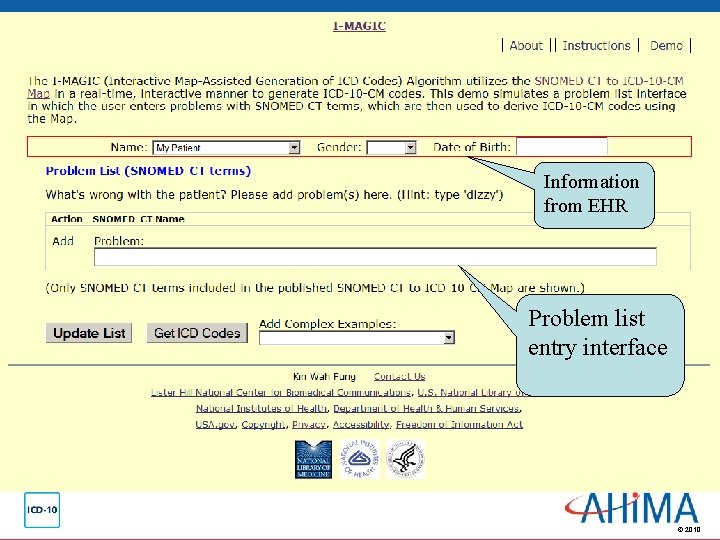
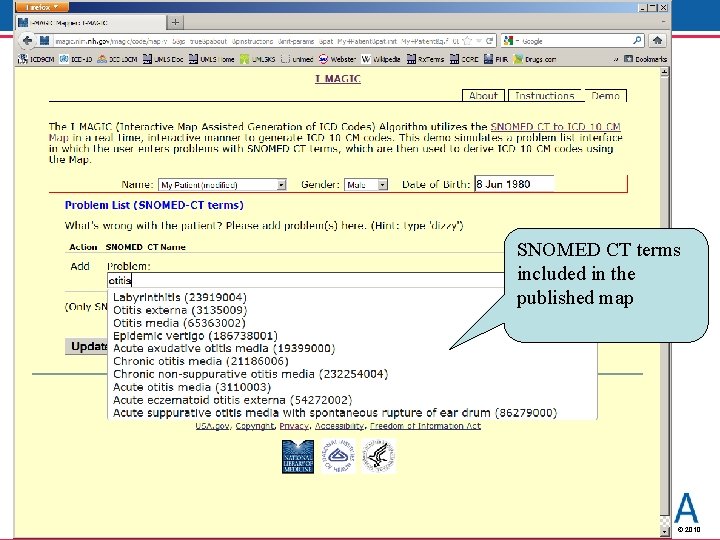
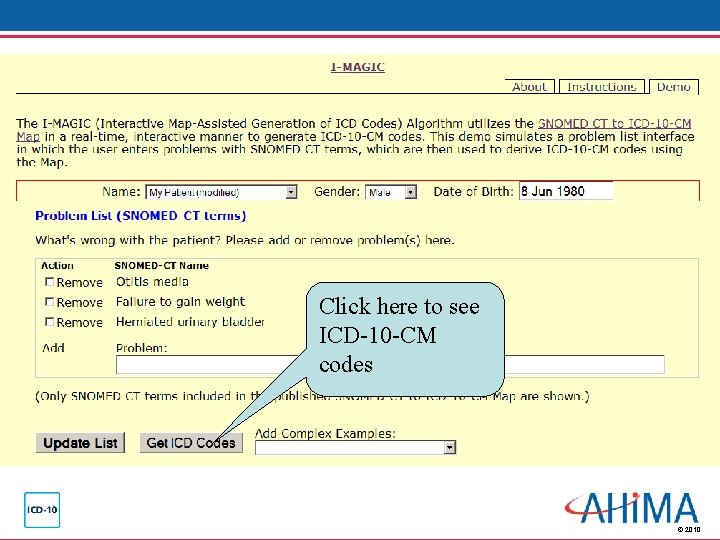
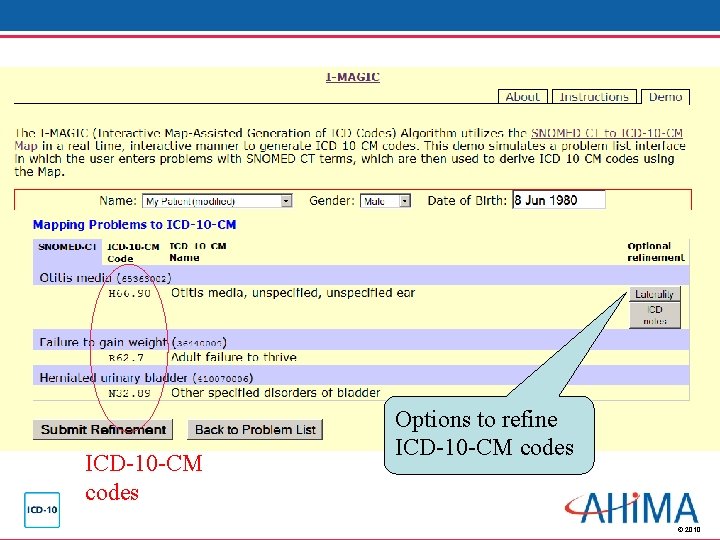
Intended uses of the map • Embedded in the EHR to find ICD-10 -CM codes in realtime – the I-MAGIC (Interactive Map-Assisted Generation of ICD Codes) use case • To assist coding professionals by suggesting ICD codes based on SNOMED CT-encoded problems © 2010
I-MAGIC demo tool • http: //imagic. nlm. nih. gov/imagic/code/map © 2010
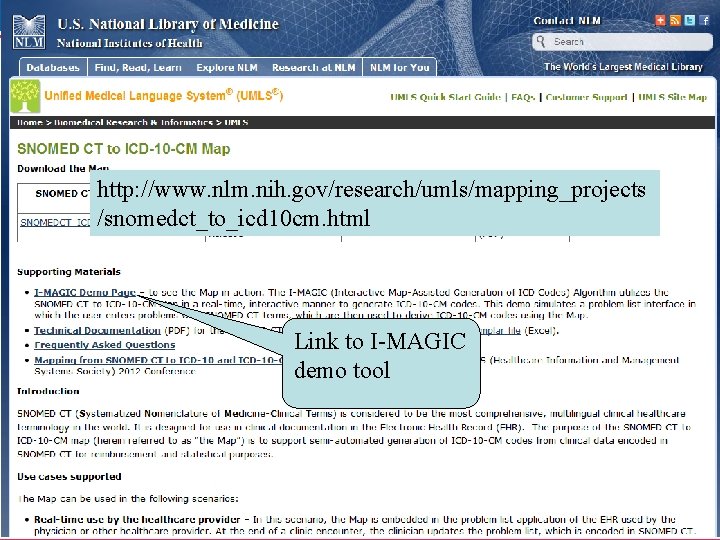
Link to I-MAGIC Demo Tool http: //www. nlm. nih. gov/research/umls/mapping_projects /snomedct_to_icd 10 cm. html Link to I-MAGIC demo tool © 2010
I-MAGIC Screen Capture - Homepage Information from EHR Problem list entry interface © 2010
I-MAGIC Screen Capture – Problem List SNOMED CT terms included in the published map © 2010
I-MAGIC Screen Capture – Get ICD Codes Button Click here to see ICD-10 -CM codes © 2010
I-MAGIC Screen Capture – Refine ICD 10 -CM Codes ICD-10 -CM codes Options to refine ICD-10 -CM codes © 2010
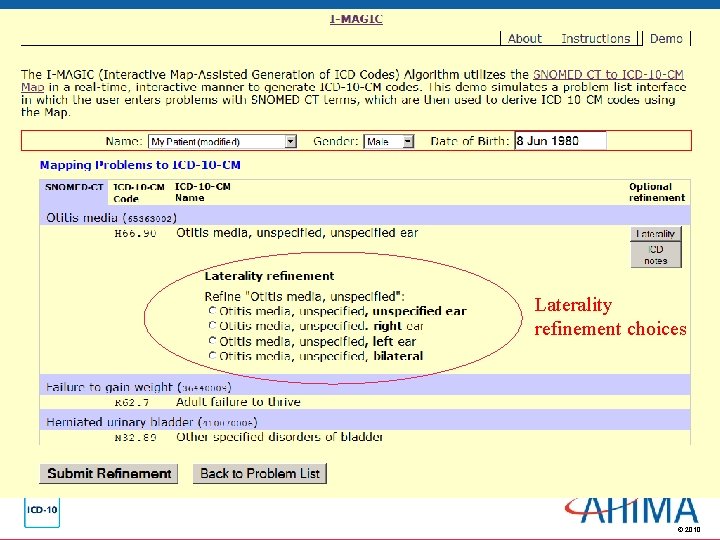
Laterality refinement choices © 2010
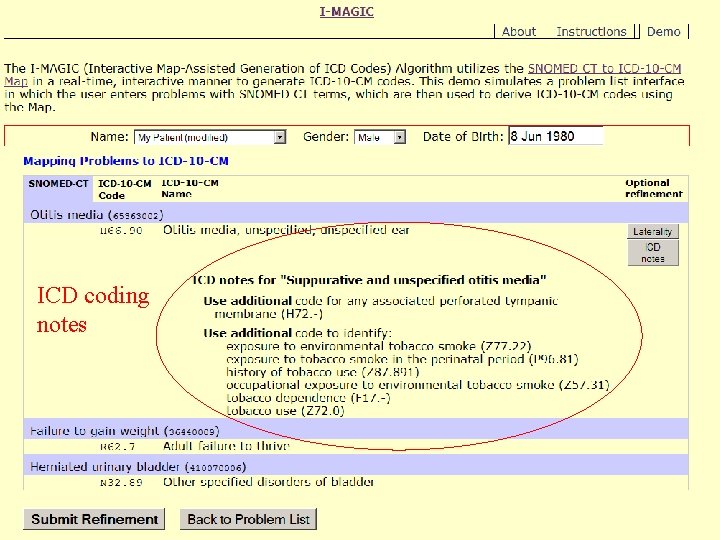
ICD coding notes © 2010
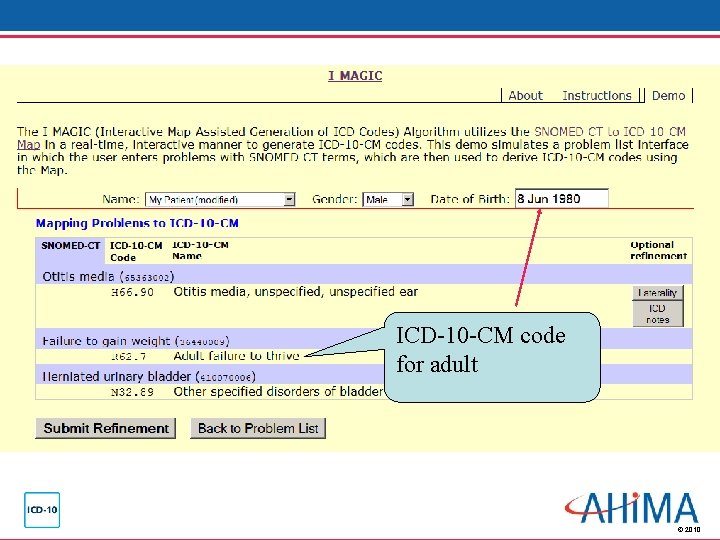
I-MAGIC Screen Capture – ICD-10 -CM Code for Adult ICD-10 -CM code for adult © 2010
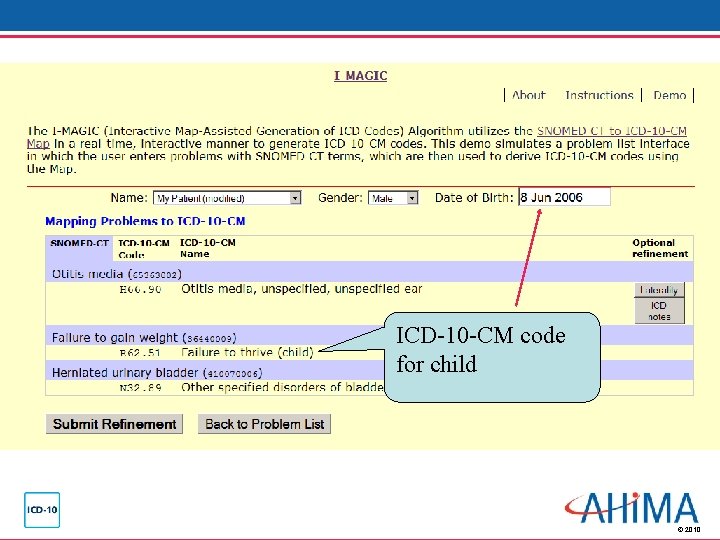
I-MAGIC Screen Capture – ICD-10 Code for Child ICD-10 -CM code for child © 2010
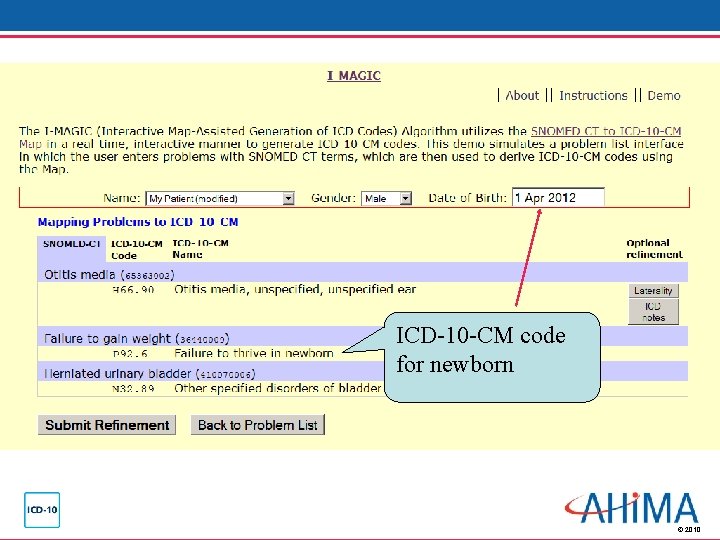
I-MAGIC Screen Capture – ICD-10 -CM Code for Newborn ICD-10 -CM code for newborn © 2010
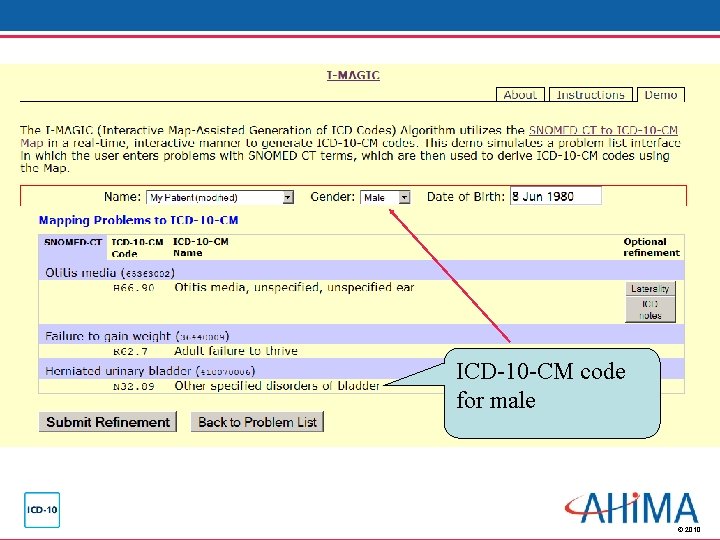
I-MAGIC Screen Capture – ICD-10 -CM Code for Male ICD-10 -CM code for male © 2010
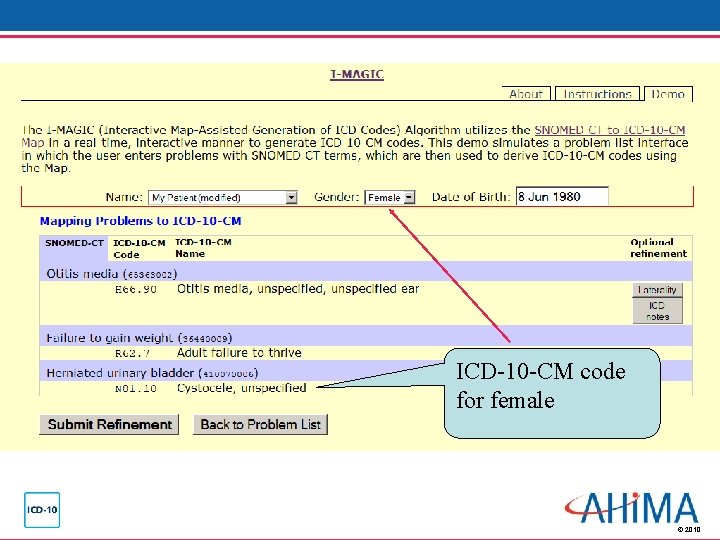
I-MAGIC Screen Capture – ICD-10 -CM Code for Female ICD-10 -CM code for female © 2010
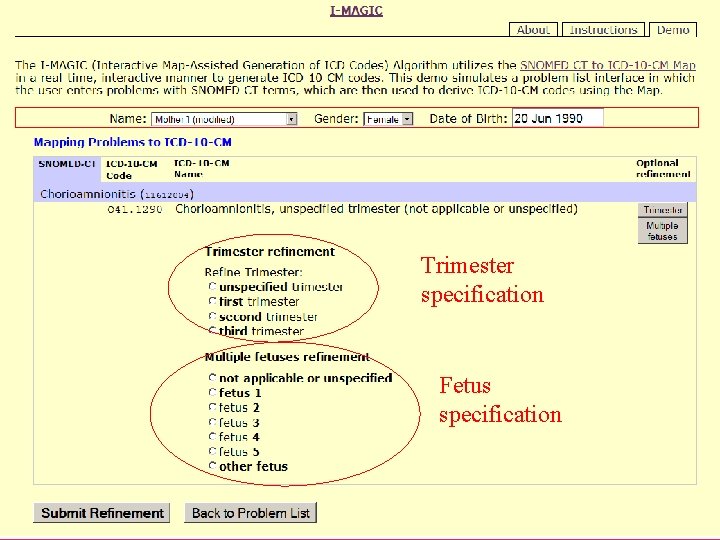
Trimester specification Fetus specification © 2010
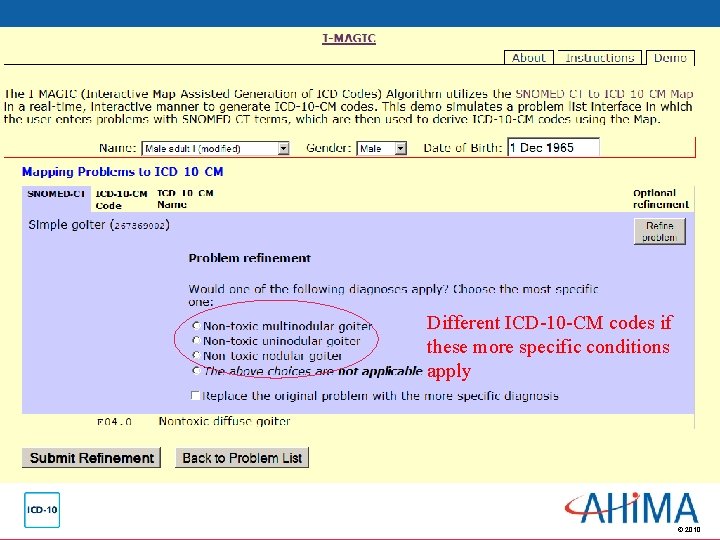
Different ICD-10 -CM codes if these more specific conditions apply © 2010
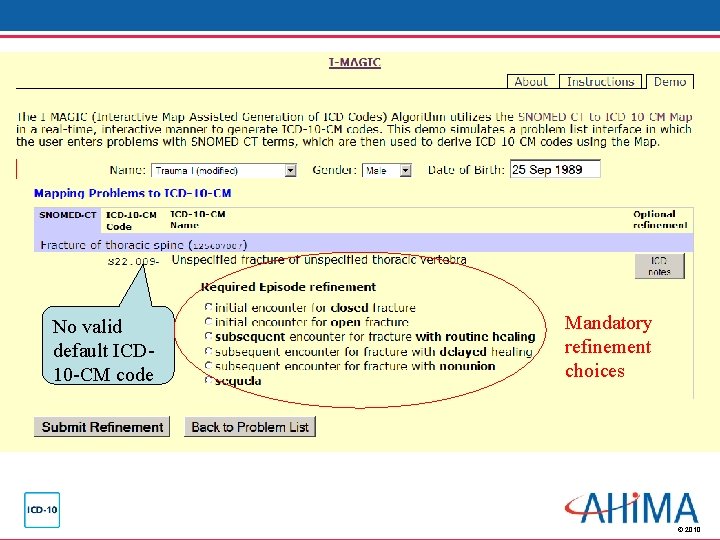
I-MAGIC Screen Capture – Mandatory Refinement Choices No valid default ICD 10 -CM code Mandatory refinement choices © 2010
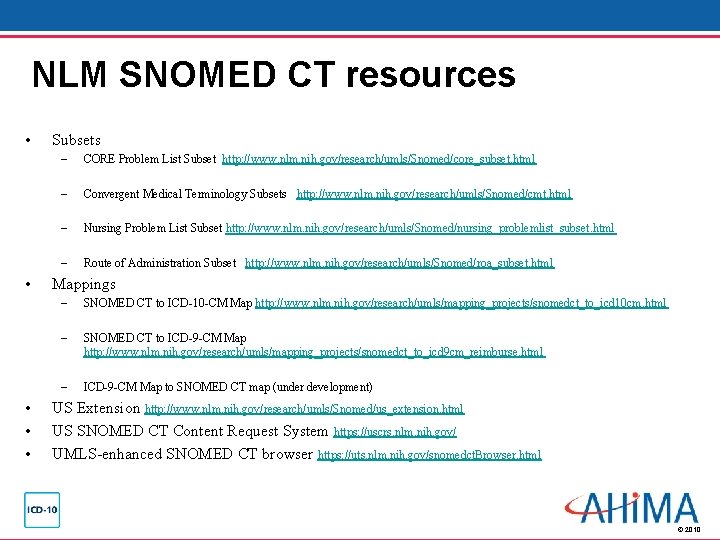
NLM SNOMED CT resources • • • Subsets – CORE Problem List Subset http: //www. nlm. nih. gov/research/umls/Snomed/core_subset. html – Convergent Medical Terminology Subsets http: //www. nlm. nih. gov/research/umls/Snomed/cmt. html – Nursing Problem List Subset http: //www. nlm. nih. gov/research/umls/Snomed/nursing_problemlist_subset. html – Route of Administration Subset http: //www. nlm. nih. gov/research/umls/Snomed/roa_subset. html Mappings – SNOMED CT to ICD-10 -CM Map http: //www. nlm. nih. gov/research/umls/mapping_projects/snomedct_to_icd 10 cm. html – SNOMED CT to ICD-9 -CM Map http: //www. nlm. nih. gov/research/umls/mapping_projects/snomedct_to_icd 9 cm_reimburse. html – ICD-9 -CM Map to SNOMED CT map (under development) US Extension http: //www. nlm. nih. gov/research/umls/Snomed/us_extension. html US SNOMED CT Content Request System https: //uscrs. nlm. nih. gov/ UMLS-enhanced SNOMED CT browser https: //uts. nlm. nih. gov/snomedct. Browser. html © 2010
Questions? • kwfung@nlm. nih. gov © 2010