
How safe is safe enough and how do
- Slides: 21
How safe is safe enough? (and how do we demonstrate that? ) Dr David Pumfrey High Integrity Systems Engineering Group Department of Computer Science University of York
Why System Safety ? Why do we strive to make systems safe? Self interest we wouldn’t want to be harmed by systems we develop and use unsafe systems are bad business We have to do so required by law required by standards But what do the law and standards represent? laws try to prevent what society finds morally unacceptable ultimately assessed by the courts, as representatives of society standards try to define what is acceptable practise to discharge legal and moral responsibilities 2
Perception of Safety Perception (and hence individual acceptance) of risk affected by many factors (Apparent) degree of control Number of deaths in one accident (aircraft versus cars) Familiarity vs. novelty “Dreadness” of risk (“falling out of the sky”, nuclear radiation) Voluntary vs. involuntary risk (hang gliding vs nuclear accident) Politics and journalism Frequency / profile of reporting of accidents / issues Experience Individual factors – age, sex, religion, culture How do companies (engineers? ) make decisions given diversity of views? 3
Getting it wrong – some examples Ariane 5 (mis-use of legacy software) A 330 ADIRUs (software could not cope with hardware failure mode) Boeing 777 (software error allowed switch back to ADIRU that had previously been detected as faulty) Therac 25 (software errors contributed to radiotherapy overdose accidents) 4
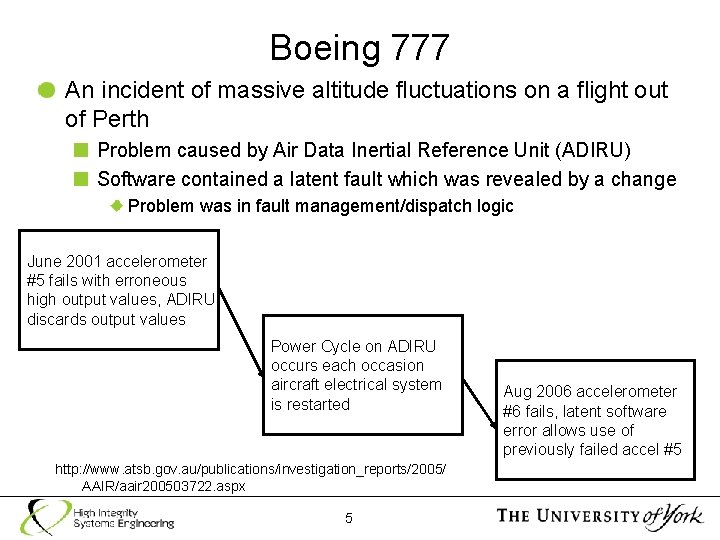
Boeing 777 An incident of massive altitude fluctuations on a flight out of Perth Problem caused by Air Data Inertial Reference Unit (ADIRU) Software contained a latent fault which was revealed by a change Problem was in fault management/dispatch logic June 2001 accelerometer #5 fails with erroneous high output values, ADIRU discards output values Power Cycle on ADIRU occurs each occasion aircraft electrical system is restarted http: //www. atsb. gov. au/publications/investigation_reports/2005/ AAIR/aair 200503722. aspx 5 Aug 2006 accelerometer #6 fails, latent software error allows use of previously failed accel #5
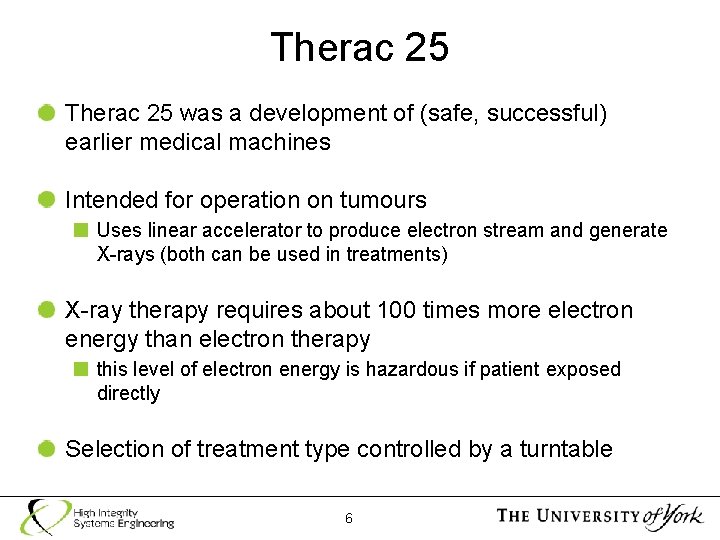
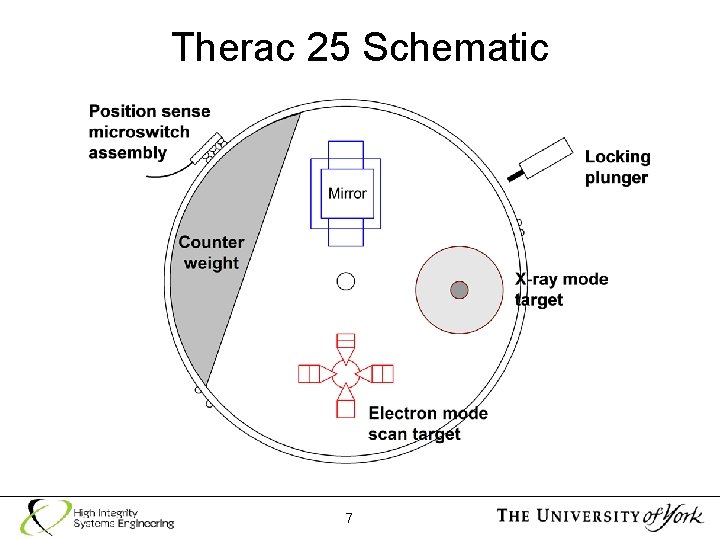
Therac 25 was a development of (safe, successful) earlier medical machines Intended for operation on tumours Uses linear accelerator to produce electron stream and generate X-rays (both can be used in treatments) X-ray therapy requires about 100 times more electron energy than electron therapy this level of electron energy is hazardous if patient exposed directly Selection of treatment type controlled by a turntable 6
Therac 25 Schematic 7
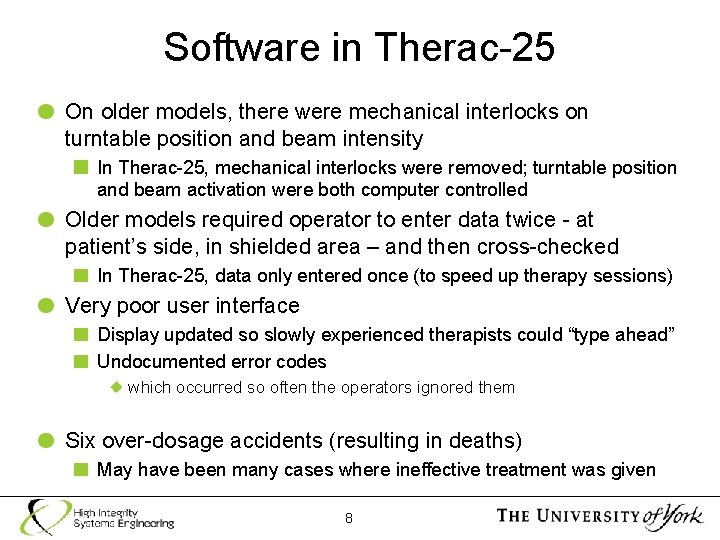
Software in Therac-25 On older models, there were mechanical interlocks on turntable position and beam intensity In Therac-25, mechanical interlocks were removed; turntable position and beam activation were both computer controlled Older models required operator to enter data twice - at patient’s side, in shielded area – and then cross-checked In Therac-25, data only entered once (to speed up therapy sessions) Very poor user interface Display updated so slowly experienced therapists could “type ahead” Undocumented error codes which occurred so often the operators ignored them Six over-dosage accidents (resulting in deaths) May have been many cases where ineffective treatment was given 8
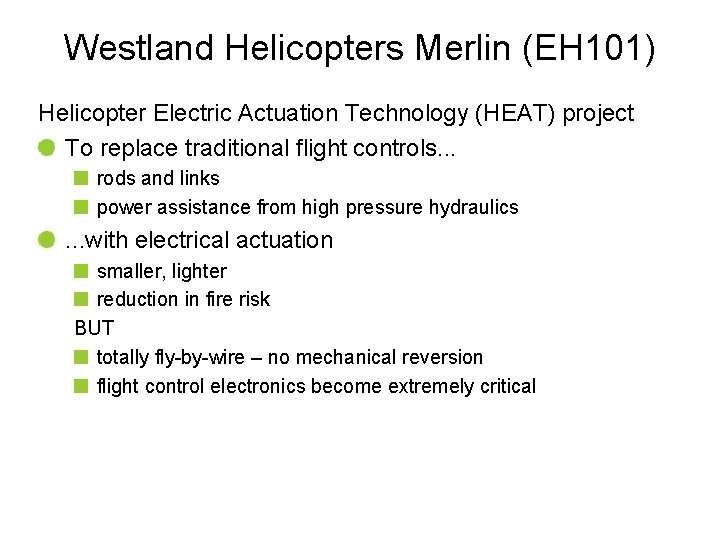
Westland Helicopters Merlin (EH 101) Helicopter Electric Actuation Technology (HEAT) project To replace traditional flight controls. . . rods and links power assistance from high pressure hydraulics . . . with electrical actuation smaller, lighter reduction in fire risk BUT totally fly-by-wire – no mechanical reversion flight control electronics become extremely critical
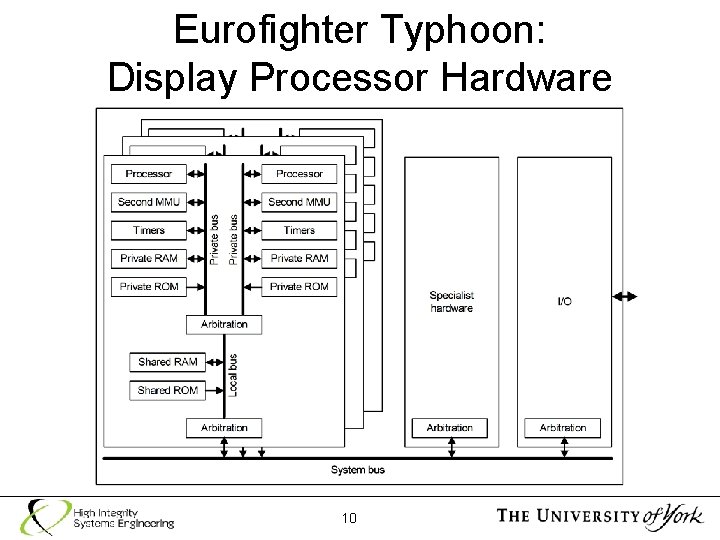
Eurofighter Typhoon: Display Processor Hardware 10
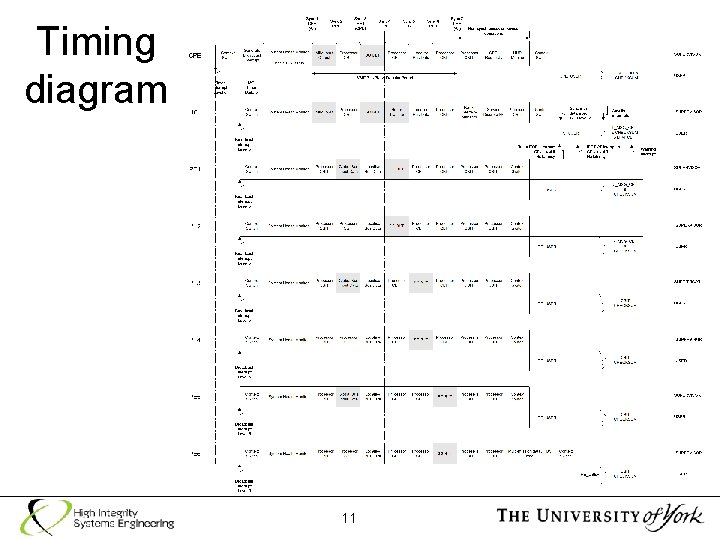
Timing diagram 11
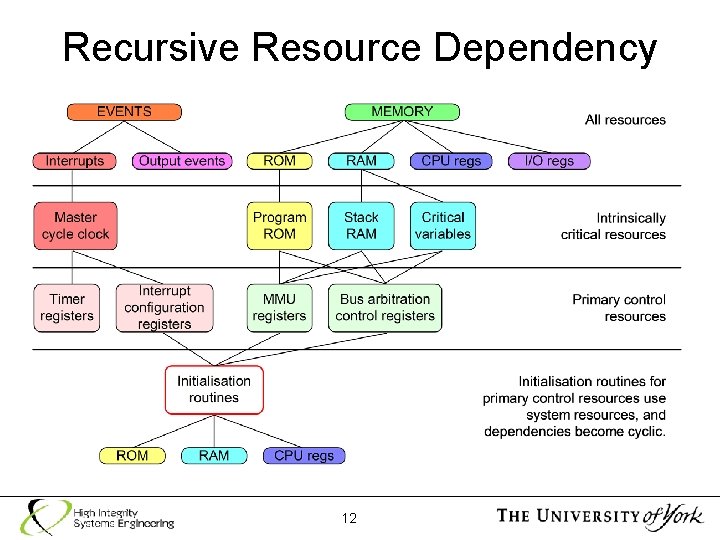
Recursive Resource Dependency 12
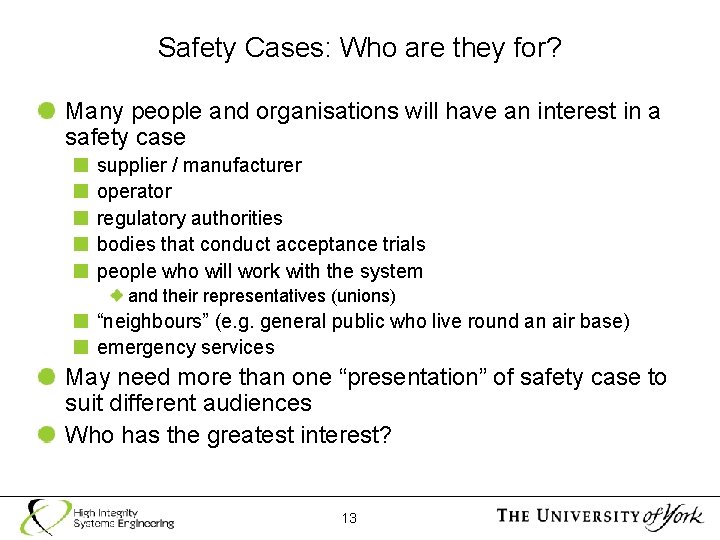
Safety Cases: Who are they for? Many people and organisations will have an interest in a safety case supplier / manufacturer operator regulatory authorities bodies that conduct acceptance trials people who will work with the system and their representatives (unions) “neighbours” (e. g. general public who live round an air base) emergency services May need more than one “presentation” of safety case to suit different audiences Who has the greatest interest? 13
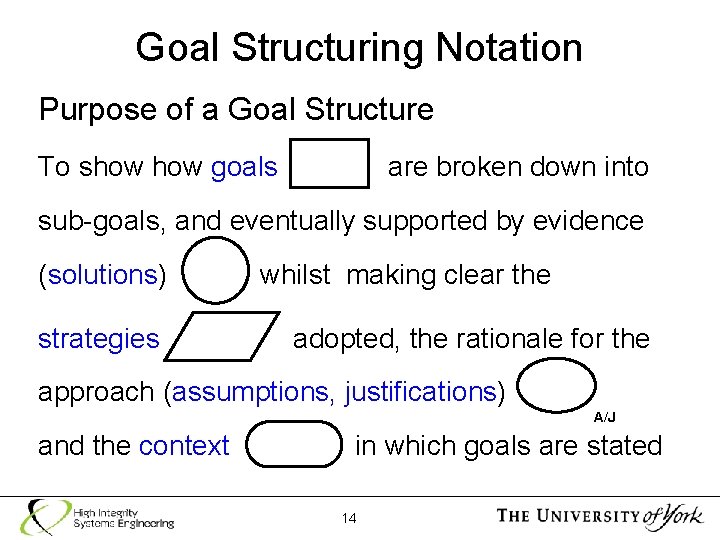
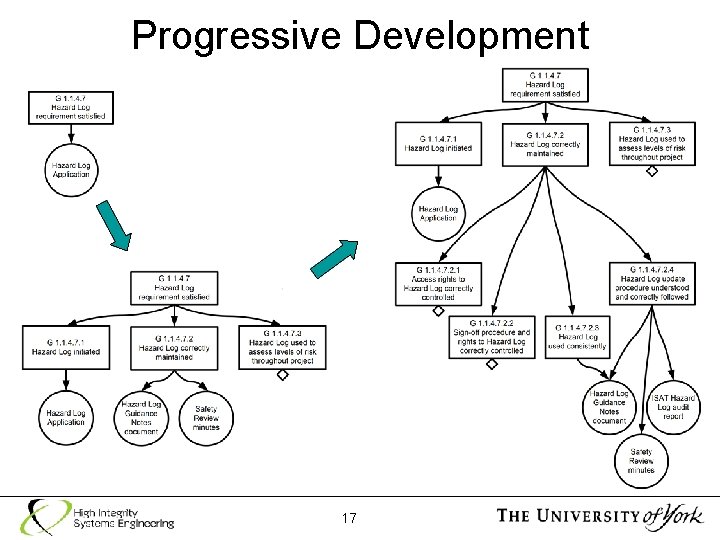
Goal Structuring Notation Purpose of a Goal Structure To show goals are broken down into sub-goals, and eventually supported by evidence (solutions) strategies whilst making clear the adopted, the rationale for the approach (assumptions, justifications) A/J and the context in which goals are stated 14
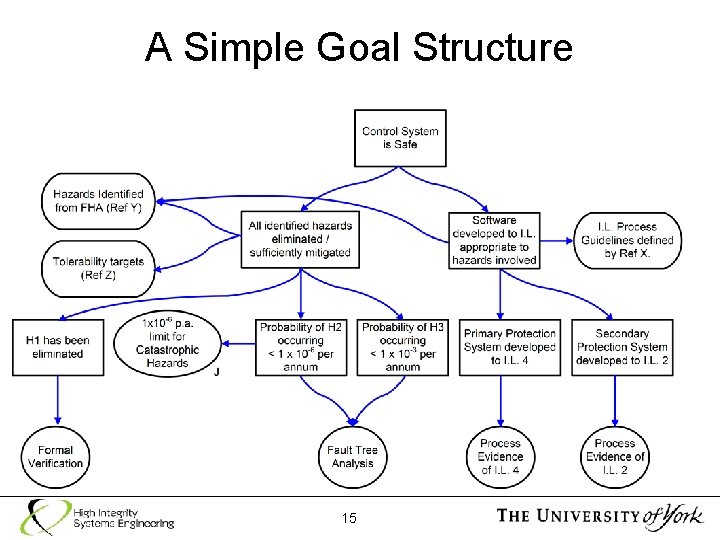
A Simple Goal Structure 15
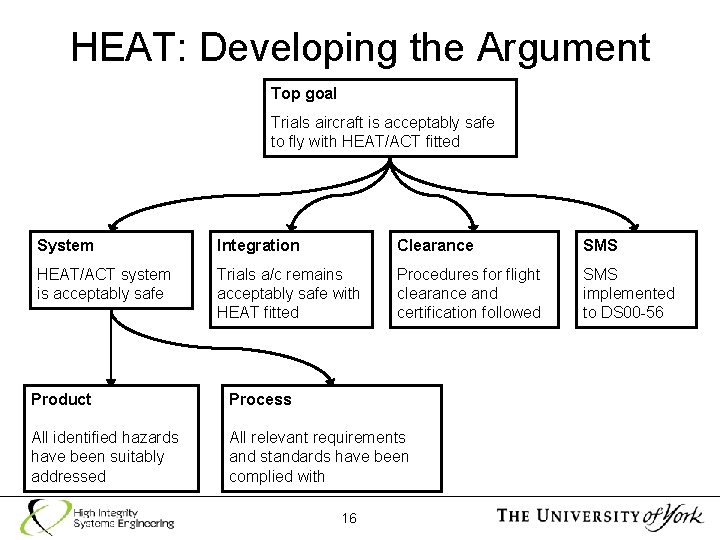
HEAT: Developing the Argument Top goal Trials aircraft is acceptably safe to fly with HEAT/ACT fitted System Integration Clearance SMS HEAT/ACT system is acceptably safe Trials a/c remains acceptably safe with HEAT fitted Procedures for flight clearance and certification followed SMS implemented to DS 00 -56 Product Process All identified hazards have been suitably addressed All relevant requirements and standards have been complied with 16
Progressive Development 17
An analogy Safety case like a legal case presented in court Like a legal case, a safety case must: be clear be credible be compelling make best use of available evidence Like a legal case, a safety case will always be subjective There is no such thing as absolute safety Safety can never be proved Always making an argument of acceptability 18
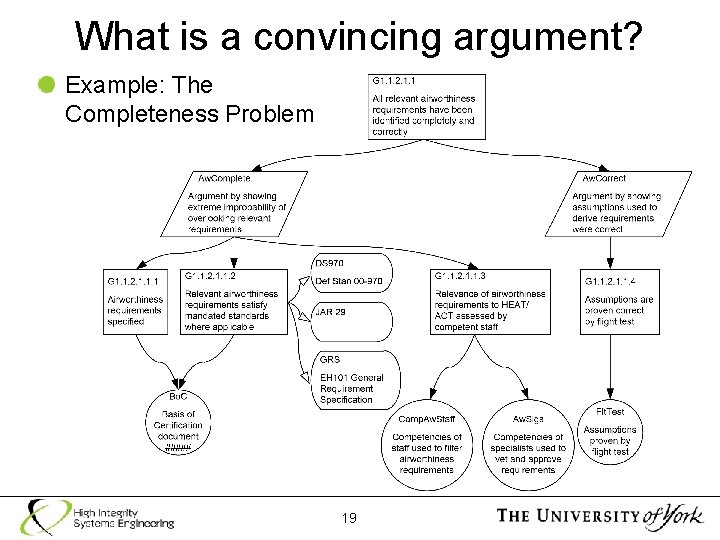
What is a convincing argument? Example: The Completeness Problem 19
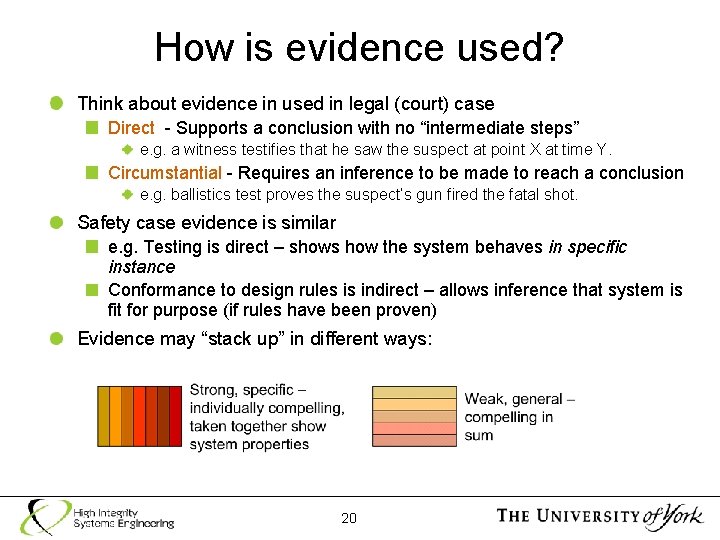
How is evidence used? Think about evidence in used in legal (court) case Direct - Supports a conclusion with no “intermediate steps” e. g. a witness testifies that he saw the suspect at point X at time Y. Circumstantial - Requires an inference to be made to reach a conclusion e. g. ballistics test proves the suspect’s gun fired the fatal shot. Safety case evidence is similar e. g. Testing is direct – shows how the system behaves in specific instance Conformance to design rules is indirect – allows inference that system is fit for purpose (if rules have been proven) Evidence may “stack up” in different ways: 20
Conclusions Demonstrating safety is a challenge We are building ever more complex systems Much of the “bespoke” complexity is in software Essential that safety is a design driver. . . and also, design for ability to demonstrate safety 21