
How Psychological Assessments Can Help You With Those



- Slides: 30
How Psychological Assessments Can Help You With Those Puzzling Patients Add Your Name Here
What Percent of Primary Care Visits Are Driven By Psychological Factors? Cummings & Vanden. Bos, 1981
Of The 10 Most Common Physical Complaints In Primary Care, What Percent Were Explained Organically ? Kroenke & Mangelsdorff, 1989
Primary care MDs treat more patients with psychological conditions than do mental health professionals
In The Fast Pace of Primary Care, Many Mental Health Patients Fall Through the Cracks n Patients with psychological problems are difficult to treat in the primary care system n As a result, psychiatric disorders are overlooked by primary care physicians between 33% and 79% of the time (Higgins, 1994).
You Order Tests All Of The Time X-rays, MRIs, Blood Tests, EKGs, etc.
Ironically, what you see so often — Stress and Psych Problems — is the one thing you cannot order a test for. Until now.
True or False? n Since pain and depression are subjective states, they cannot be measured scientifically. n False
Psychometrics is the scientific method used to assess subjective states, such as pain, depression or anxiety.
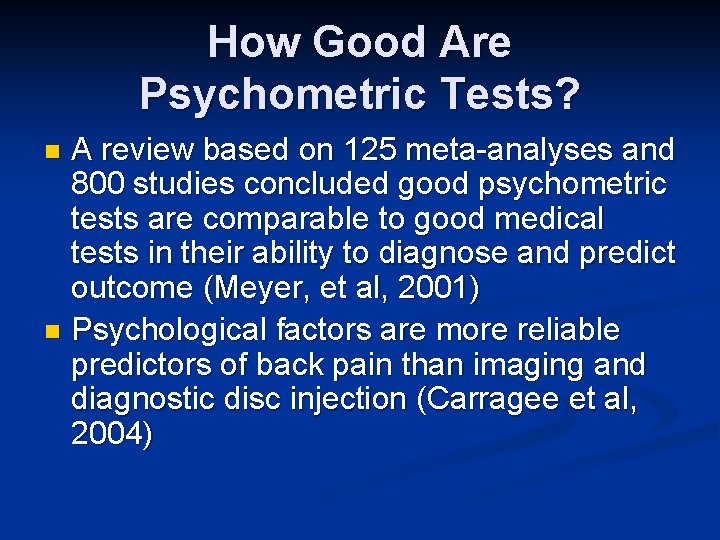
How Good Are Psychometric Tests? A review based on 125 meta-analyses and 800 studies concluded good psychometric tests are comparable to good medical tests in their ability to diagnose and predict outcome (Meyer, et al, 2001) n Psychological factors are more reliable predictors of back pain than imaging and diagnostic disc injection (Carragee et al, 2004) n
What is the Value of using Psychological Tests n How much more difficult would you life be if you didn’t have tests like x-rays or blood tests? n In the same way, psychometric tests can help you assess subjective experiences, and identify psychosocial complications
New psychological tests, like the BHI™ 2 and BBHI™ 2, have been developed specifically use with medical patients… and can help to answer many of your questions.
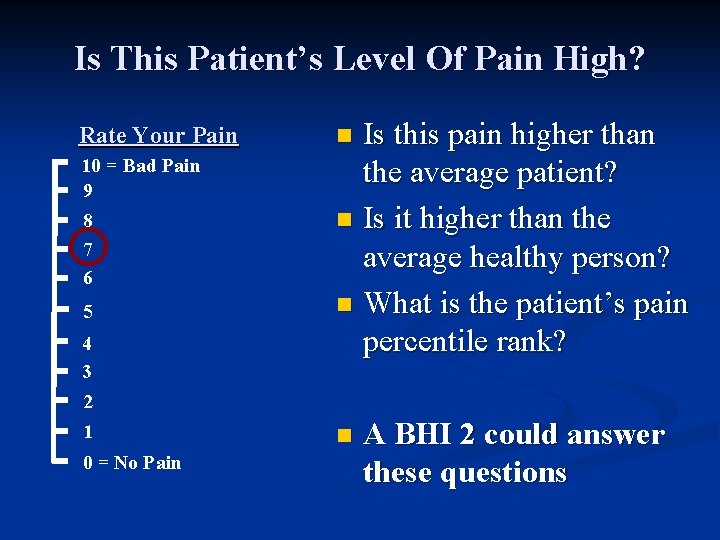
Is This Patient’s Level Of Pain High? Rate Your Pain 10 = Bad Pain 9 8 7 6 5 4 3 2 1 0 = No Pain Is this pain higher than the average patient? n Is it higher than the average healthy person? n What is the patient’s pain percentile rank? n n A BHI 2 could answer these questions
Only BHIConditions 2 Assesses Bring All Of What. The Psych These Variables Patients into Primary Care? Anxiety 20% Depression 20% Miscellaneous includes Misc substance abuse & personality 15% disorders Job Stress 10% Chronic Pain/ Somatization 25% Family Problems 10% Tulkin and Gordon, 1998
The BHI 2 was designed to help psychologists and physicians collaborate n It can help to answer a physician’s questions n It points out to the psychologist what info is needed from the physician
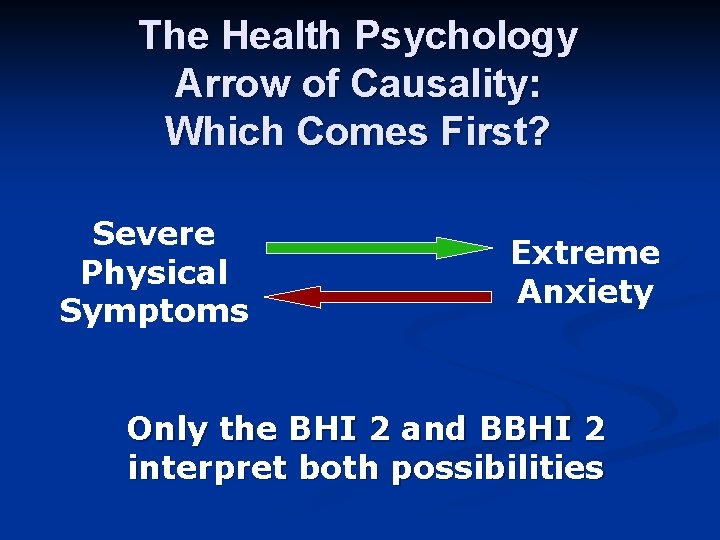
The Health Psychology Arrow of Causality: Which Comes First? Severe Physical Symptoms Extreme Anxiety Only the BHI 2 and BBHI 2 interpret both possibilities
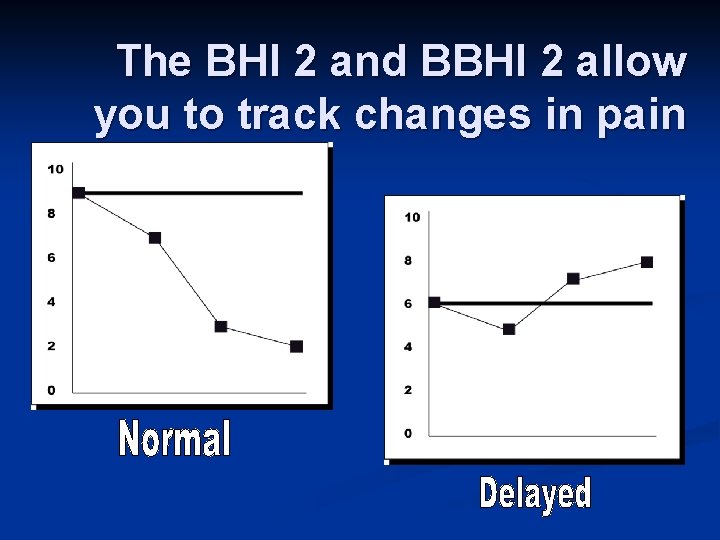
The BHI 2 and BBHI 2 allow you to track changes in pain
The BHI 2 Was Designed to Assess Common Psychological Concerns Depression n Anxiety n Family Dysfunction n Survivor of Violence n Borderline personality n Etc. n
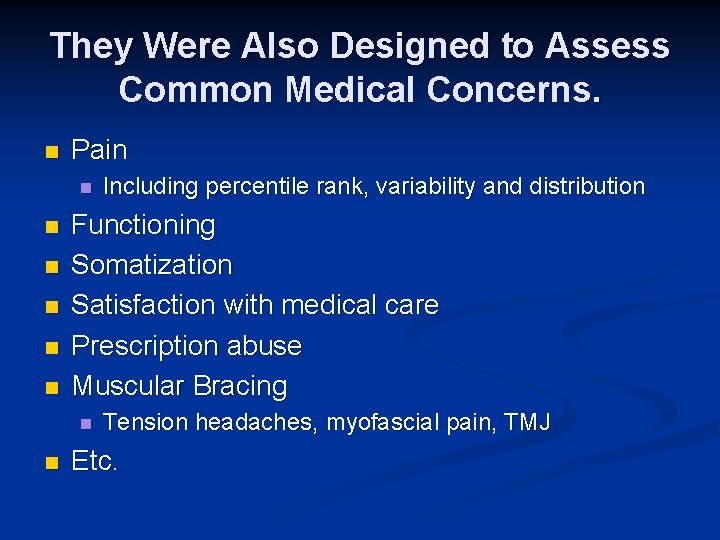
They Were Also Designed to Assess Common Medical Concerns. n Pain n n n Functioning Somatization Satisfaction with medical care Prescription abuse Muscular Bracing n n Including percentile rank, variability and distribution Tension headaches, myofascial pain, TMJ Etc.
For Those Patients Who Are Especially Puzzling A certain percentage of psychologically-involved patients may be difficult for you to figure out. A referral for a BHI 2 test might shed some light on the matter.
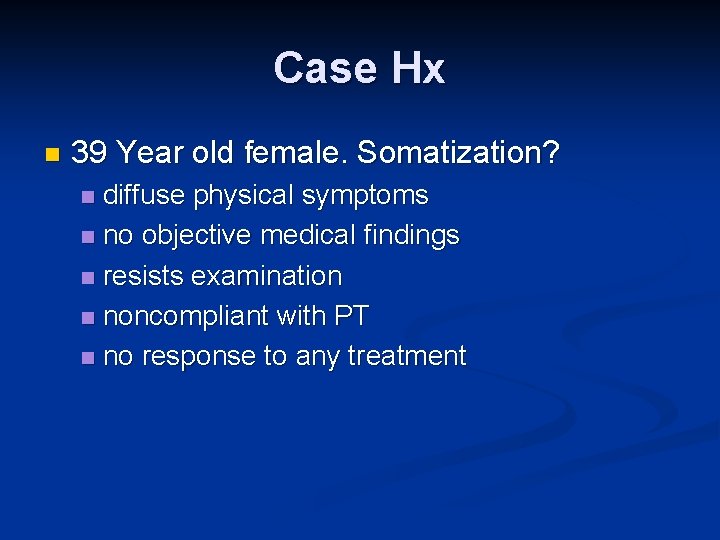
Case Hx n 39 Year old female. Somatization? diffuse physical symptoms n no objective medical findings n resists examination n noncompliant with PT n no response to any treatment n
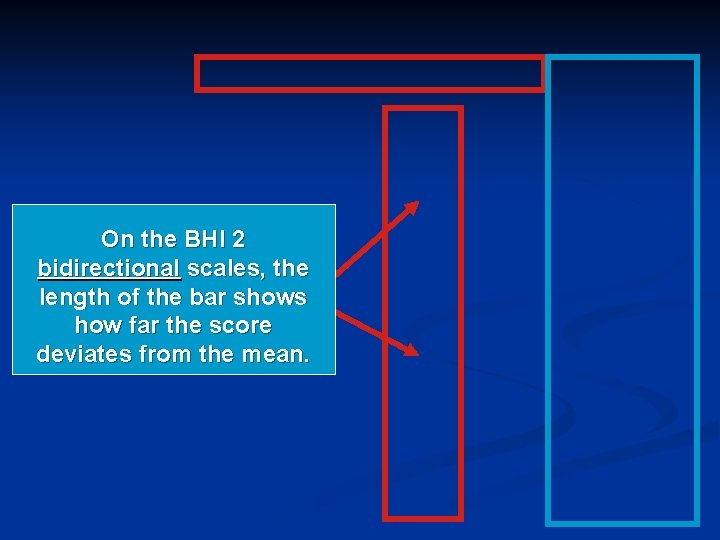
On the BHI 2 bidirectional scales, the length of the bar shows how far the score deviates from the mean.
Validity Scales These validity scores give no indication of biased responding
Physical Symptom Scales Unusually high level of diffuse somatic symptoms, coupled with great difficulties functioning
Affective Scales Reports of depression are higher than 87% of patients Very low level of anger. Total absence of anger, or difficulty expressing angry feelings? (Somatization often involves denied feelings)
Psychosocial Scales The patient reports a history of trauma and abuse. Is that why she hates being examined? The patient views the workplace and medical setting as being supportive.
Character Scales Symptom Dependency High = using symptoms to meet dependency needs Perseverance High = still showing some determination and optimism
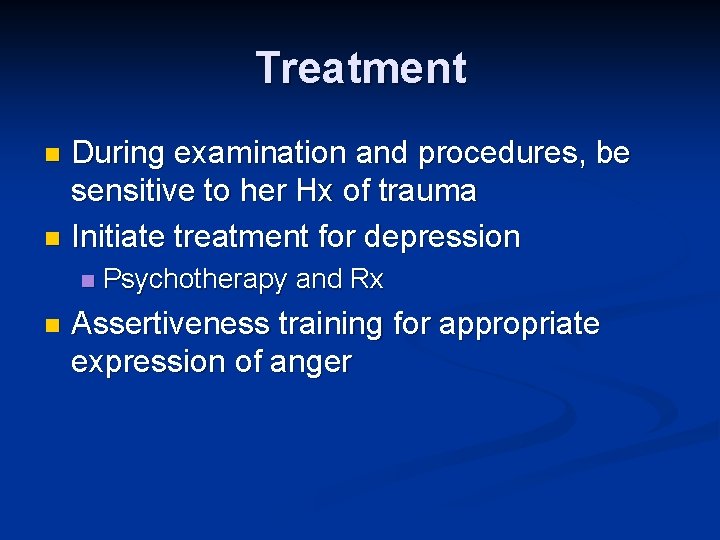
Treatment During examination and procedures, be sensitive to her Hx of trauma n Initiate treatment for depression n Psychotherapy and Rx Assertiveness training for appropriate expression of anger
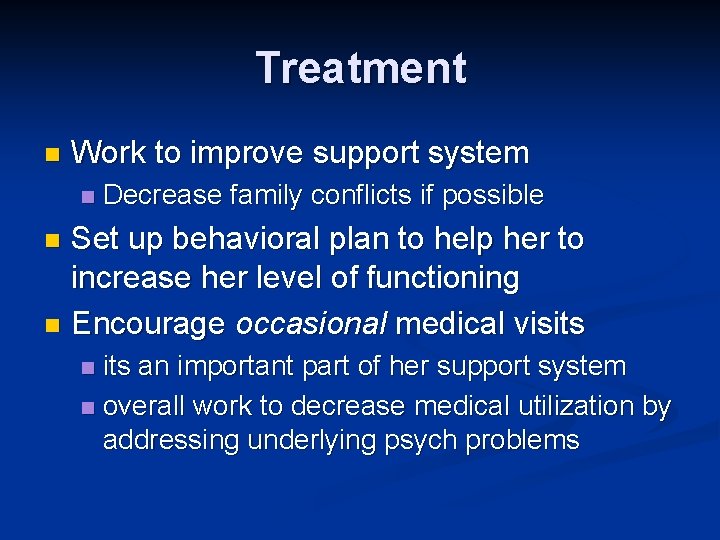
Treatment n Work to improve support system n Decrease family conflicts if possible Set up behavioral plan to help her to increase her level of functioning n Encourage occasional medical visits n its an important part of her support system n overall work to decrease medical utilization by addressing underlying psych problems n
The Results? n A satisfied patient who gets the care she needs… n And for you, the satisfaction of effectively treating a challenging case.