
HOW PROTOCOL GATEWAYS GET CONFIGURED BY You have
HOW PROTOCOL GATEWAYS GET CONFIGURED BY
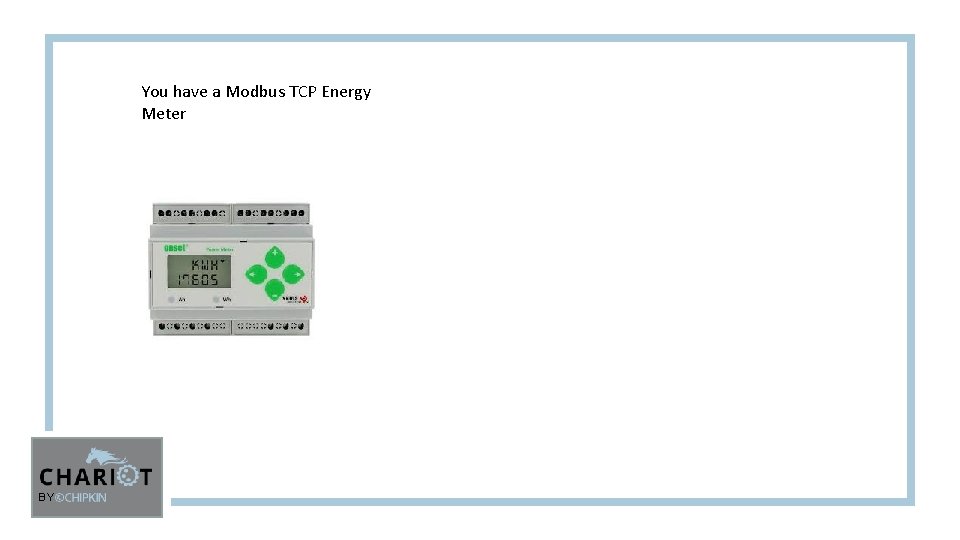
You have a Modbus TCP Energy Meter BY
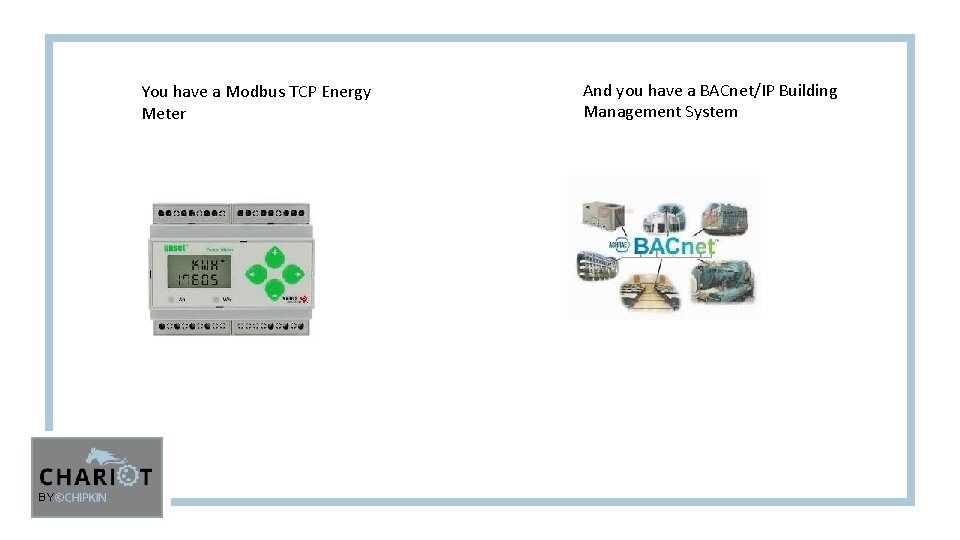
You have a Modbus TCP Energy Meter BY And you have a BACnet/IP Building Management System
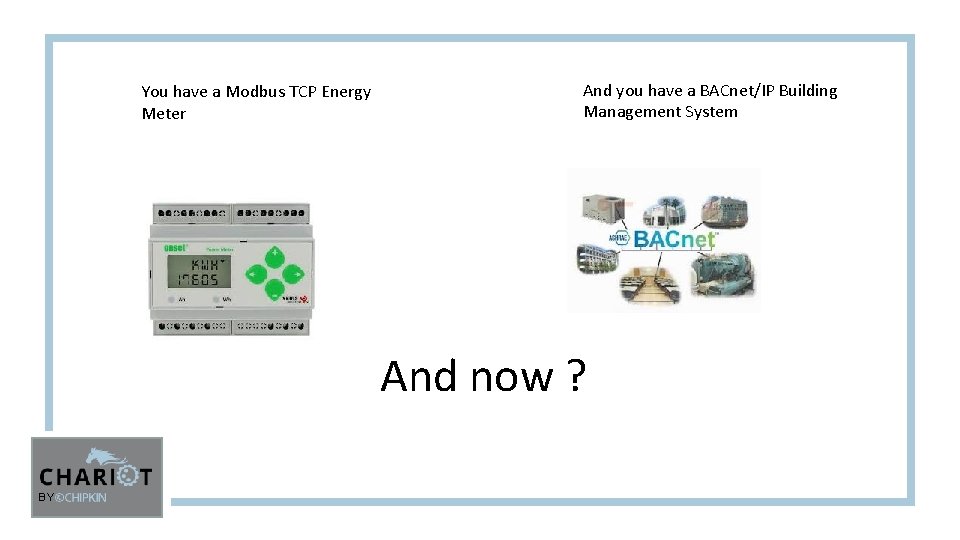
You have a Modbus TCP Energy Meter And you have a BACnet/IP Building Management System And now ? BY
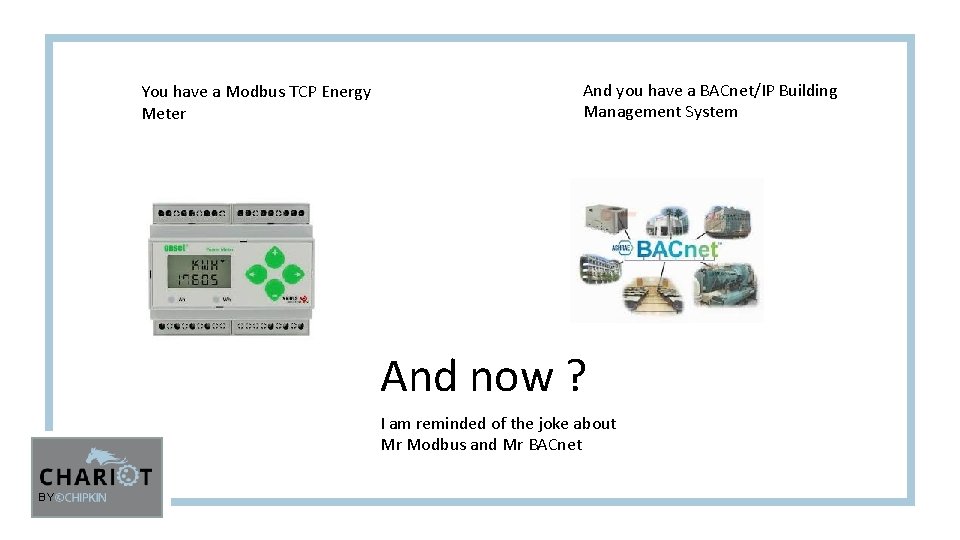
You have a Modbus TCP Energy Meter And you have a BACnet/IP Building Management System And now ? I am reminded of the joke about Mr Modbus and Mr BACnet BY
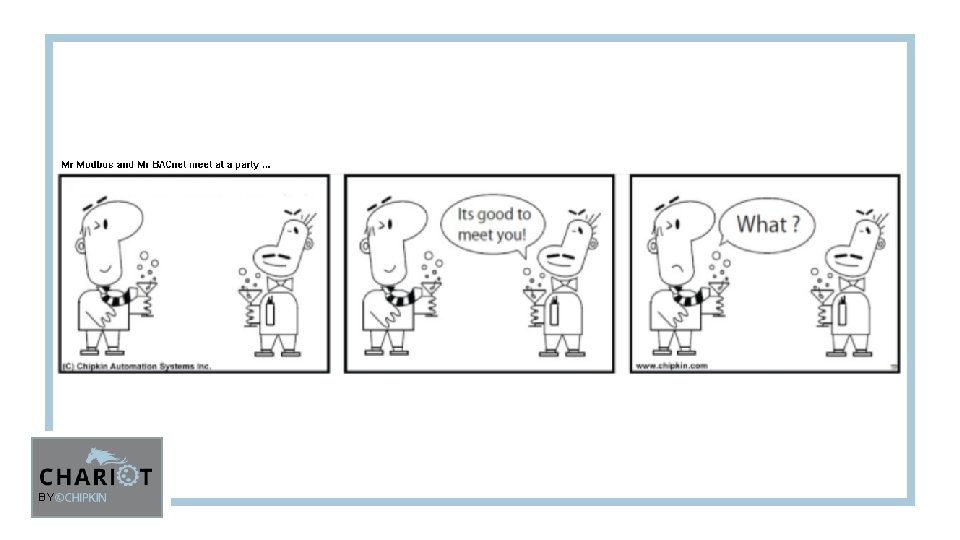
BY
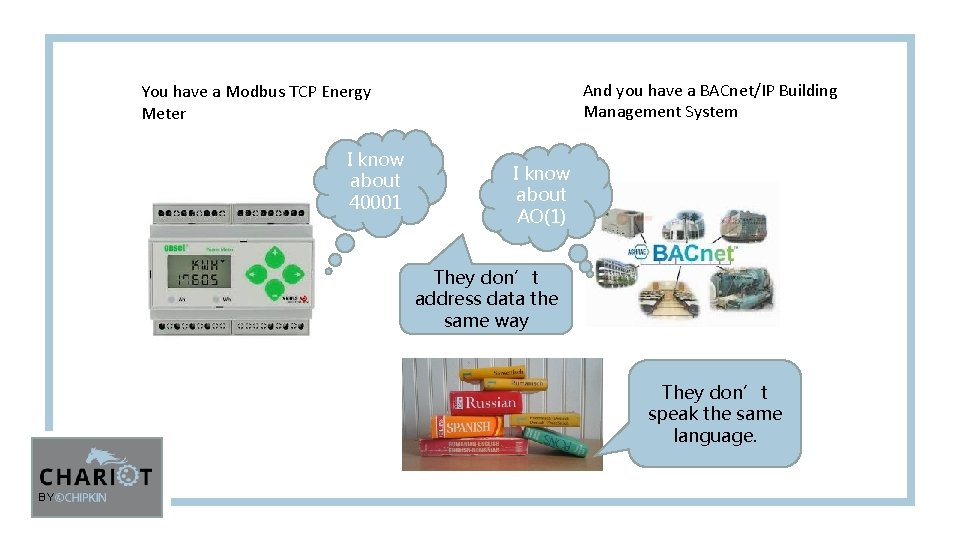
And you have a BACnet/IP Building Management System You have a Modbus TCP Energy Meter I know about 40001 I know about AO(1) They don’t address data the same way They don’t speak the same language. BY
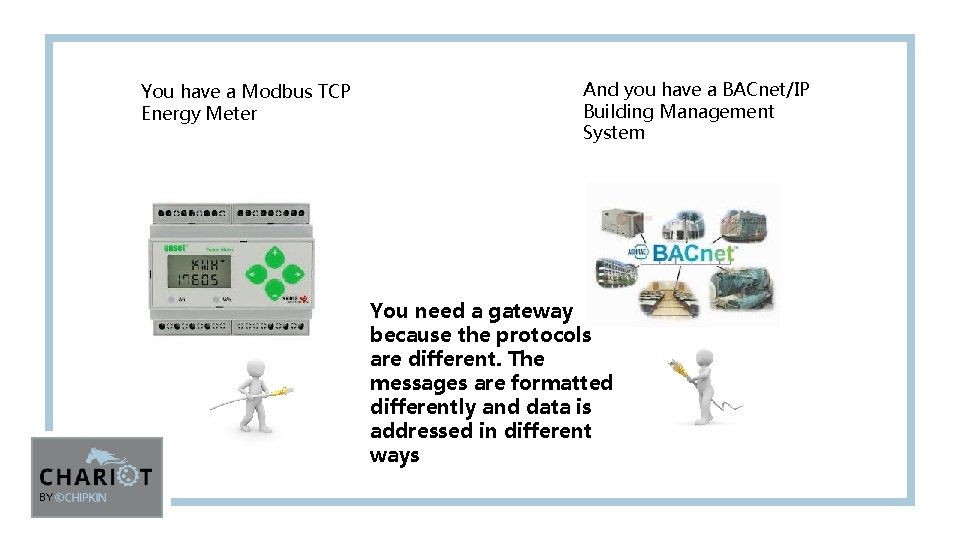
You have a Modbus TCP Energy Meter And you have a BACnet/IP Building Management System You need a gateway because the protocols are different. The messages are formatted differently and data is addressed in different ways BY
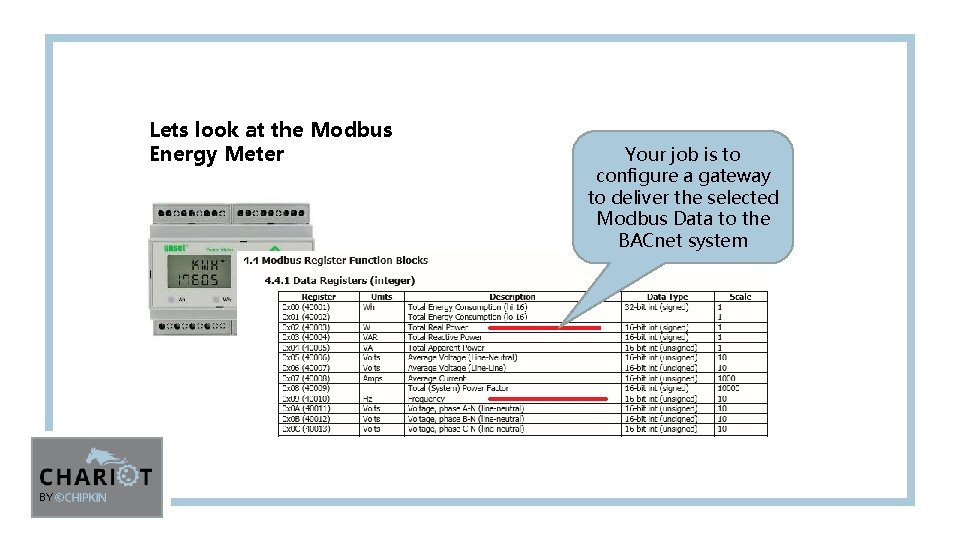
Lets look at the Modbus Energy Meter BY Your job is to configure a gateway to deliver the selected Modbus Data to the BACnet system
This is how to configure a gateway to integrate the Modbus Energy data into a BACnet Building System BY
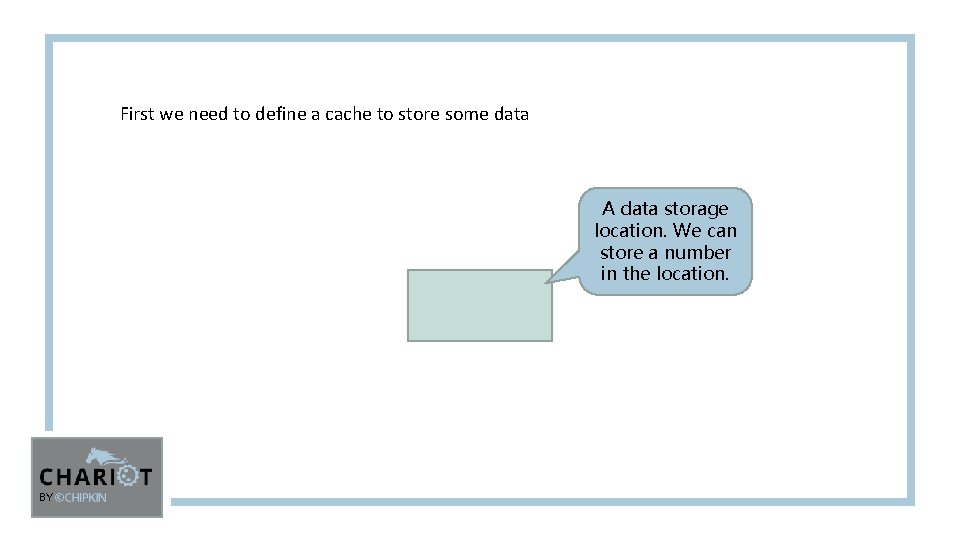
First we need to define a cache to store some data A data storage location. We can store a number in the location. BY
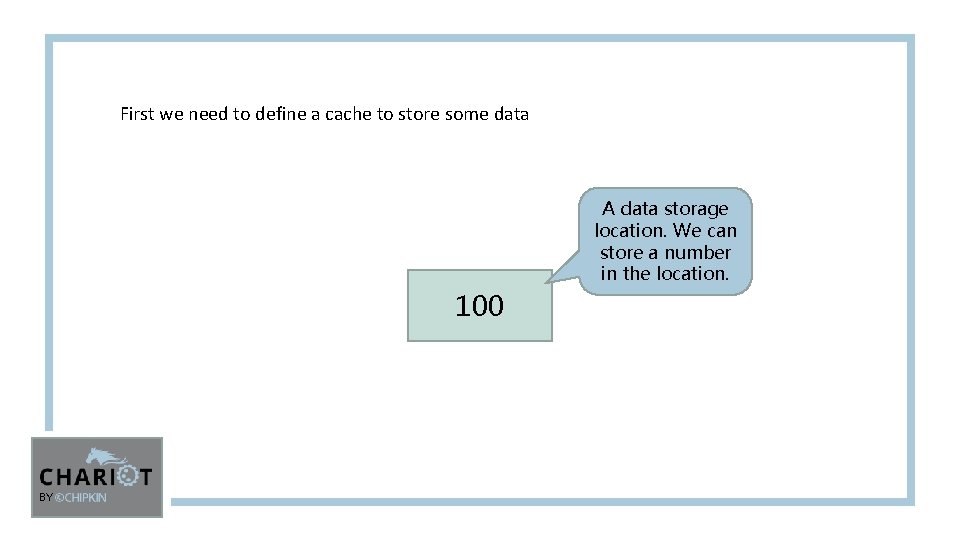
First we need to define a cache to store some data A data storage location. We can store a number in the location. 100 BY
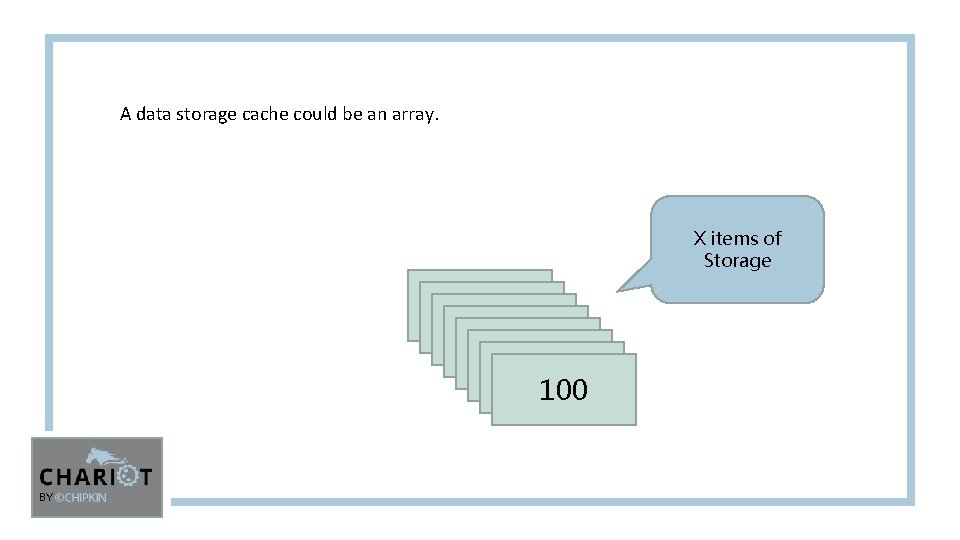
A data storage cache could be an array. X items of Storage 100 100 BY
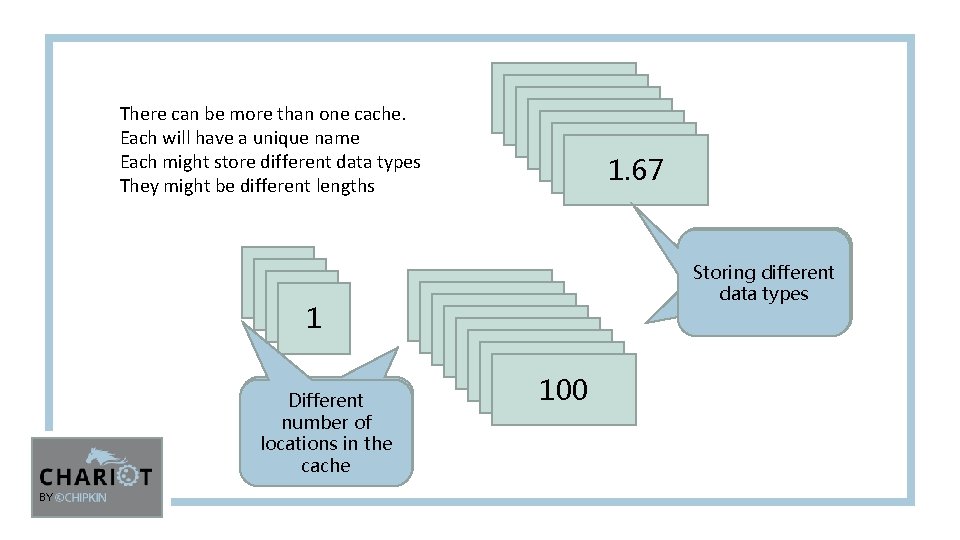
There can be more than one cache. Each will have a unique name Each might store different data types They might be different lengths 11 11 Different X items of number Storage locations in the cache BY 100 100 100 1. 67 100 100 X items of Storing different Storage data types
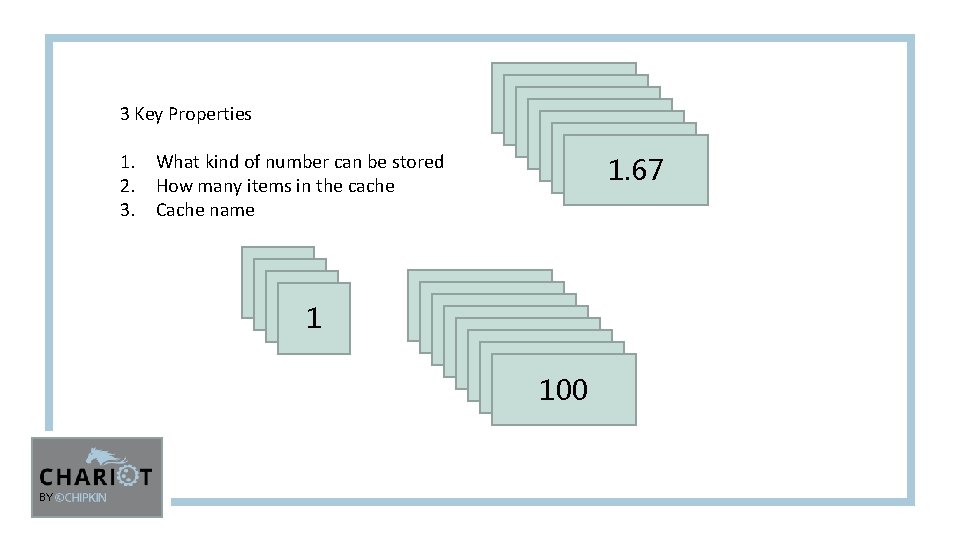
3 Key Properties 1. What kind of number can be stored 2. How many items in the cache 3. Cache name 11 11 BY 100 100 100 1. 67 100 100
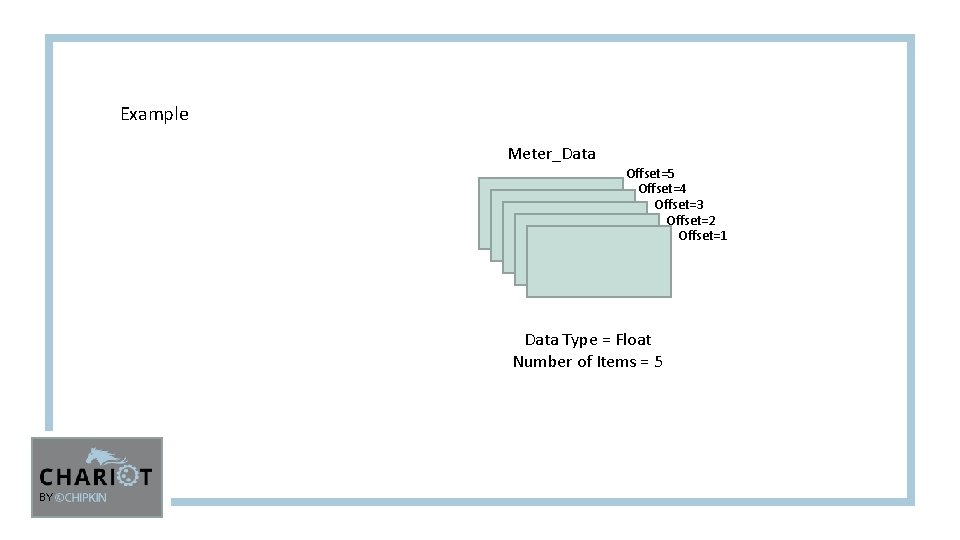
Example Meter_Data Offset=5 Offset=4 Offset=3 Offset=2 Offset=1 Data Type = Float Number of Items = 5 BY
How do we get data into the cache ? Meter_Data Offset=5 Offset=4 Offset=3 Offset=2 Offset=1 Data Type = Float Number of Items = 5 BY
What data ? Meter_Data Offset=5 Offset=4 Offset=3 Offset=2 Offset=1 Data Type = Float Number of Items = 5 BY
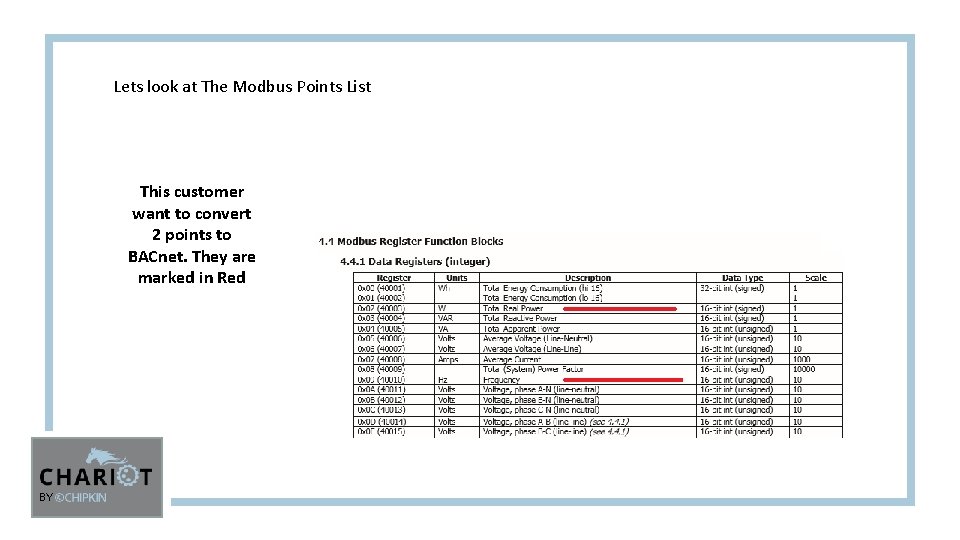
Lets look at The Modbus Points List This customer want to convert 2 points to BACnet. They are marked in Red BY
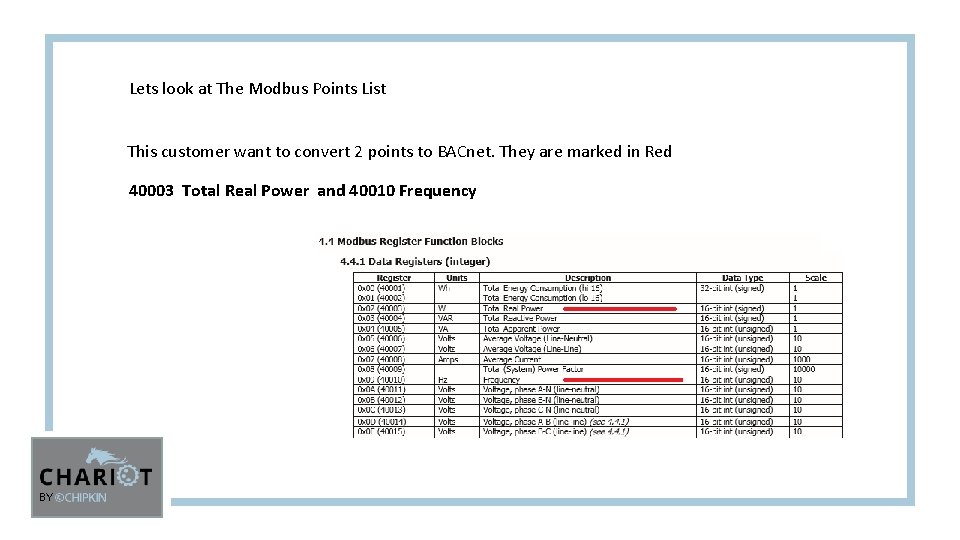
Lets look at The Modbus Points List This customer want to convert 2 points to BACnet. They are marked in Red 40003 Total Real Power and 40010 Frequency BY
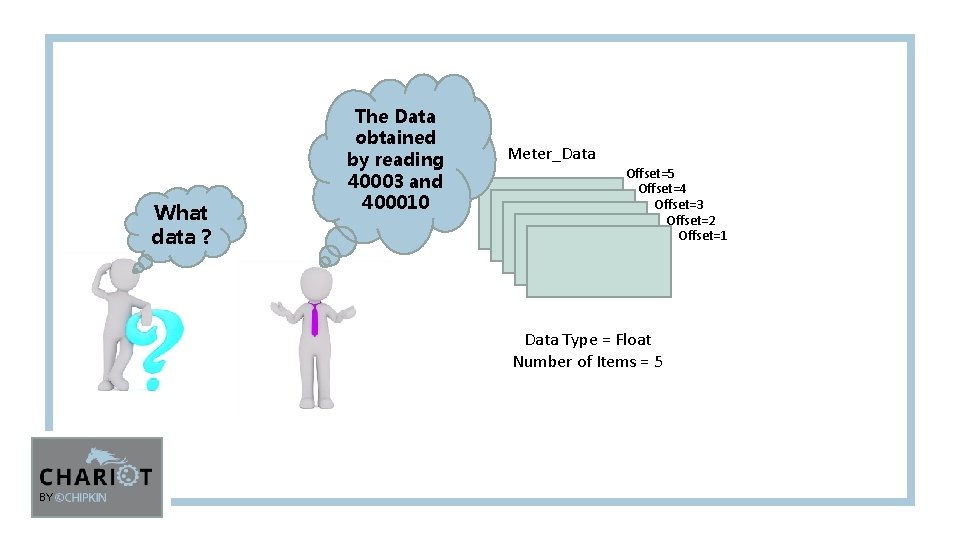
What data ? The Data obtained by reading 40003 and 400010 Meter_Data Offset=5 Offset=4 Offset=3 Offset=2 Offset=1 Data Type = Float Number of Items = 5 BY
Now we need to define tasks to read this data. BY
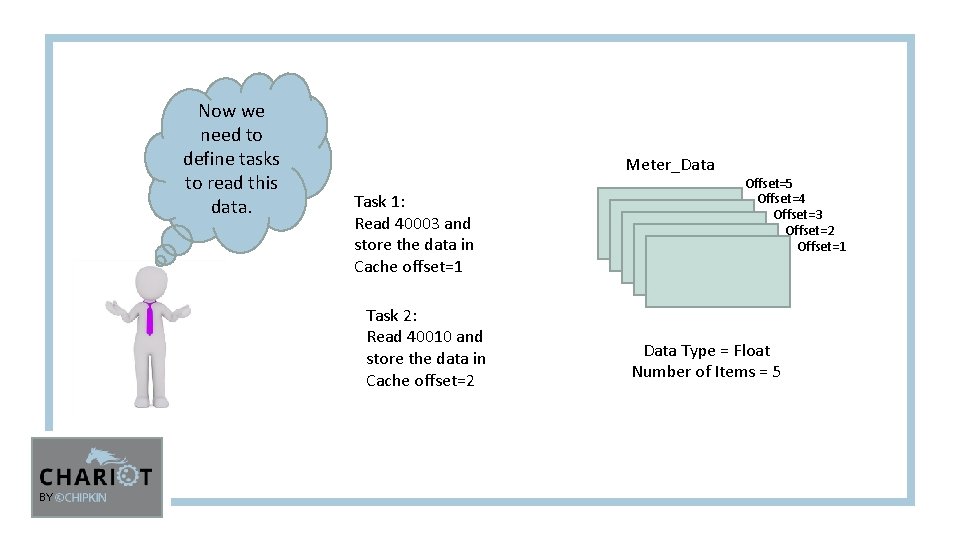
Now we need to define tasks to read this data. Meter_Data Task 1: Read 40003 and store the data in Cache offset=1 Task 2: Read 40010 and store the data in Cache offset=2 BY Offset=5 Offset=4 Offset=3 Offset=2 Offset=1 Data Type = Float Number of Items = 5
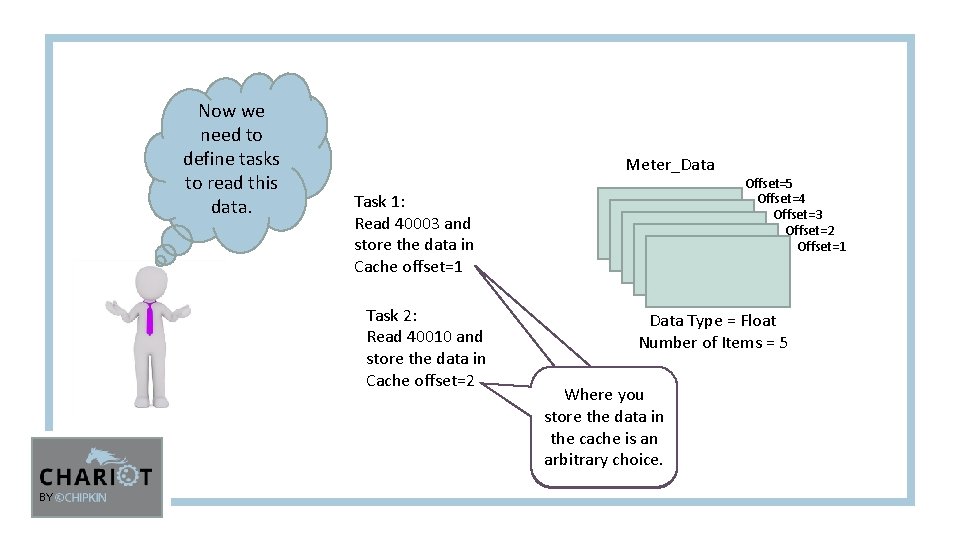
Now we need to define tasks to read this data. Meter_Data Task 1: Read 40003 and store the data in Cache offset=1 Task 2: Read 40010 and store the data in Cache offset=2 BY Offset=5 Offset=4 Offset=3 Offset=2 Offset=1 Data Type = Float Number of Items = 5 Where you store the data in the cache is an arbitrary choice.
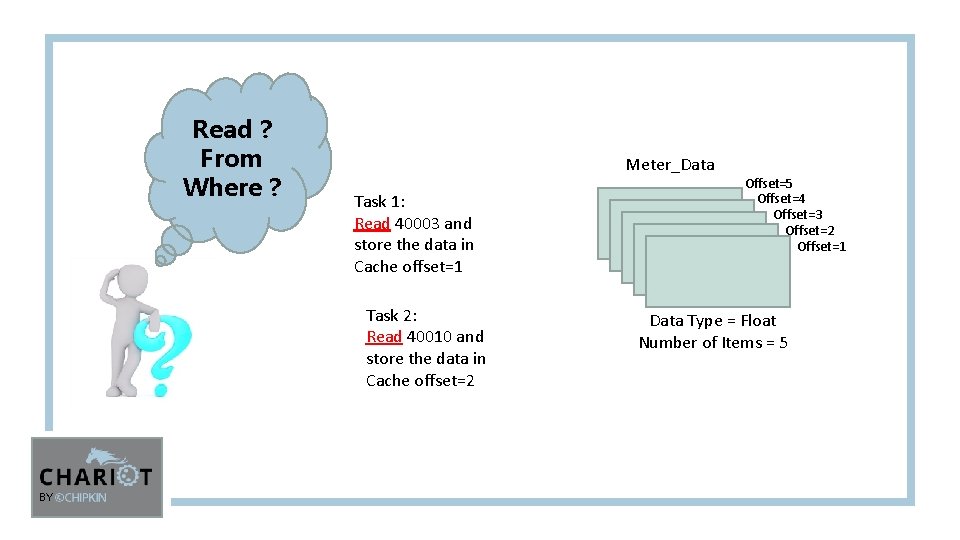
Read ? From Where ? Meter_Data Task 1: Read 40003 and store the data in Cache offset=1 Task 2: Read 40010 and store the data in Cache offset=2 BY Offset=5 Offset=4 Offset=3 Offset=2 Offset=1 Data Type = Float Number of Items = 5
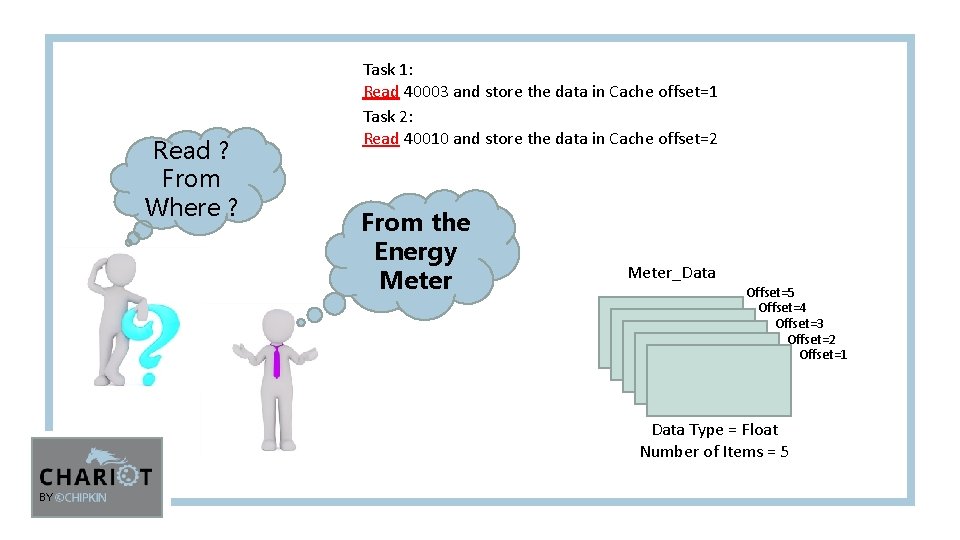
Read ? From Where ? Task 1: Read 40003 and store the data in Cache offset=1 Task 2: Read 40010 and store the data in Cache offset=2 From the Energy Meter_Data Offset=5 Offset=4 Offset=3 Offset=2 Offset=1 Data Type = Float Number of Items = 5 BY
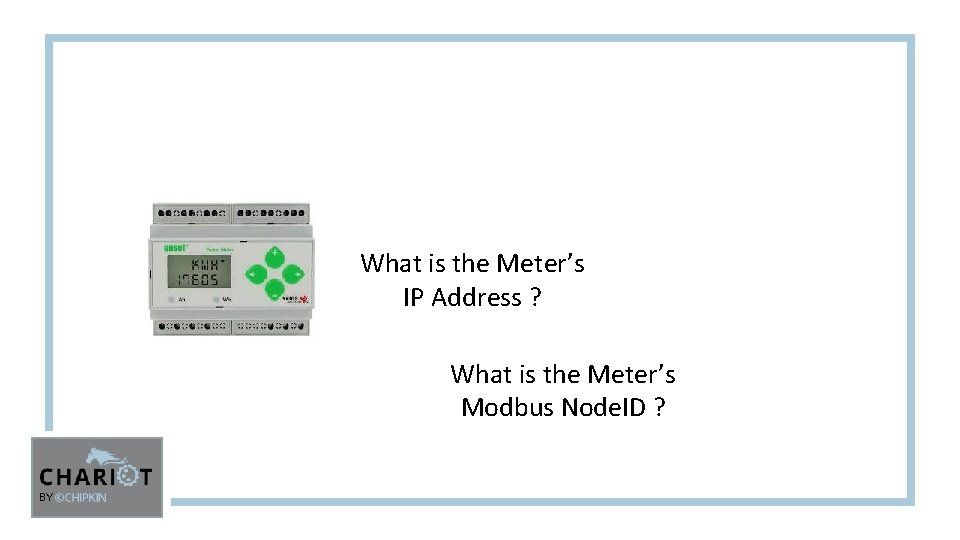
What is the Meter’s IP Address ? What is the Meter’s Modbus Node. ID ? BY
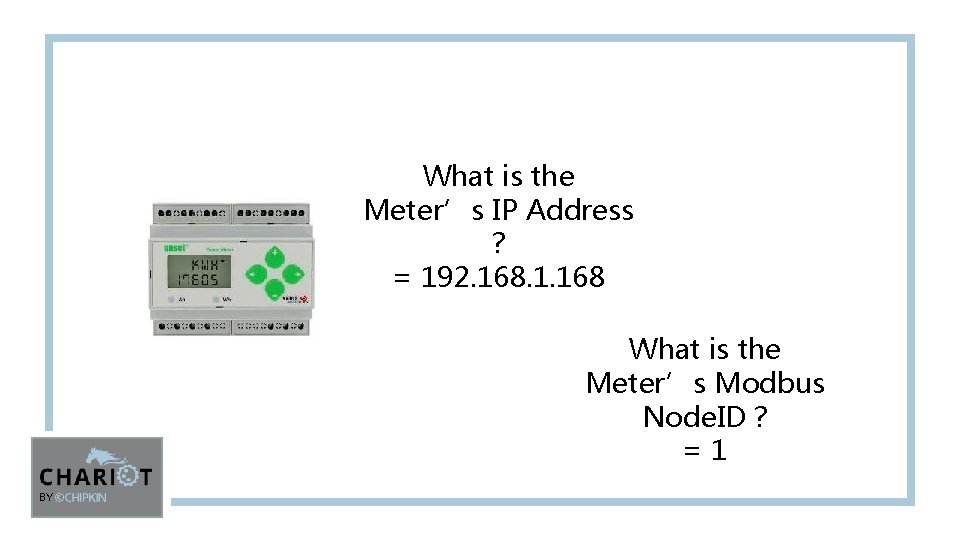
What is the Meter’s IP Address ? = 192. 168. 1. 168 What is the Meter’s Modbus Node. ID ? =1 BY
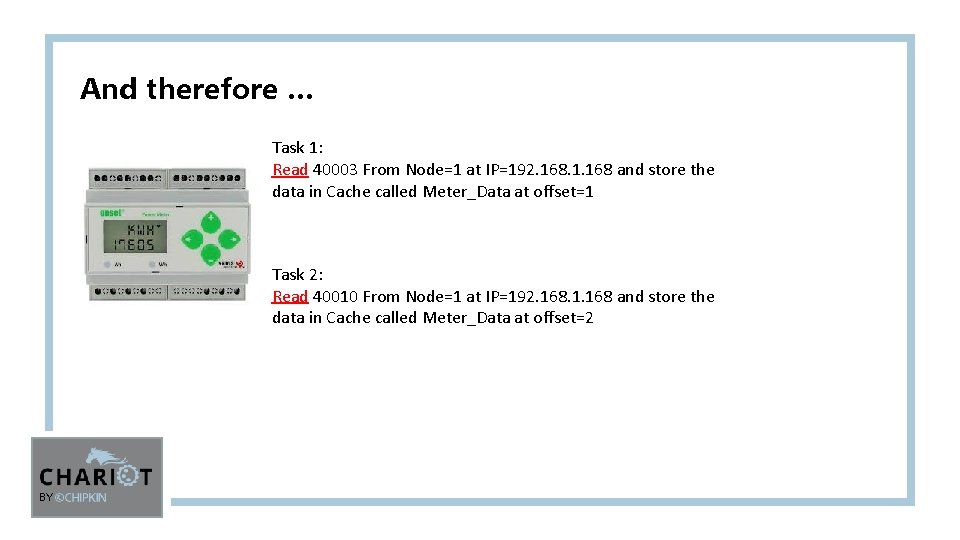
And therefore … Task 1: Read 40003 From Node=1 at IP=192. 168. 1. 168 and store the data in Cache called Meter_Data at offset=1 Task 2: Read 40010 From Node=1 at IP=192. 168. 1. 168 and store the data in Cache called Meter_Data at offset=2 BY
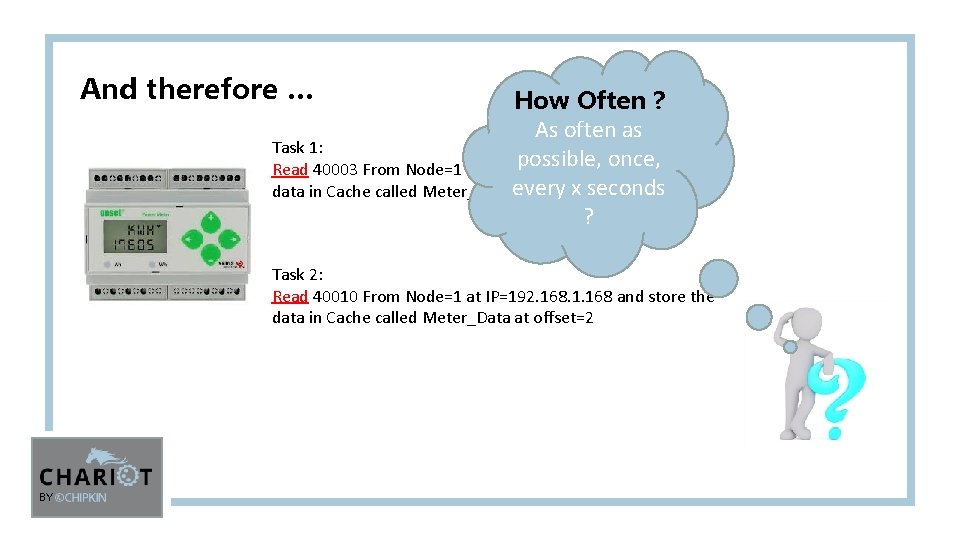
And therefore … How Often ? As often as Task 1: possible, once, Read 40003 From Node=1 at IP=192. 168. 1. 168 and store the x seconds data in Cache called Meter_Data every at offset=1 ? Task 2: Read 40010 From Node=1 at IP=192. 168. 1. 168 and store the data in Cache called Meter_Data at offset=2 BY
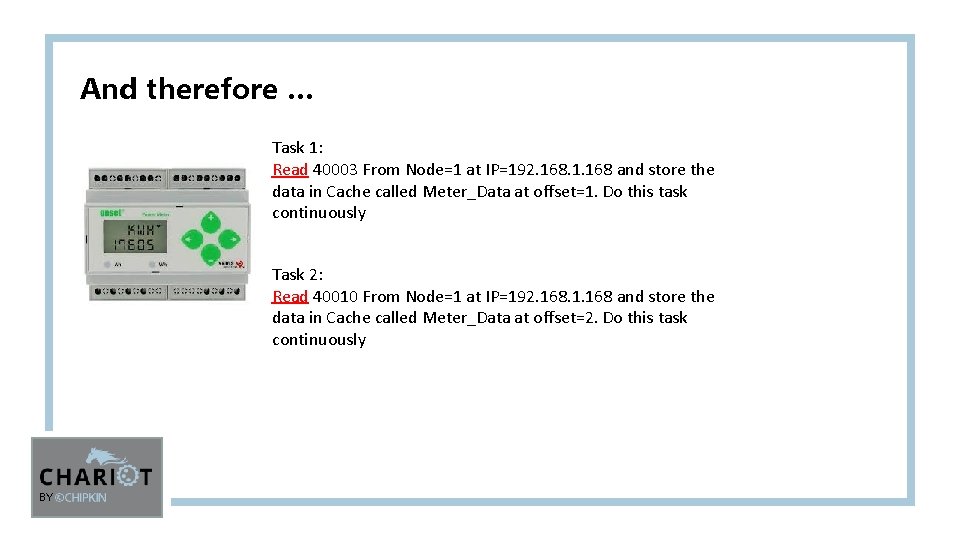
And therefore … Task 1: Read 40003 From Node=1 at IP=192. 168. 1. 168 and store the data in Cache called Meter_Data at offset=1. Do this task continuously Task 2: Read 40010 From Node=1 at IP=192. 168. 1. 168 and store the data in Cache called Meter_Data at offset=2. Do this task continuously BY
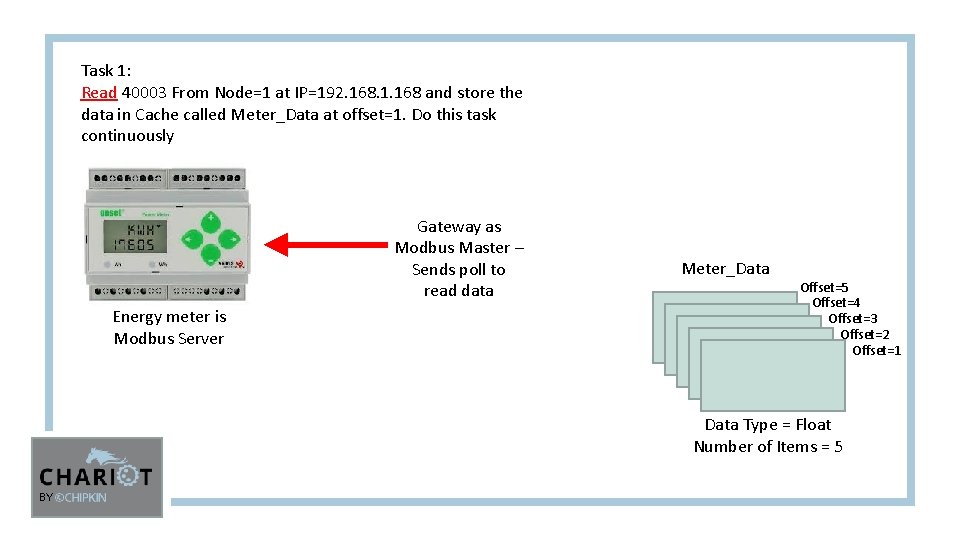
Task 1: Read 40003 From Node=1 at IP=192. 168. 1. 168 and store the data in Cache called Meter_Data at offset=1. Do this task continuously Gateway as Modbus Master – Sends poll to read data Energy meter is Modbus Server Meter_Data Offset=5 Offset=4 Offset=3 Offset=2 Offset=1 Data Type = Float Number of Items = 5 BY
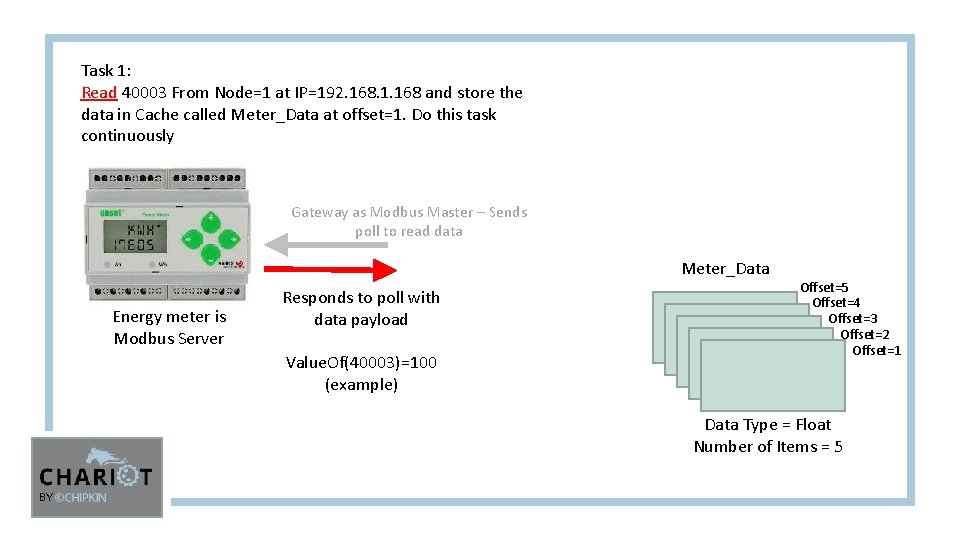
Task 1: Read 40003 From Node=1 at IP=192. 168. 1. 168 and store the data in Cache called Meter_Data at offset=1. Do this task continuously Gateway as Modbus Master – Sends poll to read data Meter_Data Energy meter is Modbus Server Responds to poll with data payload Value. Of(40003)=100 (example) Offset=5 Offset=4 Offset=3 Offset=2 Offset=1 Data Type = Float Number of Items = 5 BY
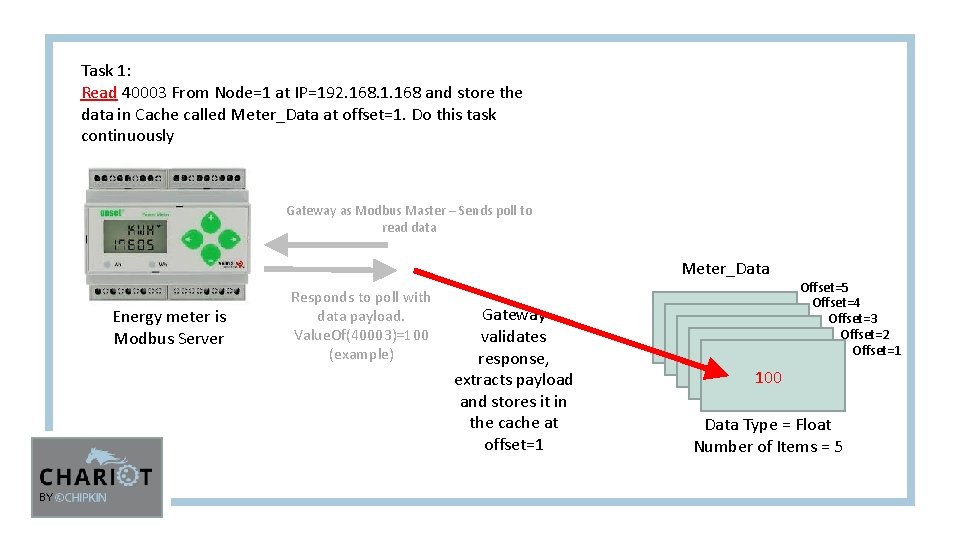
Task 1: Read 40003 From Node=1 at IP=192. 168. 1. 168 and store the data in Cache called Meter_Data at offset=1. Do this task continuously Gateway as Modbus Master – Sends poll to read data Meter_Data Energy meter is Modbus Server BY Responds to poll with data payload. Value. Of(40003)=100 (example) Gateway validates response, extracts payload and stores it in the cache at offset=1 Offset=5 Offset=4 Offset=3 Offset=2 Offset=1 100 Data Type = Float Number of Items = 5
Its similar for task 2 BY
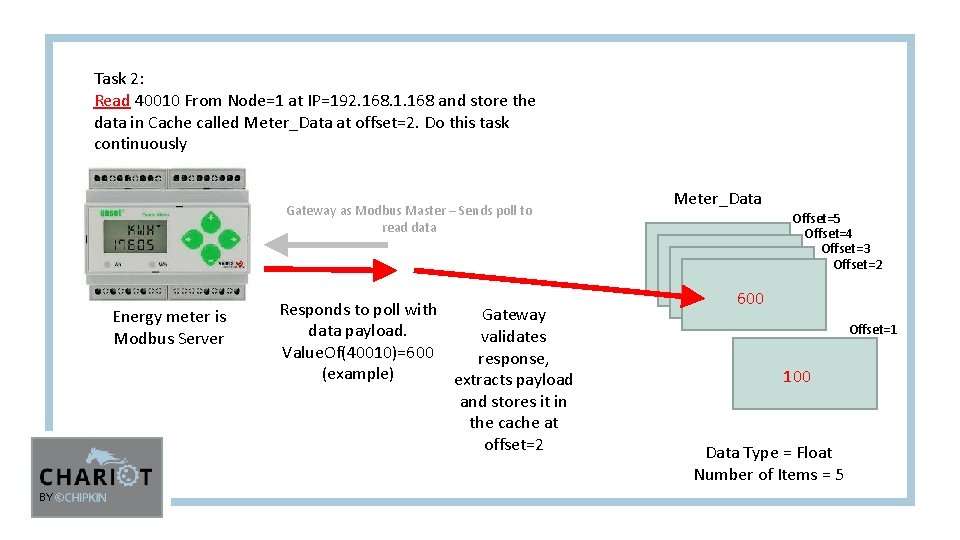
Task 2: Read 40010 From Node=1 at IP=192. 168. 1. 168 and store the data in Cache called Meter_Data at offset=2. Do this task continuously Gateway as Modbus Master – Sends poll to read data Energy meter is Modbus Server BY Responds to poll with Gateway data payload. validates Value. Of(40010)=600 response, (example) extracts payload and stores it in the cache at offset=2 Meter_Data Offset=5 Offset=4 Offset=3 Offset=2 600 Offset=1 100 Data Type = Float Number of Items = 5
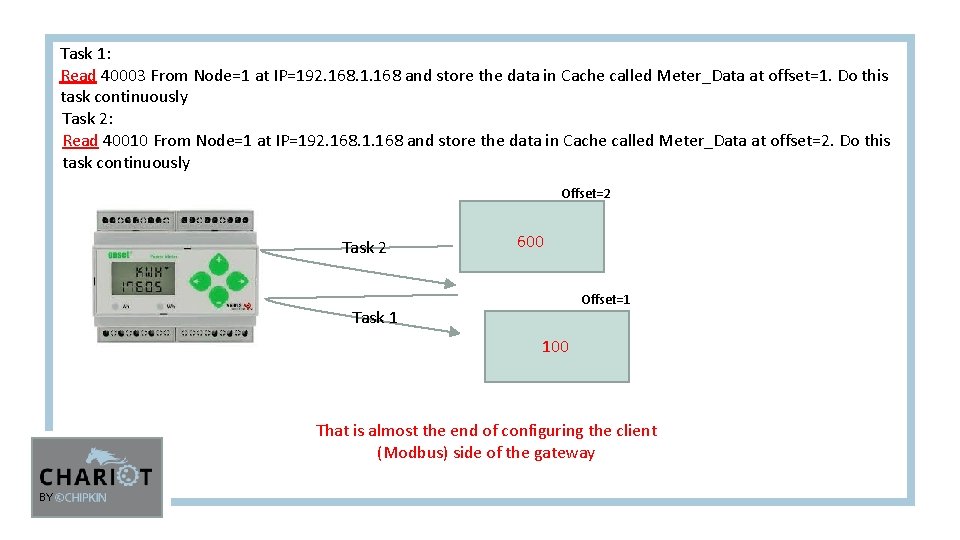
Task 1: Read 40003 From Node=1 at IP=192. 168. 1. 168 and store the data in Cache called Meter_Data at offset=1. Do this task continuously Task 2: Read 40010 From Node=1 at IP=192. 168. 1. 168 and store the data in Cache called Meter_Data at offset=2. Do this task continuously Offset=2 Task 2 600 Offset=1 Task 1 100 That is almost the end of configuring the client (Modbus) side of the gateway BY
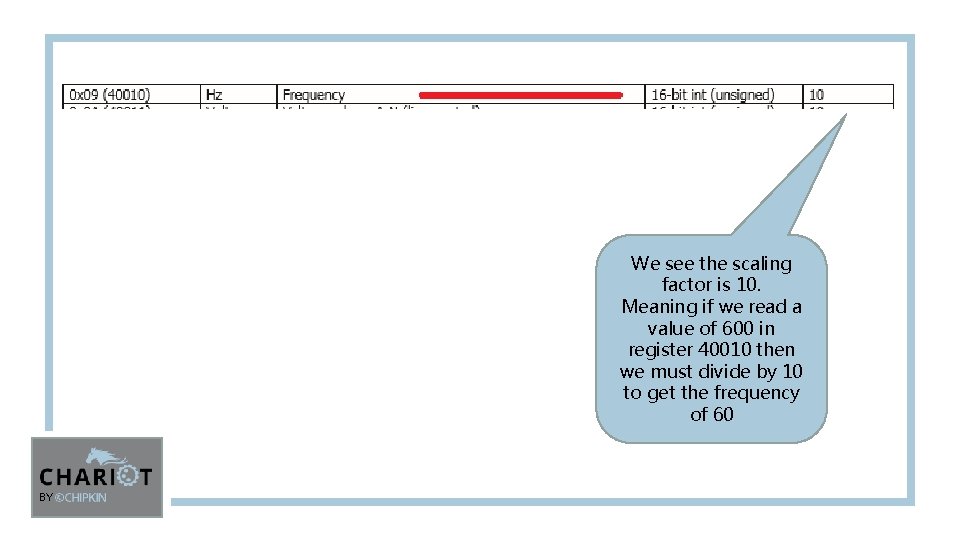
We see the scaling factor is 10. Meaning if we read a value of 600 in register 40010 then we must divide by 10 to get the frequency of 60 BY
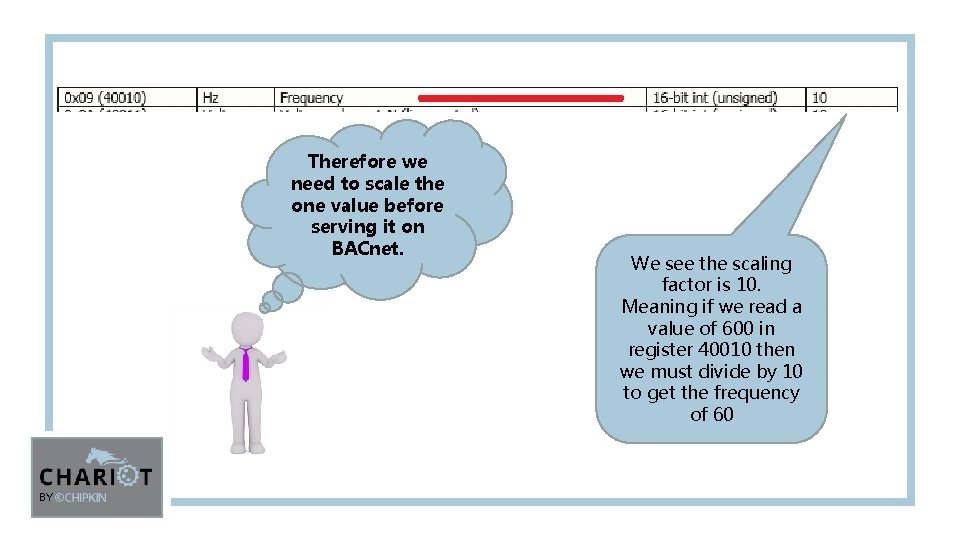
Therefore we need to scale the one value before serving it on BACnet. BY We see the scaling factor is 10. Meaning if we read a value of 600 in register 40010 then we must divide by 10 to get the frequency of 60
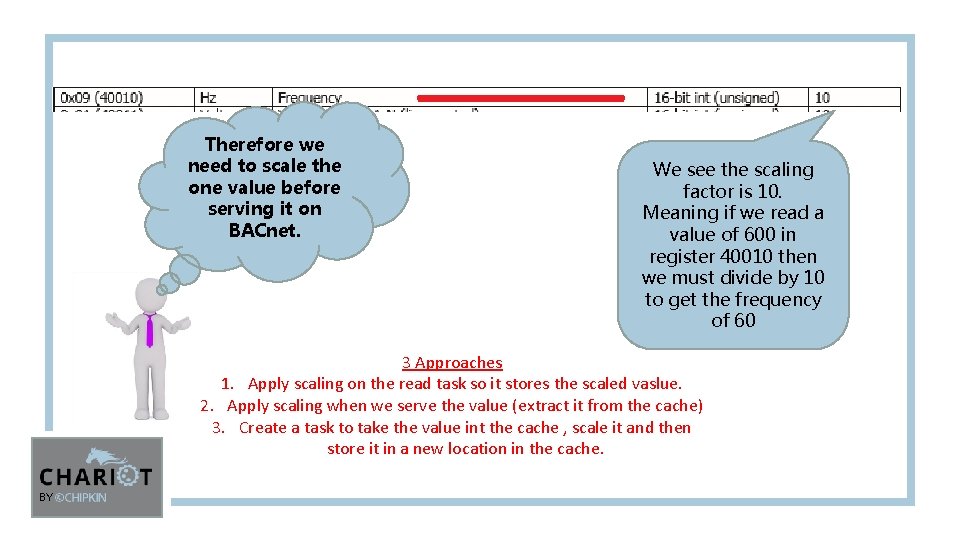
Therefore we need to scale the one value before serving it on BACnet. We see the scaling factor is 10. Meaning if we read a value of 600 in register 40010 then we must divide by 10 to get the frequency of 60 3 Approaches 1. Apply scaling on the read task so it stores the scaled vaslue. 2. Apply scaling when we serve the value (extract it from the cache) 3. Create a task to take the value int the cache , scale it and then store it in a new location in the cache. BY
Now we must configure the BACnet side of the gateway BY
Now we must configure the BACnet side of the gateway • Did the customer constrain us ? • Ie did they tell us to use particular instance numbers, …. • Probably not. – Lets assume they did not BY
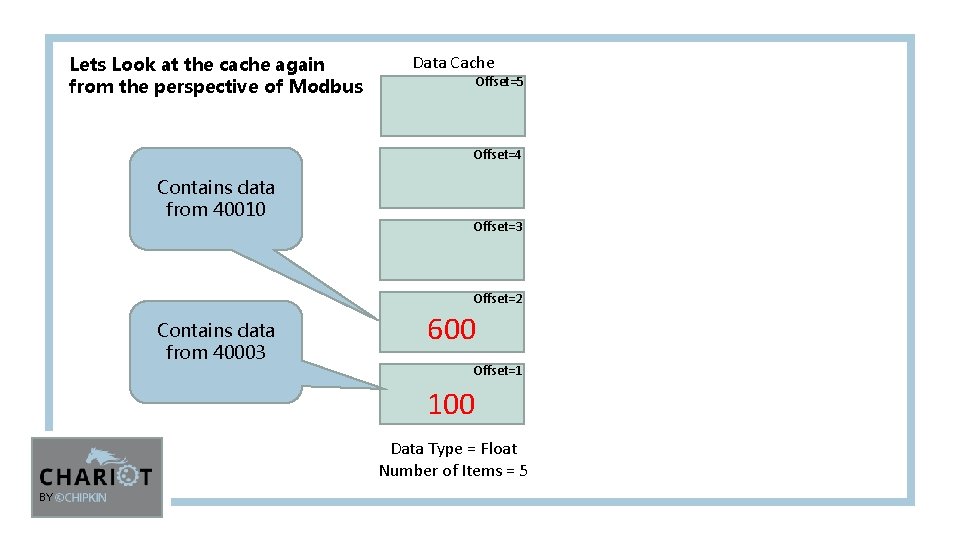
Lets Look at the cache again from the perspective of Modbus Data Cache Offset=5 Offset=4 Contains data from 40010 Offset=3 Offset=2 Contains data from 40003 600 Offset=1 100 Data Type = Float Number of Items = 5 BY
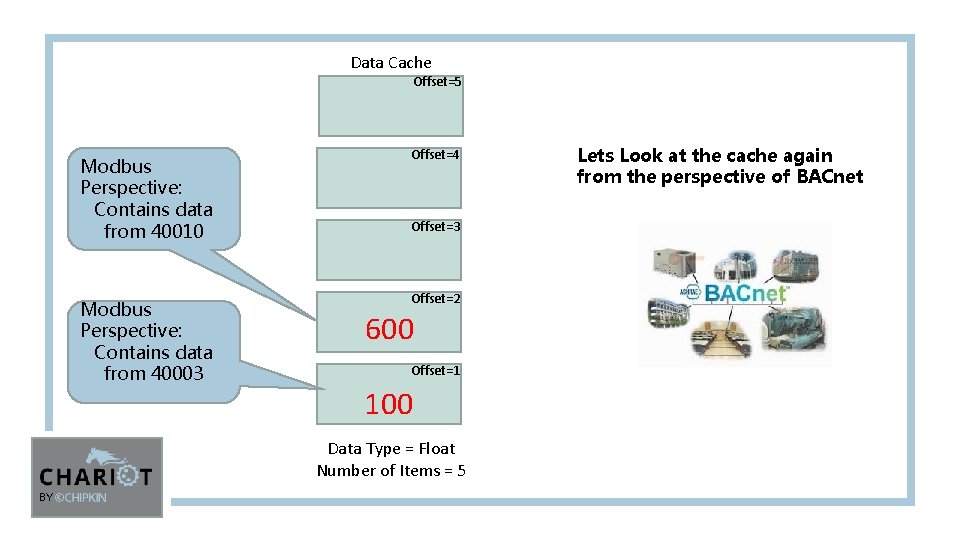
Data Cache Offset=5 Modbus Perspective: Contains data from 40010 Modbus Perspective: Contains data from 40003 Offset=4 Offset=3 Offset=2 600 Offset=1 100 Data Type = Float Number of Items = 5 BY Lets Look at the cache again from the perspective of BACnet
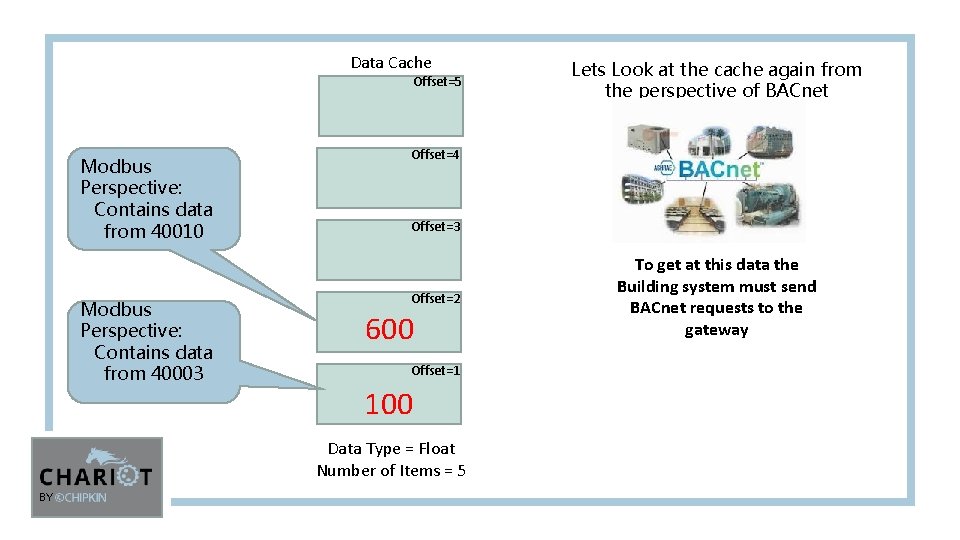
Data Cache Offset=5 Modbus Perspective: Contains data from 40010 Modbus Perspective: Contains data from 40003 Offset=4 Offset=3 Offset=2 600 Offset=1 100 Data Type = Float Number of Items = 5 BY Lets Look at the cache again from the perspective of BACnet To get at this data the Building system must send BACnet requests to the gateway
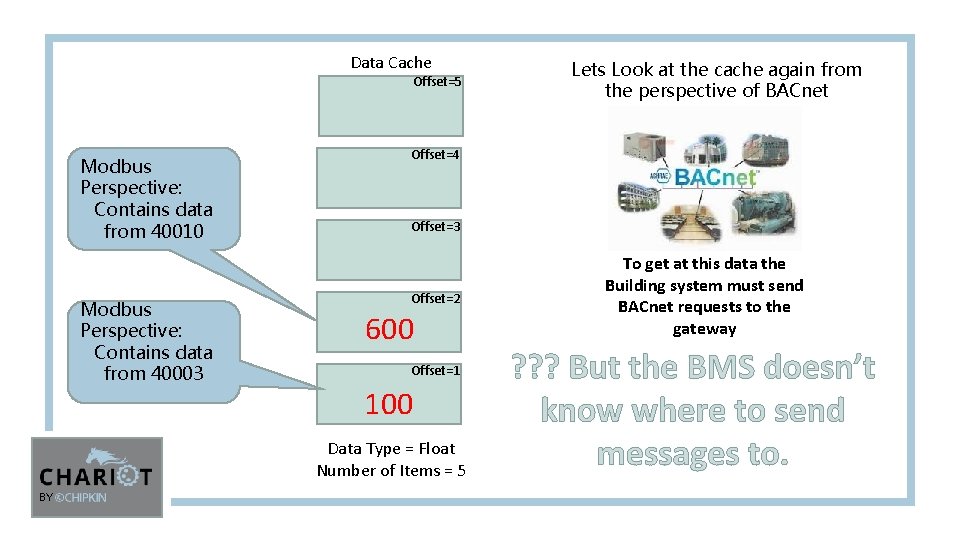
Data Cache Offset=5 Modbus Perspective: Contains data from 40010 Modbus Perspective: Contains data from 40003 Offset=4 Offset=3 Offset=2 600 Offset=1 100 Data Type = Float Number of Items = 5 BY Lets Look at the cache again from the perspective of BACnet To get at this data the Building system must send BACnet requests to the gateway ? ? ? But the BMS doesn’t know where to send messages to.
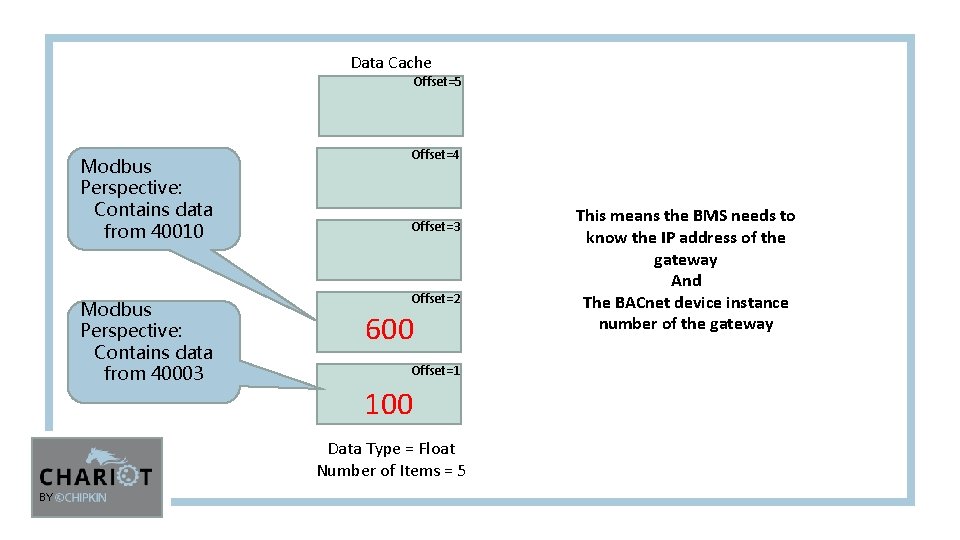
Data Cache Offset=5 Modbus Perspective: Contains data from 40010 Modbus Perspective: Contains data from 40003 Offset=4 Offset=3 Offset=2 600 Offset=1 100 Data Type = Float Number of Items = 5 BY This means the BMS needs to know the IP address of the gateway And The BACnet device instance number of the gateway
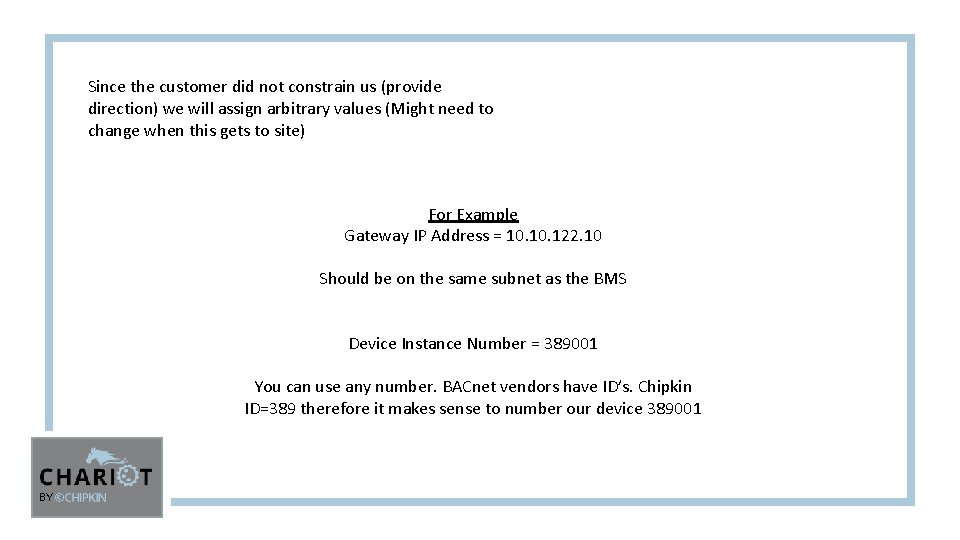
Since the customer did not constrain us (provide direction) we will assign arbitrary values (Might need to change when this gets to site) For Example Gateway IP Address = 10. 122. 10 Should be on the same subnet as the BMS Device Instance Number = 389001 You can use any number. BACnet vendors have ID’s. Chipkin ID=389 therefore it makes sense to number our device 389001 BY
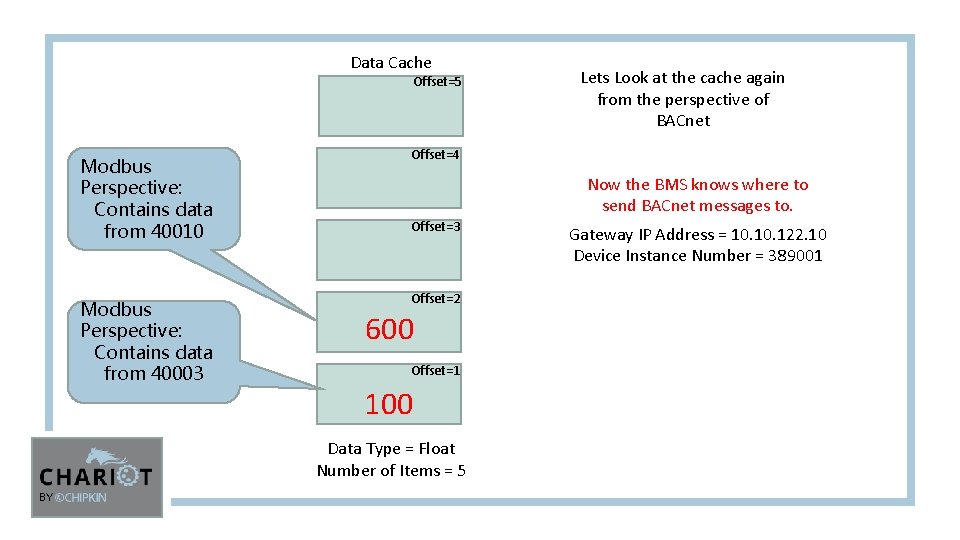
Data Cache Offset=5 Modbus Perspective: Contains data from 40010 Modbus Perspective: Contains data from 40003 Offset=4 Now the BMS knows where to send BACnet messages to. Offset=3 Offset=2 600 Offset=1 100 Data Type = Float Number of Items = 5 BY Lets Look at the cache again from the perspective of BACnet Gateway IP Address = 10. 122. 10 Device Instance Number = 389001
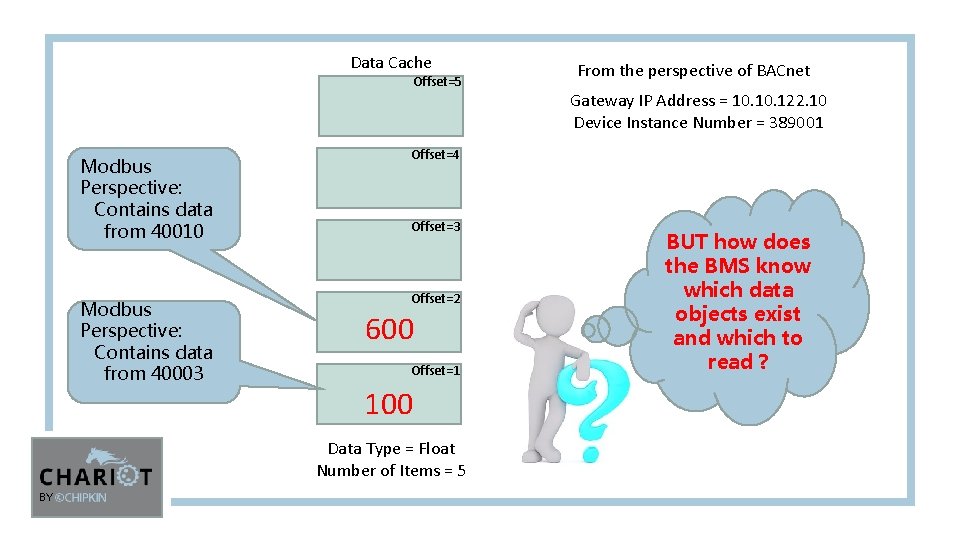
Data Cache Offset=5 Modbus Perspective: Contains data from 40010 Modbus Perspective: Contains data from 40003 Gateway IP Address = 10. 122. 10 Device Instance Number = 389001 Offset=4 Offset=3 Offset=2 600 Offset=1 100 Data Type = Float Number of Items = 5 BY From the perspective of BACnet BUT how does the BMS know which data objects exist and which to read ?
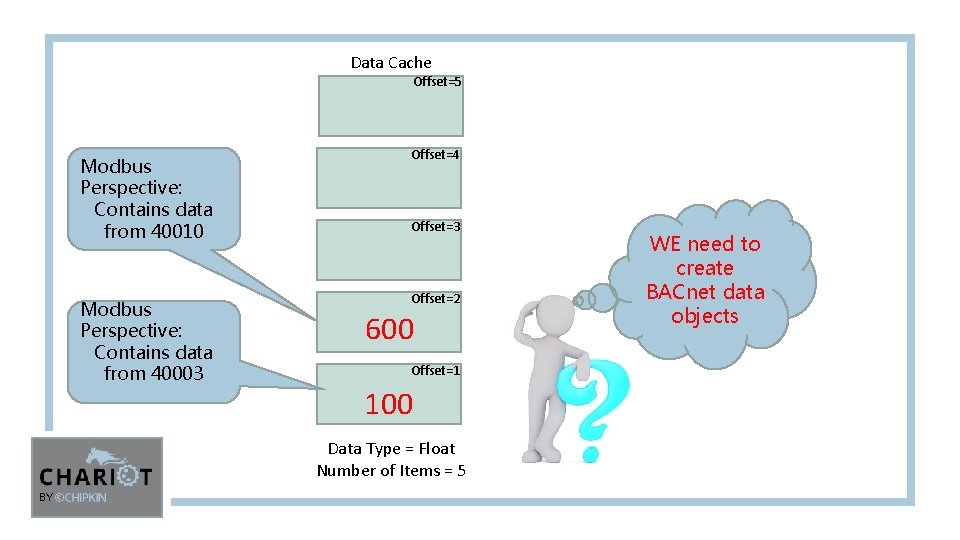
Data Cache Offset=5 Modbus Perspective: Contains data from 40010 Modbus Perspective: Contains data from 40003 Offset=4 Offset=3 Offset=2 600 Offset=1 100 Data Type = Float Number of Items = 5 BY WE need to create BACnet data objects
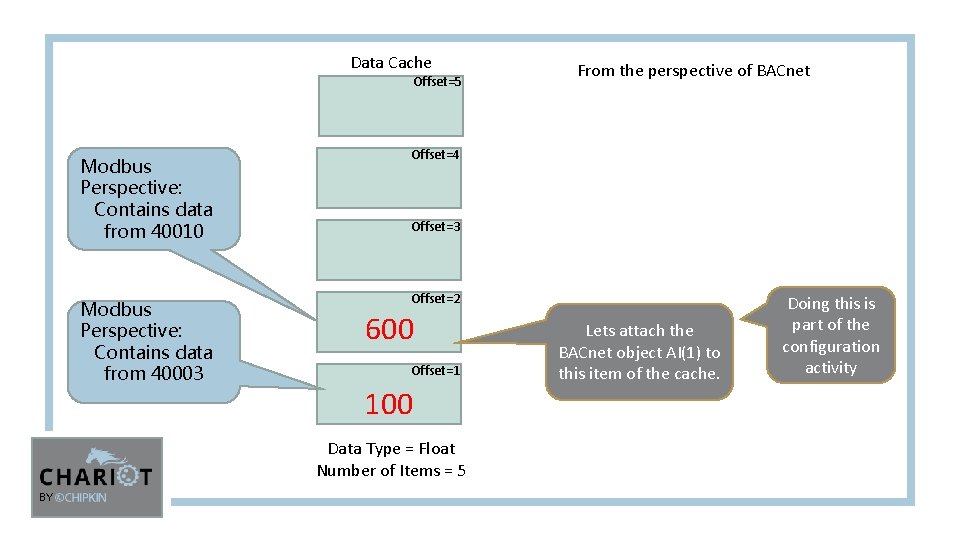
Data Cache Offset=5 Modbus Perspective: Contains data from 40010 Modbus Perspective: Contains data from 40003 Offset=4 Offset=3 Offset=2 600 Offset=1 100 Data Type = Float Number of Items = 5 BY From the perspective of BACnet Lets attach the BACnet object AI(1) to this item of the cache. Doing this is part of the configuration activity
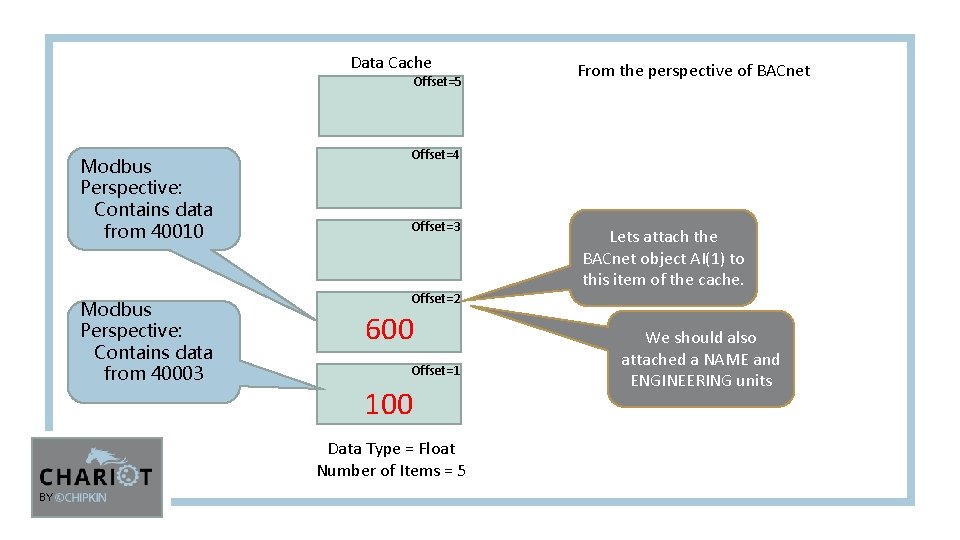
Data Cache Offset=5 Modbus Perspective: Contains data from 40010 Modbus Perspective: Contains data from 40003 Offset=4 Offset=3 Offset=2 600 Offset=1 100 Data Type = Float Number of Items = 5 BY From the perspective of BACnet Lets attach the BACnet object AI(1) to this item of the cache. We should also attached a NAME and ENGINEERING units
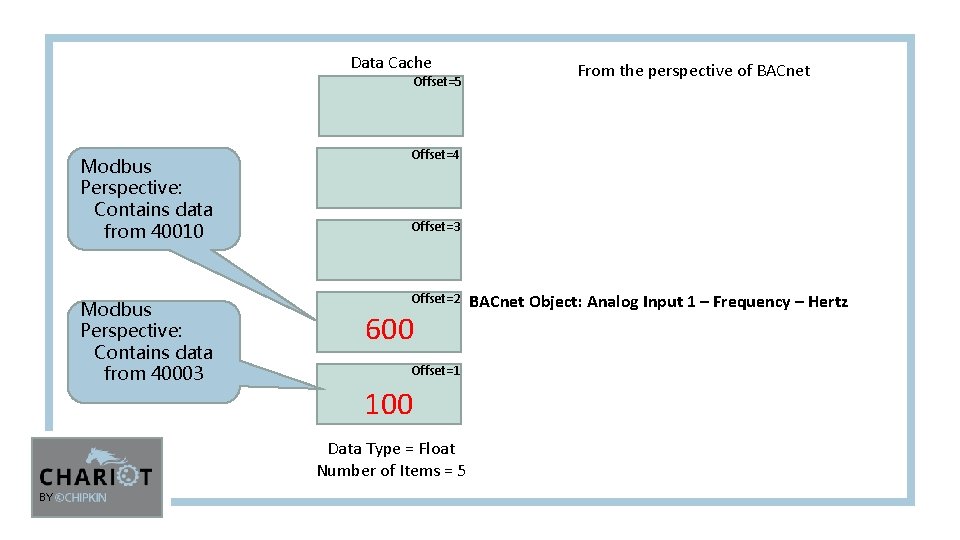
Data Cache Offset=5 Modbus Perspective: Contains data from 40010 Modbus Perspective: Contains data from 40003 Offset=4 Offset=3 Offset=2 600 Offset=1 100 Data Type = Float Number of Items = 5 BY From the perspective of BACnet Object: Analog Input 1 – Frequency – Hertz
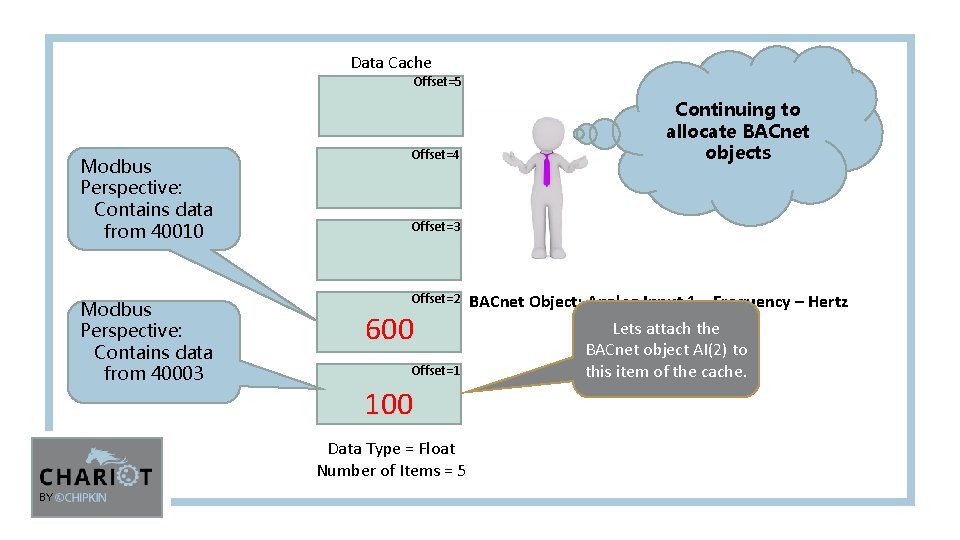
Data Cache Offset=5 Modbus Perspective: Contains data from 40010 Modbus Perspective: Contains data from 40003 Offset=4 Offset=3 Offset=2 600 Offset=1 100 Data Type = Float Number of Items = 5 BY Continuing to allocate BACnet objects BACnet Object: Analog Input 1 – Frequency – Hertz Lets attach the BACnet object AI(2) to this item of the cache.
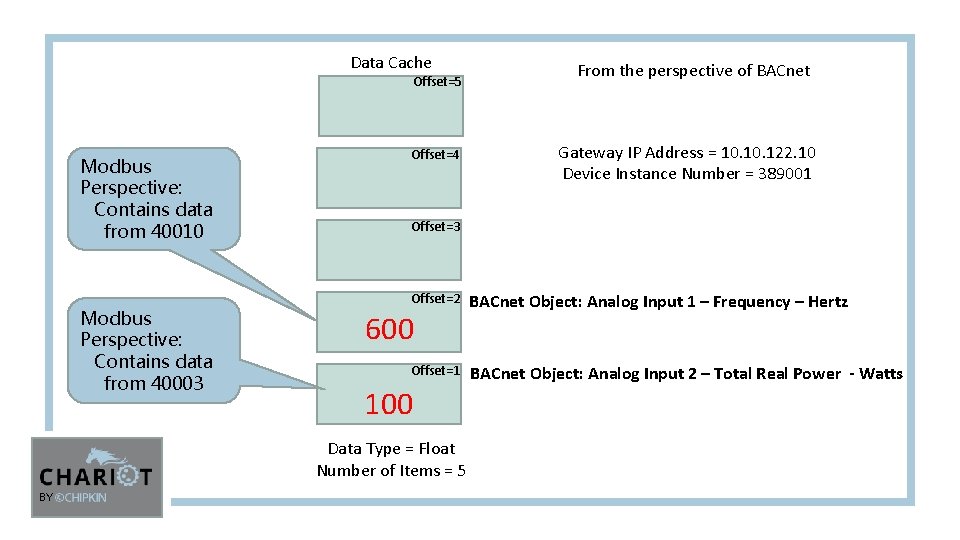
Data Cache Offset=5 Modbus Perspective: Contains data from 40010 Modbus Perspective: Contains data from 40003 Offset=4 Gateway IP Address = 10. 122. 10 Device Instance Number = 389001 Offset=3 Offset=2 600 Offset=1 100 Data Type = Float Number of Items = 5 BY From the perspective of BACnet Object: Analog Input 1 – Frequency – Hertz BACnet Object: Analog Input 2 – Total Real Power - Watts
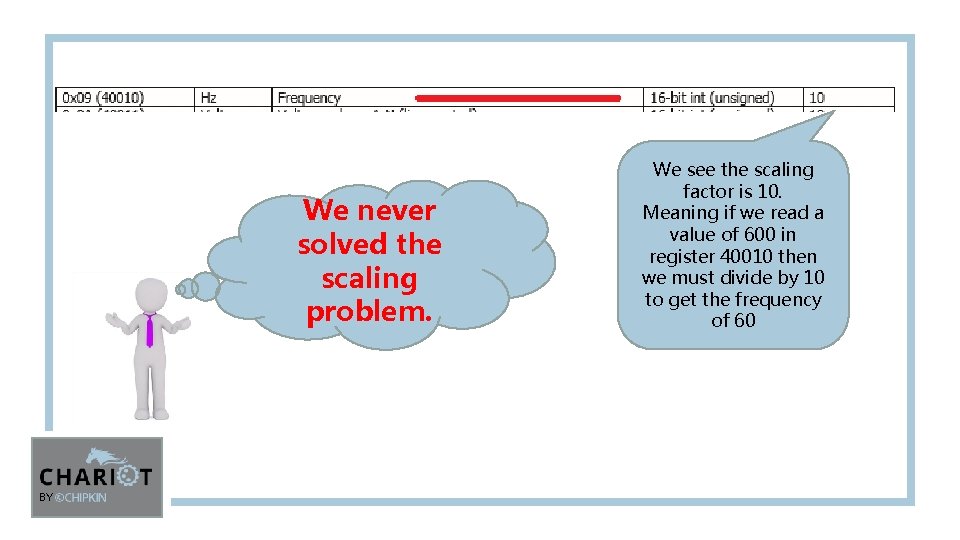
We never solved the scaling problem. BY We see the scaling factor is 10. Meaning if we read a value of 600 in register 40010 then we must divide by 10 to get the frequency of 60
Lets define a ‘Mod’ or ‘Modification’ – a task that manipulate data BY
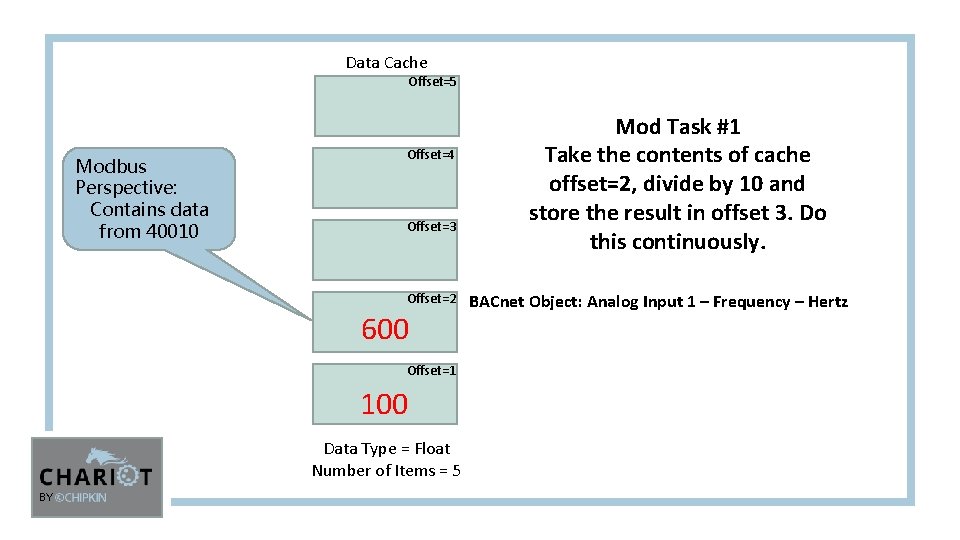
Data Cache Offset=5 Modbus Perspective: Contains data from 40010 Offset=4 Offset=3 Offset=2 600 Offset=1 100 Data Type = Float Number of Items = 5 BY Mod Task #1 Take the contents of cache offset=2, divide by 10 and store the result in offset 3. Do this continuously. BACnet Object: Analog Input 1 – Frequency – Hertz
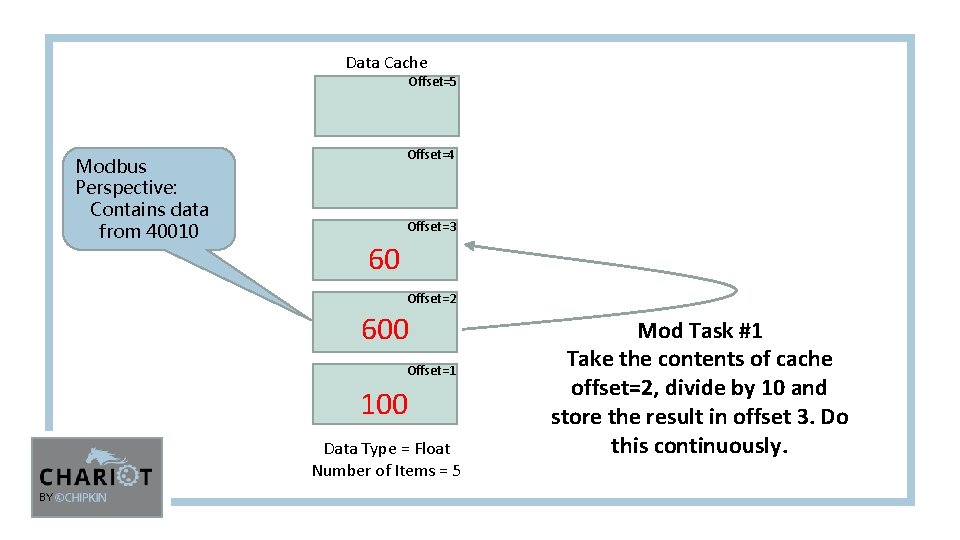
Data Cache Offset=5 Modbus Perspective: Contains data from 40010 Offset=4 Offset=3 60 Offset=2 600 Offset=1 100 Data Type = Float Number of Items = 5 BY Mod Task #1 Take the contents of cache offset=2, divide by 10 and store the result in offset 3. Do this continuously.
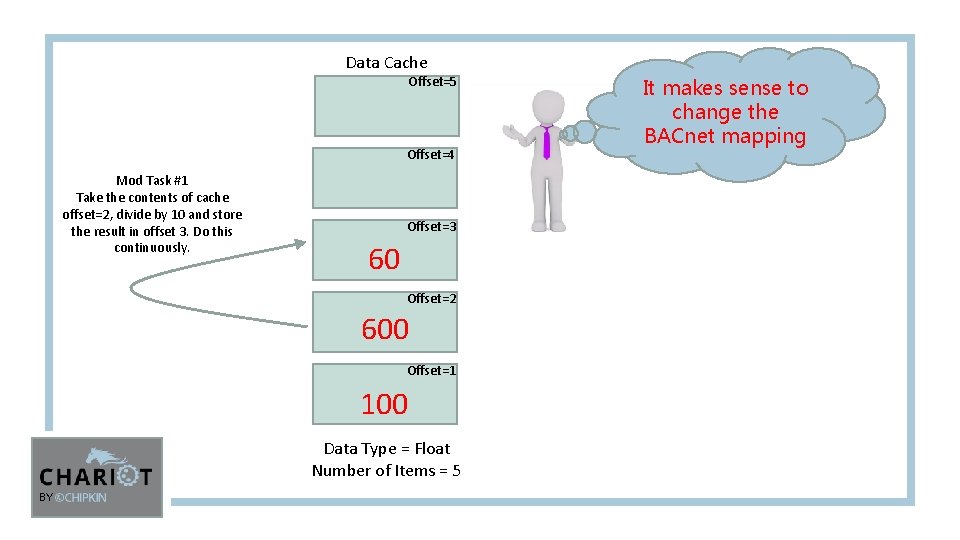
Data Cache Offset=5 Offset=4 Mod Task #1 Take the contents of cache offset=2, divide by 10 and store the result in offset 3. Do this continuously. Offset=3 60 Offset=2 600 Offset=1 100 Data Type = Float Number of Items = 5 BY It makes sense to change the BACnet mapping
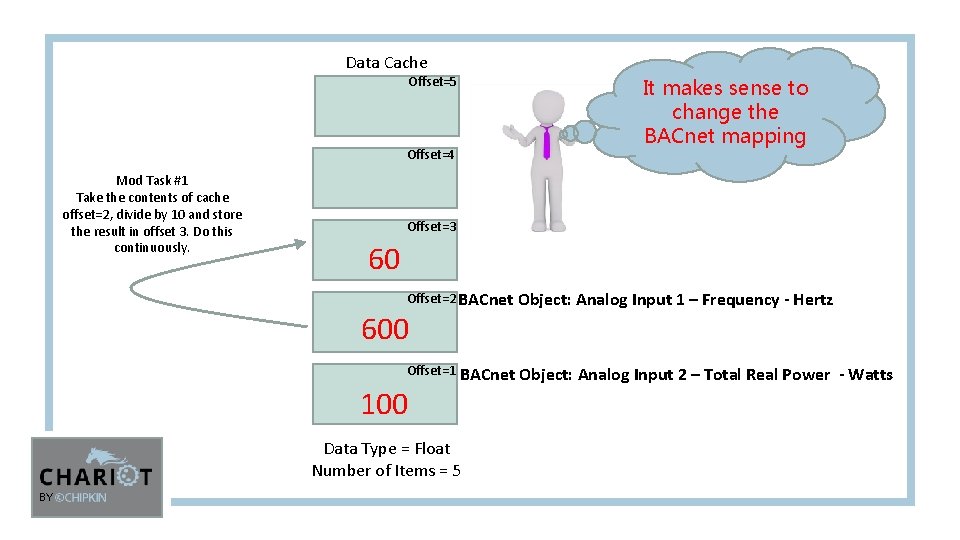
Data Cache Offset=5 It makes sense to change the BACnet mapping Offset=4 Mod Task #1 Take the contents of cache offset=2, divide by 10 and store the result in offset 3. Do this continuously. Offset=3 60 Offset=2 BACnet Object: Analog Input 1 – Frequency - Hertz 600 Offset=1 100 BACnet Object: Analog Input 2 – Total Real Power - Watts Data Type = Float Number of Items = 5 BY
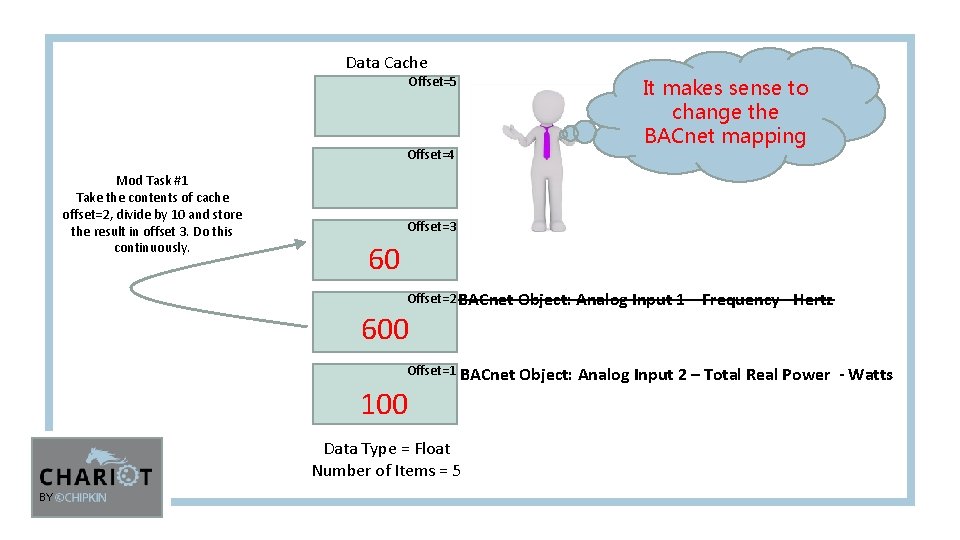
Data Cache Offset=5 It makes sense to change the BACnet mapping Offset=4 Mod Task #1 Take the contents of cache offset=2, divide by 10 and store the result in offset 3. Do this continuously. Offset=3 60 Offset=2 BACnet Object: Analog Input 1 – Frequency - Hertz 600 Offset=1 100 BACnet Object: Analog Input 2 – Total Real Power - Watts Data Type = Float Number of Items = 5 BY
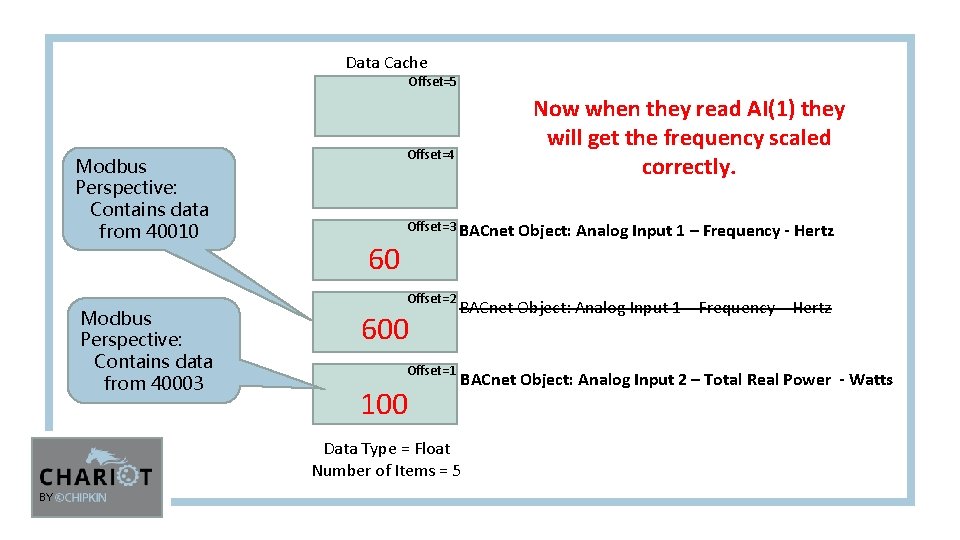
Data Cache Offset=5 Modbus Perspective: Contains data from 40010 Modbus Perspective: Contains data from 40003 Now when they read AI(1) they will get the frequency scaled correctly. Offset=4 60 Offset=3 BACnet Object: Analog Input 1 – Frequency - Hertz Offset=2 600 Offset=1 100 BACnet Object: Analog Input 1 – Frequency – Hertz BACnet Object: Analog Input 2 – Total Real Power - Watts Data Type = Float Number of Items = 5 BY
Lets make testing easier BY
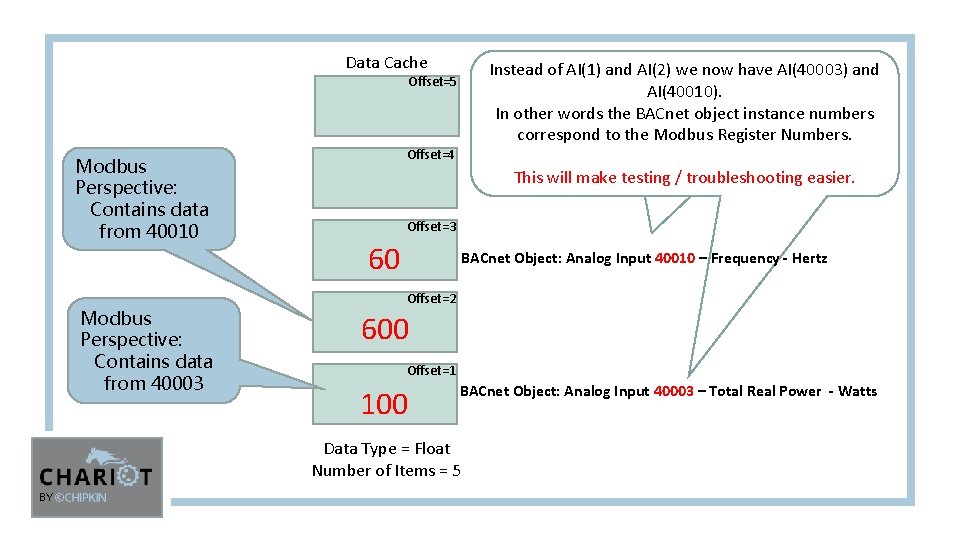
Data Cache Instead of AI(1) and AI(2) we now have AI(40003) and AI(40010). In other words the BACnet object instance numbers correspond to the Modbus Register Numbers. Offset=5 Modbus Perspective: Contains data from 40010 Modbus Perspective: Contains data from 40003 Offset=4 This will make testing / troubleshooting easier. Offset=3 60 BACnet Object: Analog Input 40010 – Frequency - Hertz Offset=2 600 Offset=1 100 BACnet Object: Analog Input 40003 – Total Real Power - Watts Data Type = Float Number of Items = 5 BY
The End 2018 June © Chipkin Automation Systems Inc. Contact Chipkin – chariot@chipkin. com BY
- Slides: 67