
How Productively Effectively Can Communicate with the U
- Slides: 31
How Productively & Effectively Can Communicate with the U. S. FDA! Heemin (Herman) Rhee, Ph. D. President Health Research International 11320 Coral Gables Drive North Potomac, Maryland 20878 U. S. A. Tel: 1 -301 -762 -7211 Email: rheehm 41@gmail. com
Sponsors and FDA Communication � *Draft Guidance for Industry and Review Staff, Good Review Practice, Dec. 2015 �VII. BEST PRACTICES AND COMMUNICATION METHODS �A. Meetings Between FDA and Sponsors �B. Written Correspondence From FDA �C. Submissions From Sponsors �D. Acknowledging Receipt of Communications �E. Email Between FDA and Sponsors �F. General Telephone Calls Between FDA and Sponsors �G. Faxes Between FDA and Sponsors �H. Use of Out-of-Office Messages by FDA and Sponsors �I. Resources for Sponsors…. .
VII: I. Resources for Sponsors � 1. FDA Guidances � 2. FDA Policy and Procedures � 3. FDA Basics for Industry � 4. FDA Interactive Media � 5. FDA Presentations � 6. FDA Labeling and Approvals � 7. FDA Rules and Regulations � 8. Code of Federal Regulations
Sponsor & Review Team Interaction �The review division regulatory project manager (RPM) is the primary point of contact for communications between IND sponsors and FDA during the life cycle of drug development. � As a co-leader of the FDA review team, the review division RPM has comprehensive knowledge of the drug and its regulatory history. �The RPM is also the primary contact for facilitating the timely resolution of technical, scientific, and regulatory questions, conflicts, or communication challenges between the sponsor and the review team. �During drug development there are circumstances under which it is appropriate for sponsors to directly contact FDA project managers other than the review division RPM in CDER.
Other Project Managers �CDER’s Office of Pharmaceutical Quality regulatory business project managers manage meeting requests, regulatory submissions, and other inquiries that are solely related to CMC, including facility and product quality issues. �CDER’s Office of Surveillance and Epidemiology safety regulatory project managers manage sponsor requests for proprietary name review. �CDER’s Formal Dispute Resolution Project Manager manages sponsor requests for resolving scientific and/or medical disputes that cannot be resolved at the division level. �There also limited circumstances where sponsors may need to use certain FDA points of contact for responses to basic or procedural drug development questions not directly linked to an existing or planned development program. �These may be in specific functional areas and serve as an alternative means to obtain general information or address issues that arise in the context of the regulatory process.
VIII. ADDITIONAL CONTACTS �A. CDER � 1. Controlled Substance Staff � 2. Division of Drug Information � 3. Division of Pediatric and Maternal Health � 4. Enhanced Communication Team � 5. Import/Export � 6. Ombudsman � 7. Rare Diseases Program � 8. Small Business and Industry Assistance Program �B. CBER � 1. Manufacturers Assistance and Technical Training Branch. � 2. Ombudsman �C. Office of Special Medical Programs � 1. Advisory Committee Oversight and Management Staff � 2. Office of Combination Products � 3. Office of Good Clinical Practice � 4. Office of Orphan Products Development � 5. Office of Pediatric Therapeutics.
Why Do We Engage with FDA? �To discuss your development plan to support NDA or BLA regulatory submission �To identify and mitigate potential issues early �To identify any critical issues and aspects of your program such as �Preclinical studies: Pharmacology and Toxicology (GLP) �Chemisty, Manufacturing and Controls (CMC) considerations �c. GMC �Clinical studies �Pediatric considerations �Statistics or regulatory considerations
Small Business and Industry Assistance under 500 employees �Initial point of contact to obtain regulatory information for drugs and biological products �Interacts with and assists domestic and international regulated industry �Resides within CDER's Office of Communications/Division of Drug Information �Performs a variety of activities to assist small pharmaceutical business and industry �SBIR, STTR grants, benefits, etc
Enhanced Communication Team �Developed as part of the fifth reauthorization of the Prescription Drug User Fee Act (PDUFA V) �PDUFA V promotes innovation through enhanced communication between FDA and sponsors during drug development �Ask the FDA for more information �The FDA Enhanced Communication Team supports timely interactive communication with sponsors during drug development �This facilitates efficient and effective drug development programs, and enhances public health by making new and effective drugs available in a timely manner �Serves as a point of contact for general questions about the drug development process �Provides clarification on which review division to contact for questions
Enhanced Communication Team-1 �Serves as a secondary point of communication for the review division �Sponsors may contact the Enhanced Communication Team if they have yet to receive a response to a request or question in a reasonable timeframe �The team assists in evaluating issues, determines appropriate next steps, and helps to facilitate resolution �Identifies and disseminates best practices for enhanced communication �Establishing clear expectations for appropriate mechanisms and frequency of communication �Contact the Enhanced Communication Team �ONDEnhanced. Comm@fda. hhs. gov �(301)796 -0319
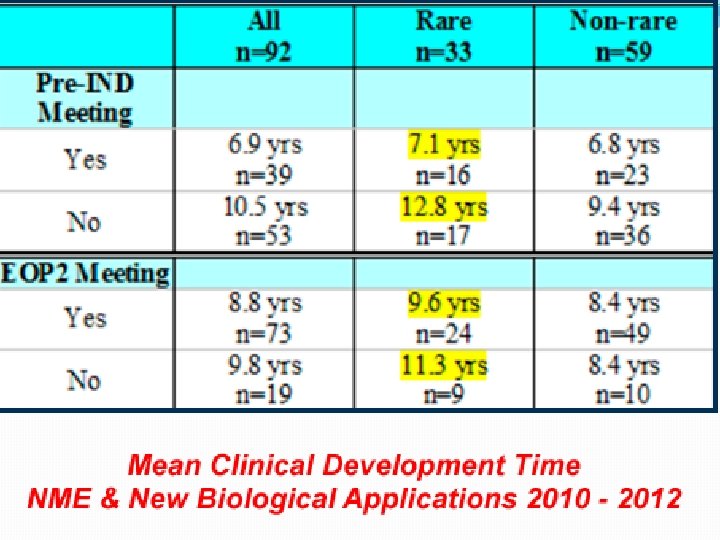
Milestone Meetings �Occur at critical junctures in drug development and include: �Pre-Investigational New Drug (IND) Application �End-of-Phase 1 (EOP 1) �End-of-Phase 2 (EOP 2) �Pre-New Drug Application (NDA) �Biologics License Application (BLA) �A sponsor also can request other types of meetings with CDER/CBER/CDRH.
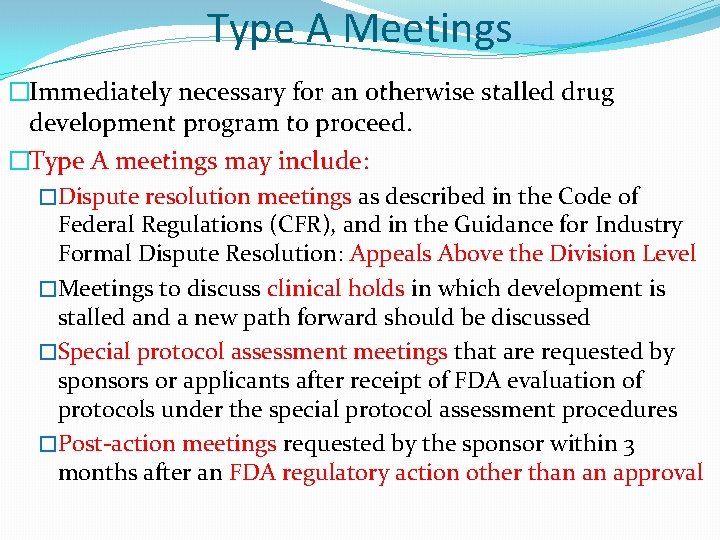
Type A Meetings �Immediately necessary for an otherwise stalled drug development program to proceed. �Type A meetings may include: �Dispute resolution meetings as described in the Code of Federal Regulations (CFR), and in the Guidance for Industry Formal Dispute Resolution: Appeals Above the Division Level �Meetings to discuss clinical holds in which development is stalled and a new path forward should be discussed �Special protocol assessment meetings that are requested by sponsors or applicants after receipt of FDA evaluation of protocols under the special protocol assessment procedures �Post-action meetings requested by the sponsor within 3 months after an FDA regulatory action other than an approval
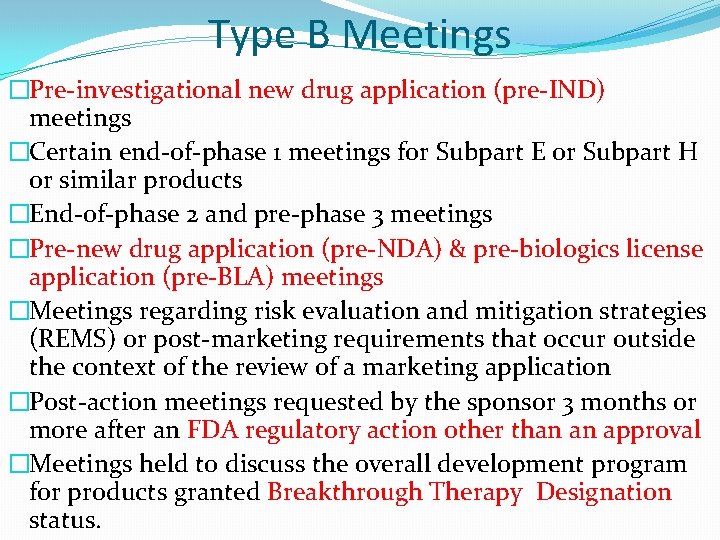
Type B Meetings �Pre-investigational new drug application (pre-IND) meetings �Certain end-of-phase 1 meetings for Subpart E or Subpart H or similar products �End-of-phase 2 and pre-phase 3 meetings �Pre-new drug application (pre-NDA) & pre-biologics license application (pre-BLA) meetings �Meetings regarding risk evaluation and mitigation strategies (REMS) or post-marketing requirements that occur outside the context of the review of a marketing application �Post-action meetings requested by the sponsor 3 months or more after an FDA regulatory action other than an approval �Meetings held to discuss the overall development program for products granted Breakthrough Therapy Designation status.
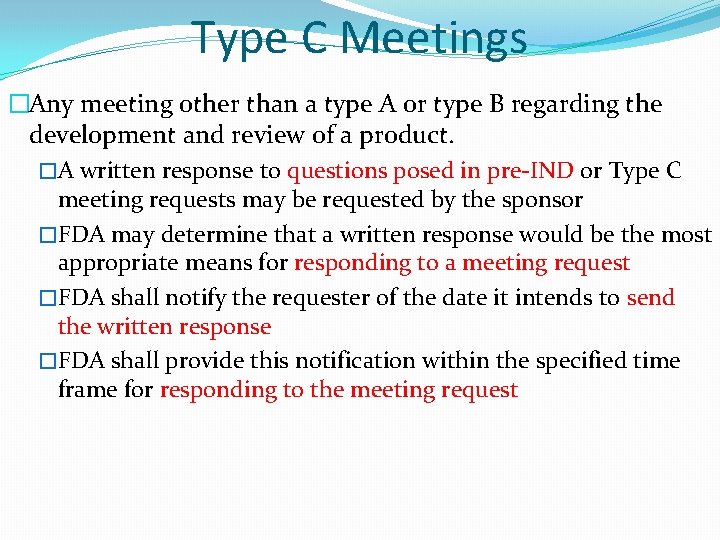
Type C Meetings �Any meeting other than a type A or type B regarding the development and review of a product. �A written response to questions posed in pre-IND or Type C meeting requests may be requested by the sponsor �FDA may determine that a written response would be the most appropriate means for responding to a meeting request �FDA shall notify the requester of the date it intends to send the written response �FDA shall provide this notification within the specified time frame for responding to the meeting request
Meeting Requests �Before requesting a meeting with FDA, sponsors should use the public sources of drug development information. �FDA typically grants meeting requests at these major milestones. �Sponsors should only submit milestone meeting requests when drug development has progressed to the point where requests are often denied by FDA. �Premature meeting (i. e. , face-to-face or teleconference), sponsors also can seek feedback through WRO requests, specifically for pre -IND feedback and feedback that would otherwise have been requested in a Type C meeting request. �FDA may convert a traditional meeting request for a pre-IND or Type C meeting to WRO responses. The number of questions posed in a WRO request should be no more than what would be reasonably expected to be addressed in a traditional meeting’s allotted duration. �Sponsors should outline the purpose of the meeting include their preferred dates and requested FDA attendees.
Question #1: When is the earliest I can request a meeting?
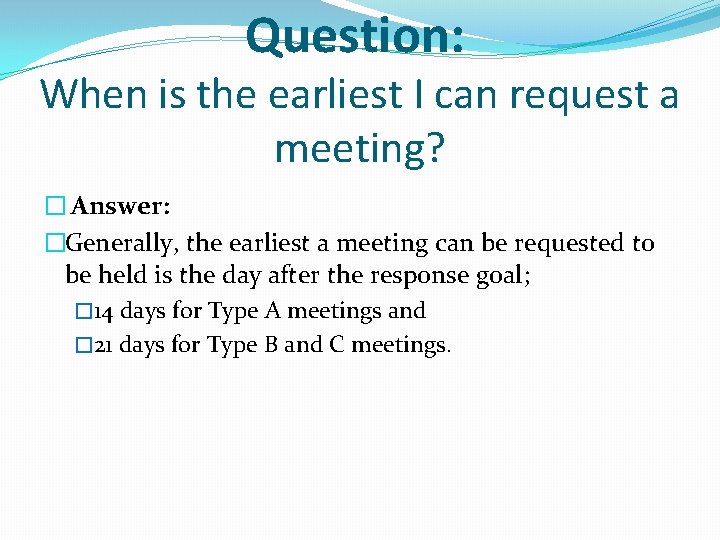
Question: When is the earliest I can request a meeting? � Answer: �Generally, the earliest a meeting can be requested to be held is the day after the response goal; � 14 days for Type A meetings and � 21 days for Type B and C meetings.
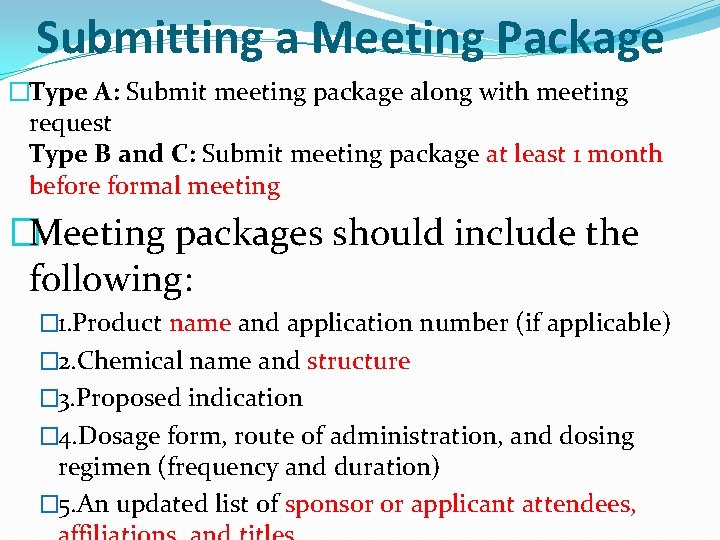
Submitting a Meeting Package �Type A: Submit meeting package along with meeting request Type B and C: Submit meeting package at least 1 month before formal meeting �Meeting packages should include the following: � 1. Product name and application number (if applicable) � 2. Chemical name and structure � 3. Proposed indication � 4. Dosage form, route of administration, and dosing regimen (frequency and duration) � 5. An updated list of sponsor or applicant attendees,
Meeting packages (Cont. ): � 6. A background section that includes: � A brief history of the development program � The events leading up to the meeting � The status of product development � 7. A brief statement summarizing the purpose of the meeting. � 8. A proposed agenda. � 9. A list of the final questions for discussion grouped by discipline and with a brief summary for each question to explain the need or context for the question. � 10. Data to support discussion organized by discipline and question.
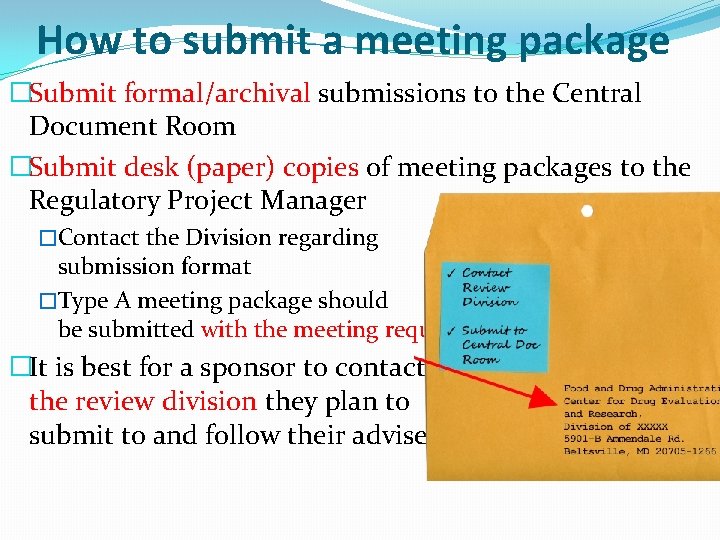
How to submit a meeting package �Submit formal/archival submissions to the Central Document Room �Submit desk (paper) copies of meeting packages to the Regulatory Project Manager �Contact the Division regarding submission format �Type A meeting package should be submitted with the meeting request �It is best for a sponsor to contact the review division they plan to submit to and follow their advise.
How to have a productive meeting �Contact the RPM prior to submitting any meeting request �Make sure that the issues support good use of industry and FDA time (is a pre-IND meeting necessary? ), as answers to your questions may be available in the guidances. �Ask clear, specific, well-phrased questions �Prioritize questions and stay focused on the agenda �Present clear, consistent, relevant data �Do not present data not included in the meeting package! �Work with FDA to find the best meeting time for you and all desired attendees.
Important Contact Points �Contact this area of CDER for application-specific, technical, and scientific questions. �This area of CDER offers many options for industry to obtain news and guidance from FDA, including webinars and FDA Drug Info Twitter. �A. CDER Small Business and Industry (SBIR)/STTR �B. OND �C. Enhanced Communication Team �D. New Drugs Rare Diseases Program
Question #2 True or False Test �For Type A meetings, the meeting package should be submitted along with the meeting request. �A. True �B. False
True or False Test �For Type A meetings, the meeting package should be submitted along with the meeting request. �A. True �B. False �Remember, for Type A meetings, the meeting package should be submitted along with the meeting request. �For Type B and Type C meetings, the meeting package should be submitted at least one month before the formal meeting
21 CFR: Part 312 IND Application �Subpart A: General Provisions �Subpart B: IND �Subpart C: Administrative Actions �Subpart D: Responsibilities of Sponsors and Investigators �Subpart E: Drugs Intended to treat life-threatening and severely-debilitating illnesses �Subpart F: Miscellaneous (import and export requirements) �Subpart G: Drugs for investigational use in laboratory research animals or in vitro test �Subpart H: Humanitarian Use Devices
New Drugs Rare Diseases Program �Program Mission: To facilitate, support, and accelerate the development of drug and biologic products for the benefit of patients with rare disorders �Program Activities Coordinates the development of CDER policy, procedures, and training for the review of treatments for rare diseases �Assists in outside development and maintenance of good science as the basis for the development of treatments for rare diseases �Works collaboratively with external and internal rare disease stakeholders �Serves as CDER's focal point to the rare disease drug development community on how best to interact with CDER
4. Office of Orphan Products Devlpmt �OOPD: Drugs, biologics, devices, or medical foods that demonstrate promise for the diagnosis and/or treatment of rare diseases or conditions that affect <200, 000 people in the U. S. , or that affect >200, 000 but are not expected to recover the costs of developing and marketing a drug. �OOPD: work on rare disease issues with the medical and research communities, professional organizations, academia, governmental agencies, industry, and rare disease patient groups. �OOPD regularly participates in meetings with these stakeholders who seek input on orphan-drug designation requests, humanitarian use device designation requests, rare pediatric disease designation requests, funding opportunities through the Orphan Products Grants Program and the Pediatric Device Consortium Grants Program, and other orphan product patientrelated issues. �Contact: http: //www. fda. gov/For. Industry/Developing. Productsfor. Rare. Diseases. Conditions/default. htm
Future Health & Pharmaceutical Industry in Korea �Effective translational research and education! �How to speed up FDA approval processes �New drugs: NCEs, NMEs, Generic, OTC �Biologics: Cell & Gene therapy, Vaccines, Biosimilars �Botanicals/Natural source-Fulyzaq & Veragen �↑Multi-national CTs in Korea (↑domestic phase I) �Therapeutic devices-Drugs or Biologic combo. �Electronic therapeutic engineering & recording �Biomarkers/Bio-chips for Personalized Medicine �International collaborative R&D for drug marketing �TBI, AD, PD, T 2 DM, N-/Alcoholic Liver Diseases, etc 30
Thank You for your Attention! �Questions �Discussion �Any perspective and aspects….