
How photocopiers and laser printers use static electricity


- Slides: 5
How photocopiers and laser printers use static electricity A presentation by Sam, Fortune, Oscar, and Dylan
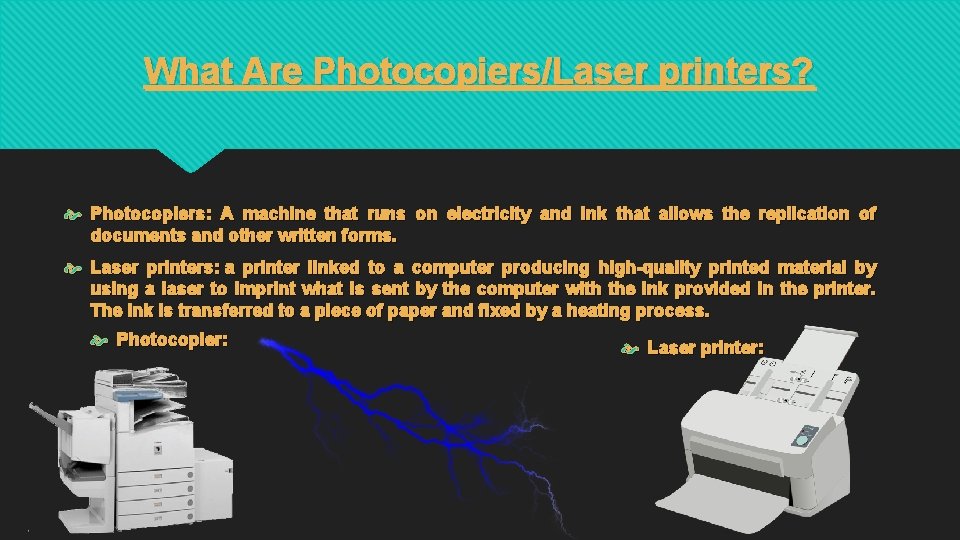
What Are Photocopiers/Laser printers? Photocopiers: A machine that runs on electricity and ink that allows the replication of documents and other written forms. Laser printers: a printer linked to a computer producing high-quality printed material by using a laser to imprint what is sent by the computer with the ink provided in the printer. The ink is transferred to a piece of paper and fixed by a heating process. Photocopier: Laser printer:
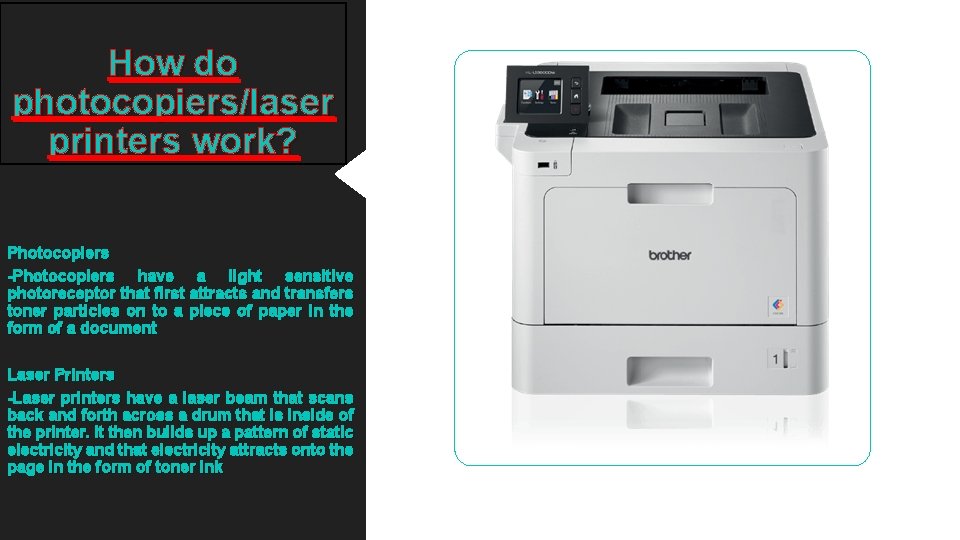
How do photocopiers/laser printers work? Photocopiers -Photocopiers have a light sensitive photoreceptor that first attracts and transfers toner particles on to a piece of paper in the form of a document Laser Printers -Laser printers have a laser beam that scans back and forth across a drum that is inside of the printer. It then builds up a pattern of static electricity and that electricity attracts onto the page in the form of toner ink
What do photocopiers and Laser Printers have to do with Static Electricity? A photocopier relies on static electricity and photoconductivity to work. Essentially photoconductivity relies on the added electrical activity caused by light ergo "photocopy". There's a light-sensitive photoreceptor, a little machine that can detect when light is falling on it inside the machine that first attracts and then transfers toner particles that stick to the oppositely charged paper onto plain paper to form a copy of a document With a laser printer a laser is blasted onto a sheet creating a static imbalance on the paper so the toner can be added on. The laser reflects off the page onto a light-sensitive drum. You can see the minor differences between the photocopier(top) and the laser printer(bottom)
The End