
How Parliament works Starter Copy the terms below
How Parliament works Starter – Copy the terms below into your exercise book under your Learning Objective. Keywords: Scrutinise: To examine or inspect closely and thoroughly. Accountable: To justify actions or decisions. Committee: A group of people appointed for a specific function Learning Objective: To understand how parliament holds the government to account. Success Criteria: Grade 7 -9 – Evaluate how parliament works with regards to scrutinising government and making it accountable. Grade 4 -6 – Explain how parliament works relating to questions, committees and debates. Grade 1 -3 – Identify the way parliament works
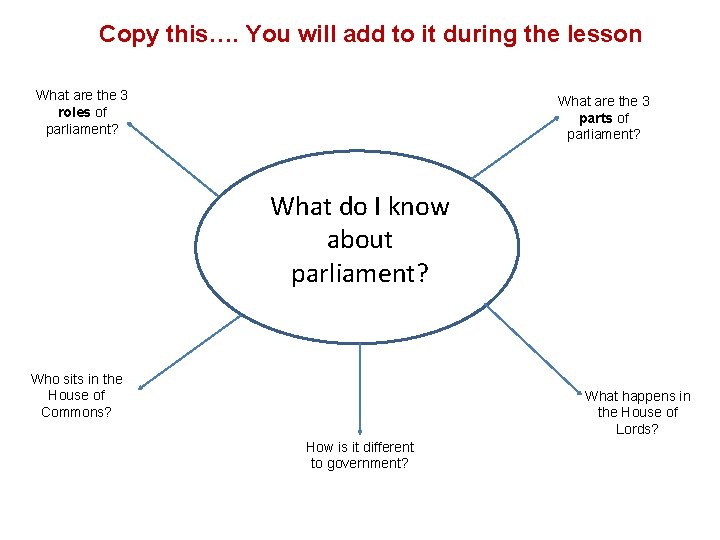
Copy this…. You will add to it during the lesson What are the 3 roles of parliament? What are the 3 parts of parliament? What do I know about parliament? Who sits in the House of Commons? What happens in the House of Lords? How is it different to government?
Learning Objective: To understand how parliament holds the government to account. What is the difference between government and parliament? • Government: The leading party in parliament. Since May 2010 we have had a coalition of both Conservatives and Liberal Democrats • Parliament is made up of 3 sections; 650 MPs in the Commons, 740 Lords in the House of Lords, and one Queen! Success Criteria: Grade 7 -9 – Evaluate how parliament works with regards to scrutinising government and making it accountable. Grade 4 -6 – Explain how parliament works relating to questions, committees and debates. Grade 1 -3 – Identify the way parliament works
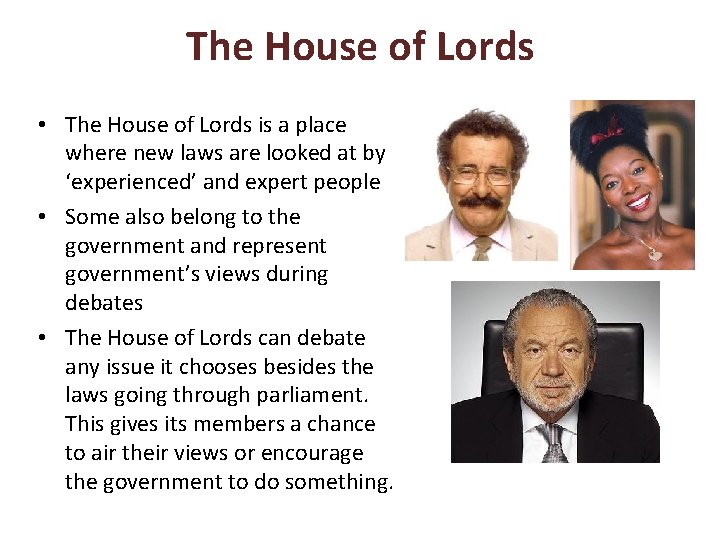
The House of Lords • The House of Lords is a place where new laws are looked at by ‘experienced’ and expert people • Some also belong to the government and represent government’s views during debates • The House of Lords can debate any issue it chooses besides the laws going through parliament. This gives its members a chance to air their views or encourage the government to do something.
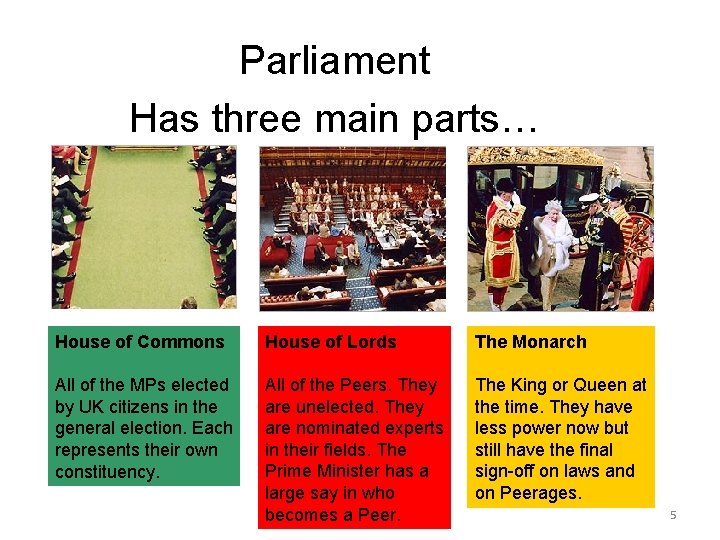
Parliament Has three main parts… House of Commons House of Lords The Monarch All of the MPs elected by UK citizens in the general election. Each represents their own constituency. All of the Peers. They are unelected. They are nominated experts in their fields. The Prime Minister has a large say in who becomes a Peer. The King or Queen at the time. They have less power now but still have the final sign-off on laws and on Peerages. 5
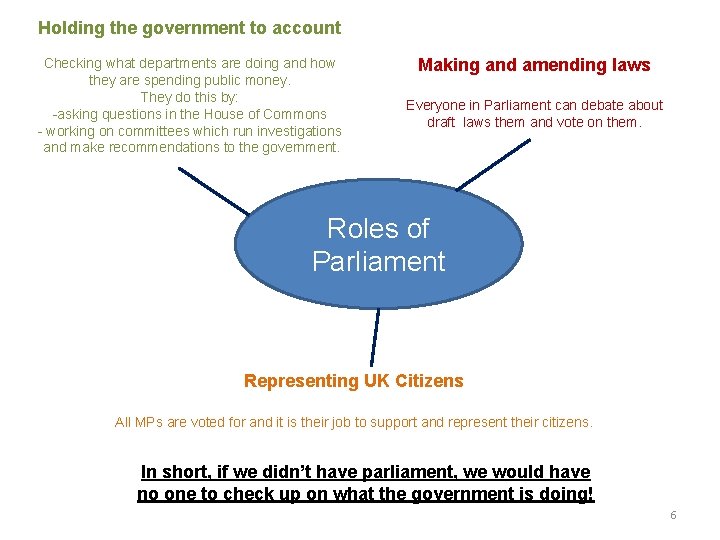
Holding the government to account Checking what departments are doing and how they are spending public money. They do this by: -asking questions in the House of Commons - working on committees which run investigations and make recommendations to the government. Making and amending laws Everyone in Parliament can debate about draft laws them and vote on them. Roles of Parliament Representing UK Citizens All MPs are voted for and it is their job to support and represent their citizens. In short, if we didn’t have parliament, we would have no one to check up on what the government is doing! 6
Learning Objective: To understand how parliament holds the government to account. The concept of a bicameral parliament In the United Kingdom, parliament is made up of two parts: the House of Commons and the House of Lords. This system of a two-chamber legislature/parliament is called bicameral (two chambers). The House of Commons is the more important of the two chambers of Parliament. The government is formed on the basis of the elections held to this chamber. The Prime minister and most government ministers are members of this house. Success Criteria: Grade 7 -9 – Evaluate how parliament works with regards to scrutinising government and making it accountable. Grade 4 -6 – Explain how parliament works relating to questions, committees and debates. Grade 1 -3 – Identify the way parliament works
Learning Objective: To understand how parliament holds the government to account. Task: Using pages 121 -122 of the textbook make four mind maps to explain how parliament works. They need to be labelled: Question Time Prime Minister’s Questions Select Committees Debates Success Criteria: Grade 7 -9 – Evaluate how parliament works with regards to scrutinising government and making it accountable. Grade 4 -6 – Explain how parliament works relating to questions, committees and debates. Grade 1 -3 – Identify the way parliament works
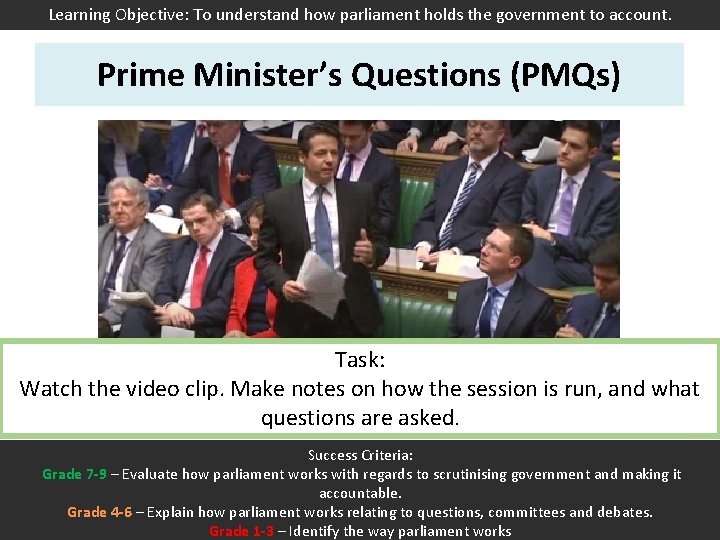
Learning Objective: To understand how parliament holds the government to account. Prime Minister’s Questions (PMQs) Task: Watch the video clip. Make notes on how the session is run, and what questions are asked. Success Criteria: Grade 7 -9 – Evaluate how parliament works with regards to scrutinising government and making it accountable. Grade 4 -6 – Explain how parliament works relating to questions, committees and debates. Grade 1 -3 – Identify the way parliament works
Learning Objective: To understand how parliament holds the government to account. What are select committees and how do they work? Success Criteria: Grade 7 -9 – Evaluate how parliament works with regards to scrutinising government and making it accountable. Grade 4 -6 – Explain how parliament works relating to questions, committees and debates. Grade 1 -3 – Identify the way parliament works
Learning Objective: To understand how parliament holds the government to account. Parliament or Government? Government: Government is the name given to a smaller group of politicians from the party with a majority in the general election. Typically just one party has the majority, but at the moment we have a coalition government of Conservatives and Liberal Democrats. The Government is responsible for amending laws, making new ones and abolishing old ones; they set the rate of taxes, plan the budget and pursue the policies they talked about during their election campaign. https: //www. youtube. com/watch? v=Am. GCwi. Qvh. H 0 Success Criteria: Grade 7 -9 – Evaluate how parliament works with regards to scrutinising government and making it accountable. Grade 4 -6 – Explain how parliament works relating to questions, committees and debates. Grade 1 -3 – Identify the way parliament works
Learning Objective: To understand how parliament holds the government to account. Parliament or Government? Parliament: Parliament is the name given to the House of Lords and the House of Commons, both of which are large chambers in the Palace of Westminster. Members of Parliament come from different political parties and their role is to represent the people and to scrutinise the work of the Government. Both houses must approve a new law before it can be passed. Success Criteria: Grade 7 -9 – Evaluate how parliament works with regards to scrutinising government and making it accountable. Grade 4 -6 – Explain how parliament works relating to questions, committees and debates. Grade 1 -3 – Identify the way parliament works
Learning Objective: To understand how parliament holds the government to account. Parliament or Government? Parliament: Parliament is the name given to the House of Lords and the House of Commons, both of which are large chambers in the Palace of Westminster. Members of Parliament come from different political parties and their role is to represent the people and to scrutinise the work of the Government. Both houses must approve a new law before it can be passed. Government: Government is the name given to a smaller group of politicians from the party with a majority in the general election. Typically just one party has the majority, but at the moment we have a coalition government of Conservatives and Liberal Democrats. The Government is responsible for amending laws, making new ones and abolishing old ones; they set the rate of taxes, plan the budget and pursue the policies they talked about during their election campaign. Read the definitions of Parliament and Government. Explain the difference between them in your own words. Success Criteria: Grade 7 -9 – Evaluate how parliament works with regards to scrutinising government and making it accountable. Grade 4 -6 – Explain how parliament works relating to questions, committees and debates. Grade 1 -3 – Identify the way parliament works
Learning Objective: To understand how parliament holds the government to account. 1. What does the term ‘democracy’ mean? a) Government by a single ruler b) Government by the people or their elected representatives c) Government by one family d) Government by the royal family Success Criteria: Grade 7 -9 – Evaluate how parliament works with regards to scrutinising government and making it accountable. Grade 4 -6 – Explain how parliament works relating to questions, committees and debates. Grade 1 -3 – Identify the way parliament works
Learning Objective: To understand how parliament holds the government to account. 2. Where is UK Parliament based? a) b) c) d) London Edinburgh Belfast Cardiff Success Criteria: Grade 7 -9 – Evaluate how parliament works with regards to scrutinising government and making it accountable. Grade 4 -6 – Explain how parliament works relating to questions, committees and debates. Grade 1 -3 – Identify the way parliament works
Learning Objective: To understand how parliament holds the government to account. 3. What is the Government? a) It is all the elected MPs in Parliament b) It is all the elected MPs of the party with the biggest majority in Parliament c) It is the group of most senior politicians in the majority party in Parliament – including the Prime Minister and the Ministers of State Success Criteria: Grade 7 -9 – Evaluate how parliament works with regards to scrutinising government and making it accountable. Grade 4 -6 – Explain how parliament works relating to questions, committees and debates. Grade 1 -3 – Identify the way parliament works
Learning Objective: To understand how parliament holds the government to account. 4. Which of the following statements are true of the Parliament in Westminster? a) It is the supreme authority in the UK b) It is made up of two ‘Houses’ – the House of Commons and the House of Lords – and the Queen c) It is responsible for making and changing UK laws d) It checks on (scrutinises) the work of the Government Success Criteria: Grade 7 -9 – Evaluate how parliament works with regards to scrutinising government and making it accountable. Grade 4 -6 – Explain how parliament works relating to questions, committees and debates. Grade 1 -3 – Identify the way parliament works
Learning Objective: To understand how parliament holds the government to account. 5. Who is the current Prime Minister? 6. Which political party do they represent? Success Criteria: Grade 7 -9 – Evaluate how parliament works with regards to scrutinising government and making it accountable. Grade 4 -6 – Explain how parliament works relating to questions, committees and debates. Grade 1 -3 – Identify the way parliament works
1. What does the term ‘democracy’ mean? a) Government by a single ruler b) Government by the people or their elected representatives c) Government by one family d) Government by the royal family
2. Where is UK Parliament based? a) b) c) d) London Edinburgh Belfast Cardiff
3. What is the Government? a) It is all the elected MPs in Parliament b) It is all the elected MPs of the party with the biggest majority in Parliament c) It is the group of most senior politicians in the majority party in Parliament – including the Prime Minister and the Ministers of State
4. Which of the following statements are true of the Parliament in Westminster? a) It is the supreme authority in the UK b) It is made up of two ‘Houses’ – the House of Commons and the House of Lords – and the Queen c) It is responsible for making and changing UK laws d) It checks on (scrutinises) the work of the Government ALL ARE TRUE!
5. Who is the current Prime Minister? Theresa May 6. Which political party do they represent? The Conservative Party
Learning Objective: To understand how parliament holds the government to account. Reflection Plenary Why are Department Select Committees important? (6 marks) Success Criteria: Grade 7 -9 – Evaluate how parliament works with regards to scrutinising government and making it accountable. Grade 4 -6 – Explain how parliament works relating to questions, committees and debates. Grade 1 -3 – Identify the way parliament works
- Slides: 24