
How Neurons Work An Introduction DENDRITES in light
- Slides: 23
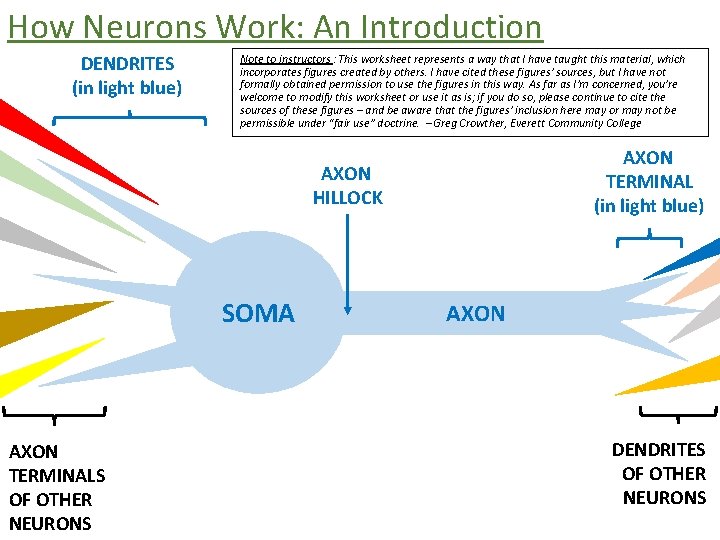
How Neurons Work: An Introduction DENDRITES (in light blue) Note to instructors : This worksheet represents a way that I have taught this material, which incorporates figures created by others. I have cited these figures’ sources, but I have not formally obtained permission to use the figures in this way. As far as I’m concerned, you’re welcome to modify this worksheet or use it as is; if you do so, please continue to cite the sources of these figures – and be aware that the figures’ inclusion here may or may not be permissible under “fair use” doctrine. --Greg Crowther, Everett Community College AXON TERMINAL (in light blue) AXON HILLOCK SOMA AXON TERMINALS OF OTHER NEURONS AXON DENDRITES OF OTHER NEURONS
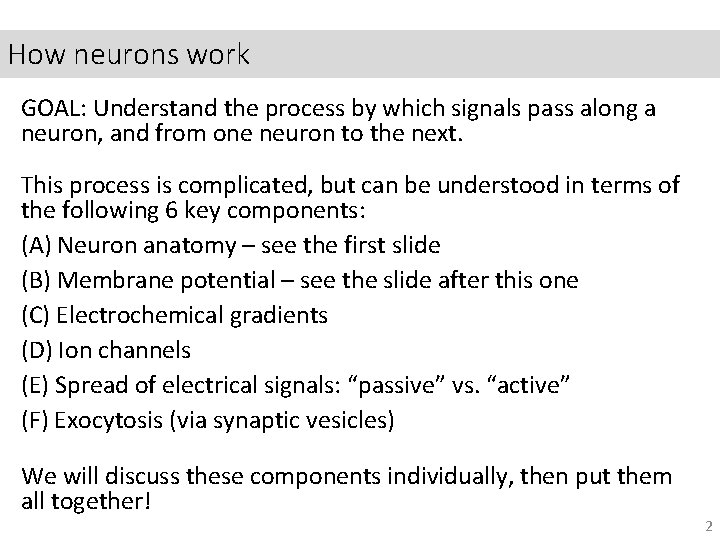
How neurons work GOAL: Understand the process by which signals pass along a neuron, and from one neuron to the next. This process is complicated, but can be understood in terms of the following 6 key components: (A) Neuron anatomy – see the first slide (B) Membrane potential – see the slide after this one (C) Electrochemical gradients (D) Ion channels (E) Spread of electrical signals: “passive” vs. “active” (F) Exocytosis (via synaptic vesicles) We will discuss these components individually, then put them all together! 2
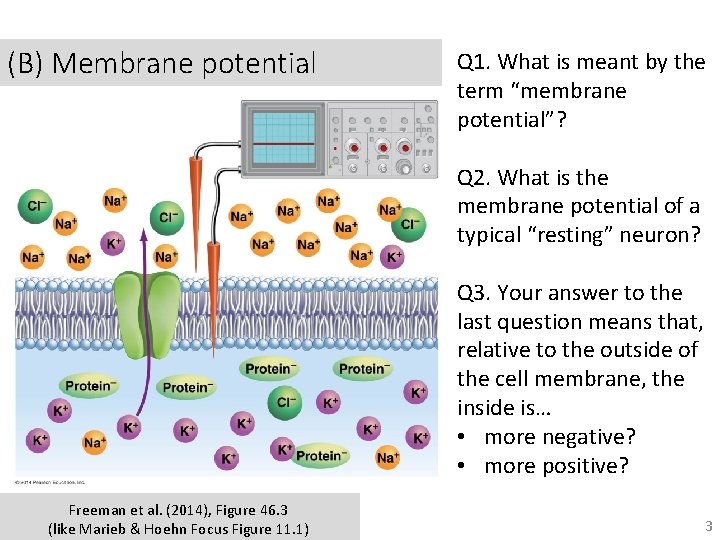
(B) Membrane potential Q 1. What is meant by the term “membrane potential”? Q 2. What is the membrane potential of a typical “resting” neuron? Q 3. Your answer to the last question means that, relative to the outside of the cell membrane, the inside is… • more negative? • more positive? Freeman et al. (2014), Figure 46. 3 (like Marieb & Hoehn Focus Figure 11. 1) 3
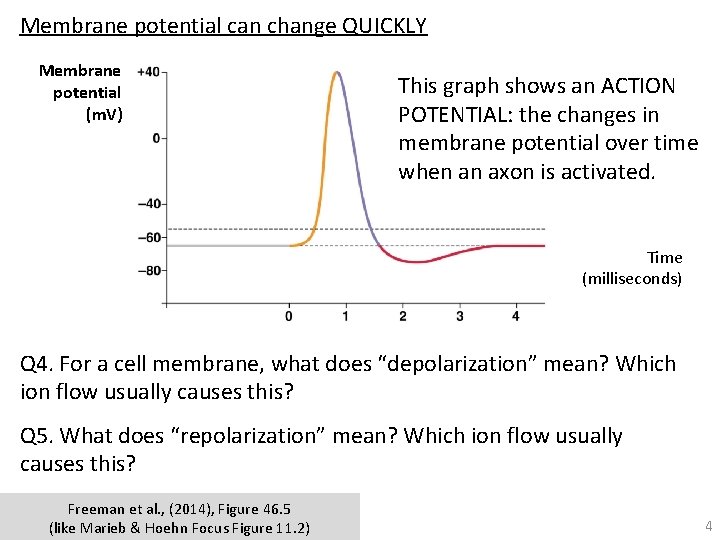
Membrane potential can change QUICKLY Membrane potential (m. V) This graph shows an ACTION POTENTIAL: the changes in membrane potential over time when an axon is activated. Time (milliseconds) Q 4. For a cell membrane, what does “depolarization” mean? Which ion flow usually causes this? Q 5. What does “repolarization” mean? Which ion flow usually causes this? Freeman et al. , (2014), Figure 46. 5 (like Marieb & Hoehn Focus Figure 11. 2) 4
(C) Electrochemical gradients Q 1. What is a chemical gradient (for all substances)? Q 2. What is an electrical gradient (for ions)? Q 3. What is an electrochemical gradient (for ions)?
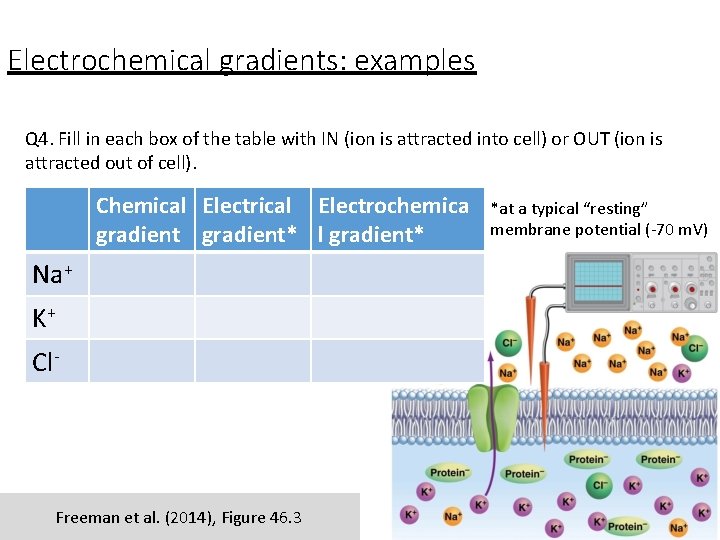
Electrochemical gradients: examples Q 4. Fill in each box of the table with IN (ion is attracted into cell) or OUT (ion is attracted out of cell). Chemical Electrochemica gradient* l gradient* Na+ K+ Cl- Freeman et al. (2014), Figure 46. 3 *at a typical “resting” membrane potential (-70 m. V)
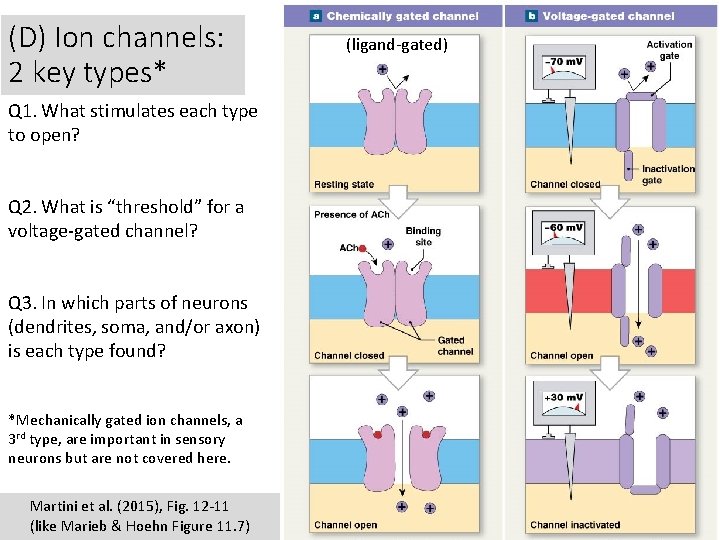
(D) Ion channels: 2 key types* Q 1. What stimulates each type to open? Q 2. What is “threshold” for a voltage-gated channel? Q 3. In which parts of neurons (dendrites, soma, and/or axon) is each type found? *Mechanically gated ion channels, a 3 rd type, are important in sensory neurons but are not covered here. Martini et al. (2015), Fig. 12 -11 (like Marieb & Hoehn Figure 11. 7) (ligand-gated)
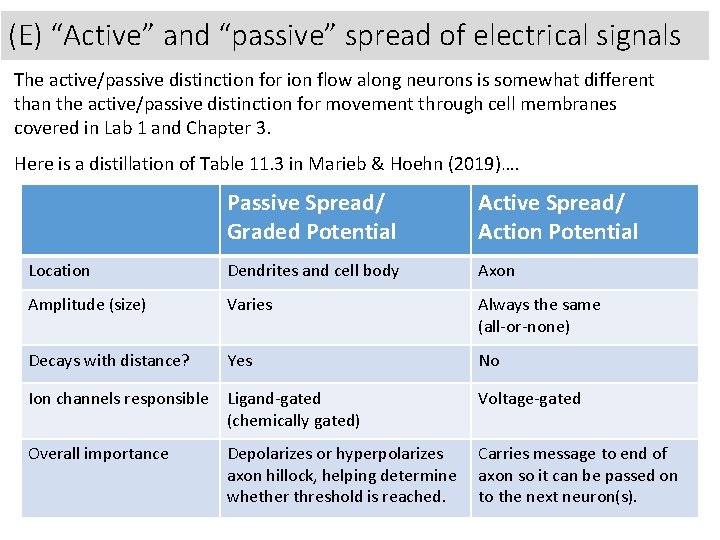
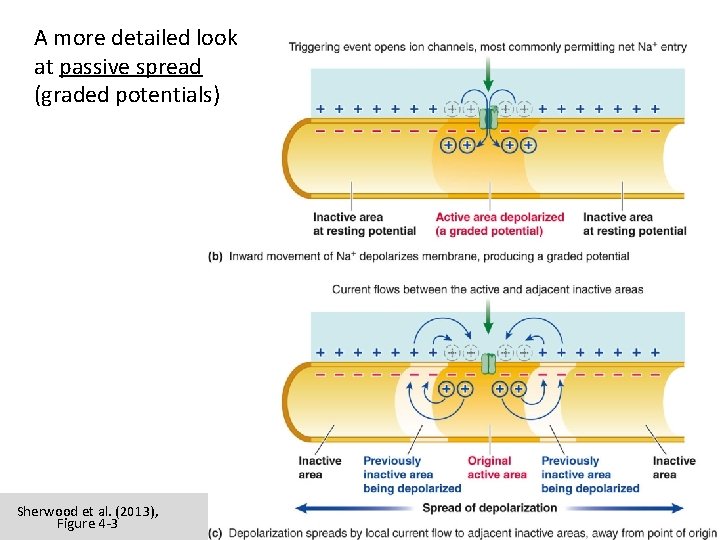
(E) “Active” and “passive” spread of electrical signals The active/passive distinction for ion flow along neurons is somewhat different than the active/passive distinction for movement through cell membranes covered in Lab 1 and Chapter 3. Here is a distillation of Table 11. 3 in Marieb & Hoehn (2019)…. Passive Spread/ Graded Potential Active Spread/ Action Potential Location Dendrites and cell body Axon Amplitude (size) Varies Always the same (all-or-none) Decays with distance? Yes No Ion channels responsible Ligand-gated (chemically gated) Voltage-gated Overall importance Depolarizes or hyperpolarizes axon hillock, helping determine whether threshold is reached. Carries message to end of axon so it can be passed on to the next neuron(s).
A more detailed look at passive spread (graded potentials) Sherwood et al. (2013), Figure 4 -3
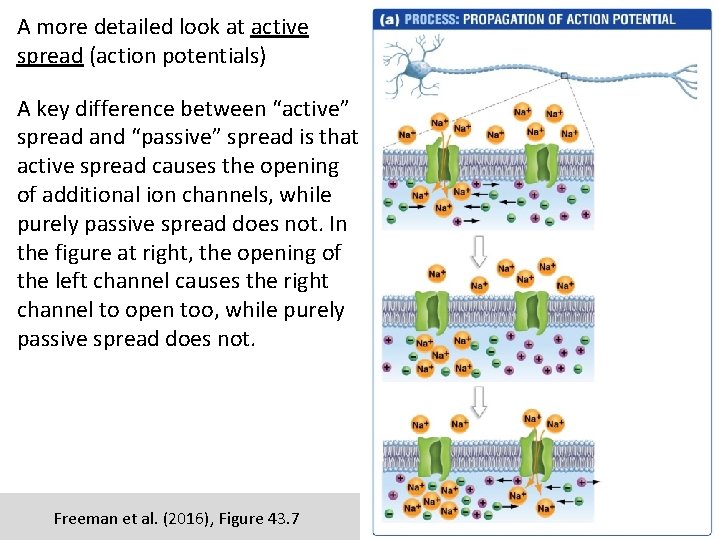
A more detailed look at active spread (action potentials) A key difference between “active” spread and “passive” spread is that active spread causes the opening of additional ion channels, while purely passive spread does not. In the figure at right, the opening of the left channel causes the right channel to open too, while purely passive spread does not. Freeman et al. (2016), Figure 43. 7
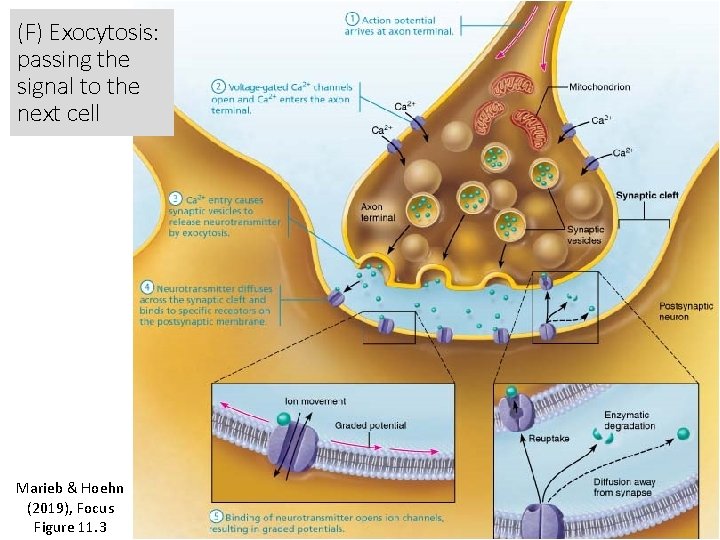
(F) Exocytosis: passing the signal to the next cell Marieb & Hoehn (2019), Focus Figure 11. 3 11
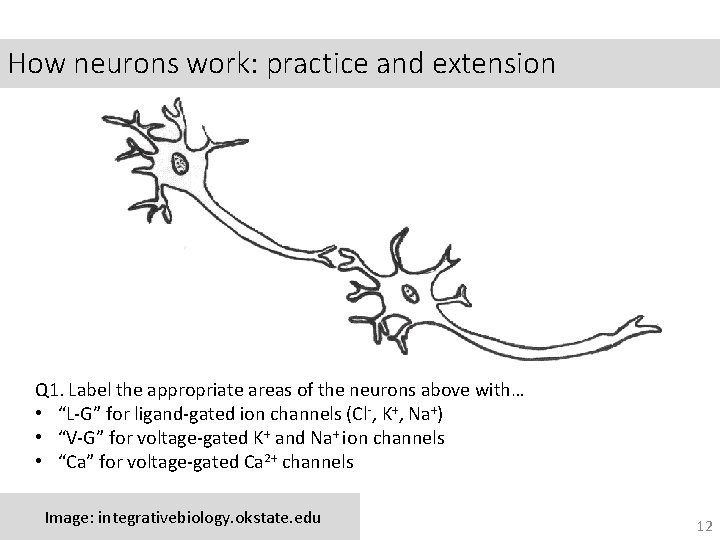
How neurons work: practice and extension Q 1. Label the appropriate areas of the neurons above with… • “L-G” for ligand-gated ion channels (Cl-, K+, Na+) • “V-G” for voltage-gated K+ and Na+ ion channels • “Ca” for voltage-gated Ca 2+ channels Image: integrativebiology. okstate. edu 12
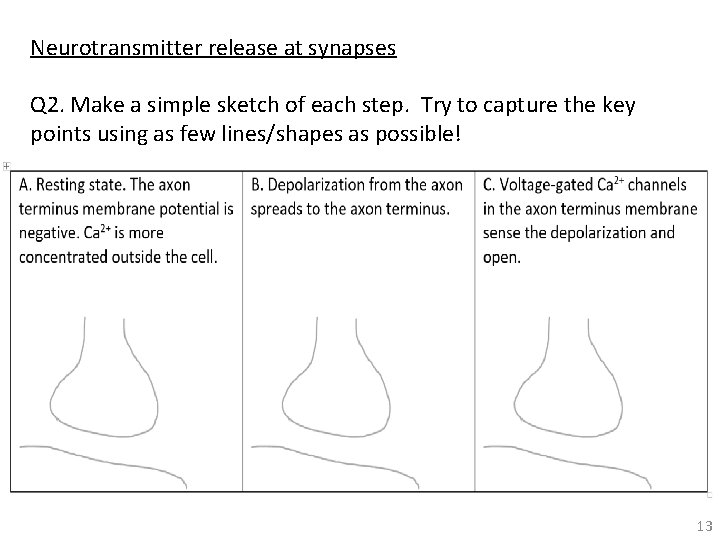
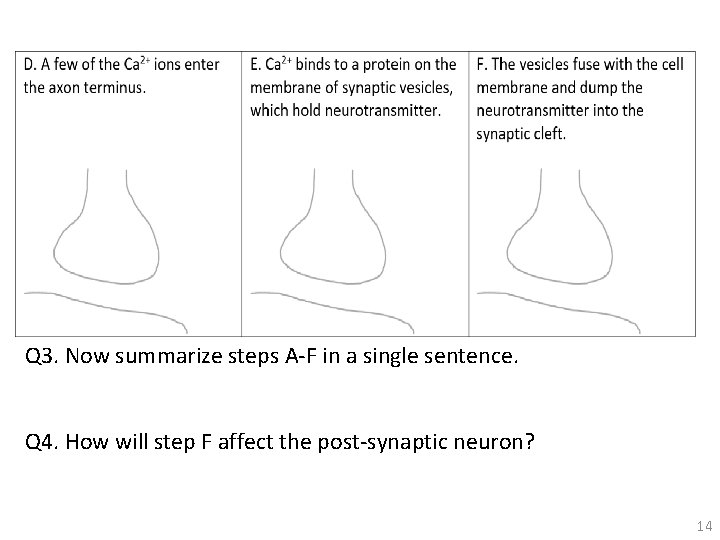
Neurotransmitter release at synapses Q 2. Make a simple sketch of each step. Try to capture the key points using as few lines/shapes as possible! 13
Q 3. Now summarize steps A-F in a single sentence. Q 4. How will step F affect the post-synaptic neuron? 14
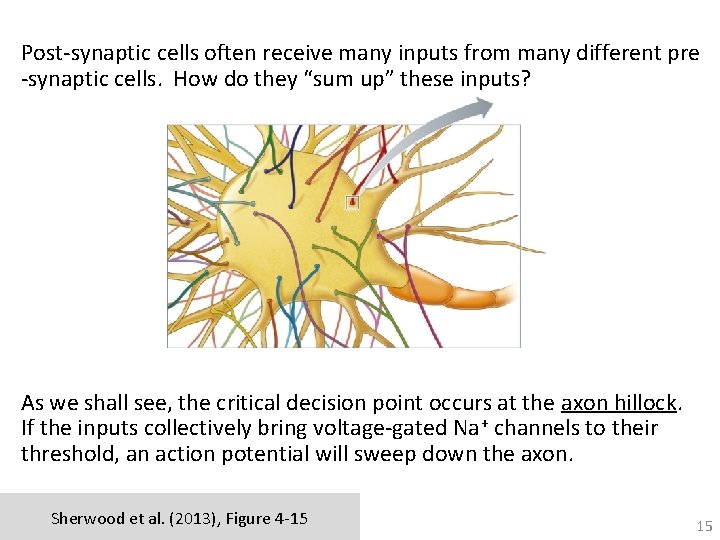
Post-synaptic cells often receive many inputs from many different pre -synaptic cells. How do they “sum up” these inputs? As we shall see, the critical decision point occurs at the axon hillock. If the inputs collectively bring voltage-gated Na+ channels to their threshold, an action potential will sweep down the axon. Sherwood et al. (2013), Figure 4 -15 15
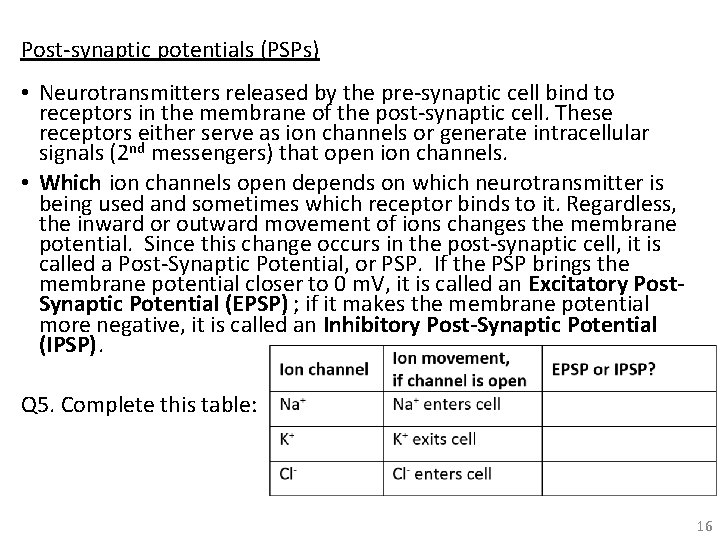
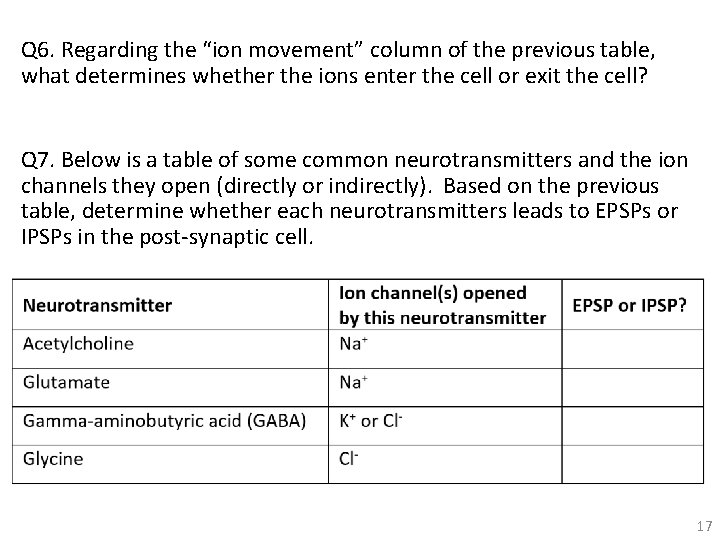
Post-synaptic potentials (PSPs) • Neurotransmitters released by the pre-synaptic cell bind to receptors in the membrane of the post-synaptic cell. These receptors either serve as ion channels or generate intracellular signals (2 nd messengers) that open ion channels. • Which ion channels open depends on which neurotransmitter is being used and sometimes which receptor binds to it. Regardless, the inward or outward movement of ions changes the membrane potential. Since this change occurs in the post-synaptic cell, it is called a Post-Synaptic Potential, or PSP. If the PSP brings the membrane potential closer to 0 m. V, it is called an Excitatory Post. Synaptic Potential (EPSP) ; if it makes the membrane potential more negative, it is called an Inhibitory Post-Synaptic Potential (IPSP). Q 5. Complete this table: 16
Q 6. Regarding the “ion movement” column of the previous table, what determines whether the ions enter the cell or exit the cell? Q 7. Below is a table of some common neurotransmitters and the ion channels they open (directly or indirectly). Based on the previous table, determine whether each neurotransmitters leads to EPSPs or IPSPs in the post-synaptic cell. 17
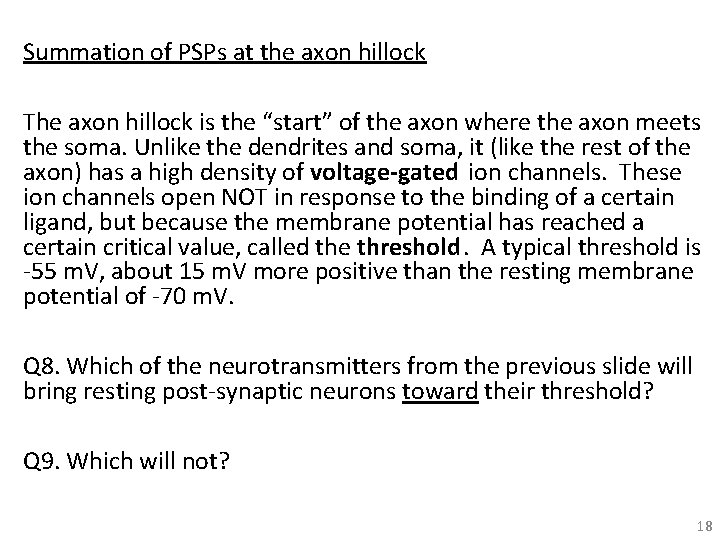
Summation of PSPs at the axon hillock The axon hillock is the “start” of the axon where the axon meets the soma. Unlike the dendrites and soma, it (like the rest of the axon) has a high density of voltage-gated ion channels. These ion channels open NOT in response to the binding of a certain ligand, but because the membrane potential has reached a certain critical value, called the threshold. A typical threshold is -55 m. V, about 15 m. V more positive than the resting membrane potential of -70 m. V. Q 8. Which of the neurotransmitters from the previous slide will bring resting post-synaptic neurons toward their threshold? Q 9. Which will not? 18
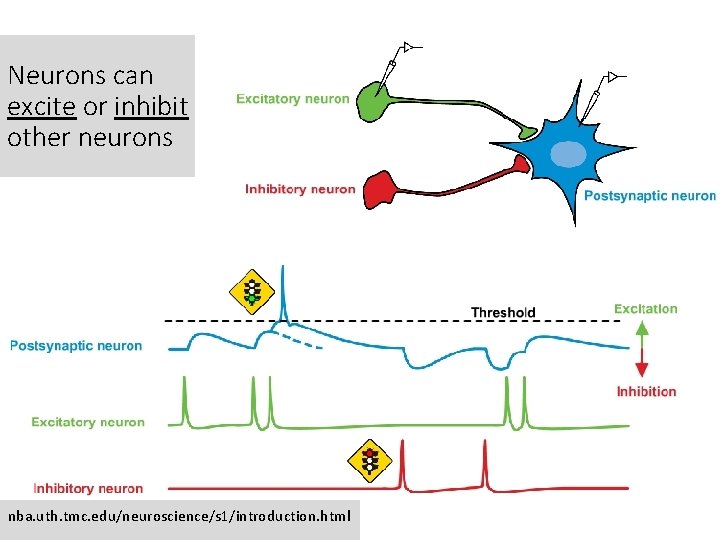
Neurons can excite or inhibit other neurons nba. uth. tmc. edu/neuroscience/s 1/introduction. html
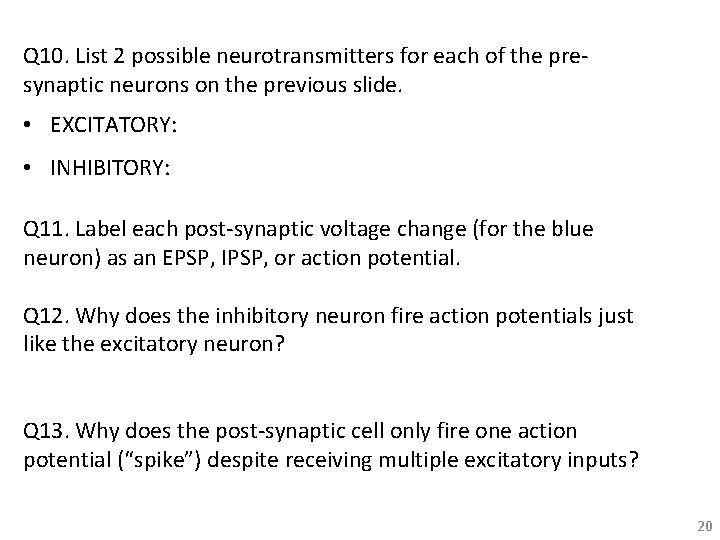
Q 10. List 2 possible neurotransmitters for each of the presynaptic neurons on the previous slide. • EXCITATORY: • INHIBITORY: Q 11. Label each post-synaptic voltage change (for the blue neuron) as an EPSP, IPSP, or action potential. Q 12. Why does the inhibitory neuron fire action potentials just like the excitatory neuron? Q 13. Why does the post-synaptic cell only fire one action potential (“spike”) despite receiving multiple excitatory inputs? 20
Alterations in synaptic communication Q 14. Serotonin-specific reuptake inhibitors (SSRIs) are often used to treat clinical depression. How do these affect synaptic transmission? (Serotonin is a neurotransmitter. ) Q 15. How would a decreased calcium concentration in the extracellular fluid affect synaptic transmission? Q 16. Learning sometimes leads to an increase in glutamate receptor density on post-synaptic neurons. How would this affect synaptic transmission? 21
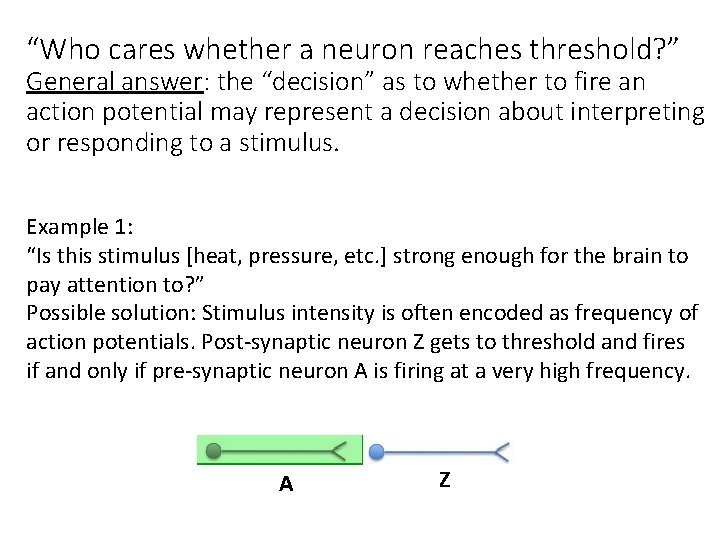
“Who cares whether a neuron reaches threshold? ” General answer: the “decision” as to whether to fire an action potential may represent a decision about interpreting or responding to a stimulus. Example 1: “Is this stimulus [heat, pressure, etc. ] strong enough for the brain to pay attention to? ” Possible solution: Stimulus intensity is often encoded as frequency of action potentials. Post-synaptic neuron Z gets to threshold and fires if and only if pre-synaptic neuron A is firing at a very high frequency. A Z
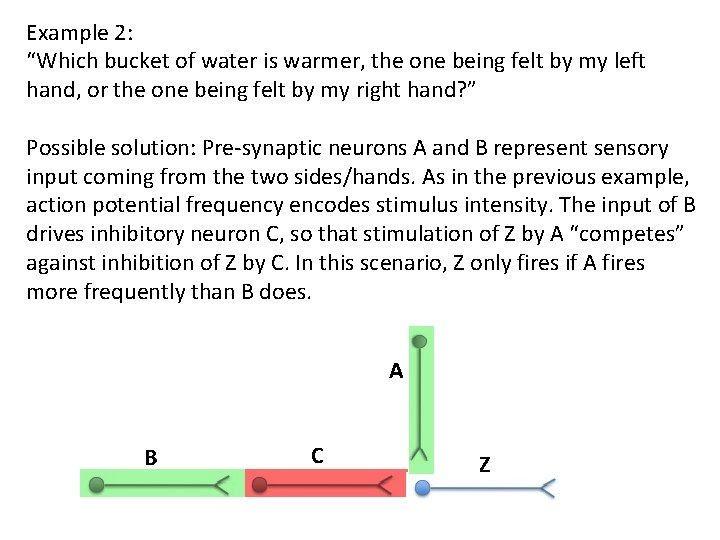
Example 2: “Which bucket of water is warmer, the one being felt by my left hand, or the one being felt by my right hand? ” Possible solution: Pre-synaptic neurons A and B represent sensory input coming from the two sides/hands. As in the previous example, action potential frequency encodes stimulus intensity. The input of B drives inhibitory neuron C, so that stimulation of Z by A “competes” against inhibition of Z by C. In this scenario, Z only fires if A fires more frequently than B does. A B C Z